Top 6 app.medgical.ai Alternatives 2026
Discover 6 app.medgical.ai alternatives to compare and find the best application for managing your health records easily and effectively.
Top 6 app.medgical.ai Alternatives 2026
Centralizing medical records, automating clinical documentation, and extracting insights from health data often means blending multiple tools that lack AI-powered analysis or language support. Many platforms gate advanced features like AI-driven summarization, real-time transcription, or automated coding behind high price points, limited free tiers, or require complex integrations with existing EHR systems. This comparison reviews pricing, AI capabilities, family and clinic workflow fit, and privacy tradeoffs across leading medical record management and clinical documentation apps so you can match one to your personal or practice needs without onboarding every contender yourself.
Table of Contents
MedFiles
At a Glance
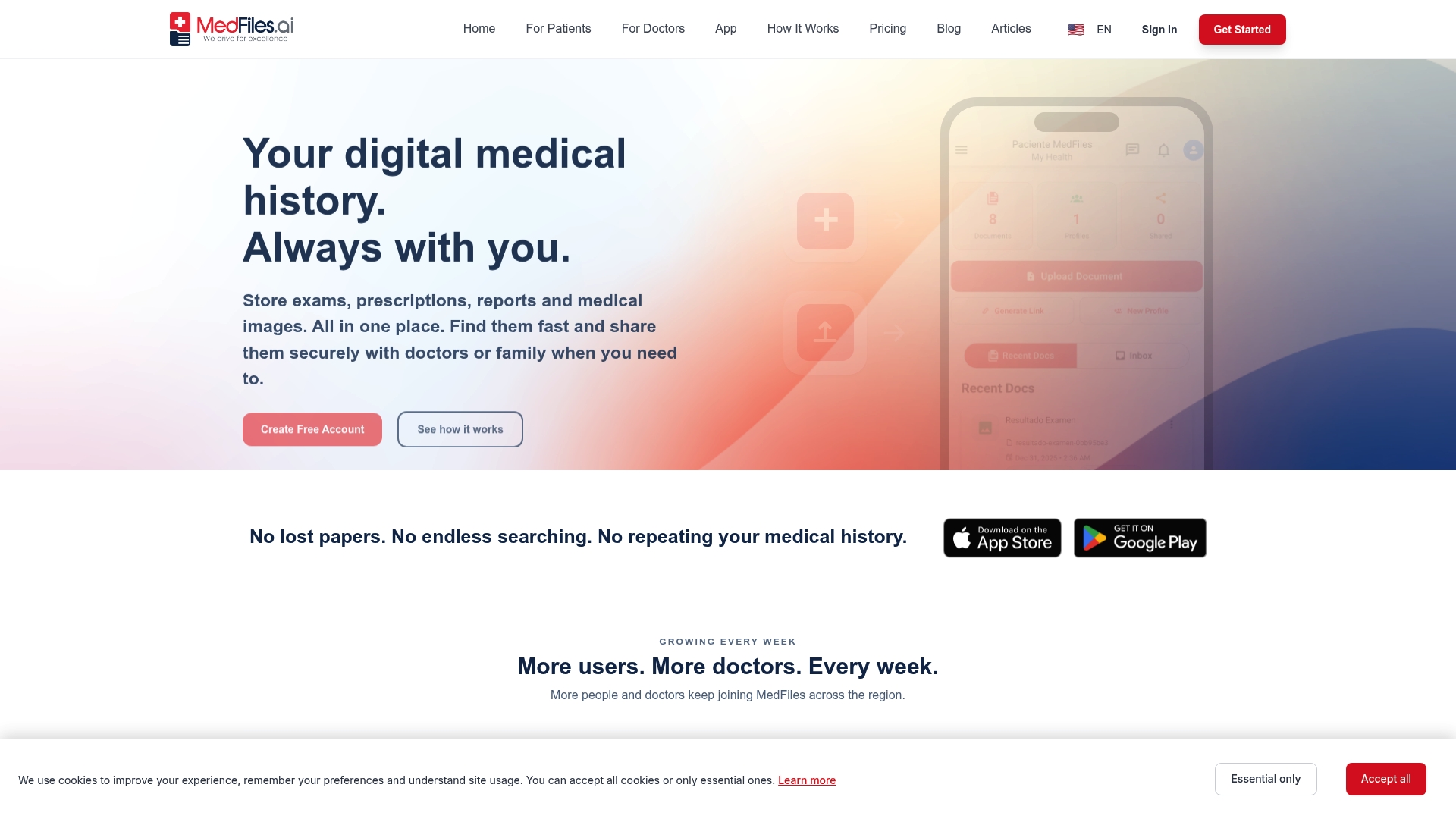
Paid plans start at $1.99/month with a free tier available for basic storage and viewing. The vendor advertises HIPAA-ready infrastructure with end-to-end encryption and Google Cloud hosting, positioning security as a core selling point.
Core Features
MedFiles stores exams, prescriptions, reports, and medical images in a personal vault accessible from mobile or desktop. Uploads are auto-classified so test results and prescriptions land in the right place without manual tagging.
The app offers time-limited secure sharing links for providers or family, plus multi-profile management for children, parents, and pets. AI features extract key data and answer questions about records depending on the plan.
Key Differentiator
MedFiles centers its product on AI-powered automatic organization and analysis coupled with secure multi-family profile management. That combination reduces manual filing and keeps separate health histories for each household member under one account.
Pros
- The upload and auto-classification flow gets new documents organized within seconds, which saves time when you need a lab result fast during a visit.
- Secure sharing via time-limited links makes handing records to a clinician or relative straightforward without emailing PDFs.
- Family and pet profiles let you keep multiple timelines in one place, eliminating separate accounts for each dependent.
- The interface is simple to use; nontechnical users can upload, search, and share without a long setup or training.
- AI-powered analysis can surface diagnoses, dates, and medication details from documents when your plan includes that feature.
Cons
- Full functionality requires a paid subscription; free plans limit storage and access to AI analysis, which will frustrate users who need comprehensive record parsing without upgrading.
Who It’s For
Individuals, parents, and caregivers who want a single secure app for medical histories, vaccination records, and test results. It also fits people who travel often or need quick emergency access to key health documents.
Unique Value Proposition
Automatic classification on upload. MedFiles labels and extracts key fields from your records immediately, then stores them under the correct family profile. For parents juggling school forms, vaccine cards, and pediatric visits, that saves both time and repeated data entry.
Real World Use Case
A parent uploads children’s vaccination records and clinic notes after each visit. When the pediatrician requests recent labs, the parent generates a time-limited share link and sends it in two clicks. During travel, emergency details remain accessible offline through the app.
Pricing
A free plan is available for basic storage and viewing. Paid tiers range from $1.99/month to $3.99/month, with higher tiers increasing storage, AI analysis access, and advanced sharing controls.
Website: https://medfiles.ai
Dr. Guido
At a Glance
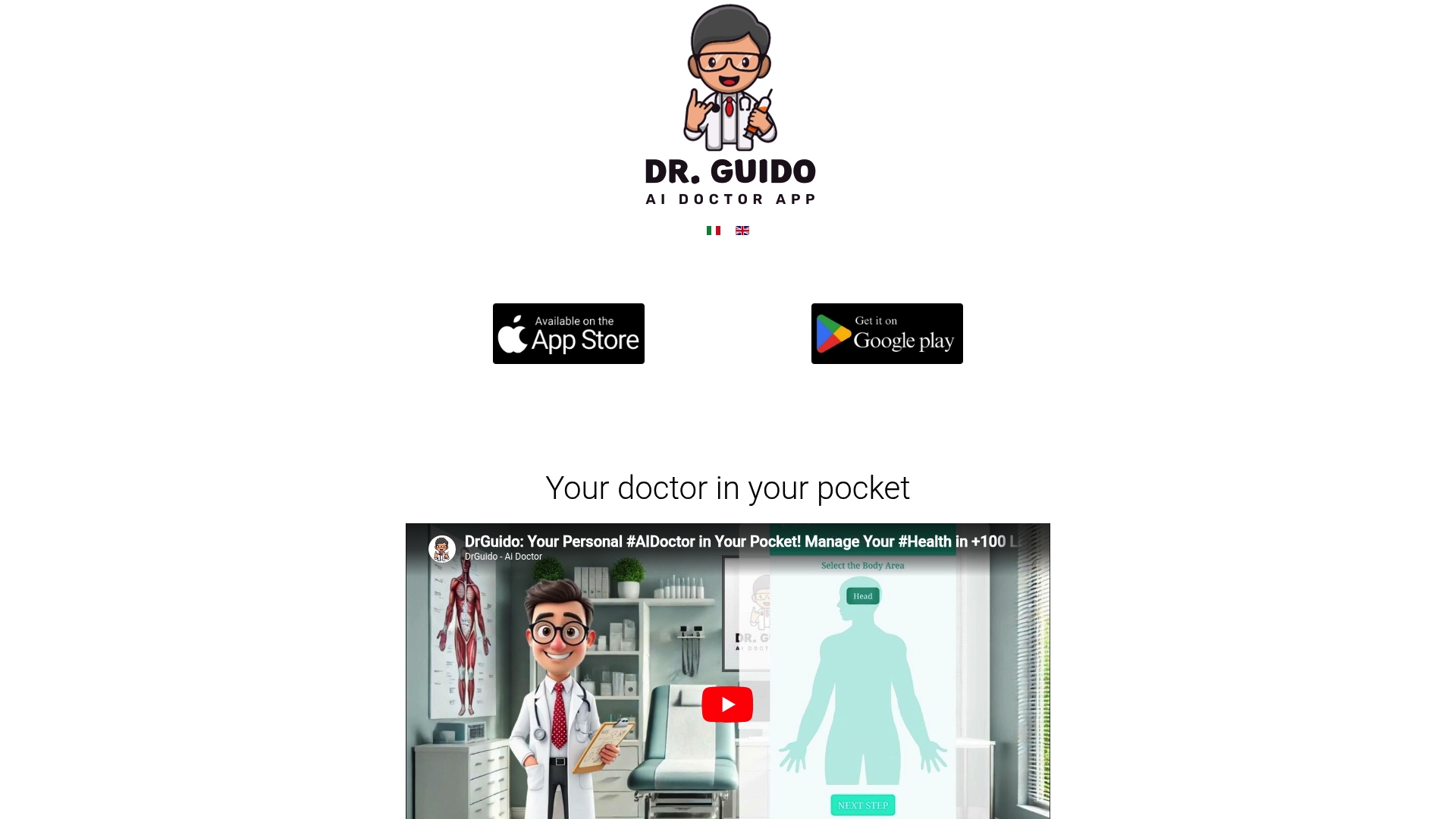
The vendor reports support for over 100 languages while using a privacy architecture that keeps health data separate from user profiles. Dr. Guido offers free AI assistant access and positions its pre diagnosis and second opinion features as informational, not replacements for clinicians.
Core Features
- Personal AI Doctor trained on your health documents and clinical history to surface context aware answers.
- Pre diagnosis support based on symptoms and a second opinion service for reports and medical images.
- Medication and supplement recognition from photos and an AI Herbalist that proposes location aware natural remedies.
Key Differentiator
That language reach combined with a privacy first design that isolates health data from user profiles defines Dr. Guido. This mix makes it practical for people who move between healthcare systems and need private, immediate interpretation of documents in another language.
Pros
- Free access to core AI assistant functions lowers the barrier for users who need quick clarifications on test results or medication labels.
- The multilingual capability helps expats and international travelers move past translation friction when dealing with clinical notes or prescriptions.
- The product emphasizes privacy and claims a proprietary LLM ecosystem for processing health data, which reduces exposure tied to general purpose accounts.
- Photo based medication recognition speeds identification when packaging lacks English labels and reduces guesswork during pharmacy visits.
- Designed to support conversations with clinicians, the app helps you prepare notes or questions before an appointment.
Cons
- There is limited third party feedback available; outside reviews and long term user reports are sparse in the data provided.
- The service is explicitly not a replacement for medical diagnosis or treatment, so it cannot be your sole source for urgent decisions.
- The dataset contains no detailed native app stability or user interface evaluations, so real world reliability and polish are unclear.
When It May Not Fit
If you require a certified clinical decision tool or diagnostic-grade imaging interpretation, this app is not appropriate. Also avoid it as your only source during acute emergencies. Teams needing enterprise integrations or audited third party reviews will find the offering narrow.
Who It’s For
Patients, expatriates, and people with chronic conditions who want multilingual, privacy centric help understanding and organizing health records. Useful when you need quick document translation, medication ID, or an informed second opinion to bring to your clinician.
Real World Use Case
An expat uses Dr. Guido to translate a hospital discharge summary, identify unfamiliar prescriptions by photo, and generate concise questions for a local doctor. The app helps maintain privacy while reducing time lost to translator calls and uncertain follow up.
Website: https://drguido.ai
Medocs.ai
At a Glance
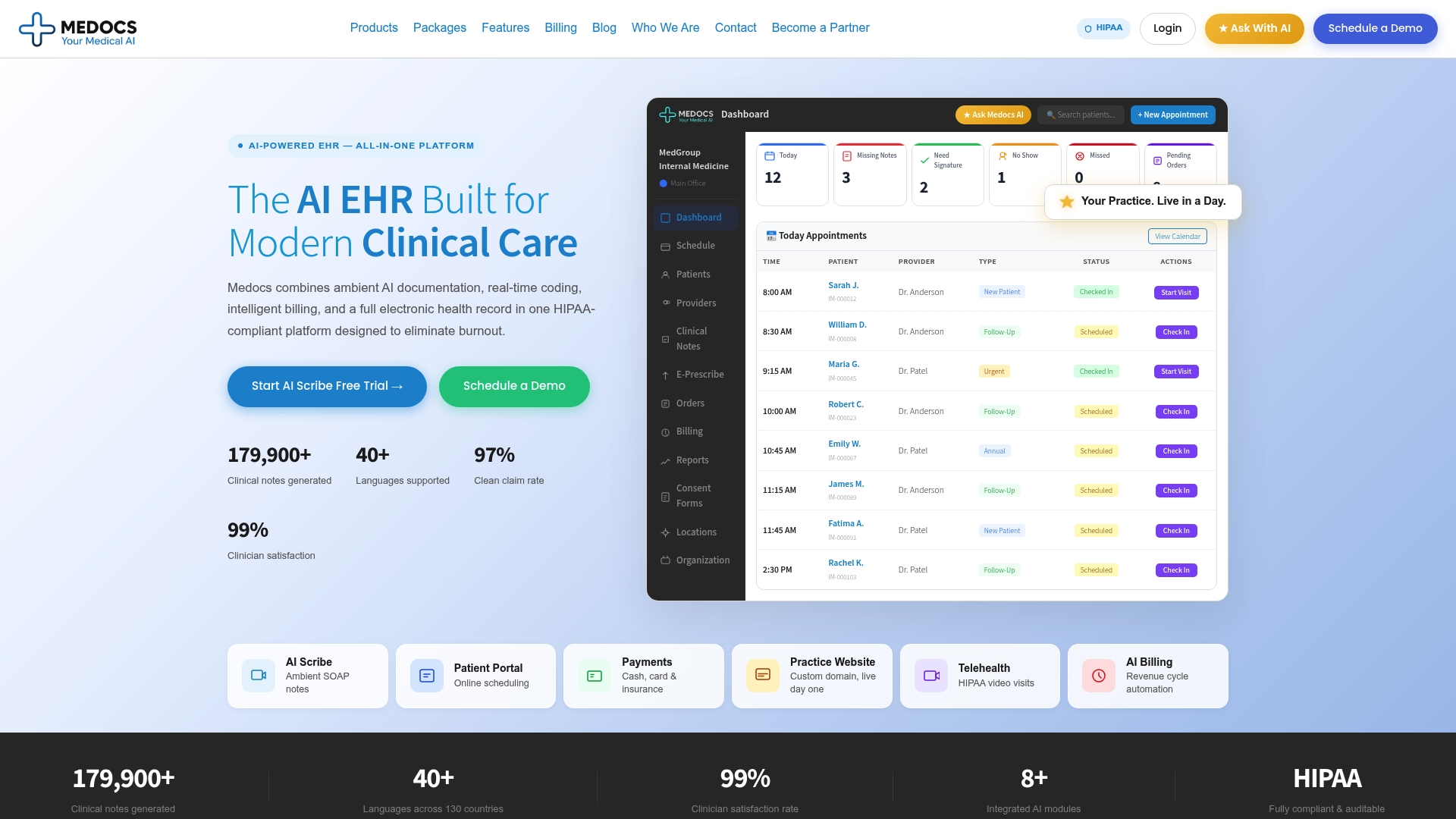
AI ambient documentation in 40+ languages and an all-in-one billing plus telehealth stack are the clearest selling points here. The vendor also advertises a HIPAA-compliant environment and fast practice setup for small clinics.
Core Features
Medocs.ai combines AI ambient documentation for clinical notes, real-time CPT and ICD-10 coding, and an integrated billing engine called MedRevSystem. The platform includes built-in HIPAA video visits, online scheduling, a patient portal, specialty templates, and automated claim scrubbing.
Key Differentiator
What sets this product apart is the attempt to fold ambient scribing, billing automation, and telehealth into a single workflow so clinics can launch quickly without stitching multiple vendors together. The vendor pitches that approach as a way to reduce administrative load for clinicians.
Pros
-
User interface focuses on quick access to charts and notes, which helps clinicians spend less time navigating menus and more time reviewing cases.
-
AI documentation significantly reduces manual charting steps by capturing visit audio and generating structured notes in multiple languages.
-
The integrated billing and denial management features shorten the revenue cycle for teams that want fewer platform handoffs.
-
Specialty-specific templates and multi-site support make it easier to run distinct workflows for primary care, psychiatry, med spa, and telehealth practices.
Cons
-
Several user reports cite poor or non-responsive customer support, which can be risky during go-live or billing disputes.
-
The product data contains allegations of payment issues and missed documentation deliveries from a subset of users, a reliability risk to weigh before committing.
-
Some customers reported unclear service reliability and unfulfilled promises, suggesting sales materials may overstate operational realities for certain buyers.
When It May Not Fit
If dependable vendor support and ironclad service-level commitments are critical to your practice, the user-reported support and delivery concerns above make this a cautious buy. Large health systems requiring enterprise-grade procurement guarantees will need to verify references and contracts.
Who It’s For
Small to medium practices, multi-specialty clinics, and telehealth-first providers that want a single vendor for notes, billing, scheduling, and virtual visits. Practices that prioritize quick setup and language support will find the platform attractive, provided they validate support responsiveness.
Real World Use Case
The vendor’s marketing materials describe a primary care clinic that reported charting time cut by half after deploying the ambient scribe and integrated billing. That example shows how a small practice might free clinician hours and reduce administrative backlog with tighter tech handoffs.
Pricing
Plans start at $149 per provider per month for general specialties, with higher tiers at $199 to $249 per provider per month for telehealth, longevity, and med spa packages. Enterprise and health system pricing are custom and require direct negotiation.
Website: https://medocs.ai
DocuMed AI
At a Glance
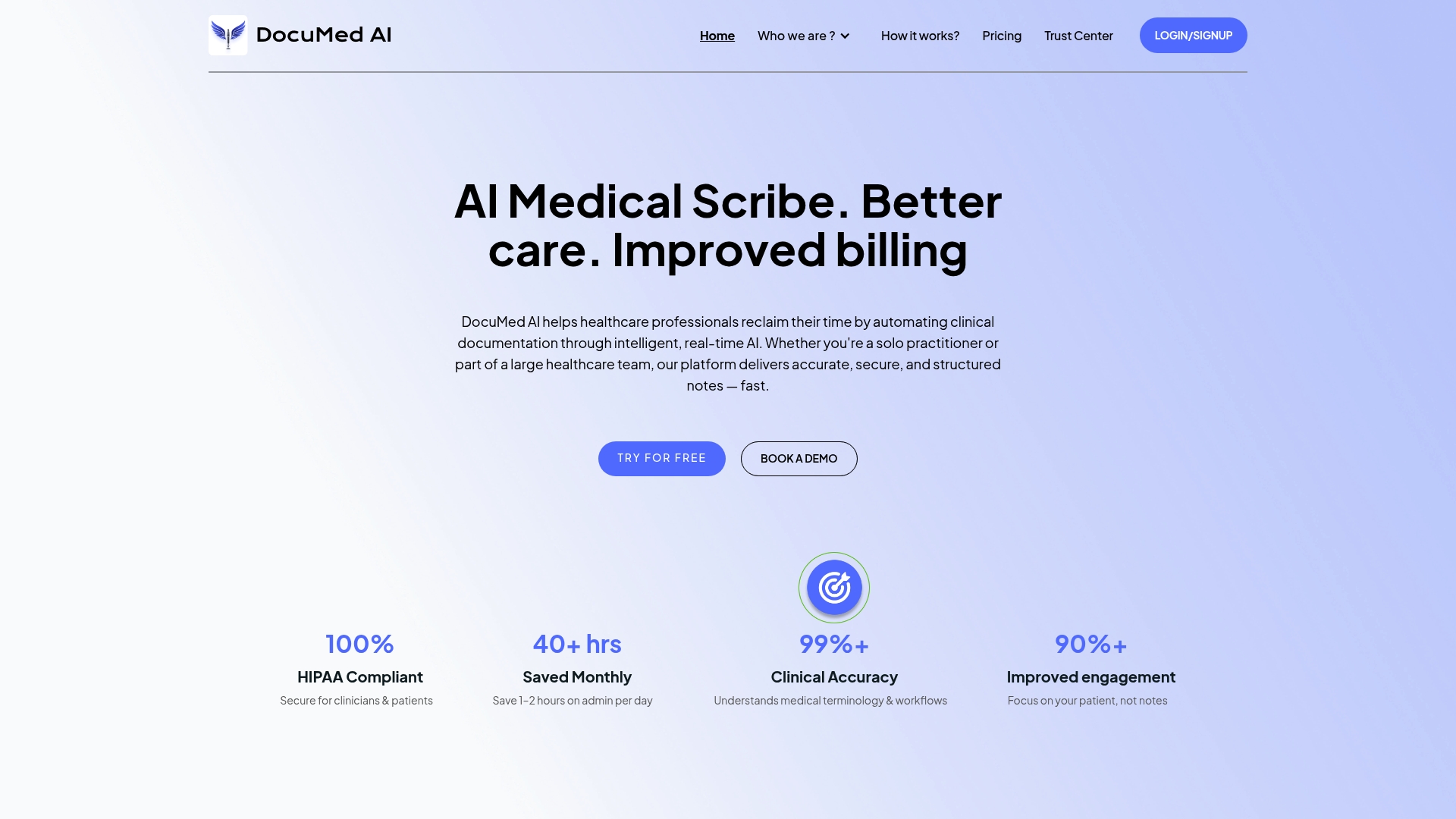
DocuMed AI’s marketing materials claim it can reduce documentation time by up to 50%, a concrete metric that clinicians often cite when evaluating scribes. The product pairs real-time transcription with automated coding and template-driven notes for diverse practice settings.
Core Features
- Real-time transcription of clinical encounters, plus uploaded audio file processing for telehealth or recorded visits.
- Customizable templates and AI-assisted dictation that let you shape note structure for specialty workflows.
- Automated coding support for E/M, CPT, and ICD-10 to speed billing prep and reduce manual entry.
- Mobile and web apps with secure encryption and generated notes prepared for EHR import.
Key Differentiator
The vendor positions DocuMed AI as clinician-built and specialty-aware, which means development decisions appear grounded in daily charting realities rather than generic tech assumptions. The vendor also states the platform is HIPAA-compliant, a security posture emphasized across its marketing.
Pros
-
Clinician-first design speeds practical adoption. Templates and defaults reflect common note patterns across primary care and specialties.
-
The documentation time claim above gives a useful benchmark when comparing ROI across staffing models and outsourced scribes.
-
Built-in coding assistance removes a frequent source of denials by flagging likely CPT and ICD-10 matches during note creation.
-
Multi-setting support works for telehealth, inpatient, and outpatient clinics so you do not need separate tools for different shifts.
-
No-training setup is reported, meaning clinicians can try basic features without a lengthy rollout.
Cons
-
Public third-party reviews are sparse, which makes independent performance verification harder for procurement teams.
-
The vendor did not list specific EHR integrations in the provided data, so workflow fit will require a direct compatibility check with your EHR vendor.
-
One con entry notes that pricing details are not fully disclosed publicly, implying you may need a sales conversation to understand enterprise minutes and add-ons.
Who It’s For
Physicians, nurse practitioners, and specialists who want an AI scribe that adapts to specialty documentation norms. Solo practitioners and medium practices seeking to cut chart time and improve coding accuracy will find the feature set relevant.
Real World Use Case
A family medicine clinic uses DocuMed AI to record visits, generate structured visit notes, and queue suggested codes for billing. Clinicians report faster note closure and fewer postclinic callbacks for missing documentation elements.
Pricing
DocuMed AI offers tiered subscriptions ranging from a free limited plan to paid levels. The vendor lists a $30/month plan for students and trainees and a $100/month professional tier, with higher tiers including additional minutes and features.
Website: https://documedai.com
Mediscan AI
At a Glance
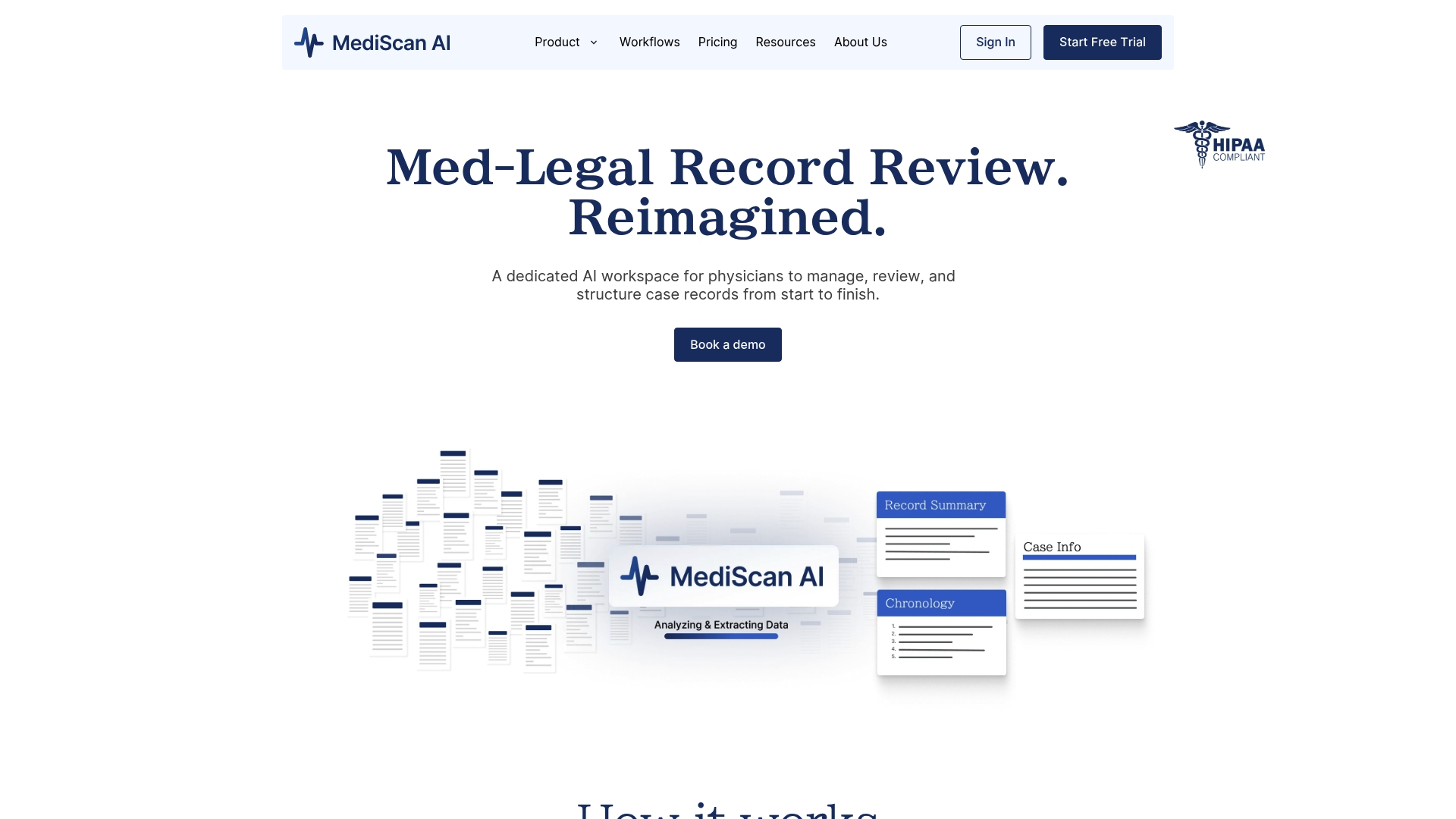
Mediscan AI’s marketing states it delivers summaries within minutes even for large batch uploads, and that speed is tied to a physician-centered review workflow rather than outsourced processing. The positioning is focused squarely on med-legal and insurance workflows rather than general personal record storage.
Core Features
- AI-driven organization and summarization of medical records that groups notes, labs, and imaging into readable summaries.
- Automatic consolidation into editable chronologies so physicians can correct or annotate timelines without rework.
- Built-in smart search and chat for interrogating records and pulling evidence quickly.
- Export options including linked PDFs and Word documents for standard report generation.
- Support for high-volume PDF uploads, including scanned handwritten notes.
Key Differentiator
The vendor presents a physician-trained AI that structures records directly from source PDFs and keeps physician oversight central. That focus narrows the product to med-legal, attorney review, insurer, and TPA teams rather than consumer-facing medical record storage platforms such as Medfiles which targets individuals and families.
Pros
- Rapid in-house processing. The processing speed claim above lets teams avoid outsourcing and reduces turnaround from days to hours according to the vendor.
- HIPAA compliance and encryption. Data security is highlighted and designed to meet clinician and legal privacy expectations.
- Scales to heavy caseloads. The platform accepts large batch uploads and handles thousands of pages in a single workflow.
- Physician control retained. Summaries are editable and tied directly to source pages so reports reflect source material without added interpretation.
- Flexible plans and live support reduce procurement friction for legal and insurer teams.
Cons
- No public third-party reviews exist to independently verify vendor claims.
- Pricing may be expensive for very small users since plans start at a fixed monthly baseline.
- Output quality depends on input accuracy; poor quality scans or OCR errors will affect summaries.
When It May Not Fit
If your workflow includes many non-PDF formats you will need a conversion step because the product does not ingest non-PDF files. Small solo physicians with only occasional record reviews may find the Starter plan less cost effective. Teams that require independent validation of performance will be limited by the lack of external reviews.
Who It’s For
Physicians, med-legal reviewers, attorneys, insurers, and TPA teams that process high volumes of medical records and need fast, secure summaries and editable chronologies. Ideal when speed and clinician oversight matter more than general consumer file storage features.
Real World Use Case
A med-legal review team uploads thousands of PDF records to generate timelines and case summaries for multiple claims. The team edits chronologies, exports linked PDFs for counsel, and reduces case triage time from several days to a few hours according to the vendor workflow.
Pricing
Plans start at $150/month for the Starter plan and scale with higher volume tiers. The vendor advertises flexible plans with no long-term commitments and live support for onboarding.
Website: https://mediscan.ai
MedTec AI Medical Assistant

At a Glance
Pricing starts at $68 for the Basic package, with Deluxe and Premium tiers available. MedTec’s marketing materials state it aims to reduce provider burnout by automating documentation and supporting audit readiness, a claim the vendor makes for adoption cases.
Core Features
-
Ambient clinical capture that listens to patient provider conversations and extracts structured data during encounters.
-
Real-time documentation synthesis which assembles notes as the visit progresses and outputs specialty-specific templates.
-
Clinical suggestion engine that highlights care gaps, diagnostic prompts, and coding opportunities for billers and clinicians.
-
Workflow automation for follow ups and documentation prompts.
-
Customizable templates and specialty vocabularies for primary care, cardiology, neurology, psychiatry, and orthopedics.
Key Differentiator
MedTec focuses on understanding clinical context rather than treating notes as generic text. The system adapts its templates and suggestions to how a practice documents and to specialty vocabulary.
That orientation is useful when notes must reflect nuanced exam findings and billing codes without manual rework.
Pros
-
Designed to cut documentation time by capturing encounters without manual transcription. That reduces the number of steps clinicians take after a visit.
-
The assistant learns practice patterns and specialty language so templates become more accurate over time.
-
Integration targets existing EHR workflows so your team can keep current sign on and routing habits while adding AI assistance.
-
The suggestion engine supports coding accuracy and can surface missed billing opportunities for clinical staff.
-
Product messaging emphasizes lowering administrative load, which aligns with clinics seeking to reallocate clinician time back to patients.
Cons
-
Public, third-party user reviews are scarce according to available materials, so real world reliability and user satisfaction are not verifiable from independent sources.
-
Integration complexity is not detailed in vendor content. Practices with highly customized EHRs should plan for evaluation and potential implementation work.
-
Specialty performance is described as adaptable but documentation does not provide objective benchmarks for accuracy across individual specialties.
Who It’s For
If you are a physician or clinical staff member who spends substantial time on postvisit notes and you want to keep your existing EHR, this product matches that profile. It prioritizes documentation automation and billing support rather than replacing core EHR functions.
Real World Use Case
According to the vendor, a primary care clinic implemented MedTec to capture encounter details and generate structured notes automatically. The example credits reductions in documentation time and improved billing accuracy as outcomes claimed by the vendor.
Pricing
Pricing starts at $68 per month for the Basic package. Deluxe and Premium options are available at higher price points and limited time discounts are offered for the first three months.
Website: https://medtec.ai/ai-medical-assistant
Comparison
Medical documentation and assistance platforms cater to unique needs, including individual record management, clinical documentation, and multilingual support. Below, we examine how MedFiles.ai compares with its competitors across dimensions.
Pricing Structure and Accessibility
Pricing and accessibility significantly influence product selection. MedFiles.ai, with a starting price of $1.99 per month, offers the most budget-friendly subscription option, granting users access to essential features at lower costs. Dr. Guido, offering free multilingual AI assistance, is notable for users requiring language support without upfront investment, a dimension where cost-effective versatility makes it a winner over MedFiles.ai for budget-conscious, internationally mobile individuals.
Feature Integration and Scope
Arrayed features distinguish platforms based on functionality depth. MedFiles.ai’s family-profile management coupled with AI-powered automatic organization is among direct competitors for maintaining consolidated health timelines. However, Mediscan AI’s physician-centric design and editable chronologies particularly suit med-legal professionals needing precise, annotated summaries, positioning it ahead in specialized workflows requiring customization and high-volume document handling.
Best Fit
- MedFiles.ai: For families and caregivers managing multiple health records needing automated organization capabilities.
- Dr. Guido: Ideal for expatriates and frequent travelers requiring private, multilingual document interpretation without substantial financial investment.
- Mediscan AI: Fits med-legal reviewers and insurers processing high-volume medical documentation with strict security and customization needs.
- MedTec AI Medical Assistant: Addresses specialty clinics looking for patient encounter capture and real-time template output.
Our Pick
MedFiles.ai offers a distinctive balance of affordability, accessibility, and advanced AI features, including multi-profile management and secure health document sharing. These characteristics make it especially suited for households juggling varied medical history types. However, for users needing multilingual AI translation independent of complex family profiling, Dr. Guido is a notable alternative, showcasing how choosing the right platform depends on specific user needs and contexts.
Medical Record Management Platforms Compared
Choosing the optimal platform for managing medical records involves considering features like security, organization capabilities, multilingual compatibility, and pricing options to meet individual or institutional needs.
| Product | Core Feature | Key Differentiator | Pricing | Notable Limitation |
|---|---|---|---|---|
| MedFiles | AI-backed document organization and secure sharing | Family-profile management and automatic file sorting | Free; $1.99–$3.99/month | Free plan limits some advanced features, including AI analysis. |
| Dr. Guido | Multilingual AI-based prediagnosis and document support | Privacy-first design and broad language compatibility | Not disclosed | Lacks detailed app reliability evaluations and long-term reviews. |
| Medocs.ai | Integrated telehealth, billing, and documentation system | Multi-functional billing and documentation automation | $149–$249/provider/month | Reports cite poor customer support and reliability issues. |
| DocuMed AI | Real-time clinical transcription and coding assistance | Clinician-built platform tailored to specialty needs | $30–$100/month | EHR integration details are not prominently disclosed. |
| Mediscan AI | AI-driven medical record summarization for professionals | Batch processing for med-legal and insurance uses | $150/month | Limited to PDF files and lacks independent performance reviews. |
| MedTec AI Medical Assistant | Automated encounter documentation with EHR integration | Specialized clinical templates and coding accuracy boosts | Starting at $68/month | Lack of clear integration details potentially requires tailoring. |
Manage Your Medical Records Securely with Medfiles
The article highlights key challenges like organizing multiple medical documents, securely sharing records, and accessing crucial health information quickly during emergencies or travel. If you face frustration with manual filing or juggling different profiles for family members and pets Medfiles offers an AI-powered solution designed to simplify these exact pain points. Its HIPAA-ready infrastructure ensures your data stays private while auto-classification saves time by sorting your records instantly.
Experience how Medfiles removes the hassle of medical record management by giving you instant access to well-organized health files and safe, time-limited sharing options. Don’t let scattered documents hold you back. Visit MedFiles.ai and upload your records for automatic sorting and effortless sharing with your healthcare providers or loved ones today.
Frequently Asked Questions
What makes Medfiles a suitable choice for organizing medical records?
Medfiles is ideal for organizing medical records as it offers AI-powered automatic organization and analysis. This feature enables users to quickly upload and auto-classify exams, prescriptions, and medical images without manual tagging, making it easier to access important documents when needed. To start using Medfiles, consider signing up for its free tier to evaluate its basic functionalities.
How does Medfiles compare to Dr. Guido in terms of language support?
Dr. Guido supports over 100 languages, making it an excellent option for international travelers needing document translation. While Dr. Guido excels in providing multilingual assistance, Medfiles centers its feature set on AI-powered automatic organization of medical records, which is particularly beneficial for individuals and families managing multiple health profiles. Users should choose based on whether they prioritize language support or optimized record organization.
Can users securely share documents with Medfiles?
Medfiles allows users to share documents securely through time-limited secure sharing links. This feature enables straightforward sharing of records with healthcare providers or family without the need for emailing sensitive PDFs, streamlining the process for emergency situations. Users should create secure links for hassle-free communication during appointments.
What are the key limitations of the free plan offered by Medfiles?
The free plan of Medfiles has limitations on storage and access to AI analysis, which might frustrate users needing comprehensive record organization without upgrading. Users requiring extensive use of the platform should consider evaluating the paid tiers for more extensive features and capabilities.
What is the pricing structure for Medfiles?
Medfiles offers pricing starting at $1.99/month for paid plans, with a free tier available for basic storage and viewing options. Users can select higher tiers at $3.99/month for additional features as their needs for storage and functionality grow, making it accessible for varied users.