Why Share Records with Providers: a Patient's Guide
Discover why share records with providers enhances your healthcare. Learn about benefits, protections, and easy sharing tools in our guide.

Why Share Records with Providers: a Patient’s Guide
Many patients feel uneasy about sharing their medical records. The hesitation is understandable. Your health history feels personal, and handing it over to yet another provider or system raises real questions. But understanding why share records with providers is one of the most practical things you can do for your own health. When your doctors have complete, accurate information, they make better decisions. Faster. With fewer gaps. This guide breaks down the real benefits, the legal protections that safeguard your data, and the tools that make sharing secure and simple.
Table of Contents
- Key takeaways
- Why share records with providers
- Your privacy is protected by law
- Digital tools that make sharing records simple
- Common obstacles and how to handle them
- How shared records protect caregivers and families
- My take on why this matters more than most patients realize
- Take control with Medfiles
- FAQ
Key takeaways
| Point | Details |
|---|---|
| Sharing prevents medical errors | Complete records help providers avoid misdiagnosis, dangerous drug interactions, and redundant testing. |
| Legal protections are strong | HIPAA, TEFCA, and consent controls protect how your data is accessed, shared, and used. |
| Technology makes it easy | Mobile apps, secure portals, and QR codes let you share records instantly and securely. |
| Caregivers depend on shared data | Family members and caregivers need authorized access to respond effectively in emergencies. |
| Quality of data matters too | Accurate, organized records produce better outcomes than incomplete or fragmented files. |
Why share records with providers
Your doctor can only work with what they know. That sounds obvious, but think about what happens when a specialist sees you for the first time with no access to your primary care records. They’re starting from scratch. They may order tests you already had. They may prescribe something that conflicts with a medication you’re already taking. Incomplete histories are directly linked to misdiagnosis and inefficient treatment in outpatient care.
The benefits of sharing records go well beyond convenience. Here is what complete, accessible records actually do for your care:
- Prevent dangerous errors. Your allergies, current medications, and past diagnoses are on record. A provider seeing you for the first time won’t accidentally prescribe something harmful.
- Eliminate redundant testing. Blood work, imaging, and lab tests cost time and money. When records follow you, you avoid repeating tests that were already done last month.
- Support smooth care transitions. Moving from a hospital to a rehab facility or from a specialist back to your primary care doctor becomes far less risky when records transfer with you.
- Enable personalized treatment. Providers can make evidence-based decisions when they see the full picture of your health history, not just today’s symptoms.
Sharing also plays a role in utilization review and care coordination. Payers and providers working from the same accurate data catch waste early and close care gaps that might otherwise go unnoticed for months.
Pro Tip: Before any specialist appointment, request that your primary care provider send a summary of your recent records directly. Confirm receipt at least two days in advance so the specialist walks in prepared.
Your privacy is protected by law
One of the most common reasons people hesitate to share their health information is fear. Fear that records will be misused, seen by the wrong person, or shared without consent. That fear deserves a direct, honest answer.
| Protection | What it does |
|---|---|
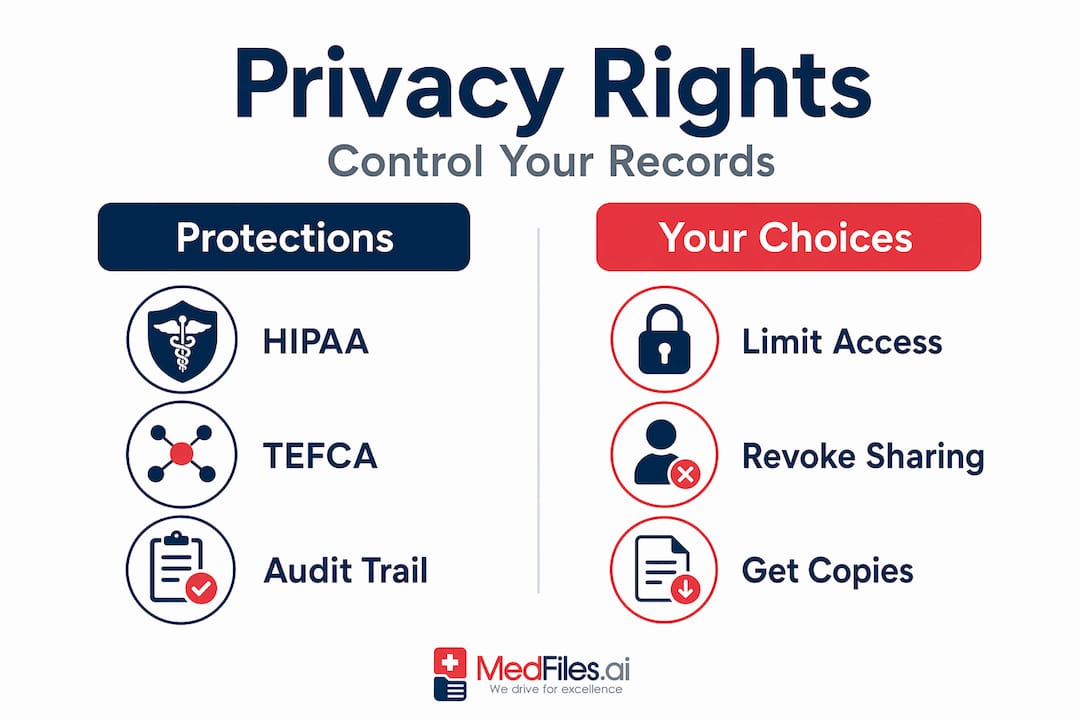
| HIPAA | Sets federal standards limiting who can access and share your health information |
| Patient consent rights | You can authorize, restrict, or revoke sharing permissions at any time |
| TEFCA legal agreements | TEFCA participants are bound by enforceable rules and subject to compliance audits |
| Audit trails | Your records log who accessed your data and when, creating full accountability |
| Data encryption | Modern platforms use end-to-end encryption to prevent unauthorized access during transmission |
TEFCA, the Trusted Exchange Framework and Common Agreement, is the national framework governing how health data moves between providers, payers, and networks. It does not just facilitate sharing. It requires transparency, legal accountability, and regular oversight of everyone participating. Trust is not assumed. It is built into the system.
You also have the right to say no. You can restrict what gets shared, with whom, and for how long. You can revoke access. And if a provider accesses your records inappropriately, audit logs create a traceable record of exactly what happened.
Pro Tip: Ask your provider’s office for a copy of their Notice of Privacy Practices. This one-page document tells you exactly how your information is used, who it can be shared with, and what your rights are.
Digital tools that make sharing records simple
Technology has changed what it means to share your medical records. You no longer need to mail paper files or carry folders to every appointment. The process has become faster, more secure, and increasingly patient-controlled.
Medicare enrollees can now generate secure QR codes through mobile apps for instant, authorized sharing of their records with any provider. Authentication through trusted platforms like Login.gov and ID.me keeps the process secure. The provider scans the code, and the records appear. No forms. No phone calls. No waiting.
Nationwide, the scale of digital record exchange is growing fast. The TEFCA network has exchanged nearly 1 billion records in just 16 months, up from roughly 10 million in early 2025. That is not a technical milestone. It is a signal that the infrastructure for safe, reliable sharing is already here and working at scale.
Beyond TEFCA, patients benefit from:
- Patient portals like MyChart. These let you view, download, and send records to any provider in the network with a few taps.
- Electronic health record interoperability. When your providers use connected EHR systems, records update automatically across your care team without any action required from you.
- Secure platforms for personal record management. Tools like Medfiles let you store, organize, and share your complete medical history digitally, with HIPAA-ready encryption and instant access from any device.
When shared data enables predictive analytics inside clinical workflows, providers can identify your risks before they become urgent. That means proactive outreach for overdue screenings, early flags for worsening chronic conditions, and faster interventions. Sharing transforms your records from a passive file into a tool your care team actively uses.
Common obstacles and how to handle them
Knowing the advantages of sharing health information is one thing. Actually getting your records to the right place is another. These are the most common barriers patients face, and what to do about each.
-
“I’m worried about privacy.” This is the most frequent concern. Revisit the legal protections above. HIPAA is federal law, not a suggestion. TEFCA adds another layer of enforceable accountability. Your consent controls what gets shared and when.
-
“I don’t know how to authorize sharing.” Contact your provider’s front desk or patient portal. Request a medical records release form. Most can be completed online now. Specify what records you want shared, with which provider, and for how long.
-
“My records are scattered across multiple providers.” Start by requesting copies from each provider and uploading them to a single secure platform. Healthcare information management tools help you consolidate everything in one place.
-
“I authorized sharing but my new provider never received the records.” This happens more than it should. Some providers still process requests manually, using fax or paper forms that cause delays even after you’ve given authorization. Follow up directly with both offices and confirm receipt before your appointment.
-
“My records contain errors.” You have the right to request corrections. Submit a written amendment request to the provider who created the record. Keeping a personal copy of your records also lets you catch discrepancies before they cause problems.
Pro Tip: Keep a personal summary document with your current medications, known allergies, and major diagnoses. Bring it to every appointment. It fills gaps immediately, even when records haven’t arrived yet.
How shared records protect caregivers and families
If you are managing care for a parent, a child, or a spouse with a chronic condition, incomplete records are not just an inconvenience. They can be dangerous. Caregivers who lack access to current health information are forced to make decisions with missing pieces.
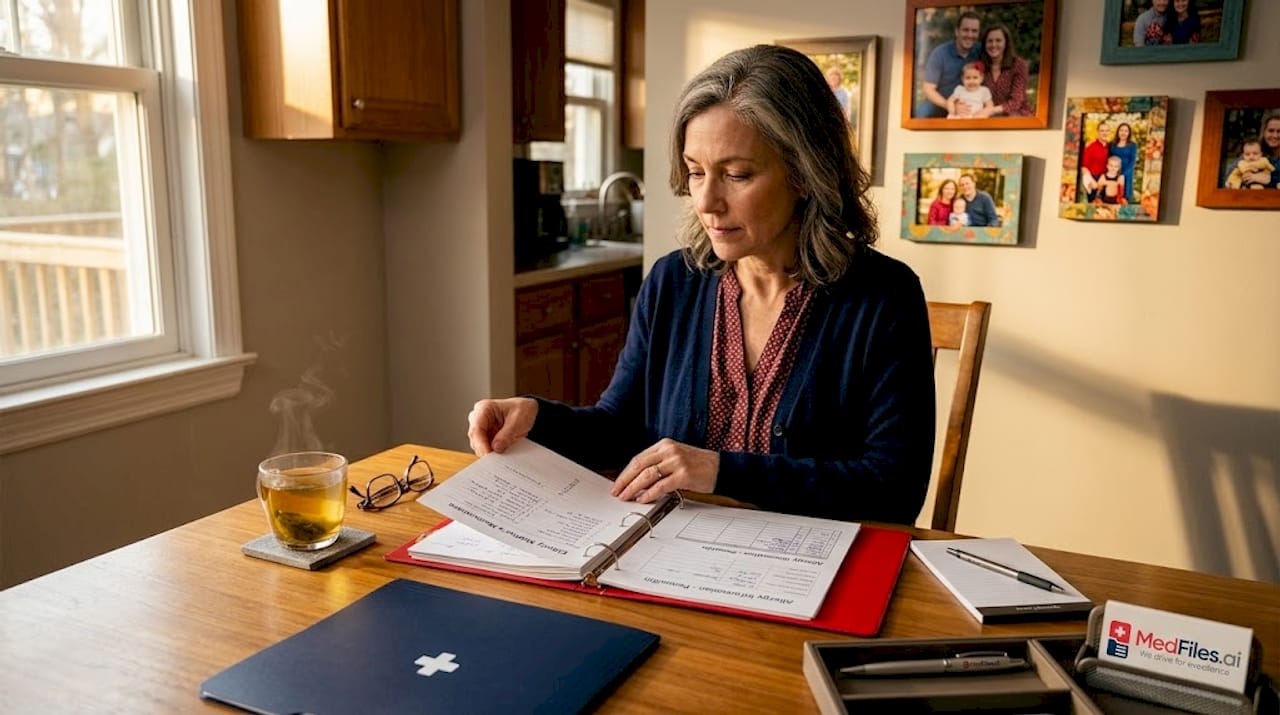
The impact of record sharing becomes most visible in urgent situations. When a caregiver arrives at an emergency room with a family member who cannot speak for themselves, the ER team needs to know about heart conditions, current medications, and allergies. Immediately. Not after a 30-minute phone call to track down a different hospital’s records.
Here is how to set up shared access that actually works:
- Establish authorized access in advance. Most providers allow a designated caregiver or family member to be added to a patient’s account with written consent. Set this up before an emergency happens.
- Use a shared digital records platform. A tool that supports multi-profile family management lets you store and access health records for every family member from one account.
- Keep records updated after every visit. A diagnosis or medication change that goes unrecorded becomes a gap that can cause harm down the line.
- Share access during travel. If a family member receives care away from home, having records accessible via a secure mobile app means the treating provider gets accurate information instantly, regardless of location.
Caregiving is already demanding. Organized, shareable records reduce one of its biggest stress points: not knowing what the care team needs to know right now.
My take on why this matters more than most patients realize
I’ve spent years watching patients and families navigate the healthcare system. And one pattern stands out: people who actively share their records with providers consistently get better, faster, and safer care. Not because their doctors are better. Because their doctors are better informed.
What I’ve found is that privacy fears, while valid, are often based on outdated assumptions about how data actually moves. The legal framework today is far stronger than it was even five years ago. What concerns me more is the patient who withholds records out of fear and ends up repeating tests, experiencing a medication conflict, or missing a preventable complication.
I’ve also seen the data quality issue up close. Simply sharing records is not enough if those records are disorganized, incomplete, or scattered across a dozen different portals. Fixing data quality at the source produces far more reliable outcomes than trying to reconcile fragmented information later. That means organizing your records proactively, not just sharing them reactively.
The patients who benefit most from the reasons to share patient information are the ones who treat their health records like a living document. They update it. They organize it. They bring it to appointments. They make sure caregivers have access before it is urgently needed. That is not just good data hygiene. It is self-advocacy.
— Team
Take control with Medfiles
You now know why sharing records with providers matters and what protections back you up. The next step is making it practical.
Medfiles gives you one secure place to store, organize, and share your complete medical history. Upload test results, prescriptions, imaging reports, and visit summaries. Share instantly with any provider using encrypted, HIPAA-ready technology. Manage records for your entire family from a single account. Whether you’re preparing for a specialist visit, managing a chronic condition, or supporting a family member, Medfiles keeps your information ready when it counts. Explore plans for patients or see how Medfiles supports doctors and care teams with secure, real-time access to patient records. Your records. Your control. Always available.
FAQ
Why should patients share records with providers?
Sharing records gives providers a complete picture of your health history, reducing the risk of medication errors, duplicate testing, and misdiagnosis. It is one of the most direct ways to improve the quality and safety of your care.
Is sharing medical records safe?
Yes. Federal laws like HIPAA and frameworks like TEFCA require legal accountability, consent controls, and audit trails for any authorized data exchange. Your information cannot be shared without your permission.
What technology helps patients share records easily?
Mobile apps, secure patient portals like MyChart, and platforms like Medfiles let you share records digitally using encrypted connections. Medicare’s QR code system is one recent example of instant, authorized sharing at the point of care.
How do caregivers benefit from shared medical records?
Caregivers with authorized access to a family member’s records can provide accurate information during emergencies, coordinate ongoing treatments, and communicate effectively with care teams without delays or guesswork.
What do I do if my provider did not receive my records?
Follow up directly with both the sending and receiving offices. Manual processing delays are still common in some settings. Confirm receipt before your appointment and keep a personal copy of key records on hand as a backup.