Co-Parenting Medical Records: Access, Rights and Sharing
Co-parenting medical records explained: what each parent can access, how to request records, and how to keep one shared, organized file for your child.

Co-Parenting Medical Records: Access, Rights and Sharing
In most U.S. states, both parents can see their child’s medical records, whatever the custody schedule says. What goes wrong is rarely the law. It is the logistics: records scattered across portals, a parent who is not told about an appointment, a provider who cuts one parent off by default. The most reliable fix is one organized file for your child that both parents can reach, built from records you request yourself. That is what we built MedFiles.ai for: a secure place to store, organize and share your child’s records with the people who need them.
TL;DR
- Under HIPAA, a parent who can make health-care decisions for a minor is generally treated as the child’s personal representative and can see the records. State law fills in the details.
- Many state statutes say a parent cannot be denied records just because they are not the custodial parent. A court order can limit that, and a provider must have seen the order to act on it.
- Request records in writing. Providers generally have 30 days to respond, and sometimes up to 60.
- Confidential care, such as some mental health services, and abuse concerns are the main exceptions.
- Keep one organized, secure copy of everything and share it with the other parent, so neither of you depends on the other to pass along information.
Table of Contents
- What the law says about a co-parent’s access
- Why a provider may still say no
- The real exceptions: confidential care and safety
- How to request your child’s records, step by step
- If access is denied
- Keeping both parents informed without the friction
- Where MedFiles.ai fits
- Start your child’s shared record
- FAQ
- Sources
What the law says about a co-parent’s access
Two layers of law apply: federal privacy rules and your state’s family law.
Federal: HIPAA. HIPAA is the federal health privacy law. It treats a parent who has authority to make health-care decisions for an unemancipated minor as the child’s “personal representative.” HHS explains that HIPAA follows state law: parental access is allowed when state law requires or permits it, blocked when state law prohibits it, and left to a licensed professional’s judgment when state law is silent and the parent is not the personal representative.
State: custody and access statutes. Most states have a statute saying a parent keeps access to the child’s records after separation. A few examples show the pattern:
| State | What the statute says |
|---|---|
| California (Family Code § 3025) | Access to medical, dental and school records cannot be denied to a parent because that parent is not the custodial parent. |
| Arizona (A.R.S. § 25-403.06) | Unless a court orders otherwise, both parents are entitled on reasonable request to equal access to documents and information about the child’s physical and mental health. A person who does not comply can owe the requesting parent court costs and attorney fees. |
| Texas (Family Code § 153.073) | Unless limited by court order, a parent appointed as conservator has the right to the child’s medical, dental, psychological and educational records. |
| Pennsylvania (23 Pa.C.S. § 5336) | A parent with sole or shared legal custody must be given access to medical records, and access cannot be denied solely because of the physical custody schedule. |
| Indiana (Code § 16-39-1-7) | Custodial and noncustodial parents have equal access to a child’s health records. A provider may refuse only when a court has limited that parent’s access and the provider has the order or knows of it. |
| Maryland (§ 9-104) | Unless a court orders otherwise, a parent cannot be denied access to medical, dental and educational records for lacking physical custody. |
Oregon’s court instructions say the same in plain language: in most cases both parents have equal rights to information about the child, including medical records, unless the court orders otherwise.
The practical rule: legal custody and the parenting schedule are different things. Where your child sleeps does not decide who can see the chart. A court order that expressly limits access does. Check your own decree, and if your state is not listed above, look up your state’s family code or ask a family law attorney.
Why a provider may still say no
Even when you have the right, you can hit a wall. Common reasons:
- The provider has a court order on file limiting one parent’s access. In Indiana, for example, that is the one situation where a provider may refuse the other parent.
- Your name is not in the chart. Front-desk staff often only know the parent who brought the child in.
- Portal defaults. Some systems turn off a parent’s proxy access when a child reaches a certain age. HHS’s Office for Civil Rights (OCR) addressed this in a December 3, 2025 letter, saying that denying parents access, or requiring a minor’s authorization when applicable law does not, may violate the Privacy Rule. It urged providers to correct default portal settings that improperly block timely access. Reporting on OCR’s director says parental right-of-access complaints are a focus of enforcement.
- Confidential care exceptions (covered next).
If you want to understand how a clinic’s patient portal access policies usually work, such as who gets a login and how proxy access is set up, the clinic’s own FAQ is a good place to start before you call.
The real exceptions: confidential care and safety
OCR’s letter names three situations where a parent may not be treated as the personal representative:
- The minor lawfully consents to the care themselves, and the law does not require a parent’s consent.
- The minor receives care at a court’s direction, or at the direction of a court-appointed person.
- The parent agrees to a confidential relationship between the minor and the provider.
These are generally limited to certain services, such as mental health care. A parent can usually keep access to the rest of the child’s records even when one episode of care is confidential.
Separately, a provider can decline to treat a parent as the personal representative if it reasonably believes, in professional judgment, that the child has been or may be subjected to domestic violence, abuse or neglect by that parent, or that disclosure could endanger the child. Pennsylvania’s statute adds that a court will not order disclosure of an abuse victim’s address or confidential counselor and shelter information. Vermont’s law lets a court deny access when it is not in the child’s best interest.
If safety is a concern, talk to your family law attorney or, in an emergency, call 911. For teens, our guide to teen medical privacy laws explains what parents and teens can each see.
How to request your child’s records, step by step
Don’t wait for the other parent to forward anything. Ask the provider directly.
- List every provider. Pediatrician, dentist, specialists, urgent care, hospital, therapist, school nurse. Our walkthrough on how to find your medical records helps when you are not sure where care happened.
- Put the request in writing. Use the provider’s release form if they have one. Name the child, date of birth, the date range and the records you want: visit notes, immunizations, lab results, imaging, prescriptions.
- State your relationship. Say you are the child’s parent. Be ready to show ID and, if asked, the section of your custody order that covers records. Keep that page handy.
- Mind the clock. Pennsylvania’s patient safety guide says a provider must make reasonable accommodations to view or copy records within 30 days of a written request, or up to 60 days if records are kept offsite. A health system’s published HIPAA policy likewise describes a 30-day response with one 30-day extension. Your state may set a shorter limit.
- Expect modest fees. Providers may charge reasonable copying, shipping and postage fees, but HIPAA-covered providers may not charge for searching for and retrieving records. Fees vary by state, and Indiana lets providers charge a fee that covers the added expense of granting equal access.
- Ask for electronic copies when you can. They are faster to store and share.
For a closer look at the timelines, see our piece on who can view your medical records and the 30-day rule.
If access is denied
Stay calm and stay on paper.
- Ask why, in writing. A denial should come with a reason. Often it is a missing order, a wrong name on file or a portal setting.
- Send your order. If your decree grants you access, send the relevant page to the provider’s privacy or medical records office.
- Ask for the privacy officer. Every HIPAA-covered provider has one, and a parent’s right of access is a stated OCR enforcement priority.
- Ask the court. Some states let a judge order compliance. Missouri’s statute says that if a written request is denied without good cause, the court shall order immediate compliance and costs. Arizona’s can shift attorney fees to a noncompliant person. A Tennessee appeals court held that a custodial parent cannot intentionally thwart the other parent’s access, and that a noncustodial parent may get records directly from the provider.
- Call a family law attorney. If the other parent is interfering, or you need a subpoena or court order, that is a legal question for a lawyer in your state, not something to improvise.
Texas shows how seriously regulators now take this. The state’s attorney general sued an electronic health record vendor in December 2025, alleging its software was preconfigured to remove parents’ access to minors’ records.
Keeping both parents informed without the friction
Legal access gets you the records. A good routine keeps them useful. Disputes usually grow from missing information: who took the child to urgent care, what dose the doctor set, when the next shot is due.
A simple system works for most separated families:
- One home for records. Store visit summaries, vaccination records, lab results, prescriptions, allergy lists and insurance cards in one place, not in two email threads and a glovebox.
- Upload within a day. After any appointment, the parent who attended adds the paperwork.
- Share by access, not by forwarding. Give the other parent secure access to the file instead of sending attachments back and forth.
- Keep a short log. Dates, provider, reason for visit, medication changes. Keep it factual. If you ever need to show a court or a new doctor what happened, a clean record helps. Maryland family lawyers, for example, list medical records and routine logs among useful documentation, though your own attorney can tell you what matters in your case.
- Prepare for emergencies. Both parents should be able to show allergies, conditions and medications on a phone. Our guide on how medical records make emergencies safer for families shows why this matters.
If a grandparent, nanny or stepparent helps with care, give them limited access too. Our steps for setting up caregiver access and temporary record access cover how. For HIPAA permission forms, see HIPAA authorization for family.
Where MedFiles.ai fits
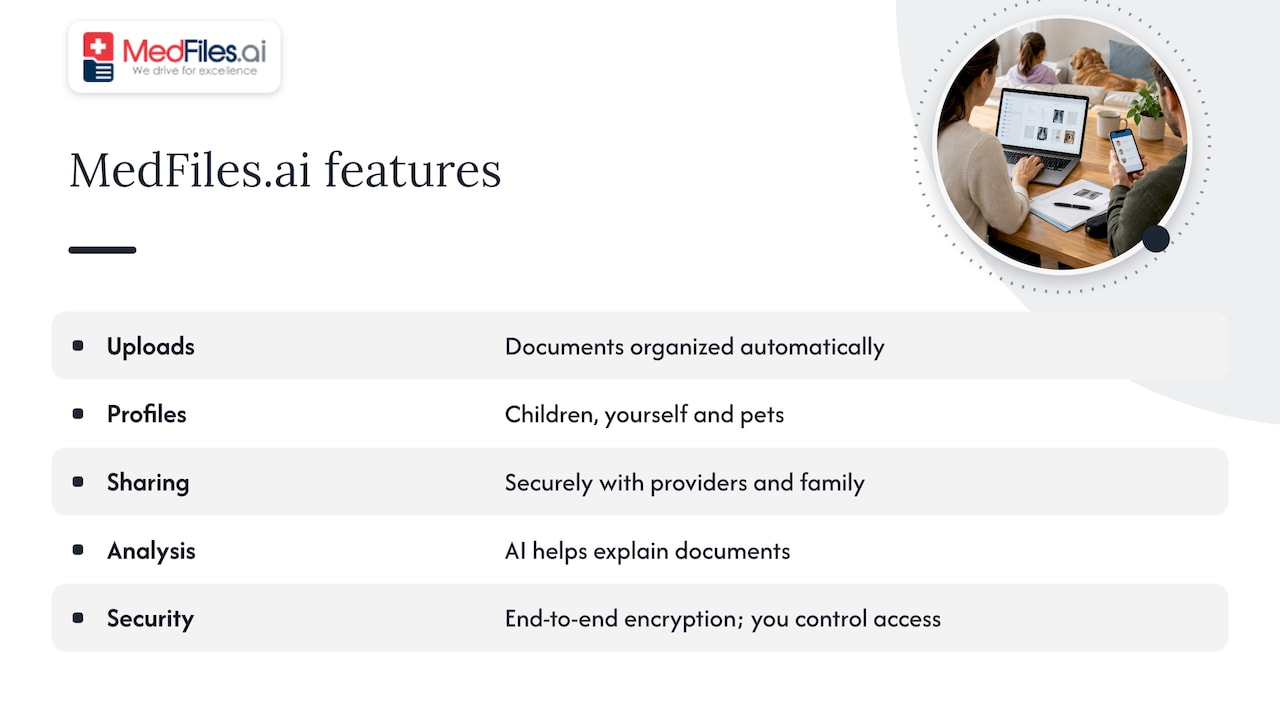
MedFiles.ai is a HIPAA-ready platform where you store, organize and access medical records digitally: test results, prescriptions, reports, images and other documents. Uploaded documents are organized automatically. You can manage several profiles, for each child, for yourself, even for pets. You can share securely with healthcare providers and family members. AI-powered analysis helps you understand what a document says, and WhatsApp alerts and a health overview dashboard, including preventive care gaps, keep you on top of what is due. Records are protected with end-to-end encryption, and you stay in control of who sees what. Details are on our security page.
For co-parents, that means the pediatrician’s after-visit summary, the vaccine record and the allergy note live in one place that can be shared, not in whoever’s inbox got it first. Healthcare professionals can receive organized records through the Doctor Center, which is useful when a new specialist needs the full history at the first visit.
What we think
Co-parenting is hard enough without a records scavenger hunt. We believe your child’s health history should belong to the family, stay complete and be there in seconds, at the pediatrician, the ER or the airport.
The law in most states already gives both parents a right to see the record. What families lack is a tidy, shared, secure place to keep it. We built multi-profile management, automatic organization and secure sharing so each parent can have the same clear picture without needing the other to hand it over.
Your entire medical history. In your pocket. Forever. For a child, that means a history that follows them from the first checkup through every move, every school and every custody schedule.
Team
Start your child’s shared record
Our plans start with a free trial that needs no credit card. Paid plans are billed per month: Understand Your Health is $2.99 per month, and Protect Everyone is $4.99 per month. See the pricing page to compare them, or read how family medical records in one place works. Create a profile for each child, upload what you have and share access securely with the people who need it.

FAQ
Can I see my child’s medical records if I don’t have custody?
Usually yes, but it depends on your state and your court order. Many states, including California, Arizona and Maryland, say a parent cannot be denied records only for lacking custody or physical custody. A court order that limits your access can change that, so check your decree.
Can the other parent block my access to the pediatrician’s portal?
A parent generally cannot override your legal right of access, but portals are often set up under one parent’s login. Ask the provider’s medical records office to add you as a parent or proxy, and send your custody order if they ask. OCR has said that improperly denying parents access can violate the Privacy Rule.
What if my teenager’s care is confidential?
Certain services, such as some mental health care, can be confidential under state law or an agreement with the provider. Under OCR’s guidance, that exception is generally limited to those services, so you can usually still see the rest of the chart. Our teen medical privacy guide explains the details.
How long does a provider have to give me the records?
Providers generally must respond to a written request within 30 days, with one possible 30-day extension, though some states set shorter limits. Fees must be reasonable, and HIPAA-covered providers cannot charge for searching for and retrieving records.
Should both parents keep their own copy of the records?
Yes. Each parent should be able to reach the full history without asking the other. A shared, secure digital file keeps the record complete and consistent for every appointment.
Sources
- HHS: Personal Representatives under HIPAA
- California Family Code § 3025
- Arizona Revised Statutes § 25-403.06
- Texas Family Code, conservator access to records
- Pennsylvania 23 Pa.C.S. § 5336
- Vermont 15 V.S.A. § 670
- Indiana Code § 16-39-1-7
- Maryland Family Law § 9-104
- Missouri Rev. Stat. § 452.375
- Oregon Instructions for Custody and Support
- HHS OCR letter on parental access to minors’ records, December 2025
- Pennsylvania Patient Safety Authority: Your Medical Records
- Health system HIPAA records request policy
- Shaw v. Shaw, Tennessee Court of Appeals
- Legal 500: Parental access to children’s health records
- HCCA: OCR enforcement on parental access