3 Portal Ready Documents That Prove Your College Vaccination Records
Learn the three documents colleges accept, exact file format and date rules to avoid portal rejection, plus tips for secure digital storage.

3 Portal Ready Documents That Prove Your College Vaccination Records
Submit an official immunization record, a state registry printout, or lab-confirmed titers through your college’s student health portal before the posted deadline. That’s the whole answer. Any of those three documents work, as long as dates are formatted correctly and your name and date of birth appear on the page. Check your portal now for the exact due date and file requirements, because holds go on fast once you miss it.
TL;DR:
- Most colleges accept immunization proof from a provider-signed certificate, state registry printout, or lab-confirmed titer, but requirements vary by vaccine and timing.
- Student health portals typically require exact date entries and supporting PDFs or JPEGs, with common rejection causes including blurry scans, missing info, or improper date formats.
- Missing deadlines usually result in registration holds and possible course drops, with some schools charging fees for reinstatement, so early submission is crucial.
- Blood titers can confirm immunity for MMR and varicella but may require vaccination and retesting if results are negative, and costs vary depending on insurance coverage.
- Maintaining a digital, organized records repository like Medfiles helps prevent delays and makes submitting vaccine proof faster and more secure.
Table of Contents
- Which Vaccines Do Colleges Actually Require?
- Where Do You Find Your Old Immunization Records?
- How Do You Submit Records Through the Student Portal?
- What Happens if You Miss the Deadline?
- Missing Records? Titers and Repeat Vaccination Can Fix It
- Why Digital Storage Prevents Portal Delays
- Put This on Your Move-In Checklist
- Keep Every Vaccination Record Ready Before Move-In
- Where to Verify Requirements and Find Your Records
- Sources
- FAQ
Which Vaccines Do Colleges Actually Require?
Most colleges build their list around five vaccines: MMR (measles, mumps, rubella), Tdap, meningococcal ACWY, varicella, and hepatitis B. Some programs add polio, seasonal influenza, or COVID-19, especially for nursing, dental, or other clinical majors that rotate through hospitals.
Timing matters as much as the vaccine itself. For MMR and varicella, campuses typically require two doses, with the first dose given on or after your first birthday and at least 28 days between shots, according to UCSD Student Health. Meningococcal ACWY usually needs a dose at or after age 16 for students living in residence halls. Miss that age cutoff and a booster is often required regardless of earlier doses.
On proof, colleges generally accept a provider-signed immunization certificate, a printout from your state’s immunization registry, or a lab-confirmed titer showing immunity, NC State’s HealthyPack program notes. Titers are widely accepted for MMR and varicella specifically. Fewer schools accept them for Tdap or meningococcal, since those depend on timed boosters rather than measurable antibody levels. Every campus sets its own fine print, so read your school’s actual policy instead of assuming it matches your friend’s school across the state.
Where Do You Find Your Old Immunization Records?
Start with your state’s Immunization Information System, or IIS. These state-run registries store vaccine records reported by pediatricians, pharmacies, and public health clinics going back decades in many cases. Florida residents can request records through the Florida Department of Health’s immunization program, and most other states run a similar portal. Search using your full legal name, date of birth, and the state where you actually received your childhood shots. Requesting the wrong state’s registry is one of the most common mistakes students make when they moved states growing up.
No luck there? Call your high school or previous college health center. Schools often retain immunization files for several years after a student leaves, though retention windows vary and some purge records faster than others. Your pediatrician’s office, family doctor, or even the pharmacy where you got a Tdap booster can pull records too. Most require a signed release-of-information form and a few business days to process the request.
If you or your family received vaccines through the military, request records through the relevant service branch’s health system. International students need certified translations for any non-English documentation. Duke Student Health advises starting with your provider or state registry first because original source records almost always process faster than reconstructed ones.
How Do You Submit Records Through the Student Portal?
Most portals follow the same basic flow: log in, enter each vaccine’s exact date, then upload supporting documentation. Every file needs your student ID and date of birth visible, either typed on the document or included in the filename.
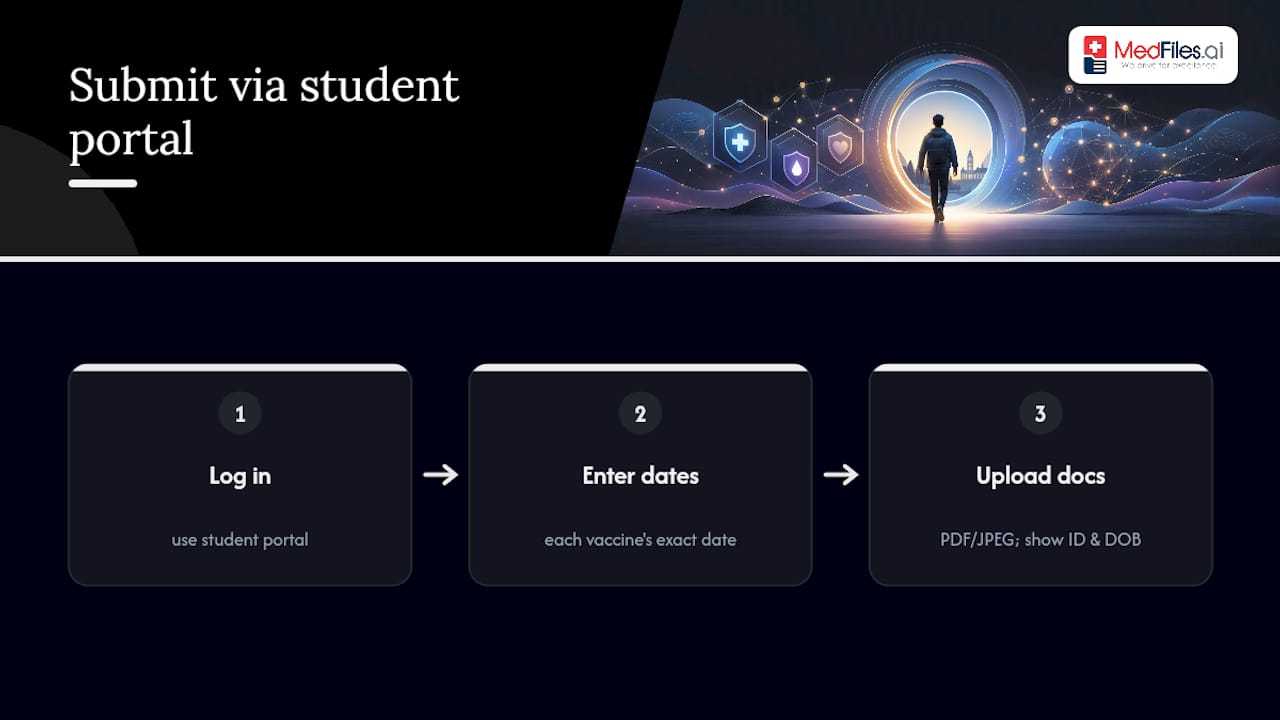
Stick to PDF or JPEG files. VCU Student Health recommends keeping files under 5 MB and scanning in color when the original record has stamps or seals that black-and-white scans blur. Non-English documents need certified translations attached alongside the original.
Rejections usually trace back to the same few issues: a blurry phone photo instead of a real scan, a missing student ID, or dates written in a format the system doesn’t recognize (stick to mo/day/year). If your upload keeps bouncing, email the immunizations office directly. Include your student ID, the vaccine in question, and a screenshot of the error message. That gets a resolution far faster than a vague “my upload isn’t working” message.
What Happens if You Miss the Deadline?
Colleges typically set deadlines either at admission or roughly 30 days before registration opens for your first term, and the consequences for missing them are real. A registration hold blocks you from signing up for classes, and in some cases, colleges may drop students from their course schedule for the term.
Reinstatement isn’t always free. Some institutions charge fees to lift a compliance hold, and while a handful of schools offer a short grace period, NC State’s HealthyPack policy shows that grace period is typically capped around 30 days before a hard hold kicks in.
If you’re going to miss the deadline, contact the immunizations office before it passes, not after. Provide proof of a scheduled vaccine appointment or documentation that you’re mid series. Many schools will grant temporary compliance status while you finish the requirement.
Missing Records? Titers and Repeat Vaccination Can Fix It
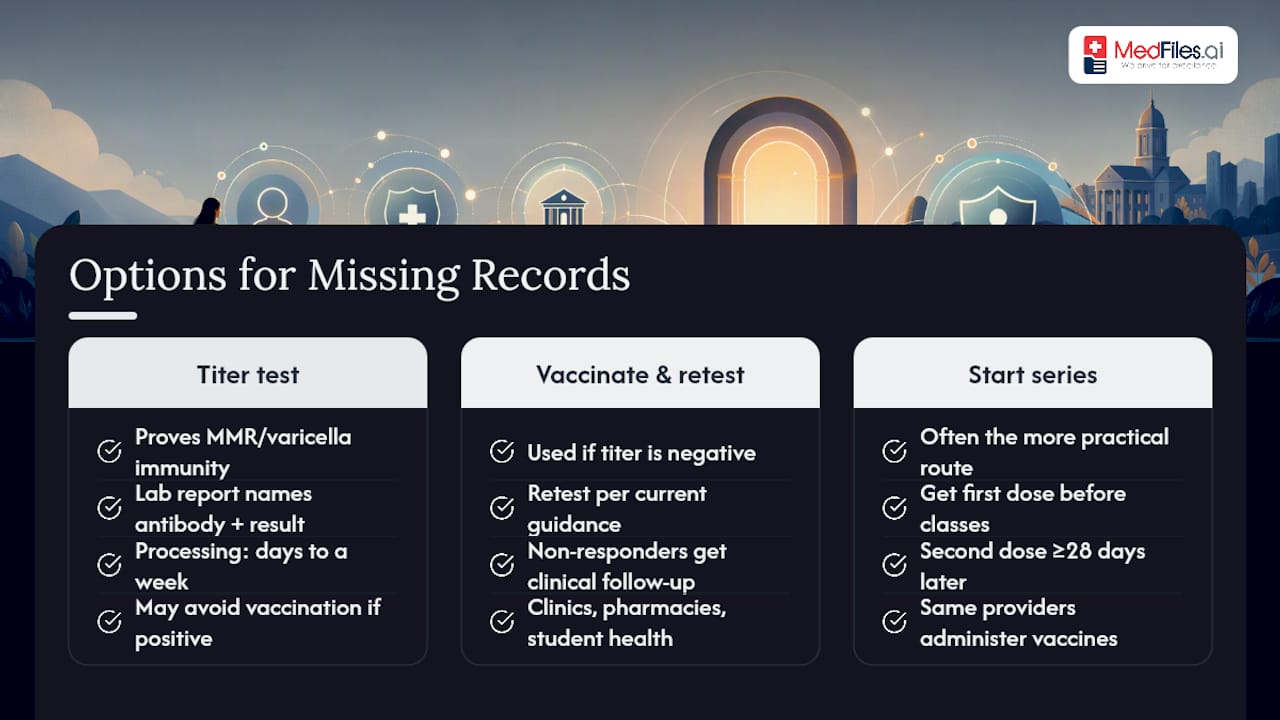
No paperwork doesn’t mean you’re out of options; a blood titer test measures existing antibodies and can prove immunity as explained in Titer Testing for Immigration Vaccines — What You Need to Know. A blood titer test measures existing antibodies and can prove immunity to MMR and varicella without needing the original vaccine record. Lab reports need to clearly state which antibody was tested and the result; processing usually takes a few days to a week depending on the lab.
If a titer comes back negative, the standard path is to get vaccinated and retest per current guidance rather than assume you’re protected. Occasionally a student tests negative even after a documented childhood series and gets classified as a non-responder, which usually means a referral for clinical follow-up.
Starting the vaccine series from scratch is often the more practical route anyway. Get your first dose before classes start, then schedule the second dose at least 28 days later for any two-dose vaccine. Student health centers, retail pharmacies, and urgent care clinics all administer these vaccines, usually within a day or two of scheduling. Check with your insurance first. Costs vary widely depending on whether the vaccine is billed as preventive care. One caution: a few states and schools don’t accept titers at all for certain vaccines, so verify your specific college’s policy before booking a lab test instead of just getting the shot.
Why Digital Storage Prevents Portal Delays
Most rejected uploads share the same root cause: a scan that’s missing your name, illegible, or saved in a format the portal won’t take. Keeping your records in one organized, secure place before move-in solves that problem before it starts.
A digital health record platform gives you:
- Portal-ready PDFs already formatted with your name and date of birth visible
- One place to store provider-signed forms so you’re not hunting through email attachments in August
- Secure sharing links you can send directly to student health services
- Encrypted storage that meets HIPAA-ready standards, rather than a folder of photos on your phone
Pro Tip: Export your vaccination record as a single-page PDF, and put your full name and date of birth both in the filename and on the page itself. Portals process clearly labeled files faster and reject them far less often.
Put This on Your Move-In Checklist
Treat your immunization record the same as your housing forms: due before you arrive, not after. Pulling records together early, and storing them somewhere organized like Medfiles, saves you from a last-minute scramble and a registration hold you didn’t see coming.
— Team
Keep Every Vaccination Record Ready Before Move-In
Medfiles gives you one place to store every vaccine record you’ll ever need for a school portal, a new doctor, or a last-minute travel requirement, so you’re never digging through old email attachments the week before classes start. Upload a provider-signed form once, and it stays organized, encrypted, and ready to export as a portal-ready PDF whenever a college asks for it again.
The platform supports managing multiple profiles under one account, useful if you’re managing records for family members or dependents. Secure sharing links let you send documents straight to student health services without emailing sensitive files back and forth, and the Doctor Center makes it simple for your pediatrician’s office to send records directly to your account. Start with the free plan to see how it works, then check the Understand Your Health and Protect Everyone plans, priced at $2.99 and $4.99 per month, for expanded storage and family profiles. Create your account today and get your first vaccination document uploaded before your next deadline.
Where to Verify Requirements and Find Your Records
For official guidance beyond your own campus, check the ACHA immunization recommendations for college students to see the vaccines public health experts recommend for campus settings. Search your own state’s health department site for its immunization registry, similar to Florida’s immunization program, to request childhood records. Your college’s own student health website will have the current forms and portal instructions specific to your enrollment term.
This article is general information, not a substitute for advice from a qualified doctor. Consult a qualified healthcare professional about your own circumstances before acting on anything here.
Sources
- Immunizations | NC State HealthyPack
- Health requirements | UCSD Student Health
- Immunization FAQ | Duke Student Health
- ACHA immunization recommendations for college students
FAQ
Where Can I Find My Immunization Records for College?
Start with your state’s Immunization Information System, then check with your pediatrician, previous school, or pharmacy if the registry comes up empty. Keep copies stored digitally through a service like Medfiles so you never have to search again for a future school or job requirement.
How Do I Find Out My Vaccination History If I Don’t Remember?
Your state IIS registry is usually the fastest option, since providers report vaccines directly to it at the time of the shot. If your state’s system doesn’t have records that far back, contact every provider you’ve used, including school nurses and pharmacies, since any of them may have administered a vaccine on record.
How Long Do Colleges Keep Immunization Records?
Retention periods vary significantly by institution and aren’t standardized across schools. Ask your previous college’s health services office directly rather than assuming records are still on file after several years.
Do Colleges Actually Check Vaccine Records?
Yes. Most colleges verify immunization documentation against required dose counts and dates before lifting a registration hold, and schools like UCSD and Duke run this through a dedicated student health portal rather than a manual review. Incomplete or illegible submissions get flagged and sent back, so accuracy on the first try matters.