Digital Record Storage Benefits for Medical Records in 2026
Discover the digital record storage benefits for medical records in 2026. Enjoy faster access, enhanced security, and reduced errors today!

Digital Record Storage Benefits for Medical Records in 2026
Digital record storage is defined as the practice of saving, organizing, and retrieving health information in electronic format rather than on paper. The digital record storage benefits for medical records are direct and measurable: faster access, stronger security, and fewer errors across every stage of care. Whether you manage records for yourself, your family, or a clinical practice, switching to electronic filing changes how quickly and safely health information reaches the people who need it. Platforms like Medfiles bring these advantages together in one place, giving you control over your medical history without the chaos of paper folders.
What are the core digital record storage benefits for medical records?
Digital retrieval is almost instantaneous, while physical document retrieval can take hours or even days. That gap matters most when a doctor needs your allergy history before prescribing a new medication, or when an emergency room needs your surgical records at 2:00 AM. A keyword search returns the right file in seconds. No filing cabinet, no phone calls, no waiting.
The advantages of digital storage go beyond speed. Electronic records are searchable, sortable, and shareable without making copies. You can pull up a lab result from three years ago as easily as one from last week. Paper records degrade, get lost in moves, and require physical presence to access. Digital files do not.

Digital health lockers consolidate medical data for entire families into one system, eliminating the need to manage separate physical folders for each person. That means your child’s vaccination records, your parent’s cardiology reports, and your own prescription history all live in one organized space. The practical time savings across a year of doctor visits and pharmacy trips add up quickly.
The benefits of electronic filing also include a permanent, organized archive. Records do not disappear in a house fire, a flood, or a move across the country. Your medical history stays intact and accessible wherever you are.
How does digital storage improve access and efficiency?
Speed is the most immediate gain, but the efficiency benefits run deeper than fast search.
- Instant retrieval: A keyword search finds any document in seconds, compared to hours or days for paper files.
- Centralized family records: One digital account holds test results, prescriptions, discharge summaries, and imaging reports for every family member.
- No physical presence required: Access your records from home, a hotel, or a clinic in another state.
- Reduced administrative delays: Providers spend less time chasing paper records and more time on clinical decisions.
- Offline access in low-connectivity areas: Advanced digital health apps allow access to prescriptions and medical documents without an internet connection, which matters in rural zones or areas with poor signal.
That last point surprises many people. A common misconception is that digital records require constant internet access. The best platforms store critical documents locally on your device so you can access them anywhere, anytime.
Pro Tip: Before choosing a digital storage platform, confirm it supports offline access. If you travel frequently or live in a rural area, offline availability is not optional. It is a core requirement.
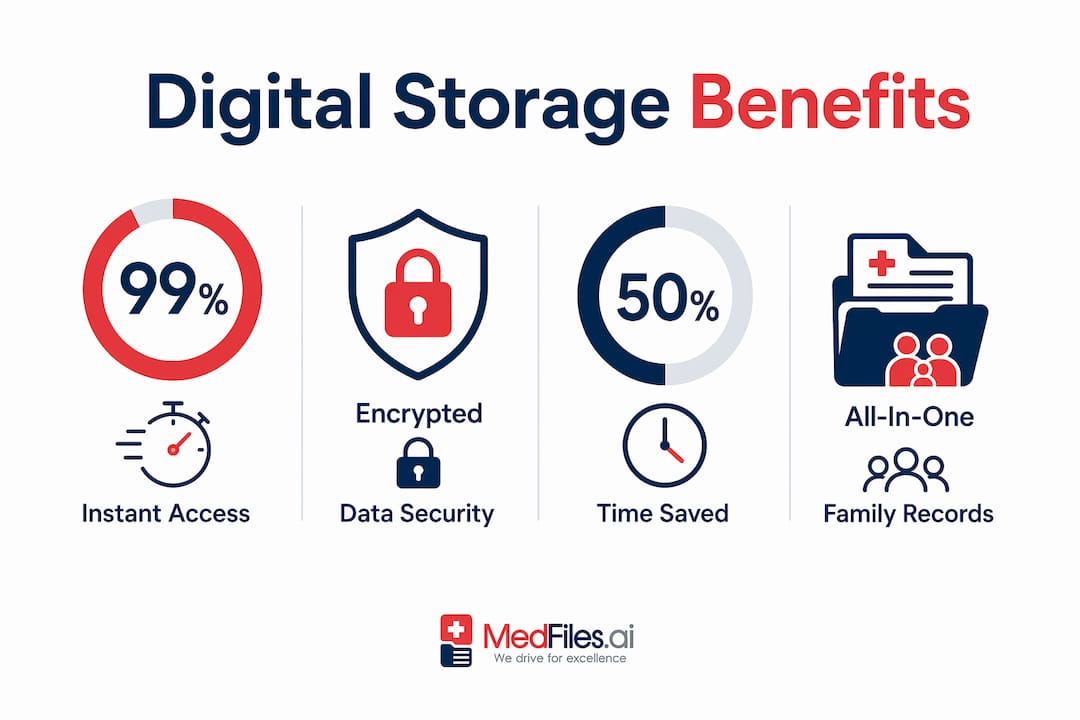
Efficiency also shows up in clinical settings. When a provider can pull your complete record instantly, the appointment focuses on your health rather than paperwork. Faster access to accurate information supports faster, safer decisions.
What security and compliance benefits come from digital medical record storage?
Security is where digital storage most clearly outperforms paper. Physical files can be stolen, copied without a trace, or destroyed in a disaster. Digital records protected by encryption and role-based access controls are far harder to compromise.
Digital systems provide audit trails, role-based permissions, and automated backup redundancies, building resilience that paper records cannot match. An audit trail logs every access event: who viewed a file, when, and from which device. That level of accountability is required under HIPAA and supports compliance in ways that a paper folder never can.
The secure digital storage benefits include:
- End-to-end encryption: Data is protected in transit and at rest, so unauthorized parties cannot read it even if they intercept it.
- Role-based access: You decide who sees which records. A specialist sees only what you share. Your primary care physician sees only what is relevant to your visit.
- Automated backups: Multiple redundant copies prevent data loss from hardware failure or cyberattack.
- Local, offline storage options: Some platforms store tokens and documents solely on your device, with no cloud syncing, giving you full data sovereignty.
“Digital transformation builds resilience unmatched by paper records. Audit trails and fine-grained access controls are vital for regulatory compliance and cannot be replicated with physical filing systems.” — Crown Records Management
Medfiles uses HIPAA-ready infrastructure with end-to-end encryption, giving you the security and privacy protections that health data demands. You control who accesses your records and when that access ends.
How do digital prescription storage benefits integrate with overall record management?
Digital prescription management is one of the most clinically significant components of a complete digital health record. Paper prescriptions introduce handwriting legibility errors, get lost, and carry no built-in safety checks.
Digital prescription management eliminates handwriting legibility issues and integrates allergy and medication history directly into the prescribing process. A structured digital format flags potential drug interactions and allergy conflicts before a prescription is filled. That single feature prevents a category of errors that paper systems cannot address.
Here is how to get the most from digital prescription storage:
- Start fresh with digital prescriptions. Scanning paper prescriptions does not provide full digital management benefits because scanned images lack the structured data needed for alerts and history tracking. Ask your provider to issue new prescriptions digitally from the start.
- Link prescriptions to your medication history. A complete digital record of every medication you have taken helps providers make safer decisions, especially during emergencies or when seeing a new specialist.
- Enable shared access for caregivers. If a family member manages your medications, grant them controlled access so they can coordinate refills and track dosage changes without relying on memory or paper notes.
- Review your prescription history regularly. A digital archive makes it easy to spot duplicate prescriptions, missed refills, or dosage changes that may have been overlooked.
Pro Tip: When uploading older paper prescriptions, add a manual note with the medication name, dosage, and prescribing date. This creates a searchable reference even when the image itself lacks structured data.
The digital prescription storage benefits extend to the pharmacy experience as well. Digital prescriptions reduce wait times, eliminate the risk of losing a paper script, and make refill requests faster for both you and your provider.
What practical advantages does digital health record storage offer for families and providers?
The cloud record storage benefits become most visible when you look at how families and healthcare providers actually use medical records across time.
Digital health records can be instantly shared with providers via interoperable platforms, facilitating faster and more accurate diagnoses. When you see a new specialist, sharing your complete history takes seconds instead of requiring you to remember every detail or carry a folder of paper documents. Independent pathology labs like EIV Diagnostics benefit directly from this model, receiving complete patient records before a consultation rather than working from incomplete verbal histories.
| Scenario | Paper records | Digital records |
|---|---|---|
| Emergency room visit | Staff call previous providers or work from memory | Complete history available instantly |
| New specialist appointment | Patient recalls history verbally | Full record shared securely before visit |
| Family member’s records | Separate folders, often incomplete | Centralized under one account |
| Travel or relocation | Records left at home or lost in transit | Accessible from any device, anywhere |
| Prescription refill | Paper script required at pharmacy | Digital prescription sent directly |
The family use case is particularly strong. A single digital account can hold records for children, parents, and even pets, organized by profile. When a pediatrician asks about your child’s vaccination history from two years ago, you find it in seconds rather than searching through a box of papers. That speed directly improves the quality of care your family receives.
Eliminating physical folders also removes a hidden burden. Carrying medical records to appointments, keeping them organized at home, and replacing lost documents all take time and energy. Digital storage removes that friction entirely. The benefits of managing family health digitally are most apparent in households managing chronic conditions, multiple providers, or members with complex medication histories.
Key takeaways
Digital record storage is the most effective way to protect, organize, and share medical information because it combines instant access, encryption, audit trails, and structured data in one system that paper cannot replicate.
| Point | Details |
|---|---|
| Instant access | Digital retrieval takes seconds; paper retrieval takes hours or days. |
| Family centralization | One digital account holds records for every family member in one organized place. |
| Security and compliance | Encryption, audit trails, and role-based access meet HIPAA standards that paper cannot. |
| Prescription safety | Structured digital prescriptions prevent errors by integrating allergy and medication history. |
| Offline availability | The best platforms allow access to records without internet in rural or low-signal areas. |
Why the paper-versus-digital debate is already settled
The question people ask me most often is whether digital records are really safer than paper. After years of working with health information management, my answer is unambiguous: yes, and it is not close.
Paper records feel tangible and controllable. That feeling is an illusion. A folder of lab results offers no encryption, no audit trail, and no backup. One house fire, one flood, one misplaced folder ends your medical history. Digital records stored with proper encryption and redundant backups survive all of those scenarios.
The privacy concern I hear most is about cloud storage. People worry that putting health data online makes it more vulnerable. The reality is that a well-designed platform with end-to-end encryption and local storage options is more private than a paper file sitting in a filing cabinet that anyone in your home can open. The key is choosing a platform that gives you control, not one that trades your data for convenience.
The adoption challenge is real but short-lived. The first two weeks of uploading records and learning a new system feel like extra work. After that, the time savings are immediate and compounding. Every appointment you attend without hunting for paper records, every prescription refill you manage without a phone call, every emergency where your history is instantly available: those moments make the initial effort irrelevant.
My honest recommendation is to start with your most critical records first. Upload your current medications, known allergies, and most recent lab results before anything else. Those three categories cover the majority of clinical decisions and deliver the most immediate safety benefit.
— Team
Medfiles makes digital medical record storage practical
Medfiles is built specifically for the way individuals and families actually use medical records: across multiple providers, over many years, and often in moments of stress or urgency.

With Medfiles, you get secure, organized medical document storage that keeps every test result, prescription, and report in one place. The platform uses HIPAA-ready infrastructure with end-to-end encryption, so your data stays private. You can manage separate profiles for every family member, share records directly with providers, and access your history from any device. When you need to share documents with a specialist or an emergency team, secure document sharing takes seconds. Your medical history should be available when you need it most. Medfiles makes that possible.
FAQ
What are the main digital record storage benefits for medical records?
Digital record storage provides instant access, stronger security through encryption and audit trails, and centralized organization for all health documents. These advantages directly reduce errors and improve care quality compared to paper filing.
Is digital medical record storage secure enough for sensitive health data?
Yes. Platforms using end-to-end encryption, role-based access controls, and HIPAA-ready infrastructure protect health data more effectively than physical files, which offer no encryption or access logging.
Can I access my digital medical records without an internet connection?
Advanced digital health platforms support offline access, storing documents locally on your device so you can retrieve prescriptions and records in rural areas or locations with poor connectivity.
What is the best way to start managing prescriptions digitally?
Ask your provider to issue new prescriptions in digital format rather than scanning existing paper scripts. Scanned images lack the structured data needed for drug interaction alerts and medication history tracking.
How does digital storage help families manage medical records?
A single digital account consolidates records for every family member, including children and elderly parents, making it easy to share complete histories with new providers and access information during emergencies.