Emergency Medical Access Workflow: A 2026 Guide
Discover how an effective emergency medical access workflow can enhance patient outcomes by speeding up critical information retrieval in 2026.

Emergency Medical Access Workflow: A 2026 Guide
An emergency medical access workflow is defined as the coordinated set of processes that enable healthcare teams and first responders to retrieve critical patient information and deploy medical resources within the shortest possible time. Speed and accuracy in this process directly determine patient outcomes. Up to 30% of healthcare spending is wasted on process inefficiencies like redundant paperwork and poor resource allocation. That figure represents a systemic failure with real consequences for patients in crisis. This guide walks you through the foundational components, step-by-step execution, common bottlenecks, and technology tools that make urgent care access faster and more reliable in 2026.
What are the key components of an emergency medical access workflow?
Every effective emergency medical access workflow rests on four foundational pillars: people, communication, data, and technology. Skipping any one of them creates gaps that surface at the worst possible moment.
Personnel roles and accountability
Role clarity is non-negotiable in emergency settings. Each team member must have a named function before an incident occurs, not during it. Emergency plans need specific, named role assignments and clear trigger points to maintain functionality despite personnel changes. Without named backups for every critical role, a single staff absence can stall the entire response. Personnel accountability procedures should target headcount completion in 10 minutes or less, per 2026 safety guidelines. That 10-minute benchmark is the difference between a controlled response and a chaotic one.
Communication systems
Communication is the connective tissue of any emergency response protocol. A single channel is never enough. Emergency response plans must rely on redundant communication channels because cellular and cloud systems frequently fail during major incidents. Redundancy means having radio backup, landline fallback, and a physical notification chain documented in writing.

Data access and technology tools
Responders need patient data immediately. The table below outlines the core tools and prerequisites for a functional urgent care access process.
| Component | Purpose | Standard or Tool |
|---|---|---|
| Electronic Health Records (EHR) | Centralized patient history access | HL7 FHIR interoperability standard |
| Digital Emergency ID | Instant patient data for first responders | Medfiles Digital Emergency ID |
| Incident Management Software | Coordination and documentation | ICS (Incident Command System) |
| Redundant Communication | Backup when primary channels fail | Radio, landline, mass notification |
| Secure Document Sharing | Real-time record transfer to care teams | HIPAA-ready encrypted platforms |
Medical record interoperability across these systems determines how fast a responder can act on accurate information. Without it, teams waste critical minutes chasing records across disconnected platforms.
How do you design a step-by-step emergency medical access workflow?
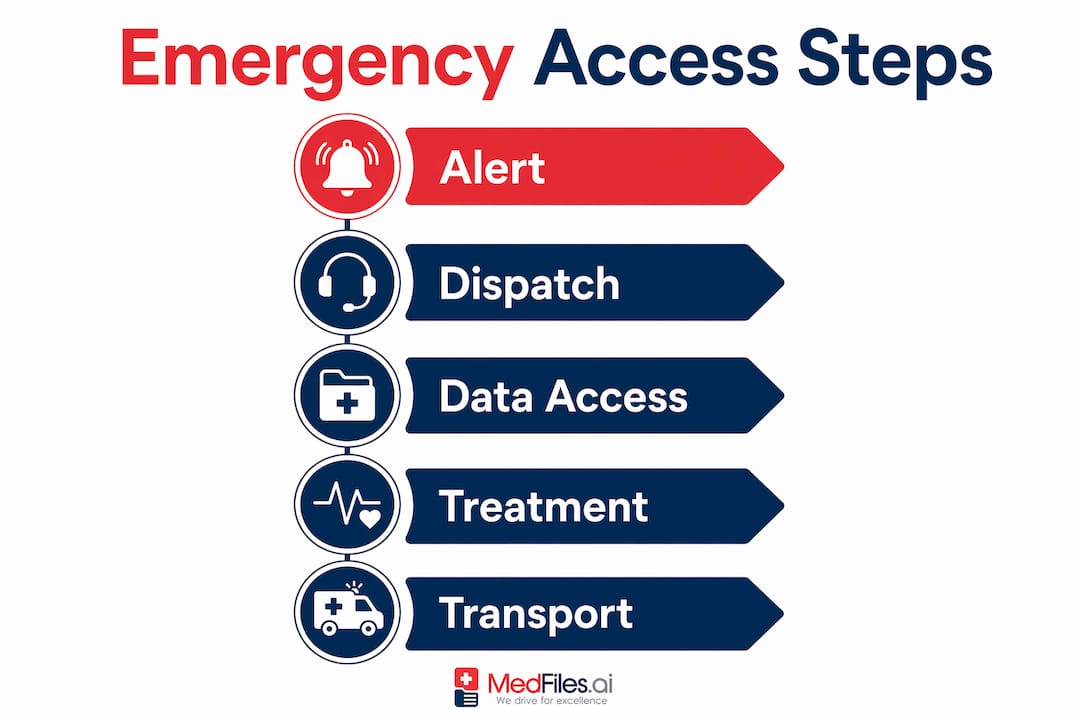
A structured workflow removes guesswork under pressure. The six phases below reflect current best practices for healthcare emergency procedures in 2026.
-
Incident detection and rapid assessment. The first responder or clinical staff member identifies the emergency and performs an immediate scene or patient assessment. Speed here sets the pace for every step that follows.
-
Emergency declaration and protocol activation. A designated authority officially declares the emergency and activates the relevant response protocol. Emergency plans must include specific trigger criteria and defined notification cascades to survive staff turnover and maintain clarity under pressure.
-
Coordinated notification and stakeholder communication. The notification cascade activates. This means alerting the on-call physician, charge nurse, hospital administrator, and any external agencies in a defined sequence. Every contact point must be documented in advance.
-
Medical access facilitation. This is the core of the workflow. Responders pull the patient’s medical history, allergies, current medications, and prior diagnoses. A digital emergency ID makes this step nearly instant, even when the patient is unconscious or unable to communicate.
-
Response management: triage, treatment, and documentation. The clinical team triages based on retrieved data, initiates treatment, and documents every intervention in real time. Accurate documentation at this stage protects both the patient and the provider.
-
Stabilization, recovery, and debrief. Once the patient is stable, the team conducts a structured debrief. This review identifies what slowed the workflow and what worked well. Debrief findings feed directly into the next revision of the protocol.
Pro Tip: Record the exact timestamps for each phase during drills. Comparing drill times against real incident times reveals where your workflow loses speed under actual pressure.
What are the common bottlenecks in emergency medical access workflows?
Knowing where workflows break down is as valuable as knowing how to build them. Three bottlenecks appear consistently across healthcare settings.
Inefficient case assignment and workload imbalance
Inefficient case assignment in emergency workflows causes 17.7-minute delays for expedited cases, costing $2.1M–$4.2M across hospitals. That delay is not a minor inconvenience. In time-sensitive emergencies, 17 minutes can determine whether a patient survives a cardiac event or a stroke.
Workload imbalance compounds the problem. When one specialist is overloaded while another sits idle, the system fails the patient. Structured case-routing protocols, reviewed regularly, prevent this from becoming a default pattern.
Communication failures during peak load
Communication systems that work fine during routine operations often collapse under emergency peak load. Staff resort to informal workarounds: text messages, personal cell phones, verbal relay chains. Staff create informal “shadow workflows” to bypass broken digital systems in emergencies. Documenting these shadow workflows reveals exactly where the official system fails. That documentation is the starting point for a real fix.
Pro Tip: Run a quarterly “communication stress test” by simulating a primary system outage during a drill. You will quickly learn which backup channels your team actually trusts.
Staff burnout and workflow workarounds
Workflow analysis reveals actual operational reality, exposing root causes of clinician burnout and inefficient workarounds. Burnout is not just a human resources problem. It directly degrades workflow reliability because exhausted staff skip documentation steps, miss handoff details, and default to workarounds that bypass safety checks. Regular workflow analysis, not just annual reviews, catches these patterns before they become crises.
The table below maps the most common bottlenecks to practical solutions.
| Bottleneck | Impact | Solution |
|---|---|---|
| Inefficient case assignment | 17.7-minute delays per expedited case | AI-assisted case routing by specialist availability |
| Communication system failure | Missed notifications, delayed response | Redundant channels: radio, landline, mass alert |
| Staff burnout and workarounds | Documentation gaps, safety risks | Regular workflow analysis and workload balancing |
| Outdated patient data | Wrong treatment decisions | Real-time EHR access and digital emergency IDs |
| No defined trigger criteria | Delayed protocol activation | Named triggers and written notification cascades |
How can technology improve emergency medical access workflow efficiency?
Technology works in emergency settings only when it fits the way clinical teams actually operate. Technology must align with emergency medical teamwork rather than disrupt it to be effective. The tools below meet that standard.
-
AI-assisted case routing. AI agents can orchestrate complex clinical workflows by matching cases to specialists based on availability, expertise, and current workload. This removes the manual bottleneck of case assignment without disrupting team collaboration.
-
Digital medical IDs. A digital emergency ID gives first responders instant access to a patient’s allergies, medications, blood type, and emergency contacts. This is especially critical when the patient cannot communicate. Medfiles provides this as a core feature within its HIPAA-ready platform.
-
Secure document sharing platforms. Secure medical document sharing allows care teams to transfer records between facilities, specialists, and emergency departments in real time. End-to-end encryption protects patient privacy while maintaining speed.
-
Cloud-based and mobile tools. Mobile access to records keeps the workflow functional even when on-site infrastructure fails. Cloud storage with offline sync capability means a responder can pull a patient’s history from a phone in the field.
-
AI-powered document analysis. AI for medical documents can surface relevant clinical history from large record sets in seconds. This reduces the time a clinician spends searching and increases the time spent treating.
-
Continuous workflow analytics. Active workflow optimization uses real data and clinician feedback rather than static EHR settings to reduce clinician burden. Analytics dashboards that track response times by phase make it possible to identify and fix slow points before the next incident.
Emergency communication systems that integrate with these digital tools create a unified response environment where every team member has the right information at the right time.
Key Takeaways
A well-designed emergency medical access workflow reduces delays, protects patients, and cuts the financial cost of inefficient care delivery across every phase of response.
| Point | Details |
|---|---|
| Define roles before incidents occur | Named assignments and written trigger criteria prevent confusion during active emergencies. |
| Build redundant communication | Cellular and cloud systems fail under peak load; radio and landline backups are non-negotiable. |
| Use digital patient IDs | Instant access to allergies, medications, and history removes the most common data bottleneck. |
| Document shadow workflows | Staff workarounds reveal where official systems break down and where redesign is needed. |
| Apply continuous analysis | Regular workflow reviews using real data and clinician feedback outperform annual protocol updates. |
Why static protocols fail the teams who need them most
The most persistent mistake I see in emergency workflow design is treating the protocol as a finished product. Teams spend months building a detailed emergency response plan, file it, and then revisit it only after something goes wrong. That approach guarantees the plan will be outdated the moment it matters most.
The evidence backs this up. Continuous workflow optimization rooted in real data and clinician experience improves emergency care delivery significantly over static protocols. The word “continuous” is doing the heavy lifting in that sentence. It means monthly reviews, not annual ones. It means asking frontline staff what they actually do during an incident, not what the protocol says they should do.
The shadow workflow concept is where I find the most honest information. When you ask a nurse what she does when the EHR goes down during a code, her answer reveals more about your system’s weaknesses than any audit ever will. Documenting those informal workarounds is not an admission of failure. It is the most accurate map of your real workflow you will ever produce.
Technology adoption follows the same logic. The best tools are the ones your team will actually use under pressure. A platform that requires three logins and two-factor authentication during a cardiac arrest is not a solution. It is an obstacle. Fit the technology to the workflow, not the other way around.
— Team
How Medfiles supports your emergency access needs
When seconds matter, your medical records need to be ready before the emergency happens. Medfiles stores your complete medical history in a HIPAA-ready, encrypted platform that you can access from any device, anywhere.

Organized medical document storage means your records are never buried in a folder or lost in a file cabinet. Medfiles automatically organizes uploaded documents, supports multi-profile management for families, and enables secure document sharing with care teams in real time. The platform’s AI-powered analysis surfaces the right records at the right moment, so your providers spend less time searching and more time treating. Whether you are a healthcare professional building a first responder access system or an individual preparing for the unexpected, Medfiles gives you control over your health data when it counts most.
FAQ
What is an emergency medical access workflow?
An emergency medical access workflow is a structured set of coordinated steps that enable healthcare teams and first responders to retrieve patient data and deploy medical resources quickly during an emergency. It covers everything from incident detection to post-incident debrief.
How long should personnel accountability take in an emergency?
Personnel accountability procedures should target headcount completion in 10 minutes or less, per 2026 safety guidelines. Exceeding that window increases the risk of delayed treatment and uncoordinated response.
Why do communication systems fail during emergencies?
Cellular and cloud systems frequently fail during major incidents due to peak load and infrastructure damage. Emergency response protocols must include redundant channels such as radio and landline to maintain coordination when primary systems go down.
How does AI improve emergency medical workflows?
AI agents match cases to available specialists based on workload and expertise, removing the manual bottleneck of case assignment. This approach has been shown to reduce expedited case delays that cost hospitals millions of dollars annually.
What is a shadow workflow and why does it matter?
A shadow workflow is an informal process that staff create to bypass broken or slow official systems during emergencies. Documenting these workarounds reveals the real weak points in your workflow and provides the clearest starting point for meaningful redesign.