LinkedIn.com Alternatives for Healthcare-Minded Professionals
Explore the best linkedin.com alternatives tailored to healthcare professionals. Discover niche job boards, portfolio sites, and local networks that cut...

LinkedIn.com Alternatives for Healthcare-Minded Professionals
The best LinkedIn.com alternatives depend entirely on your goal. For job searching, try niche job boards and industry-specific networks. For showcasing work, portfolio platforms and developer hubs win. For local referrals and community, trust-based local business networks deliver a stronger signal. And if you searched this phrase because you need a secure place to store your family’s medical records rather than a professional profile, Medfiles is the HIPAA-ready answer. LinkedIn reports over 1 billion members across 200+ countries, which means the noise level is enormous. Niche platforms cut through it.
Quick shortlist by goal:
- Job search: Indeed, Glassdoor
- Portfolio and creative work: Behance, Dribbble
- Developer and open-source work: GitHub
- Healthcare professionals: Doximity
- Local business referrals: Alignable
- Events and in-person networking: Meetup
- Startup and investor connections: AngelList / Wellfound
- Community and general social: Facebook Groups
- Secure medical record storage: Medfiles
Table of Contents
- Which LinkedIn alternative fits your goal?
- What each platform category actually does for you
- How to choose the right platform for your specific goals
- What privacy and security features to check before you join
- Practical steps to expand your presence without losing control of private data
- If you actually need secure medical-record storage, not a professional network
- What makes each alternative genuinely different from LinkedIn
- How these platforms connect with your existing tools
- What the user experience actually looks like across alternatives
- Key Takeaways
- Why niche platforms matter more than most people realize
- Your medical records deserve better than a networking platform
- Useful sources
Which LinkedIn alternative fits your goal?
Different goals call for different platform types. The table below maps your primary purpose to the category that serves it best.
| Best For | Primary Purpose | Cost Model | Privacy & Security | Profile & Portfolio | Mobile Usability | Recruiter Discoverability |
|---|---|---|---|---|---|---|
| Job seekers (broad) | Job board | Free / paid upgrades | Standard data policies | Resume upload | Strong | High |
| Creatives and designers | Portfolio network | Free / paid tiers | Moderate; public by default | Rich visual portfolio | Good | Moderate |
| Developers | Code hosting and collaboration | Free / paid plans | Public repos; private options | Work samples via code | Good | High via public activity |
| Healthcare professionals | Verified clinical network | Free / subscription | Verification-gated; HIPAA-aware | Clinical credentials | Good | Specialty-specific |
| Local small businesses | Trust-based referral network | Free / paid | Moderated; spam-reduction policies | Business profile | Moderate | Local/regional |
| Event-driven networking | In-person and virtual events | Free / paid | Standard | Minimal | Strong | Low |
| Startups and investors | Fundraising and hiring | Free / paid | Standard | Startup profile | Moderate | Startup-focused |
| Secure medical records | Document storage and sharing | Subscription | HIPAA-ready, end-to-end encrypted | Health records only | Strong | N/A |
Categories with stronger privacy controls, such as verified healthcare networks and HIPAA-ready storage platforms, are the safer choice for anyone handling health-adjacent content or sensitive personal data.
What each platform category actually does for you
Understanding what each category is built for saves you from joining the wrong one.

Job boards: Indeed and Glassdoor
Job boards like Indeed and Glassdoor serve wide-reach hiring. Glassdoor adds company reviews and salary data, which gives you leverage before an interview. Neither replaces a professional network, but both surface roles that LinkedIn’s algorithm may bury. Recruiters use job boards for volume hiring and niche networks for specialized roles.
- Pros: Large listing volume; free to apply; salary transparency (Glassdoor)
- Cons: High competition per listing; limited relationship-building
Portfolio platforms: Behance and Dribbble
Behance (Adobe’s platform) and Dribbble serve designers, illustrators, and creative professionals. Recruiters find candidates through demonstrated work samples rather than keyword-matched profiles. Public by default, so privacy controls are limited.
- Pros: Work speaks for itself; strong recruiter discovery
- Cons: Public exposure; not suited for sensitive personal data
Developer hub: GitHub
GitHub is where code is the resume. Open-source contributions, commit history, and project quality signal competence directly to technical recruiters. Free for public repositories; private repos available on paid plans.
- Pros: Objective, verifiable work history; global recruiter reach
- Cons: Only relevant for technical roles; public activity is visible
Healthcare professional network: Doximity
Doximity is the largest verified network for U.S. physicians and clinicians. Membership requires credential verification, which keeps the community tight and reduces spam. It is not a general-purpose network.
- Pros: Verified peers; HIPAA-aware messaging; clinical focus
- Cons: U.S.-only; limited to licensed healthcare professionals
Local business network: Alignable
Alignable is built for small business owners who want local referrals. Its intentional moderation policies reduce cold solicitation and keep conversations productive. Strong in North America; less established internationally.
- Pros: Trust-based referrals; low spam
- Cons: Smaller global reach; less useful for job seekers
Event and community platforms: Meetup and Facebook Groups
Meetup organizes in-person and virtual professional events. Facebook Groups offer broad community reach across virtually every industry. Both are discovery tools, not profile-hosting platforms.
- Pros: Face-to-face relationship quality; free to join
- Cons: Minimal professional credentialing; Facebook privacy concerns
Startup and investor network: AngelList / Wellfound
Wellfound (formerly AngelList Talent) connects job seekers with startup roles and investors with founders. Salary and equity are often listed upfront, which saves negotiation time.
- Pros: Startup-specific roles; transparent compensation
- Cons: Niche audience; less useful outside the startup world
How to choose the right platform for your specific goals
Niche platforms give job seekers stronger alignment with specific industries and can surface opportunities that general networks miss. Start by answering three questions: What is your primary goal? Who is your target audience? How much public exposure are you comfortable with?
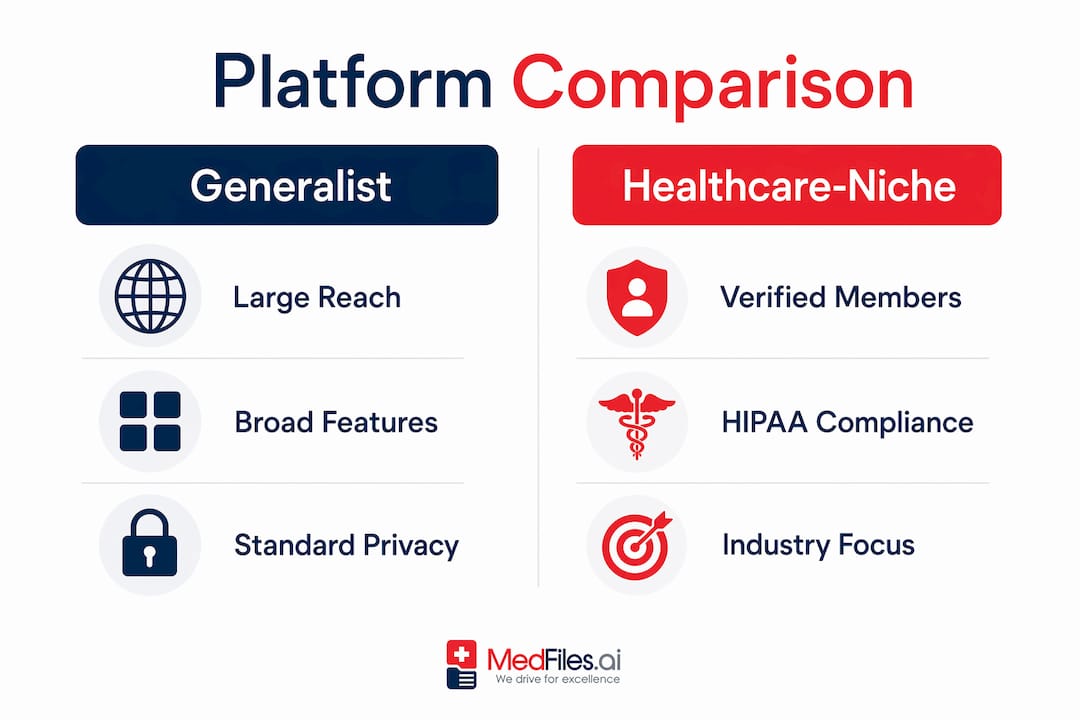
If your goal is job searching, add at least one niche or industry-specific board alongside a general job board. If your goal is portfolio visibility, pick the platform where your target clients or recruiters already spend time. If your goal is local referrals, a moderated community network beats a global one every time. For healthcare professionals, a verified clinical network protects your reputation and your patients’ privacy simultaneously.
Ask yourself: Does this platform verify its members? Can I control what is public? Does it integrate with my existing workflow? Those three questions eliminate most poor fits quickly.
Pro Tip: If you work in healthcare or handle any health-related information, choose platforms that explicitly state their data policies. Avoid uploading anything that touches patient data or personal health history to a public professional profile.
What privacy and security features to check before you join
Before you create a profile on any platform, check these controls:
| Security Control | Why It Matters for Health-Adjacent Users |
|---|---|
| Encryption in transit (TLS) | Protects data as it moves between your device and the platform |
| Encryption at rest | Keeps stored data unreadable if servers are breached |
| Data portability | Lets you export and delete your data if you leave |
| Two-factor authentication | Blocks unauthorized account access |
| Breach notification policy | Tells you how fast the platform will alert you after an incident |
| HIPAA compliance | Required for any platform storing actual medical records |
Niche sites intentionally design policies to prioritize genuine introductions over cold solicitation, which reduces the risk of your contact data being harvested and resold.
Statistic: Approximately 90% of business cards exchanged at conferences never lead to a follow-up interaction. Automated contact capture tools close that gap and reduce the risk of sensitive contact details being lost or mishandled.
Practical steps to expand your presence without losing control of private data
Follow this sequence when testing new platforms:
- Audit your existing profile. List every piece of information currently public on LinkedIn. Decide what genuinely needs to be public versus what you shared by default.
- Decide which assets to publish. Resume, portfolio links, and professional credentials are fair game. Personal health history, family details, and medical documents are not.
- Configure privacy settings first. Before you add any content, set your visibility, contact, and data-sharing preferences. Do not accept defaults.
- Export and import public assets. Download your LinkedIn data export (Settings > Data Privacy > Get a copy of your data), then adapt your resume and summary for each new platform’s format.
- Monitor recruiter visibility. After 30 days on a new platform, check whether your profile appears in relevant searches. Adjust keywords and settings based on what you find.
Pro Tip: Use a dedicated professional email address for networking platforms. Keep your personal or family email separate to reduce spam and protect your household’s contact data.
Pro Tip: Track outreach across platforms in a simple spreadsheet or a contact management tool. Note where each connection originated so you can measure which platform actually delivers results for your goals.
If you actually need secure medical-record storage, not a professional network
Professional networking platforms and secure medical-record storage solve completely different problems. A LinkedIn alternative helps you find jobs or clients. A medical-record platform helps you store, organize, and share your health documents safely.
If you or your family need the latter, the features that matter are: HIPAA-ready infrastructure, end-to-end encryption, family and multi-profile management, and secure sharing with healthcare providers.
Common use cases where a dedicated medical-record solution matters:
- Emergency access: Your records are available instantly, even when you cannot speak for yourself.
- Travel: Carry your complete health history without paper documents.
- Caregiver coordination: Share a parent’s or child’s records with multiple providers without faxing.
- New provider onboarding: Send a complete record summary before a first appointment.
Medfiles is built for exactly these situations. Key capabilities include:
- HIPAA-ready infrastructure with end-to-end encryption
- AI-powered document organization and analysis
- Multi-profile management for your whole family, including pets
- Secure sharing with healthcare providers and family members
- WhatsApp alerts and health overview dashboards
- Instant access during emergencies or travel
Networking platforms were not designed to handle medical documents. Uploading lab results or prescriptions to a public profile creates real privacy risk. Keep your healthcare data in a platform built to protect it.
What makes each alternative genuinely different from LinkedIn
LinkedIn is a generalist platform. Its strength is scale; its weakness is noise. Each alternative trades breadth for depth in a specific area.
GitHub replaces the resume with a live, verifiable record of what you have actually built. No endorsements needed. Behance and Dribbble do the same for visual work. Doximity adds credential verification that LinkedIn cannot replicate for clinical roles. Alignable replaces cold outreach with warm, community-moderated introductions. Wellfound puts compensation transparency front and center, which LinkedIn still avoids. Meetup converts online discovery into face-to-face relationships, which professional networking tools consistently show produce stronger long-term connections than digital-only exchanges.
The pattern is consistent: platforms categorized by use case outperform general networks for the specific task they were designed for.
How these platforms connect with your existing tools
Integration capability varies widely across platform types.
Job boards (Indeed, Glassdoor) integrate with most applicant tracking systems. Recruiters using tools like Greenhouse or Lever can pull applications directly. GitHub connects natively with project management tools like Jira and deployment platforms like Vercel. Behance links to Adobe Creative Cloud, which matters if your workflow lives in Photoshop or Illustrator. Doximity integrates with electronic health record systems for clinical messaging. Alignable focuses on its own community ecosystem with limited third-party integrations. Wellfound connects with common startup hiring stacks.
For contact management across all platforms, tools that capture and sync contacts automatically, such as digital business card platforms with CRM connectors, help convert scattered connections into organized relationships.
What the user experience actually looks like across alternatives
Interface quality varies as much as feature sets.
Indeed and Glassdoor are clean and fast. Search is the core action, and both do it well on mobile. GitHub has a steeper learning curve for non-developers but is highly functional once you know it. Behance is visually rich and well-suited to browsing on a tablet or desktop. Dribbble is similarly polished, with a strong mobile experience. Doximity feels clinical and efficient, which fits its audience. Alignable is straightforward but less refined than the larger platforms. Meetup is easy to navigate and strong on mobile for event discovery. Wellfound is clean and startup-friendly, with salary and equity data surfaced prominently.
None of these platforms match LinkedIn’s raw feature depth, but most are faster and less cluttered for their specific use case.
Key Takeaways
Niche platforms consistently outperform general networks when your goal is specific: the right category of alternative delivers better results than a second general-purpose profile.
| Point | Details |
|---|---|
| Match platform to goal | Job boards for volume search, portfolio sites for creative work, developer hubs for technical roles, verified networks for healthcare. |
| Privacy checks first | Confirm encryption, data portability, two-factor authentication, and breach notification before you create any profile. |
| Migrate carefully | Export your LinkedIn data, publish only professional assets publicly, and keep health or personal documents off all networking platforms. |
| Niche beats general | Niche job-seeking platforms surface roles and connections that broad networks miss, especially for specialized industries. |
| Medfiles for health records | If you need secure medical-record storage, Medfiles offers HIPAA-ready infrastructure, end-to-end encryption, and family multi-profile management. |
Why niche platforms matter more than most people realize
The conventional wisdom says you need to be on LinkedIn because everyone else is. That logic made sense a decade ago. It makes less sense now. A platform with over a billion members is not a network — it is a directory with a messaging feature bolted on.
Niche platforms force a different kind of interaction. When a community is built around a specific industry or use case, the conversations are more relevant, the introductions carry more weight, and the moderation keeps noise low. For healthcare professionals especially, a verified clinical network protects your reputation in ways a general platform simply cannot.
The tradeoff is real: smaller reach, but far higher quality per connection. For most professionals, that is the better deal. One warm introduction from a trusted local network outperforms fifty cold connection requests from a global one.
Your medical records deserve better than a networking platform
If you landed here because you need a secure way to store and share your family’s health documents, professional networking platforms are the wrong tool entirely.
Medfiles gives individuals and families a HIPAA-ready home for their complete medical history. Every document you upload, from lab results to prescriptions to imaging reports, is protected with end-to-end encryption and organized automatically with AI. You can manage profiles for your entire family, share records securely with any provider, and access everything instantly in an emergency. No paper. No fax. No scrambling.
Start with a free trial, no credit card required. Visit Medfiles medical document storage to create your account and see how simple secure health record management can be.
Useful sources
| Source | What It Covers |
|---|---|
| Best Sites Like LinkedIn for Smarter Hiring | Platform categories, recruiter use cases, and discoverability by platform type |
| Job Networking Alternatives to LinkedIn | Niche and location-based networks for job seekers |
| Best Professional Networking Tools for Busy Executives | Contact capture, relationship analytics, and event-driven networking tools |
| Alignable Business Networking Platform | Local trust-based networking, moderation policies, and spam reduction |
| LinkedIn Alternatives for Professional Networking | Event platforms, Meetup, and in-person networking as discovery channels |
| LinkedIn People Directory Overview | How LinkedIn search and third-party directories work for profile discovery |
| Medfiles Security & Privacy | HIPAA-ready infrastructure, encryption standards, and data security for medical records |