Personal Health Record App Cost: Subscription & Build Prices
Discover the costs of personal health record apps and custom builds. Learn about subscription prices and budgeting for your health management needs.

Personal Health Record App Cost: Subscription & Build Prices
Most people pay somewhere between $0 and $80 a year for a personal health record app, with premium tiers landing near $69.99 to $79.99 annually. If you’re weighing whether to build one instead, budget a realistic range from the low tens of thousands for a bare prototype to roughly $450,000 for a full-fledged service, according to an academic cost model built specifically for personal health record (PHR) infrastructure.
You’ll generally choose one of three paths: subscribe to an existing PHR app, use a free app and pay only for specific features, or commission a custom build. Each path has a very different cost shape.
Here’s your quick reference before we break down the details:
- What to expect to pay monthly: $0 (free tier) to $4.99-$7.99 for individual premium plans.
- What to expect to pay annually: $29.99-$79.99 for most consumer apps, often discounted 30-50% off the monthly rate.
- What to budget to build: $15,000-$50,000 for a prototype, $80,000-$180,000 for an MVP, and up to $450,000 for a full HIPAA-ready product.
Key Takeaways
Consumer personal health record apps typically cost $0 to $80 a year, while a custom-built HIPAA-ready product can run from $15,000 for a prototype to $450,000 for a full service.
| Point | Details |
|---|---|
| Subscription range | Most consumer PHR apps charge $0 to $79.99 a year, with annual plans discounted 30-50% off monthly rates. |
| Build cost baseline | The PMC cost model estimates roughly $450,000 for a full-fledged PHR service including infrastructure and compliance. |
| Price drivers | Storage limits, AI analysis, multi-profile support, and HIPAA compliance work push subscription and build costs higher. |
| Ongoing costs matter | Hosting, BAAs, security audits, and support create recurring costs that shape per-user pricing long after launch. |
| Medfiles approach | Medfiles bundles HIPAA-ready infrastructure, encryption, and AI analysis into its subscription tiers with a free trial to start. |
Table of Contents
- How Much Does a Personal Health Record App Cost Each Month?
- What Do Real Personal Health Record Apps Actually Charge?
- What Makes One Health Record App Cost More Than Another?
- How Much Does It Cost To Build a Personal Health Record App?
- What Costs Keep Running After the App Launches?
- How Do You Estimate Your Own Total Cost?
- How Does MedFiles.ai Structure Its Pricing?
- When Should You Subscribe Instead of Build?
- Try Medfiles Before You Budget for a Build
- Research and Benchmarks Behind This Guide
- Frequently Asked Questions
- Sources
How Much Does a Personal Health Record App Cost Each Month?
Personal health record apps don’t use one pricing model. You’ll run into six or seven different structures, sometimes stacked on top of each other, and knowing which one you’re looking at tells you what you’re actually buying.
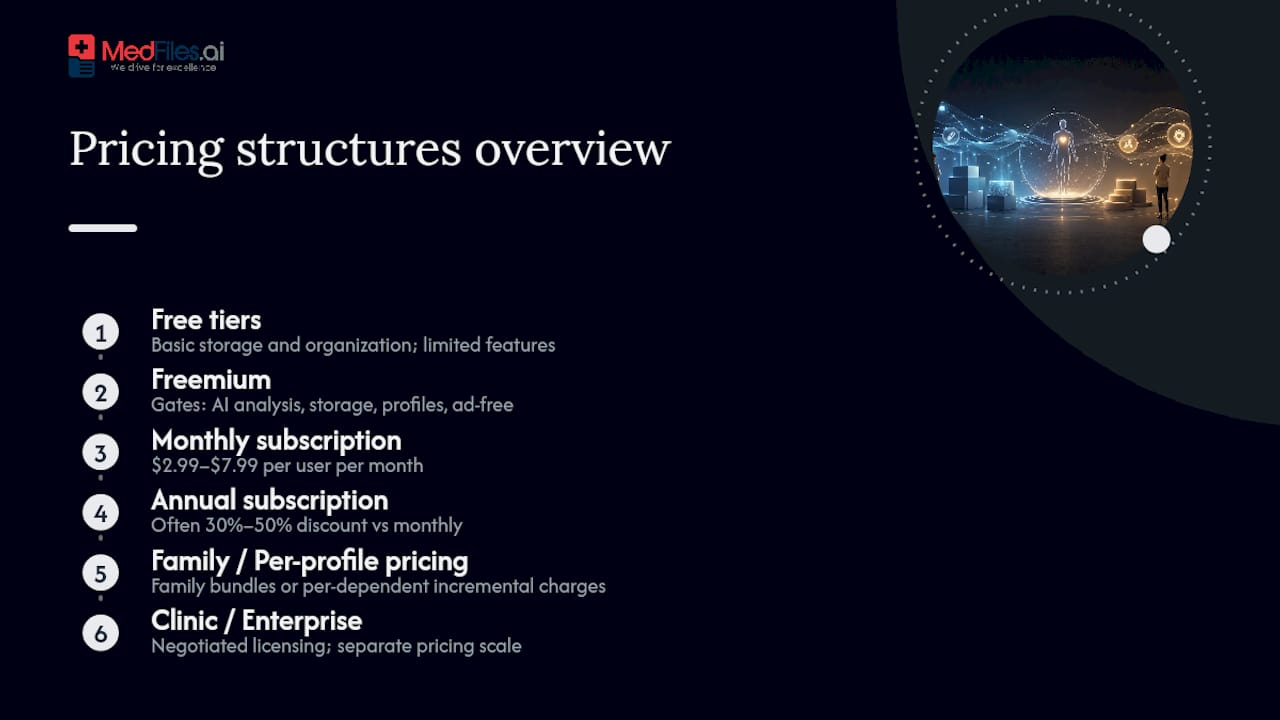
Free tiers exist almost everywhere, but they rarely include everything you need. Freemium is the dominant model: core storage and organization stay free, while AI analysis, cloud sync, or multi-provider sharing sit behind a paywall. Monthly subscriptions typically run $2.99 to $7.99 for individual plans. Annual subscriptions offer a discount, often 30% to 50% cheaper than paying month to month, which is why most subscription apps report annual plans as their best per-user value. Family or household plans cover multiple profiles under one price instead of charging per person. Per-profile pricing charges incrementally as you add dependents, which adds up fast for larger families. Clinic or enterprise licensing operates on a completely separate scale, often negotiated directly rather than published.
Paywalls typically gate one of four things: AI-powered document analysis, cloud storage above a low free cap, the number of profiles you can manage, or an ad-free experience. Trial periods commonly run 7 to 14 days, and annual-first pricing has become standard practice because industry benchmarks show it improves long-term customer value compared to leading with monthly plans.
Pro Tip: Choose monthly if you’re testing whether an app fits your workflow. Switch to annual only after you’ve used it through at least one full doctor visit and one document upload from a new provider. That’s when you’ll know if the features you’re paying for actually get used.
What Do Real Personal Health Record Apps Actually Charge?
Numbers help more than categories here, so consider what’s actually listed in app stores right now.
On the low end, Sync.MD prices its Premium subscription at a few dollars a month, a straightforward example of what a basic paid tier costs for individual users. Medication-focused apps in the same broad category tend to price premium monthly access around $2.99 to $4.99, with premium annual plans clustering at $29.99 to $39.99. At the higher end of the Health & Fitness app category, annual prices commonly land in the $69.99 to $79.99 band.
The $69.99-$79.99 Annual Benchmark: Across the Health & Fitness app category broadly, annual subscriptions clustering in a common premium annual price range represent a common ceiling for premium consumer health tools, not a floor. Apps priced well below this band often signal fewer features or smaller storage caps.
A few patterns worth flagging:
- Free tiers frequently omit features you’d assume were basic, like automatic backup or secure sharing with a new provider.
- Regional pricing varies substantially. Benchmark data shows significant price gaps between countries like Germany and Turkey for comparable health app subscriptions.
- Higher list prices don’t always mean better retention. Price often works as a rough quality filter, but it isn’t a guarantee.
What Makes One Health Record App Cost More Than Another?
Price differences almost never come down to branding. They trace back to specific features and infrastructure choices that cost real money to build and maintain.

On the feature side, storage capacity is the most obvious lever. Apps that let you upload high-resolution scans, imaging files, or DICOM medical images need far more backend storage than apps limited to text and PDFs. Multi-profile and family support adds engineering complexity, since each profile needs its own permissions and data isolation. AI-powered document analysis, the kind that reads a lab report and flags an abnormal value, requires ongoing model costs that scale with usage. Integrations with electronic health record (EHR) systems or lab networks add both development time and ongoing API fees.
On the operational side, HIPAA-ready infrastructure is a baseline cost, not an optional upgrade, for any app handling real medical documents. Business Associate Agreements (BAAs) with cloud vendors and third-party security audits add recurring legal and technical expense. Data residency requirements, keeping data within specific geographic boundaries, can force more expensive hosting configurations.
Then there’s user experience overhead: white-glove onboarding, clinician review services, advanced analytics dashboards, and priority support all cost money to staff, even when the app itself is stable.
Pro Tip: When you’re comparing pricing pages, scroll past the headline number and look for “additional storage,” “export fee,” or “clinician access” line items. These add-ons rarely show up in the marketing copy but can double your effective annual cost if you actually need them.
How Much Does It Cost To Build a Personal Health Record App?
If you’re evaluating whether to build rather than subscribe, the PMC cost model for personal health records remains the most detailed academic baseline available, estimating roughly $450,000 for a full-fledged PHR service once infrastructure and application development are both accounted for. That figure holds up reasonably well as a ceiling estimate even years later, though labor costs and cloud pricing have both shifted since the original study.
Here’s how that breaks down across build stages:
| Build Stage | Estimated Cost Range | Primary Cost Drivers |
|---|---|---|
| Prototype | $15,000-$50,000 | Basic UI, single-platform build, no compliance work |
| MVP (minimum viable product) | $80,000-$180,000 | Core features, one compliance pass, iOS or Android only |
| Full product | $250,000-$450,000+ | Multi-platform, HIPAA infrastructure, integrations, QA |
A prototype gets you a proof of concept, usually a single-platform app with basic document upload and no real compliance work. An MVP adds the features you’d need to actually pilot with real users: secure login, basic sharing, and a first compliance review. A full product means multi-platform coverage (iOS, Android, and web), complete HIPAA-ready infrastructure, EHR or lab integrations, and a proper testing and quality assurance cycle before launch.
Several costs recur regardless of stage, and they front-load quickly:
- HIPAA compliance work, including risk assessments and policy documentation.
- Security testing, from automated vulnerability scans to manual penetration tests.
- Legal costs tied to drafting and reviewing BAAs with every vendor touching patient data.
- Data migration, if you’re importing records from an existing system or spreadsheet.
Adapting the PMC model to 2026 market conditions mostly means adjusting for higher cloud infrastructure costs and more mature (but not cheaper) compliance tooling. The core proportions in the model, roughly a third infrastructure, a third application development, and the remainder testing and compliance, still hold as a reasonable planning ratio for teams sizing a custom build. For more on the technical and clinical factors that shape these numbers, see this breakdown of healthcare data and digital record infrastructure.
What Costs Keep Running After the App Launches?
Launch day is the cheap part. What comes after determines whether the pricing model actually holds up.
Server and cloud hosting costs scale with your user base and storage volume, and they don’t shrink when growth slows. Backups, encryption key management, and continuous monitoring run in the background whether or not anyone notices them. Incident response planning, the process for handling a data breach, needs to exist before you need it, not after.

Compliance and administrative costs recur every year: renewing BAAs as vendor relationships change, periodic legal reviews as regulations shift, penetration testing on a regular cadence, and cybersecurity insurance premiums that rise as you store more sensitive data.
Then there’s plain operational overhead: customer support staffing, ongoing developer maintenance for bug fixes and OS updates, third-party API fees for anything from lab integrations to SMS alerts, and marketing spend to keep acquiring new users.
All of this adds up to real per-user price pressure. An app that only charges a few dollars a month has to spread hosting, compliance, and support costs across enough paying users to stay solvent, which is exactly why family and enterprise tiers exist. A four-person family plan or a clinic license effectively cross-subsidizes the infrastructure that a single $4.99 subscriber alone couldn’t support. It’s also why compliance frameworks differ meaningfully depending on jurisdiction, and why apps serving both U.S. and international users often carry higher fixed costs than single-market competitors.
How Do You Estimate Your Own Total Cost?
Run through this five-step worksheet before you commit to either a subscription or a build:
- List required features. Be specific: do you need AI analysis, or just organized storage? Do you need to share with three providers or thirty?
- Choose your scale. Individual, family of four, or clinic serving hundreds of patients each require very different cost structures.
- Pick a compliance posture. A personal-use app has lower requirements than one you’ll share with a healthcare provider for clinical decisions.
- Add one-time and ongoing costs. One-time covers setup or development; ongoing covers subscription fees or hosting and support.
- Compute per-user and annual totals. Divide any shared plan cost across the people actually using it to get a real comparison number.
Three scenarios show how differently this plays out:
An individual consumer using a freemium app with a basic premium upgrade might spend up to several dozen dollars a year total, assuming they only need core storage and occasional sharing.
A family of four on a paid family plan often lands between generally regarded moderate to higher price tiers for family plans, since family plans typically cover multiple profiles under one price rather than charging per person.
A small clinic commissioning a custom PHR MVP should expect higher five-figure to mid-six-figure upfront costs, plus ongoing costs that may reach tens of thousands annually depending on patient volume.
That range tends to hold up across small healthcare software projects.*
That work almost always takes longer and costs more than the initial scope suggests.
How Does MedFiles.ai Structure Its Pricing?
Medfiles uses a tiered subscription model built around how much support and storage you actually need. You start with a free trial, no credit card required, then move into individual or family plans as your document volume and sharing needs grow.
Every tier includes the same non-negotiable foundation: HIPAA-ready infrastructure, end-to-end encryption, and secure sharing with providers or family members. Higher tiers add multi-profile management for families and pets, AI-powered document analysis that reads and organizes uploaded records automatically, and instant emergency access when you’re traveling or seeing a new doctor.
Medfiles absorbs the core infrastructure and compliance costs, the parts most builders underestimate, into every subscription tier rather than charging separately for baseline security. Add-ons are reserved for genuinely optional needs: extra storage beyond your plan’s cap, clinician review services, and enterprise-level integrations for practices.
- Free trial: full feature access, no credit card required.
- Individual and family tiers: scale by profile count and storage needs.
- Add-ons only for storage overages, clinician tools, and enterprise integrations.
Pro Tip: If you’re comparing plans, check whether AI analysis and secure sharing are included at your tier or sold separately. Those two features are where competing apps most often hide their real cost.
How we estimated development and subscription ranges
These estimates combine the PMC cost model, current app-store subscription listings, industry benchmark reports, and consumer willingness-to-pay research.
- Currency figures are presented in U.S. dollars as reported by each source.
- Annualized prices assume standard 30-50% annual discounts observed across subscription apps.
- Development ranges include a contingency buffer for compliance and testing work.
Regional pricing, fast-moving product features, and the gap between consumer apps and clinic-facing tools all limit how precisely any range can predict your specific cost.
When Should You Subscribe Instead of Build?
Subscribing wins for nearly everyone reading this. Low upfront cost, immediate access, and someone else absorbing the compliance burden make a paid app the fastest path for individuals and families who need their records organized now, not in six months.
Building only makes sense when your workflow is genuinely unique: deep EHR integrations, control over data residency, or clinical processes no existing app supports. And even then, a hybrid path often works best. Start with a solid SaaS platform, then invest in custom integrations once you’ve proven the core need at scale.
Try Medfiles Before You Budget for a Build
Building a custom personal health record system can cost you $250,000 or more before it ever reaches a patient. Medfiles gets you HIPAA-ready storage, AI-powered document analysis, and secure sharing with providers and family, all live today, for a fraction of what a custom build costs to even prototype.
You get automatic organization the moment you upload a document, multi-profile management if you’re tracking records for your kids or your parents, and instant access during a hospital visit when you can’t remember which folder holds last year’s blood work. Every tier runs on the same encrypted, HIPAA-ready security infrastructure, so you’re not choosing between affordability and protection.
Start with a free trial, no credit card required, and see what fits before you commit. Compare plans and features on the Medfiles pricing page and pick the tier that matches how many people you’re managing records for.
Research and Benchmarks Behind This Guide
These estimates draw on a handful of sources worth reading directly if you want more detail on methodology or regional variation:
- The PMC cost model for personal health records, the academic baseline for development cost estimates.
- Health & Fitness app subscription benchmarks for annual pricing bands and regional variation.
- App-store listings like Sync.MD’s premium tier for real-world consumer pricing examples.
Frequently Asked Questions
Is there a free personal health record app that actually works?
Yes, but check what’s excluded first. Many free tiers cover basic document storage while gating automatic backup, secure sharing, or AI analysis behind a paywall. Read the feature list carefully before assuming “free” covers your actual needs.
What’s a reasonable monthly price for a personal health record app?
Individual premium plans generally run $2.99 to $7.99 a month, with $4.99 as a common midpoint based on current app-store listings. Family plans cost more upfront but typically work out cheaper per person than paying individually.
Why do development cost estimates vary so widely, from $15,000 to $450,000?
The gap reflects scope, not inconsistency. A single-platform prototype with no compliance work costs a fraction of a full HIPAA-ready product with multi-platform support, EHR integrations, and ongoing security testing.
Do I need to pay extra for HIPAA compliance?
Not with most consumer subscription apps, since compliance costs should already be built into your subscription price. If you’re building custom software, though, budget compliance work as a distinct, recurring line item, not a one-time cost.
Are annual plans actually a better deal than monthly?
Almost always, if you plan to use the app longer than a few months.
This article is general information, not a substitute for advice from a qualified doctor. Consult a qualified healthcare professional about your own circumstances before acting on anything here.
Sources
- A Cost Model for Personal Health Records (PHRs) - PMC
- In-app subscription benchmarks for Health & Fitness apps
- Subscription Pricing Analysis: What Top Apps Charge