The Role of Automation in Health Information: 2026 Guide
Discover the role of automation in health information and how it boosts efficiency and accuracy in healthcare. Explore transformative benefits now!

The Role of Automation in Health Information: 2026 Guide
Automation in health information is the use of technology to perform repetitive, data-intensive tasks automatically, improving efficiency and accuracy across healthcare settings. Health information management (HIM) is the recognized industry term for this discipline, and automation has become its most transformative force. AI-powered automation now handles coding, scheduling, document organization, and clinical data retrieval at a scale no manual process can match. The impact reaches every layer of care delivery, from the front desk to the ICU. Understanding how these systems work, where they succeed, and where they fall short is now a core competency for every health data professional.
What is the role of automation in health information?
Automation reshapes health information management by removing the manual bottlenecks that slow data capture, coding, and retrieval. Before automated systems, a single patient encounter could generate hours of documentation work spread across multiple staff members. Today, AI-powered tools extract structured data from clinical notes, assign billing codes, and flag missing fields without human intervention.

The benefits are measurable. AI-based automation can reduce time spent on repetitive managerial duties by as much as 70%. That figure means a health information team that once spent most of its day on data entry can redirect that capacity toward quality review, compliance, and patient-facing work.
Automated health information systems also reduce duplication. When a patient’s record updates in real time across departments, clinicians stop working from outdated data. Fewer duplicate tests get ordered. Fewer conflicting medication lists reach the pharmacy. The downstream effect on patient safety is direct and significant.
- Automated data capture: Natural language processing (NLP) extracts diagnoses, procedures, and medications from free-text clinical notes.
- Intelligent coding: AI assigns ICD-10 and CPT codes with high accuracy, reducing claim denials.
- Real-time record updates: Integrated systems push changes across EHR modules instantly.
- Document classification: Uploaded files get sorted by type, date, and provider without manual tagging.
- Interoperability support: HL7 FHIR standards allow automated data exchange between disparate systems.
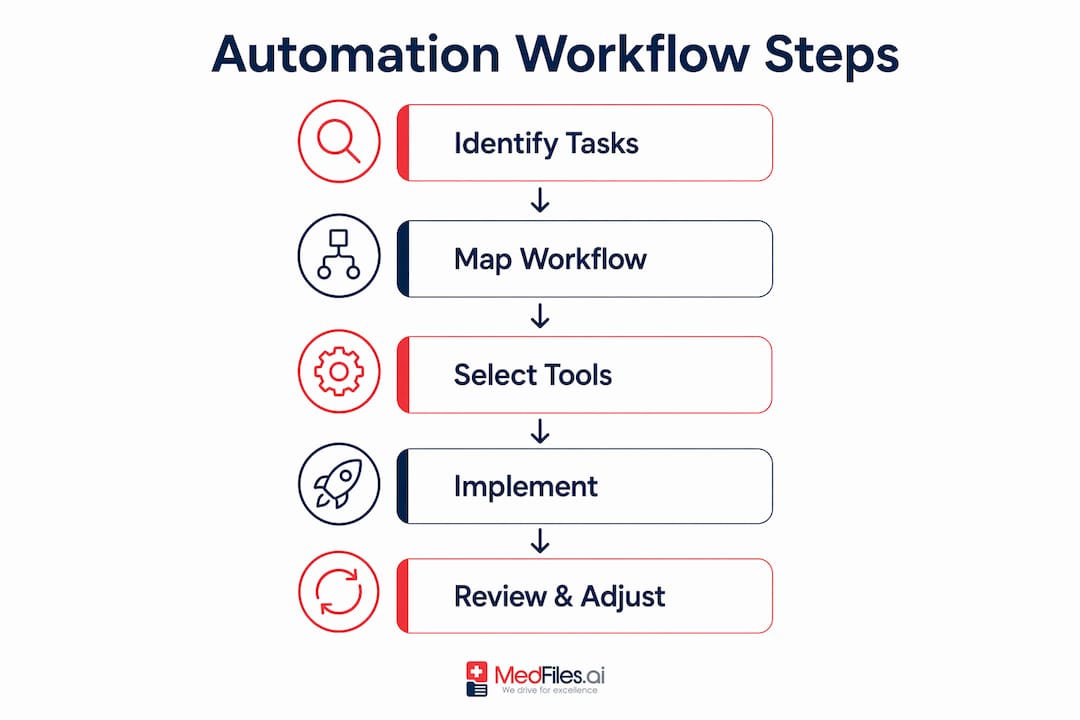
Pro Tip: Before deploying any automated coding or documentation tool, map your current workflow end to end. Automation applied to a broken process produces faster errors, not better outcomes.
How does automation affect healthcare operational workflows?
Automation changes what health information professionals actually do each day. The shift is not elimination. It is redistribution. Digital technologies reorganize work by redistributing coordination and sequencing rather than simply reducing workload. That distinction matters when planning staffing and training.
The numbers support cautious optimism. Health information technologists face a 63% AI exposure rate and a 51% automation risk, yet the Bureau of Labor Statistics projects role growth of 17% through 2034. Automation creates demand for professionals who can govern, audit, and interpret automated outputs, not just produce them.
Here is how workflow impact typically unfolds across a health system:
- Administrative burden drops. Scheduling, prior authorizations, and billing queries shift to automated queues. Automation of coding and scheduling reduces patient waiting times by around 30%.
- Clinician documentation time changes. Ambient AI scribes capture encounter notes in real time, but clinicians must still review and sign off. The task shifts from typing to verification.
- Quality roles expand. With routine tasks automated, HIM professionals spend more time on audits, denial management, and data governance.
- Training requirements increase. Staff need competency in evaluating AI outputs, not just operating software.
- Supervision becomes critical. Automated systems require human oversight to catch edge cases, rare diagnoses, and system errors.
The risk is not that automation replaces staff. The risk is that poorly implemented automation fragments care by creating new coordination gaps between systems and the humans who depend on them.
Pro Tip: Involve frontline health information staff in every automation design session. They know where the workflow breaks before any vendor does.
What are the challenges of automation in health data?
Automation in health data carries real risks that no governance framework can fully eliminate. Automation is a double-edged sword that augments tasks but risks care fragmentation when not integrated with clinical reality. The technology does not fail in isolation. It fails when deployed without understanding the human system around it.
The most documented challenges include:
- Alert fatigue: Automated clinical decision support fires too many low-priority alerts. Clinicians begin ignoring them, including the critical ones.
- Burnout from documentation burden: Clinical documentation burden expands alongside clinical tasks when automation is misaligned with actual workflows.
- AI errors in complex cases: Automated coding fails on atypical presentations, rare diagnoses, and multi-system conditions. These errors reach billing and quality reports before anyone catches them.
- Ethical risks in nursing: AI optimizes technical nursing tasks but risks disrupting the moral and empathetic responsibilities that define nursing practice. The Nursing Code of Ethics draws a clear line between AI support and AI interference.
- Bias in AI tools: Algorithms trained on non-representative datasets produce skewed outputs for underrepresented patient populations.
“Many downsides of automation, like alert fatigue and burnout, stem from poor implementation rather than technology itself.”
That insight reframes the problem. The question is not whether to automate. The question is whether your organization has the governance structure to implement automation responsibly. Workforce upskilling, clear escalation protocols, and regular bias audits are not optional add-ons. They are prerequisites.
How to implement automation in health information systems
Effective implementation starts before any software gets purchased. Successful automation depends on rigorous task segmentation and reconciling clinician workflows with management metrics. Automating complex clinical judgment without breaking it into discrete, repeatable steps consistently fails.
| Implementation strategy | Expected outcome |
|---|---|
| Task segmentation and workflow mapping | Identifies which tasks are automatable vs. judgment-dependent |
| Stakeholder co-design with frontline staff | Reduces resistance and catches workflow gaps early |
| Phased rollout with pilot testing | Limits system-wide disruption and allows iterative fixes |
| Continuous monitoring and feedback loops | Catches errors before they affect patient safety or billing |
| AI bias evaluation and clinical relevance review | Protects patient equity and regulatory compliance |
| Workforce upskilling in AI governance | Builds internal capacity to manage and audit automated systems |
Data governance and bias evaluation are now critical competencies for health information professionals. Simply deploying a vendor module and assuming it works is not a governance strategy. Your team needs the skills to interrogate AI outputs, identify systematic errors, and escalate findings to clinical leadership.
Aligning technology capabilities with clinical realities also requires honest assessment. Not every task benefits from automation. Staff training, ethical judgment, and complex care coordination remain highly human-dependent, with automation potential as low as 35% for those functions. Knowing where automation helps and where it hinders is the most valuable skill a health data manager can develop in 2026.
Pro Tip: Build a “human in the loop” checkpoint into every automated workflow. Define exactly who reviews AI outputs, at what frequency, and what triggers manual escalation. Document it. Audit it quarterly.
For a broader view of how AI is changing healthcare delivery beyond HIM, the applications extend into diagnostics, drug discovery, and population health management.
Key Takeaways
Automation in health information delivers measurable efficiency gains, but its long-term value depends entirely on governance, task segmentation, and workforce readiness.
| Point | Details |
|---|---|
| Automation reduces repetitive burden | AI can cut time on managerial tasks by up to 70%, freeing staff for higher-value work. |
| Roles grow, not disappear | Health information technologist positions are projected to grow 17% through 2034 despite high AI exposure. |
| Poor implementation causes harm | Alert fatigue, burnout, and care fragmentation come from bad rollouts, not the technology itself. |
| Task segmentation is non-negotiable | Automating discrete, repeatable tasks succeeds; automating complex clinical judgment without segmentation fails. |
| Governance is a core competency | Health information professionals must evaluate AI tools for bias and clinical relevance, not just operate them. |
Automation as enabler: what the data actually tells us
I have spent years watching health systems buy automation tools with enormous confidence and then struggle to explain why outcomes did not improve. The pattern is consistent. The technology works. The implementation does not.
What the 2026 research confirms is something experienced HIM professionals already knew: automation does not fix a fragmented workflow. It accelerates it. When you automate a process that was already misaligned with clinical reality, you get faster misalignment. The documentation burden that burned out nurses in 2020 did not disappear when EHR vendors added AI scribes. It shifted shape.
The organizations that get this right treat automation as an enabler of human judgment, not a replacement for it. They invest as much in change management and workforce training as they do in software licenses. They build governance structures before go-live, not after the first audit finding. And they keep frontline staff at the center of every design decision.
The future of automation in healthcare is not a fully automated hospital. It is a workforce that spends less time on data entry and more time on the work that actually requires a human. That future is achievable. But it requires discipline, not just technology.
— Team
Medfiles and automated health information management
Secure, organized health records are the foundation of every automation benefit described in this article. When records are fragmented across paper files, email threads, and disconnected portals, no clinical automation tool can work at full capacity.

Medfiles gives patients and healthcare teams a single, HIPAA-ready platform to store, organize, and share medical documents securely. Uploaded files are automatically classified and made instantly accessible, whether you are coordinating care across providers or preparing for an emergency. Secure document sharing removes the friction that slows clinical workflows. Medical document storage keeps every record organized and retrievable without manual filing. Your records. Organized automatically. Ready when care depends on it.
FAQ
What is automation in health information management?
Automation in health information management is the use of AI and software to perform repetitive tasks like coding, data capture, and document organization without manual input. It improves accuracy and frees health information professionals for higher-value work.
How does automation improve patient records?
Automated systems update patient records in real time across departments, reduce duplicate entries, and flag missing or inconsistent data. The result is a more accurate, complete record available to every clinician who needs it.
What are the biggest risks of automation in health data?
Alert fatigue, AI coding errors, and documentation burden are the most documented risks. Most stem from poor implementation rather than technology failure, making governance and workflow design the critical safeguards.
Will automation replace health information technologists?
Health information technologist roles are projected to grow 17% through 2034 despite a 63% AI exposure rate. Automation shifts the role toward AI governance, data quality auditing, and bias evaluation rather than eliminating it.
What skills do health data managers need for automation?
Health data managers need competency in task segmentation, AI bias evaluation, workflow analysis, and clinical relevance review. Deploying vendor software without these skills leaves patient safety and compliance gaps unaddressed.