What Is Medical Image Management for Healthcare Teams
Discover what medical image management is and how it enhances healthcare teams. Learn how effective imaging workflows improve patient care!

What Is Medical Image Management for Healthcare Teams
Medical image management is defined as the end-to-end program covering the capture, indexing, storage, distribution, exchange, and analysis of clinical imaging data across a healthcare enterprise. The industry standard term for this discipline is enterprise imaging, as defined by the HIMSS-SIIM Collaborative. It is not simply file storage. It is an active infrastructure program that connects imaging data from CT scanners, MRI machines, ultrasound devices, and mobile capture tools to the electronic health record (EHR), clinical viewers, and cross-organization exchange networks. For healthcare administrators and clinical informatics teams, understanding this program is the first step toward building imaging workflows that actually support patient care.
What is medical image management and how does it work?
Enterprise imaging covers every step from the moment a scan is acquired to the moment a clinician acts on it. The workflow has six distinct stages, and each one introduces its own technical and operational requirements.
-
Image acquisition — Images originate from modalities including CT, MRI, ultrasound, digital pathology scanners, endoscopy systems, and even smartphone cameras used in wound care or dermatology. Each device produces data in different formats, with DICOM being the dominant standard for radiology but far from universal across all departments.
-
Indexing and metadata normalization — Every image must be tagged with accurate patient identity, study date, modality type, and ordering provider. Errors at this stage cascade downstream, causing mismatched records and broken links to the EHR.
-
Storage — Images move through tiered storage: fast-access storage for recent or active studies, mid-tier for studies within a defined retention window, and long-term archive for older data. Retention requirements vary by state law and image type, but most organizations maintain radiology studies for a minimum of seven years.
-
Retrieval and viewing — Clinicians access images through integrated viewers embedded in the EHR or via dedicated diagnostic workstations. Low-latency retrieval is non-negotiable for time-sensitive specialties like emergency medicine and oncology.
-
Distribution and cross-enterprise exchange — Images must move between departments, facilities, and external organizations. Health information exchanges (HIEs) and direct sharing protocols handle this, but only when governance policies are in place to authorize the exchange.
-
Analytics and AI integration — Modern enterprise imaging infrastructure supports AI inference workloads, including automated anomaly detection, image segmentation, and prior study comparison. These capabilities require the underlying platform to handle high-throughput ingestion and low-latency retrieval simultaneously.
Pro Tip: Map your current imaging workflows against these six stages before evaluating any new platform. Most organizations discover gaps at the indexing and distribution stages, not at acquisition or storage.
How does a Vendor Neutral Archive support image management?
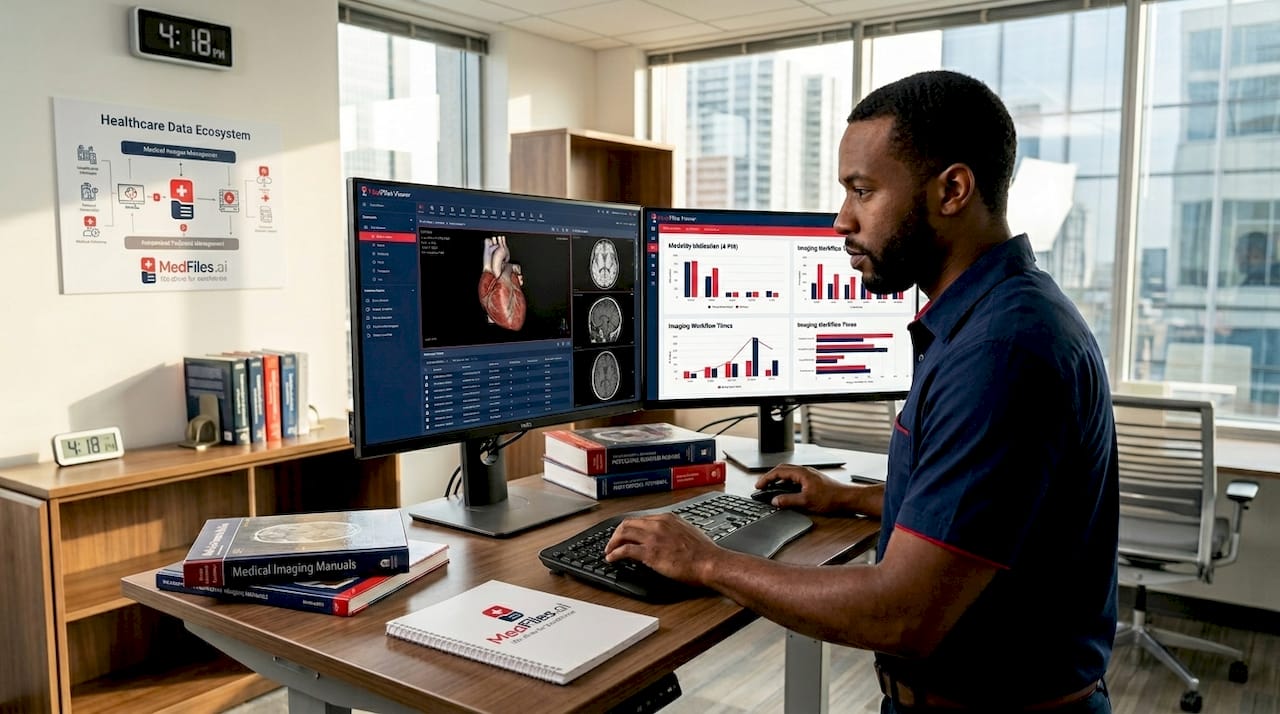
A Vendor Neutral Archive, or VNA, is the infrastructure layer that decouples image storage from any single PACS vendor, storing clinical images in standard formats and exposing them through standard interfaces. The practical result: your imaging data is no longer locked to one vendor’s proprietary system.
A VNA handles four core functions. It ingests images from multiple sources, normalizes metadata to correct inconsistencies, stores data in a vendor-neutral format (primarily DICOM), and makes images available for retrieval by any authorized system. This architecture supports longitudinal patient records by consolidating imaging data from multiple departments and facilities into a single accessible repository.
The comparison below clarifies where PACS and VNA responsibilities diverge.
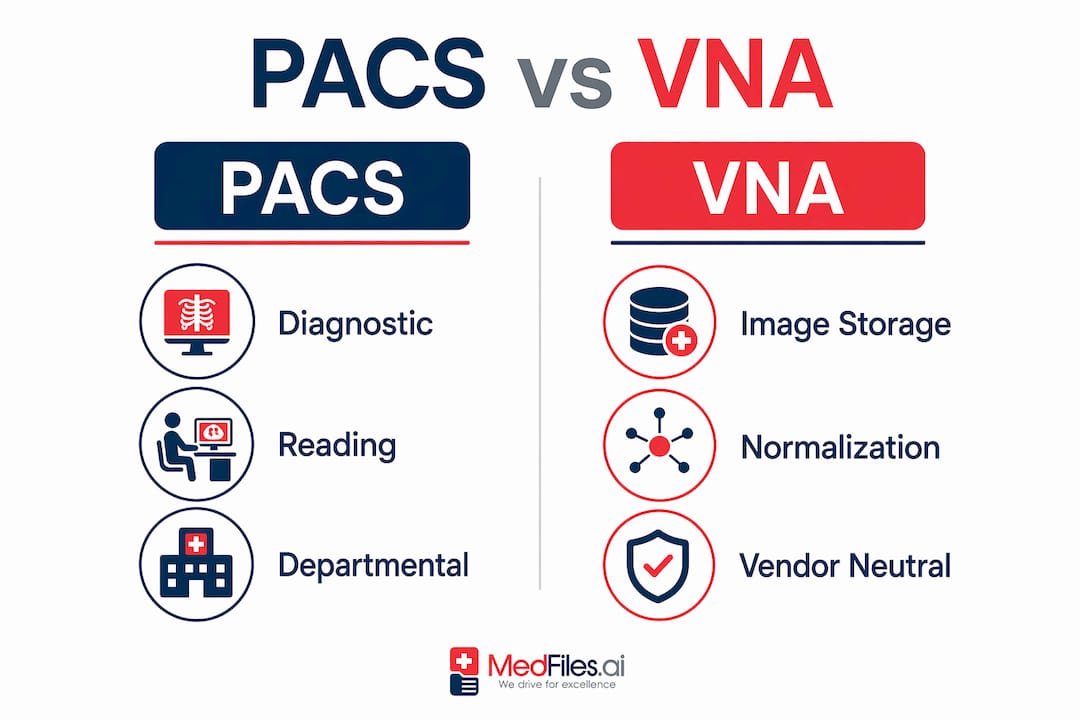
| Capability | PACS | VNA |
|---|---|---|
| Diagnostic workflow and reading | Primary function | Not designed for this |
| Vendor-neutral long-term archive | Limited or proprietary | Core function |
| Multi-department image consolidation | Department-specific | Enterprise-wide |
| Cross-enterprise image sharing | Limited | Designed for this |
| Standards-based interfaces (DICOM, HL7) | Partial | Full conformance required |
| AI and analytics integration | Vendor-dependent | Supported via standard APIs |
VNAs work best alongside PACS, not as replacements. PACS remain the right tool for radiologists performing diagnostic reads. The VNA sits behind the PACS, handling archiving, normalization, and cross-enterprise access. Treating them as competing systems is one of the most common and costly mistakes in enterprise imaging deployments.
The hardest operational challenge in any VNA deployment is metadata normalization and identity resolution. When images arrive from multiple sites, patient identifiers often differ. Study descriptions are inconsistently labeled. Accession numbers may conflict. A Master Patient Index (MPI) integration is required to reconcile these discrepancies and correctly link imaging data to the right longitudinal record.
Pro Tip: Before signing any VNA contract, confirm that your existing modalities, PACS systems, and identity management platform support the required DICOM conformance levels and IHE profiles. Discovering gaps after go-live is expensive.
What governance and interoperability standards are required?
Standards are necessary but not sufficient for medical image sharing. Successful image exchange depends equally on governance policies that define who participates, what they can access, and under what trust conditions. This is the part most technology procurement processes skip entirely.
The core technical standards in play are:
- DICOM (Digital Imaging and Communications in Medicine): The universal format for medical imaging data, covering both the image file structure and the network protocols for transmission.
- HL7 FHIR and HL7 v2: Messaging standards that connect imaging systems to EHRs, enabling order placement, result reporting, and patient demographic synchronization.
- IHE XDS and XDS-I profiles: Integrating the Healthcare Enterprise cross-document sharing profiles that define how imaging documents are registered and retrieved across organizations.
- IHE PIX and PDQ: Patient identity cross-referencing and patient demographics query profiles, which are the technical backbone of MPI integration.
Beyond standards, governance decisions shape what actually gets shared. A health information exchange can be technically capable of transmitting images between two hospitals, but if the participation agreement does not authorize the exchange, nothing moves. Governance policies define participation, access, and trust at the organizational level, and these decisions must be made before any technical integration begins.
Access control models also matter. Role-based access ensures that a primary care physician retrieving a chest X-ray sees what they need, while a billing analyst does not have access to the same image. Defining these roles and enforcing them consistently across systems is a governance function, not a technology function.
What are the challenges of integrating imaging into the EHR?
Integrating medical imaging into the EHR is where most enterprise imaging programs encounter their most persistent operational problems. Image capture and storage workflows are often heterogeneous and poorly incorporated into EHRs, requiring active management to make imaging data usable in clinical context.
The most common integration challenges include:
- Metadata inconsistencies: Patient names spelled differently across systems, mismatched date formats, and non-standard study descriptions all prevent correct image-to-record linking.
- Imaging data silos: Radiology, cardiology, pathology, and ophthalmology often operate separate imaging systems with no shared archive. A cardiologist ordering a chest CT may have no visibility into the radiology PACS where prior studies are stored.
- Non-DICOM content: Wound photos taken on smartphones, PDF reports from external facilities, and video from endoscopy systems do not conform to DICOM. An enterprise imaging platform must handle these formats alongside standard modality output.
- Viewer fragmentation: Clinicians forced to log into multiple viewers to see a complete imaging history lose time and risk missing prior studies that would affect clinical decisions.
Enterprise imaging platforms like Mach7 address these challenges by consolidating DICOM and non-DICOM content into unified patient records and orchestrating workflow routing across departments. The benefit is direct: clinicians see a complete imaging history within the EHR context, without switching applications or calling the radiology department to locate a prior study.
For healthcare administrators, the practical implication is clear. Solving EHR integration requires both a technical platform and a data governance strategy. The platform handles ingestion, normalization, and routing. The governance strategy defines how patient identity is managed, how metadata standards are enforced at the point of capture, and how access is controlled across departments and facilities.
Key takeaways
Medical image management is an enterprise-wide program requiring coordinated governance, standards-based infrastructure, and active metadata management to make clinical imaging data accessible and usable across the care continuum.
| Point | Details |
|---|---|
| Enterprise imaging scope | Covers capture, indexing, storage, distribution, exchange, and analysis, not just file storage. |
| VNA and PACS are complementary | VNAs handle vendor-neutral archiving and sharing; PACS handle diagnostic reading workflows. |
| Governance drives interoperability | Technical standards alone do not enable image sharing. Participation and trust policies must be defined first. |
| Metadata normalization is the hardest problem | MPI integration and consistent metadata standards at capture are required for accurate longitudinal records. |
| EHR integration requires both platform and policy | Enterprise imaging platforms consolidate content, but governance defines how identity and access are managed. |
The part most imaging projects get wrong
After working through dozens of healthcare imaging discussions, one pattern stands out clearly. Organizations invest heavily in PACS upgrades and VNA procurement, then discover six months into deployment that their metadata is a mess and their MPI integration was never properly scoped. The technology works. The data does not.
The HIMSS-SIIM framework is right to position enterprise imaging as a strategic program, not a technology purchase. The organizations that get this right treat imaging governance the same way they treat EHR governance: with defined ownership, documented standards, and ongoing data quality monitoring. The ones that struggle treat it as an IT infrastructure project with a go-live date and no ongoing accountability.
My honest recommendation: start your imaging modernization effort with an identity management assessment. Understand how patient identifiers flow between your registration system, your PACS, and your VNA before you finalize any architecture decisions. The standards conformance and identity strategy conversation is not a detail to address later. It is the foundation everything else depends on.
Scalability matters too. Enterprise imaging infrastructure must support ingestion, retrieval, AI inference, and workflow orchestration simultaneously. Choosing a platform that handles today’s volume but cannot scale to accommodate AI workloads or multi-site consolidation will cost you a second migration in three to five years.
— Team Medfiles
How Medfiles helps you manage medical images securely
Managing imaging data is not only a challenge for large hospital systems. Patients and families face the same problem at a personal scale: scattered images across multiple providers, no single place to store and share them, and no way to give a new specialist instant access to prior studies.
Medfiles is built to solve exactly this. The platform lets you store and organize medical images alongside test results, prescriptions, and reports in one secure, HIPAA-ready location. You can share imaging records directly with providers, access them from anywhere, and keep your full medical history available for emergencies or new consultations. For healthcare providers looking to support patients in managing their own records, Medfiles for doctors offers secure clinical sharing tools designed for real workflows. Your imaging data should work for you. Medfiles makes that possible.
FAQ
What is medical image management in simple terms?
Medical image management is the organized process of capturing, storing, indexing, and sharing clinical images such as X-rays, MRIs, and CT scans across a healthcare organization. The goal is to make imaging data accessible and usable within clinical workflows and the EHR.
What is the difference between a PACS and a VNA?
A PACS (Picture Archiving and Communication System) is designed for diagnostic reading workflows within a specific department, while a VNA (Vendor Neutral Archive) provides vendor-neutral long-term storage and cross-enterprise image sharing. They are complementary systems, not alternatives.
Why is metadata normalization so important in image management?
Metadata normalization corrects inconsistencies in patient identifiers, study descriptions, and accession numbers so that images are correctly linked to the right patient record. Without it, imaging data from multiple sites cannot be reliably consolidated into a longitudinal record.
What standards support medical image interoperability?
The core standards are DICOM for image format and transmission, HL7 FHIR and HL7 v2 for EHR integration, and IHE profiles including XDS-I for cross-enterprise document sharing and PIX/PDQ for patient identity management.
Can patients manage their own medical images?
Yes. Platforms like Medfiles allow patients to upload, store, and securely share medical images with providers. This is especially useful when switching providers, traveling, or preparing for specialist consultations where prior imaging is needed immediately.