Patient Data Interoperability: A 2026 US Healthcare Guide
Discover what is patient data interoperability and learn how it enables seamless healthcare access, enhances care coordination, and improves patient outcomes.

Patient Data Interoperability: A 2026 US Healthcare Guide
What is patient data interoperability?
Patient data interoperability is the ability of different healthcare systems and applications to access, exchange, integrate, and use electronic health information across organizations, without any special effort from the user. That last part matters more than it sounds. When a cardiologist in Chicago can pull up your complete medication list from a primary care visit in Houston without calling anyone or logging into a separate portal, that is interoperability working as intended.
The Office of the National Coordinator for Health Information Technology (ONC) and HIMSS both define interoperability around this core idea: health data should follow the patient, not stay locked inside a single system. The goal is coordinated, complete care, regardless of where or when a patient received treatment.
Health data interoperability touches every layer of the care system. Here are its core elements:
- Access: Authorized clinicians and patients can retrieve health records from any connected system.
- Exchange: Data moves securely between hospitals, clinics, labs, payers, and patients.
- Integration: Incoming data merges into existing workflows without manual re-entry.
- Coordinated use: All stakeholders, including providers, payers, and patients, act on the same accurate, up-to-date information.
- No special user effort: The exchange happens automatically, within existing tools and workflows.
- Key stakeholders: Healthcare systems, individual providers, payers, and patients all participate in and benefit from interoperable exchange.
As of 2023, about 70% of U.S. hospitals engaged in some form of interoperable health information exchange. That figure reflects real progress, but it also reveals how much ground remains.

The four levels of healthcare interoperability
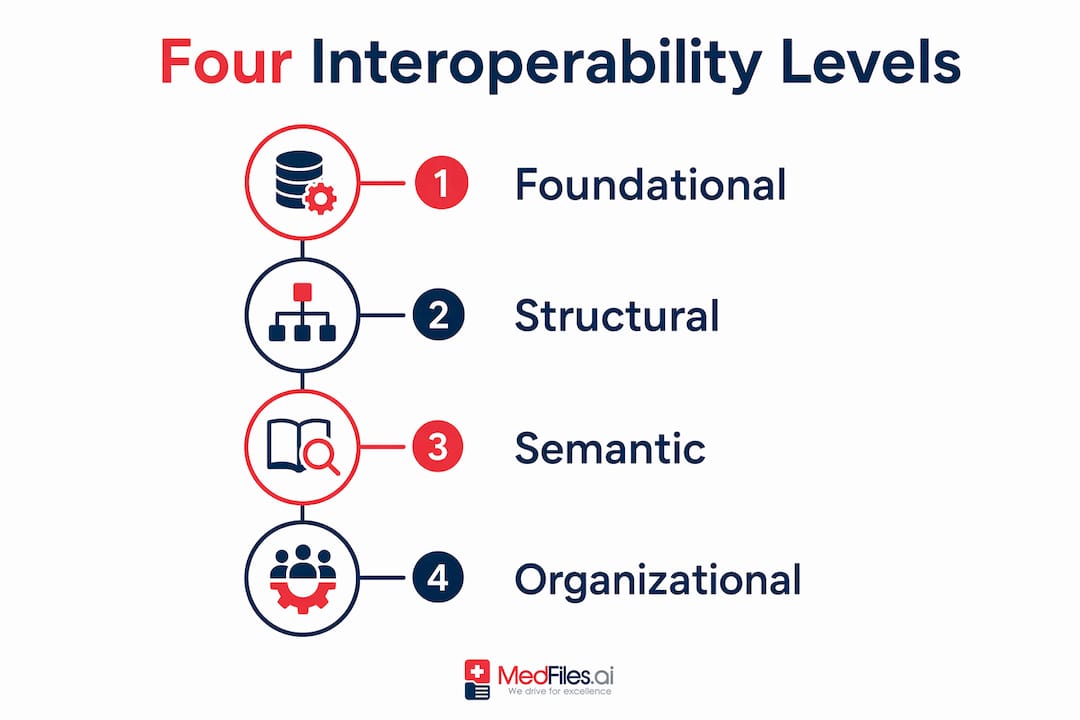
Not all interoperability is equal. HIMSS and ONC both recognize a four-level framework that describes how deeply systems can share and understand data. Think of it as a ladder: each level builds on the one below it.
-
Foundational interoperability is the base. It establishes the technical connection that lets one system send data to another. No interpretation happens here. The receiving system does not need to understand what it received, only that it arrived intact. This is the equivalent of two computers being able to talk to each other at all.
-
Structural interoperability adds format and syntax. Data is packaged in a standardized structure so the receiving system knows where each field is and what type of content to expect. HL7 messaging formats and the Clinical Document Architecture (CDA) operate at this level. A lab result arrives in a predictable format, even if the receiving system does not yet know what the result means clinically.
-
Semantic interoperability is where clinical meaning enters the picture. Systems not only receive and parse data, they understand it the same way. This requires shared vocabularies and code sets. SNOMED CT handles clinical concepts like diagnoses and procedures; LOINC standardizes lab test names and results. Without these, one system’s “acetaminophen” is another’s “Tylenol,” and the receiving system may treat them as two different medications. Semantic interoperability is the level that makes data clinically actionable.
-
Organizational interoperability sits above the technical layers entirely. It covers the governance structures, policies, legal agreements, and trust frameworks that allow institutions to exchange data across organizational and jurisdictional boundaries. TEFCA operates at this level, creating the national policy floor that makes cross-network exchange possible.
Each level is necessary. You can have perfect foundational connectivity and still fail at the semantic level if your code sets do not align. Real-world interoperability requires all four working together.
Why interoperability improves care for patients and providers
The benefits of patient data sharing are concrete and well-documented across clinical, patient-facing, and system-wide dimensions.
For clinicians and care teams:
- Providers get timely, complete patient information at the point of care, reducing the risk of duplicate testing or conflicting treatments.
- Care coordination improves when specialists, primary care physicians, and hospitals all work from the same record.
- Clinical decision support tools perform better when fed complete, accurate data from multiple sources.
- Directed exchange lets clinicians send lab results, referrals, and discharge summaries directly to the next provider in the care chain, securely and efficiently.
For patients:
- You gain access to your own complete health record, not just the portion held by one provider.
- Portability means your records travel with you, whether you are seeing a new specialist, traveling, or managing a chronic condition across multiple care settings.
- Patient empowerment increases when you can share your own data with providers of your choosing, through apps and platforms built on open APIs.
For the healthcare system:
- Reducing duplicate tests and redundant data entry cuts costs across the board.
- Public health surveillance and population health analysis become faster and more accurate when data flows freely between systems.
- Evidence-based clinical decision-making improves when researchers and clinicians can aggregate data across institutions.
The gap between access and use: In 2023, 71% of hospitals routinely had electronic access to necessary patient information from outside providers at the point of care. Yet only 42% of clinicians often used that information. Infrastructure alone does not change behavior. Adoption requires workflow integration, training, and trust in data quality.
What still blocks full interoperability in US healthcare
Progress is real, but the barriers are stubborn. Understanding them is the first step toward solving them.
- Semantic heterogeneity: Different systems use the same label for different clinical concepts. Without controlled vocabularies like SNOMED or LOINC, a term like “chest pain” can mean different things across EHR systems, creating risk at the point of care.
- Inconsistent data quality: Even when data arrives electronically, it may be incomplete, formatted differently, or contain errors introduced during manual entry upstream. Clinicians who encounter unreliable incoming data stop trusting it, which explains the usage gap noted above.
- Vendor-specific configurations: EHR vendors often implement standards differently, creating friction even when both systems nominally support the same protocol. This is a known, persistent problem that limits routine interoperability benefits for clinicians.
- Information blocking: Some organizations have historically restricted data sharing to protect competitive advantage or revenue streams. The 21st Century Cures Act directly targets this behavior, but enforcement remains an ongoing challenge.
- Governance complexity: Agreeing on who can access what data, under which legal framework, across state lines and organizational boundaries, requires sustained coordination that technical standards alone cannot provide.
- Resistance to change: Clinicians already managing heavy documentation burdens are not always eager to adopt new data-sharing workflows, especially when the immediate benefit to their own practice is unclear.
- Legacy system integration: Many hospitals still run older EHR infrastructure that was never designed for modern API-based exchange, making upgrades costly and disruptive.
None of these barriers are insurmountable. But they require coordinated action across technical, organizational, and policy dimensions simultaneously.
US regulations and policies driving interoperability forward
Federal policy has been the single biggest driver of interoperability progress in the United States. Three initiatives stand out.

The 21st Century Cures Act (2016)
Congress passed the Cures Act with bipartisan support specifically to address the failures of early health IT adoption. Its interoperability provisions require certified EHR systems to support open APIs, prohibit information blocking, and mandate that patients can access their health data through apps of their choosing. The law gave ONC and the Centers for Medicare and Medicaid Services (CMS) new enforcement tools and set the stage for everything that followed.
TEFCA: The Trusted Exchange Framework and Common Agreement
TEFCA establishes the national governance, policy, and technical floor for interoperability across the United States. It does not replace existing health information networks. Instead, it creates a common set of rules that allows those networks to connect with each other. TEFCA aims to prevent information blocking and give patients meaningful control over their own health records. Any organization that joins a Qualified Health Information Network (QHIN) under TEFCA agrees to these shared rules, enabling exchange that crosses organizational and geographic boundaries.
USCDI: United States Core Data for Interoperability
The USCDI is a federally mandated, standardized set of health data classes and elements that certified EHR systems must support for nationwide exchange. It covers clinical notes, allergies and intolerances, laboratory results, medications, patient demographics, and more. USCDI versions expand over time through a public submission process, with version 7 currently in draft as of 2026, adding detail around orders, procedures, diagnostic imaging, and anatomical localization.
Key regulatory milestones:
- 2016: 21st Century Cures Act enacted, targeting information blocking and mandating open APIs.
- 2020: ONC and CMS publish final interoperability rules implementing Cures Act provisions.
- 2022: TEFCA framework published; Qualified Health Information Networks begin onboarding.
- 2023: USCDI v3 adopted as the required data standard for certified health IT under the CMS Interoperability Framework.
- 2024–2025: TEFCA exchange goes live across multiple QHINs; enforcement of information blocking rules intensifies.
- 2026: USCDI v7 in public comment; ONC Standards Bulletin updates governance requirements for evolving data standards.
Standards and technologies that make patient data exchange possible
The technical infrastructure of health data interoperability rests on a layered set of standards. Each one solves a different part of the problem.
-
HL7 (Health Level Seven): The foundational messaging standard for healthcare data exchange. HL7 v2 messages are still the most widely used format in US hospitals today, handling lab results, orders, and ADT (admission, discharge, transfer) notifications between systems.
-
FHIR (Fast Healthcare Interoperability Resources): The modern HL7 standard built for the web era. FHIR uses APIs and standardized “resource” formats to enable flexible, efficient data exchange. Unlike older HL7 formats, FHIR works natively with REST APIs, making it far easier to build patient-facing apps and connect to modern cloud platforms. The CMS Interoperability Framework requires FHIR API support from all participating networks.
-
CDA (Clinical Document Architecture): An HL7 standard for structuring clinical documents like discharge summaries and referral notes. CDA ensures that a document created in one EHR can be read and parsed by another, even across different vendors.
-
APIs (Application Programming Interfaces): The mechanism that lets software programs access data from other systems. In healthcare, FHIR-based APIs are the primary vehicle for patient-facing data access, enabling apps to pull records from EHRs with patient authorization.
-
LOINC (Logical Observation Identifiers Names and Codes): The universal code set for lab tests, clinical observations, and measurements. When a lab result travels between systems, LOINC codes tell the receiving system exactly what was measured and how.
-
SNOMED CT (Systematized Nomenclature of Medicine Clinical Terms): The most comprehensive clinical terminology system in use. SNOMED CT codes diagnoses, procedures, symptoms, and clinical findings in a way that systems across the world can interpret consistently.
-
RxNorm: The standard terminology for medications, enabling different systems to recognize that “Tylenol 500mg” and “acetaminophen 500mg” are the same drug.
-
Transport standards: Protocols like DIRECT (a secure email-like messaging standard) and HTTPS-based REST APIs govern how data moves between systems, ensuring confidentiality and integrity in transit.
These standards do not work in isolation. A complete interoperability stack typically combines FHIR for structure and API access, LOINC and SNOMED CT for semantic meaning, and transport protocols for secure delivery. Legacy systems that predate FHIR can often be connected through translation layers, though this adds complexity.
How Medfiles helps you put interoperability to work
Understanding the standards is one thing. Having a tool that puts them to work for you is another. Medfiles is built specifically to help patients and families take control of their health data, so it can move with them across the care system.
Here is what Medfiles offers in practice:
- Secure, centralized storage: Upload test results, prescriptions, imaging reports, and clinical notes into one organized, encrypted repository. No more hunting through paper files or logging into five different patient portals.
- AI-powered document analysis: Medfiles analyzes your uploaded records to surface key information, flag patterns, and help you understand what your data contains.
- Multi-profile management: Manage health records for your entire family, including children and elderly relatives, from a single account.
- Secure sharing with providers: Share specific documents or your full record with any healthcare provider, securely and instantly. This is patient-controlled data sharing in practice, aligned with the patient access principles embedded in TEFCA and the Cures Act.
- HIPAA-ready infrastructure: End-to-end encryption and HIPAA-compliant data handling protect your information at every step. Medfiles’ security and privacy practices are built to meet the standards healthcare providers expect.
- Emergency access: Your critical health information is available instantly in an emergency, even when you cannot speak for yourself.
Pro Tip: Before your next specialist appointment, upload your most recent lab results, imaging reports, and medication list to Medfiles and share them directly with the provider. You arrive with a complete picture of your health history, and your provider can make better decisions from the first visit.
Medfiles does not replace your EHR or your provider’s systems. It gives you, the patient, a layer of control and portability that the current fragmented system often fails to provide. That is the patient-side of interoperability made real.
Real-world examples of patient data interoperability
Interoperability is not a theoretical concept. It shows up in specific, recognizable scenarios across the US healthcare system every day.
Emergency department access to outside records. When a patient arrives unconscious at an emergency department, the treating team can query a health information exchange (HIE) for prior diagnoses, current medications, and known allergies. Without interoperability, that information either does not arrive or arrives too late. With it, the ED physician can avoid a dangerous drug interaction in the first ten minutes of care.
Transitions of care. When a patient is discharged from a hospital to a skilled nursing facility, a CDA-formatted transition of care document travels electronically to the receiving facility’s EHR. The nursing staff sees the full discharge summary, medication reconciliation, and follow-up instructions without a single fax or phone call.
Patient-directed data sharing via apps. Under the Cures Act, patients can authorize third-party apps to pull their health data from any certified EHR using FHIR APIs. A patient managing a chronic condition can aggregate records from multiple providers into a single app, track trends, and share a consolidated view with their care team. Platforms like Medfiles support this model by giving patients a secure place to store and share what they collect.
Public health reporting. During disease outbreaks, interoperable systems allow public health agencies to receive near-real-time data from hospitals and labs without manual reporting. This capability, built on HL7 messaging and FHIR APIs, proved critical during the COVID-19 pandemic and continues to support population health analysis at the state and federal level.
Quality measurement and value-based care. Payers and accountable care organizations use interoperable data feeds to track quality metrics like HbA1c levels, blood pressure control, and preventive screening rates across their patient populations. This data drives both clinical improvement programs and payment calculations under value-based contracts.
How interoperability changes patient outcomes
The connection between interoperability and outcomes is direct, even if it is sometimes hard to isolate from other factors. Clinicians who have complete, accurate information at the point of care make better decisions. That is not a hypothesis. It is the premise behind every federal interoperability investment since 2009.
Hospitals that routinely engaged in all four domains of interoperable exchange reported patient health information availability rates of 92% and clinician use rates of 70%, compared to 26% and 18% respectively for hospitals with only partial interoperability. The difference in information availability between fully interoperable and partially interoperable hospitals translates directly into clinical decision quality.
Medication errors drop when a prescribing physician can see the patient’s complete medication list from all providers, not just the drugs prescribed within their own system. Readmission rates fall when the receiving facility gets a complete discharge summary rather than a verbal handoff. Duplicate imaging orders decrease when a radiologist can confirm that the same study was already performed elsewhere last month.
For patients managing medical record interoperability across multiple providers, the practical impact is even more personal. Fewer repeated tests. Less time spent re-explaining your history to every new provider. A care team that actually knows what the last care team did.
What the future of patient data interoperability looks like
The trajectory is clear, even if the pace is uneven. Several developments will shape health data interoperability through 2026 and beyond.
TEFCA expansion. More Qualified Health Information Networks are coming online, and the scope of exchange is widening beyond acute care to include behavioral health, long-term care, and social services data. The governance model is maturing, and enforcement of information blocking rules is becoming more consistent.
USCDI version expansion. Each new USCDI version adds data classes that were previously outside the standardized exchange set. Draft USCDI v7 adds detail around diagnostic imaging, procedure orders, and anatomical localization, making exchanged data more clinically precise. Interoperability is not a one-time project. It requires continuous governance as standards evolve.
AI and clinical decision support. As FHIR-based data feeds become more reliable, AI tools embedded in EHRs and third-party apps can analyze patient data in real time, flagging risks, suggesting diagnoses, and supporting clinical decision-making. The quality of those AI outputs depends entirely on the completeness and accuracy of the underlying interoperable data. Learn more about how medical decision making connects to data quality in clinical practice.
Patient-held records and digital identity. The CMS Interoperability Framework envisions a future where patients use verified digital credentials to access their complete health record from any node in the network, without knowing which specific providers hold which pieces of data. This model shifts control decisively toward the patient.
Global alignment. The US is not building interoperability in isolation. FHIR is now an international standard, and frameworks in the European Union, Australia, and Canada are converging on similar principles. Cross-border data exchange, particularly for travelers and internationally mobile patients, will become more practical as these frameworks align.
The direction is toward a healthcare system where your data follows you automatically, is understood correctly by every system that receives it, and stays under your control. That future is closer than it was five years ago, and the standards, policies, and platforms to support it are already in place.
Key Takeaways
Patient data interoperability requires all four levels of exchange, from foundational connectivity to organizational governance, working together with standards like FHIR, LOINC, and SNOMED CT, and supported by federal frameworks including TEFCA and USCDI.
| Point | Details |
|---|---|
| Four levels are all required | Foundational, structural, semantic, and organizational interoperability must all function together for real data exchange. |
| Usage gap persists | In 2023, 71% of hospitals routinely had electronic access to necessary patient information from outside providers at the point of care. Yet only 42% of clinicians often used that information. |
| Federal policy drives progress | TEFCA, USCDI, and the 21st Century Cures Act form the regulatory backbone of US interoperability advancement. |
| Semantic standards are the hardest layer | LOINC, SNOMED CT, and RxNorm prevent misinterpretation of clinical data across systems with different terminology. |
| Patient control is the goal | TEFCA and the Cures Act both empower patients to access and direct their own health data through apps and platforms of their choice. |