Why preserving medical history empowers your health: 5 key benefits
Learn why preserving your medical history improves care, cuts hospital costs by 33%, and can save your life in emergencies. Start organizing your records today.

Why preserving medical history empowers your health: 5 key benefits
Most people assume their doctor has everything on file. But that assumption breaks down fast when you switch providers, travel abroad, or land in an emergency room unable to speak. A single missing allergy or outdated medication list can change the outcome of your care. Medical history preservation is not a task for your doctor alone. It is something you own, manage, and benefit from directly. This guide walks you through what medical history really includes, why it matters at every stage of care, and how to make preserving it a simple, lasting habit.
Table of Contents
- Understanding medical history: What, why, and how it’s used
- Personal and family history: Unlocking better care and prevention
- Medical history in emergencies: Why fast access can save lives
- How to preserve medical history: Tools, habits, and common barriers
- A fresh perspective: Why medical history is your power tool, not just paperwork
- Make preserving your medical history simple with MedFiles.ai
- Frequently asked questions
Key Takeaways
| Point | Details |
|---|---|
| Empower your care | Maintaining your medical history can lead to faster, more accurate healthcare decisions when it matters most. |
| Family history matters | Understanding health issues across relatives allows for prevention and targeted screening. |
| Emergency readiness | Quick access to medical details like allergies or medications can save lives in an emergency. |
| Practical preservation | Use both digital and paper tools, and update after each appointment for the best results. |
Understanding medical history: What, why, and how it’s used
Medical history is more than a list of past illnesses. It is a living record that shapes every healthcare decision made about you. Understanding what it includes, and how it gets used, is the first step toward taking control.
Personal medical history covers everything that has happened to your own body over time. This includes:
- Diagnoses and chronic conditions
- Surgeries and hospitalizations
- Allergies and adverse drug reactions
- Current and past medications
- Vaccinations and immunizations
- Mental health history
- Reproductive and pregnancy history
Family medical history documents health conditions in your biological relatives. This helps providers identify patterns that could affect your risk for certain diseases.
Doctors rely on this information constantly. Before ordering tests, prescribing medications, or recommending procedures, they need context. Without your history, they are working with incomplete data. Preserving your personal and family history improves quality of care by giving providers a complete background, helping identify patterns, and enabling personalized treatment.
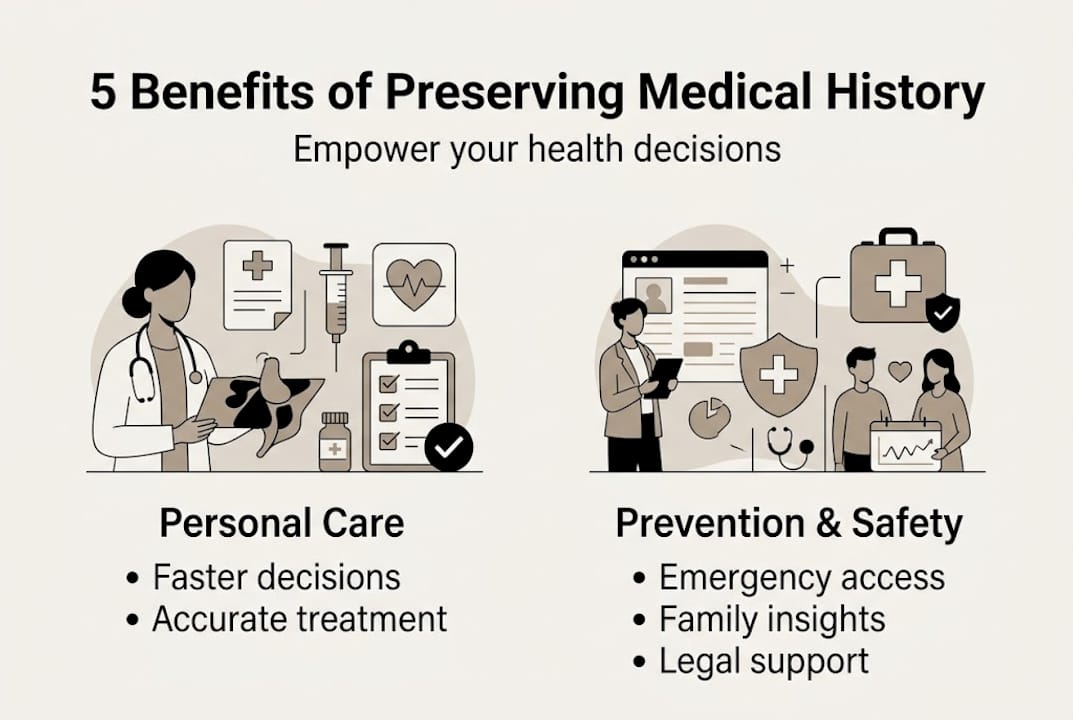
Here is something many people do not realize: your personal records and your provider’s records are not the same thing. Providers maintain their own clinical files, which are formatted for billing and clinical workflows. What you know and can communicate is your personal history. The Cleveland Clinic explains that distinguishing between these two is essential for continuity of care. Your personal account empowers you, but you should verify accuracy against provider records regularly.
This is where digital medical records become valuable. Instead of relying on memory or scattered paperwork, you can store, organize, and access everything in one place.
Pro Tip: After every appointment, spend two minutes writing down what was discussed, any new diagnoses, and any medication changes. This small habit keeps your personal record current without feeling overwhelming.
Ongoing personal involvement is not optional if you want accurate care. Providers change, systems do not always communicate with each other, and records get lost. You are the only constant in your own healthcare story.
Personal and family history: Unlocking better care and prevention
Now that you know what is included in medical history, let’s explore how it improves real healthcare decisions and outcomes.
Knowing your personal history helps your doctor make faster, smarter decisions. Knowing your family history takes that a step further. It tells your provider what you might be at risk for before symptoms ever appear.

The AMA recommends collecting detailed family health history including first, second, and third degree relatives. This information identifies higher disease risk, allows for early screening, and supports lifestyle changes and preventive measures before problems develop.
Here is a simple table to guide what you should collect:
| Relative type | Examples | Key health traits to document |
|---|---|---|
| First degree | Parents, siblings, children | Heart disease, diabetes, cancer, mental illness |
| Second degree | Grandparents, aunts, uncles | Stroke, autoimmune conditions, hereditary cancers |
| Third degree | Great-grandparents, cousins | Rare genetic conditions, early onset diseases |
The impact of accurate history goes beyond prevention. Proper history taking reduces hospital length of stay from 6.25 days to 4.82 days and cuts costs from $47,650 to $31,758 in cases like spontaneous bacterial peritonitis admissions. That is a significant difference, and it comes down to having the right information available at the right time.
“Your family health history is one of the most powerful tools available for disease prevention. It is free, it is personal, and it is actionable.”
Here is what a strong personal and family history helps your care team do:
- Order the right screenings at the right age
- Avoid medications that conflict with your genetic profile
- Catch early warning signs before they become emergencies
- Tailor treatment plans to your actual risk level
- Reduce unnecessary tests and duplicate procedures
Using family medical history tools makes collecting and updating this information far easier than building it from scratch on paper. The goal is not perfection. It is having enough detail to give your provider a meaningful picture.
Medical history in emergencies: Why fast access can save lives
While history benefits everyday care, it is especially vital in emergencies when every second matters.
Imagine you are rushed to the emergency room unconscious. The care team does not know your blood type, your allergies, or that you are on a blood thinner. Every minute they spend tracking down that information is a minute they are not treating you. Organized personal medical records enable quick access to critical information like allergies and medications, and that access can be life-saving when patients cannot communicate.
Here is how digital and paper records compare in emergency situations:
| Feature | Digital records | Paper records |
|---|---|---|
| Speed of access | Instant, from any device | Requires physical presence |
| Risk of loss | Low, with cloud backup | High, especially in disasters |
| Sharing with providers | Immediate, shareable link | Requires fax or in-person delivery |
| Update frequency | Easy to update anytime | Time-consuming to maintain |
| Emergency readiness | Accessible from your phone | May not be with you |
Digital clearly wins for emergency preparedness. But even a well-organized paper binder beats nothing at all.
Here are the steps to make your records emergency-ready:
- List all current medications with dosages and prescribing doctors
- Document all known allergies, including reaction type
- Include emergency contacts and healthcare proxy information
- Note your blood type and any critical diagnoses
- Store a digital copy in a secure, accessible app
- Share access with at least one trusted family member
The top details needed instantly in an emergency are allergies, current medications, blood type, primary diagnosis, and emergency contact names. Keep these at the front of any record system you use.
For emergency records access, having a platform that lets you share a secure link with a provider in seconds is not a luxury. It is a genuine safety net.
How to preserve medical history: Tools, habits, and common barriers
Having established why preservation matters, the final piece is making it doable in everyday life.
The good news: you do not need to be tech-savvy or spend hours organizing to build a solid medical history. You need the right tools and a repeatable process.
Digital tools are the most efficient option. These include dedicated health apps, spreadsheets, patient portals provided by your clinic, and platforms built specifically for medical record storage. Using digital formats like apps and spreadsheets, combined with requesting records from providers, insurance companies, and pharmacies, gives you a well-rounded picture.
Paper tools still work. A labeled binder with dividers for each category works well for people who prefer physical records or want a backup.
Here is what your record system should always include:
- Full name, date of birth, and blood type
- List of current conditions and diagnoses
- All medications with dosages
- Known allergies and reactions
- Vaccination history
- Family health history by relative type
- Recent lab results and imaging reports
The step-by-step process looks like this: Start by requesting records from your current providers. Add records from your pharmacy and insurance company. Organize by category. Then set a routine to update after every visit or health event.
Barriers to preservation are real but solvable. Time is the biggest one. The fix is a five-minute post-appointment habit. Tech discomfort is another. Simple folder systems or basic apps remove that friction. Accuracy concerns are valid too. Cross-verify your records against patient portals and pharmacy printouts to catch errors.
Pro Tip: Set a recurring phone reminder for 30 minutes after each scheduled appointment. Use that window to update your records while details are still fresh. Five minutes is all it takes.
Using medical history preservation tips from a platform designed for this purpose removes most of the friction. You upload, it organizes. You share, it encrypts. That is the kind of system that actually gets used.
A fresh perspective: Why medical history is your power tool, not just paperwork
Most articles about medical history focus on logistics. Collect this, store that, update regularly. That advice is useful. But it misses the bigger shift.
When you actively manage your medical history, you stop being a passive recipient of care and start being a participant. That shift changes everything. You catch errors before they cause harm. You walk into appointments prepared. You advocate for yourself with facts, not feelings.
Active record-keeping reduces errors and duplicates, supports insurance claims, and protects you in medico-legal situations. These are not edge cases. They happen to ordinary people every year.
But here is the part most guides skip: your personal history has limits. Patient-reported cancer stage only agrees with registry data 49.9% of the time, rising to 68.4% for stage IV. For complex clinical details, your memory and notes are a starting point, not a final source. Use registries and provider records to verify.
This is not a reason to stop keeping records. It is a reason to keep them well and cross-check them often. Personal ownership of your history, combined with verified provider data, is the most accurate picture you can have. That is what becoming an active patient actually looks like.
Make preserving your medical history simple with MedFiles.ai
You now know what medical history includes, why it matters in emergencies and everyday care, and how to build a system that works. The next step is putting it all in one secure place.

MedFiles.ai is a digital medical history platform built for exactly this purpose. Store test results, prescriptions, images, and reports securely. Access everything instantly, whether you are at a new clinic, traveling, or facing an emergency. Share records with providers or family members in seconds, with HIPAA-ready encryption protecting every file. Set up your profile today and give yourself the peace of mind that comes from knowing your health information is organized, secure, and always within reach.
Frequently asked questions
What is included in a personal medical history?
Your personal medical history covers your diagnoses, surgeries, allergies, medications, vaccinations, and basic identifying information like blood type and date of birth.
How often should I update my medical records at home?
Update your records after each doctor visit, medication change, or new health event to keep information current and useful.
Why is family history important for my healthcare?
Family history reveals inherited risks, which helps your doctor recommend targeted screenings and prevention strategies before conditions develop.
What’s the difference between my own records and doctor/provider records?
Your records are what you track and can access, while provider records are maintained by clinics. The Cleveland Clinic notes that combining both ensures accuracy and fast access in emergencies.
How accurate is patient-reported medical history?
Patient reports are valuable for most details but can be less precise on complex points. Cancer stage agreement with registries is only 49.9%, so cross-verify with provider records for accuracy.