Avoid RFEs: 7-Item Checklist and Digital Backup for USCIS Medical Exam
U.S. checklist for Form I-693: 7 records to bring, sealed envelope rules, and a digital backup workflow to prevent RFEs.

Avoid RFEs: 7-Item Checklist and Digital Backup for USCIS Medical Exam
If you are filing to adjust status in the U.S., you generally must submit Form I-693 completed by a civil surgeon, along with written vaccination records, TB documentation, and treatment letters. The single most important rule: keep the civil surgeon’s sealed envelope sealed for mailed filings, or follow USCIS upload instructions for online filings. Get this part wrong and your case stalls.
TL;DR:
- Failing to keep the sealed envelope of Form I-693 intact or not following USCIS upload instructions can cause your case to stall or be rejected.
- A civil surgeon in the US performs the exam, and overseas applicants must use a panel physician; mixing providers can render the exam unusable.
- Civil surgeons assess age-specific vaccine requirements based on your records and determine which vaccines are clinically appropriate, not just a checklist.
- Proper organization of complete, dated records before the exam reduces delays, and digital backups can streamline the process for the applicant and provider.
- The USCIS policy now generally considers a completed Form I-693 signed on or after November 1, 2023, to be valid indefinitely, but always verify current guidance before filing.
Table of Contents
- What Documents Does Immigration Medical Records USA Require?
- Who Performs the Medical Exam: Civil Surgeon or Panel Physician?
- Which Vaccines Does USCIS Require for Immigration?
- What Tests Are Included in the Immigration Physical Exam?
- What Medical Records Should You Bring to the Exam?
- How Long Is Form I-693 Valid?
- What Mistakes Cause Delays or RFEs?
- Building an Immigration-Ready Health Records Packet
- Treat the Exam as Evidence, Not a Checkup
- Keep Every Applicant’s Records Organized Before the Appointment
- Where to Verify Current Rules
- Sources
- FAQ
What Documents Does Immigration Medical Records USA Require?
USCIS ties Form I-693 directly to your Form I-485. Many adjustment applicants must submit it with the I-485 package, not weeks later, and USCIS has warned that missing this step can lead to rejection. Some applicant categories may qualify for a partial civil surgeon signoff, but that is the exception, not the default. Confirm your category before assuming a shortcut applies.
How you submit depends on how you file:
- Paper I-485: the civil surgeon seals I-693 in an envelope. Do not open it. USCIS treats a broken seal as compromised evidence.
- Online I-485: you open the packet yourself and upload the pages as USCIS instructs.
- Either way: hold onto the original documents until USCIS closes your case.
Pro Tip: Ask the civil surgeon’s office for a photocopy of the complete I-693 before they seal your original. You want a backup you can read without breaking the seal on the version USCIS receives.
Who Performs the Medical Exam: Civil Surgeon or Panel Physician?
Location decides the answer. A civil surgeon is a doctor USCIS has designated to perform immigration exams inside the United States. A panel physician is a doctor the State Department has approved to examine immigrant visa applicants abroad. Adjustment-of-status applicants use civil surgeons. Immigrant visa applicants overseas use panel physicians. Mix them up and the exam may be unusable for your case.
To find a legitimate provider:
- Search the USCIS civil surgeon locator by zip code.
- Verify the doctor’s designation is current before booking, not after.
- If you had a visa medical exam abroad through a panel physician, that exam typically does not substitute for a domestic civil surgeon exam once you adjust status in the U.S.
Which Vaccines Does USCIS Require for Immigration?
The civil surgeon does not just check a box. They review your written proof, then decide which vaccines are age-appropriate for you specifically. CDC technical instructions require civil surgeons to assess immunity, document each vaccine on Form I-693, and note any contraindication properly rather than skip it silently.
Vaccine categories typically reviewed include:
- MMR (measles, mumps, rubella)
- Tdap or DTaP
- Polio
- Varicella
- Hepatitis A and B
- Influenza and COVID-19, depending on current guidance at the time of your exam
If you are missing a dose, the civil surgeon can administer it on the spot or mark it “not medically appropriate” when there’s a valid clinical reason. Bring dated proof of every dose you’ve had. A vague memory of “I think I got that one as a kid” carries no weight with a civil surgeon who needs paperwork, not recollection.
What Tests Are Included in the Immigration Physical Exam?
The exam covers a medical history review, a physical exam, and specific infectious disease testing. TB screening uses an IGRA blood test, with a chest x-ray required when results or symptoms warrant it, following CDC’s medical history and physical examination instructions. Cases of infectious TB get referred to local health departments for reporting and follow-up.
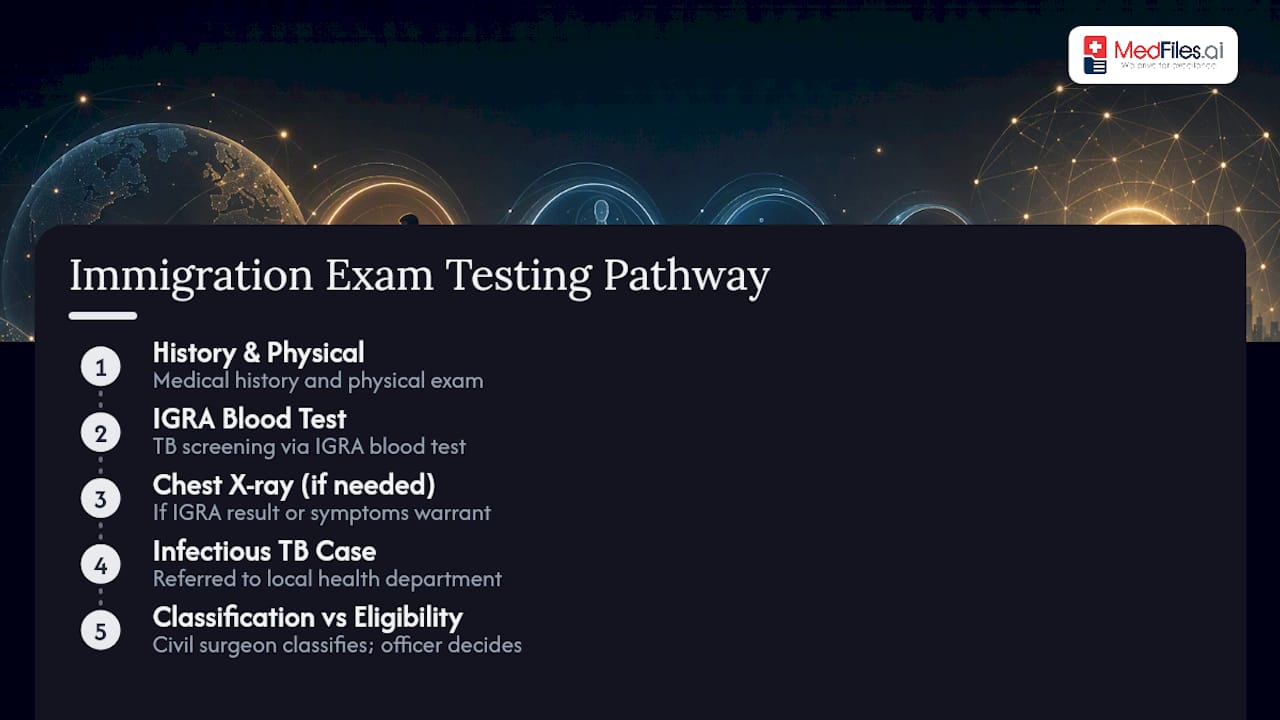
Latent TB infection (LTBI) is different from active TB disease. LTBI does not carry a Class A designation and typically does not block your adjustment of status, though the civil surgeon still has to report it. Syphilis and gonorrhea testing follow a similar logic: a positive result gets classified, but classification and eligibility are two separate questions. The civil surgeon assigns the medical classification. The immigration officer decides what it means for your case.
What Medical Records Should You Bring to the Exam?
Show up prepared and the appointment moves fast. Show up empty handed and you’re looking at a second visit, a delay, or a request for evidence you could have avoided.
- Vaccination cards or records with specific dates for every dose.
- Documentation of any prior positive TB test, plus treatment certificates if you were treated.
- Chest x-ray films or reports, especially from any past TB workup.
- Letters from specialists for any ongoing condition (psychiatric care, substance use treatment, chronic illness).
- A current medication list, including dosages.
- Form I-693 Part 1, signed by you where required.
- Government-issued photo ID.
If records are missing, don’t leave them missing. Contact your prior doctor’s office directly, request your file from a state or local immunization registry, or ask for medical-chart copies in writing. A partner guide on requesting medical records from U.S. practices walks through exactly how that request should be worded to get a response instead of a delay.
Pro Tip: Build one labeled paper packet and one secure digital folder per applicant in your household. Number every document in chronological order so the civil surgeon can flip through it in minutes instead of guessing what year a vaccine card belongs to.
How Long Is Form I-693 Valid?
Submission mechanics matter as much as content. For a paper I-485, the civil surgeon’s sealed envelope goes in as is. For an online I-485, you open the packet and upload it per USCIS instructions, but you still keep the original sealed version and the physical form.
- Paper filing: sealed envelope stays sealed until USCIS opens it.
- Online filing: you upload, but retain the physical originals.
- Costs vary by civil surgeon’s office; there’s no fixed federal fee for the exam itself.
- Build in extra time for vaccines requiring spaced-out doses or for any specialist referral the civil surgeon orders.
Under USCIS policy guidance, a properly completed Form I-693 signed on or after November 1, 2023, generally does not expire. Confirm current USCIS guidance before you file, since policy on this point has shifted before and can shift again.
What Mistakes Cause Delays or RFEs?
Most delays trace back to a handful of preventable errors, not bad luck.
- An opened or altered sealed envelope. USCIS may reject it outright.
- Vaccine dates missing or vague. “Sometime in childhood” isn’t documentation.
- The wrong provider. A panel physician’s overseas exam won’t substitute for a civil surgeon’s domestic one.
- Incomplete applicant signatures on Form I-693. A form the applicant never signed where required is a red flag USCIS will catch.
- Fragmented family files. When one household member’s vaccination card ends up mixed into another’s folder, someone’s exam gets delayed sorting it out.
If you receive a Request for Evidence, respond promptly. Provide the original documents requested or, if the exam window has lapsed, get a newly completed I-693 from a civil surgeon rather than trying to patch the old one.
Building an Immigration-Ready Health Records Packet
Good documentation doesn’t happen at the appointment. It happens in the weeks before it, while you still have time to track down a record instead of scrambling for one.
Build your packet in chronological order: vaccination records first, then TB history and any treatment certificates, then imaging files, specialist letters, current medications, and the relevant I-693 pages. One sealed original goes to USCIS exactly as required. A secure digital copy stays with you, so nothing gets lost between your primary doctor’s office, the civil surgeon, and USCIS.
Practical workflow steps that save real time:
- Scan chest x-rays and treatment certificates as high-resolution PDFs, not phone photos.
- Label every image file with the date it covers, not just “TB xray.”
- Create a one-page index sheet listing every document in the packet, so the civil surgeon can scan it in seconds.
Storing that packet in a HIPAA-ready platform with encrypted sharing makes it easier to hand a civil surgeon or clinic exactly what they need without emailing scans back and forth. Digitizing your family’s vaccination records before the appointment, rather than during it, also means you’re not reconstructing a decade-old immunization history from memory in a waiting room.
Treat the Exam as Evidence, Not a Checkup
A civil surgeon’s exam isn’t a routine physical. Its evidence submitted to an adjudicator who will never meet you. Your strongest position at that appointment is a complete, dated, organized record, not a good explanation for why the records are incomplete.
Start reconstructing gaps in your vaccination or treatment history weeks before you book the exam, not the morning of it. Immigration officers evaluate paperwork. Paperwork you build early beats paperwork you’re chasing after the fact.
— Team
Keep Every Applicant’s Records Organized Before the Appointment
There are digital platforms that allow you to store and organize the exact documents a civil surgeon asks for, so you can enter that appointment with a complete packet instead of a stack of loose papers.

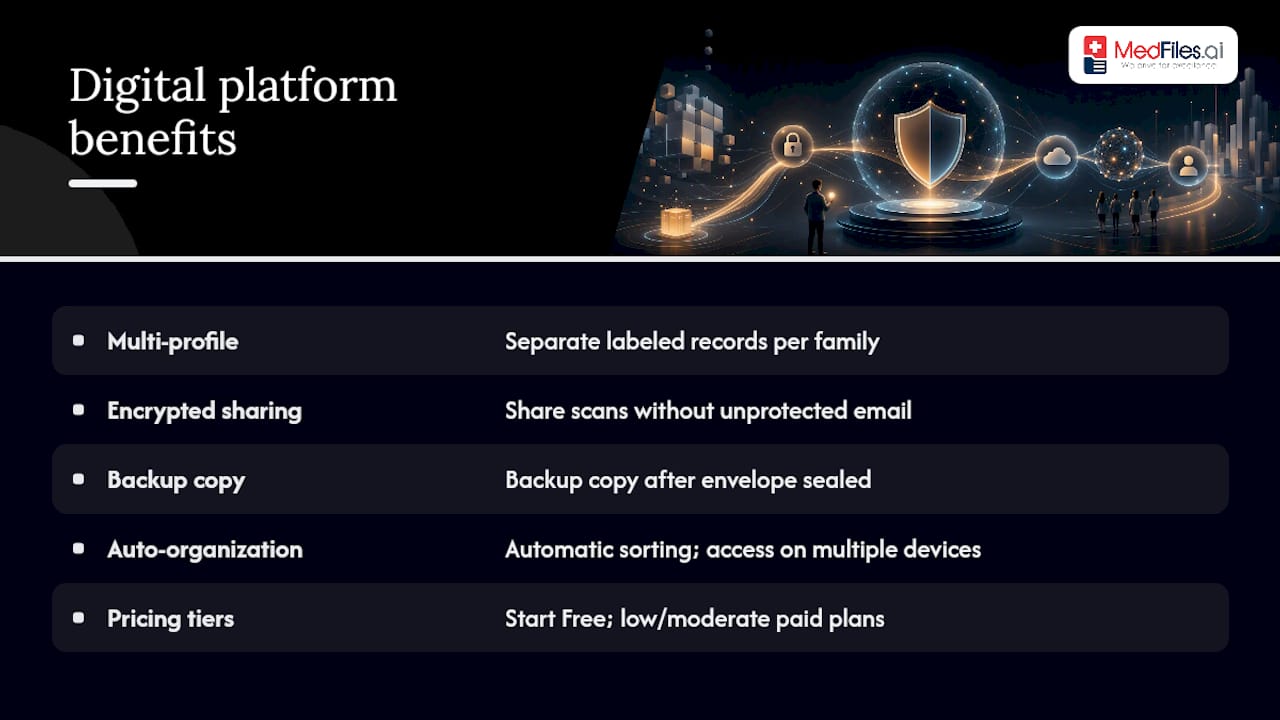
Some services offer multi-profile management to keep separate, labeled records for each family member filing their own I-693, including kids and dependents with distinct vaccination histories. Encrypted sharing options can enable sending scanned vaccination cards, TB films, and specialist letters to a civil surgeon or clinic without emailing unprotected attachments. Storing documents digitally provides the possibility of having a backup copy once the civil surgeon seals your original envelope, helping prevent loss between the appointment and mailing date.
Some platforms work alongside the civil surgeon and Form I-693 process by providing secure, organized access to documents needed for the appointment, often using automatic organization features and accessible from multiple devices.
Try building one applicant’s packet on the free Start Free plan, or move up to Understand Your Health at a low monthly fee or Protect Everyone at a moderate monthly fee for full family management.
Where to Verify Current Rules
Confirm everything here against the primary sources before your appointment, since USCIS and CDC guidance changes.
- Form I-693 official page
- USCIS policy alert on I-693 submission requirements
- CDC vaccination technical instructions for civil surgeons
- Designated civil surgeon locator
- Travel
This article is general information, not a substitute for advice from a qualified doctor. Consult a qualified healthcare professional about your own circumstances before acting on anything here.
Sources
- I-693 | Report of Immigration Medical Examination and Vaccination Record | USCIS
- USCIS Now Requires Report of Immigration Medical Examination and Vaccination Record to be Submitted with Form I-485 for Certain Applicants | USCIS
- Vaccination | Technical Instructions for Civil Surgeons | Immigrant and Refugee Health | CDC
- Designated civil surgeons | USCIS
FAQ
Can Immigration Access Your Medical Records?
USCIS and civil surgeons only see what you submit through Form I-693 and supporting documents, not your full medical history at every provider you’ve ever seen. The civil surgeon reviews your records to complete the exam, then reports the required findings to USCIS on the form itself.
What Is USCIS’s Current Rule on Green Card Medical Exam Validity?
A properly completed Form I-693 signed on or after November 1, 2023 generally does not expire under current USCIS policy. Check current USCIS guidance before filing, since validity rules have changed in the past.
How Much Does Form I-693 Cost?
There is no fixed federal fee for Form I-693 itself. The exam cost is set by the individual civil surgeon’s office and varies depending on the provider and any vaccines or tests administered.
What Medical Conditions Can Disqualify You From a U.S. Visa?
Certain communicable diseases of public health significance, like infectious TB, can result in a Class A classification that affects admissibility. Latent TB infection, by contrast, does not carry a Class A designation and typically does not block adjustment of status, though it must still be reported.
What Should I Do if I’m Missing Old Vaccination Records?
Contact your previous doctor’s office or pediatrician directly, and check with your state or local immunization registry, since many states track vaccination history electronically. Avoid relying on memory alone. A civil surgeon needs dated, written proof of each vaccine.