What Is Digital Health Infrastructure: A 2026 Guide
Discover what digital health infrastructure is and why it matters for secure and efficient health data exchange. Explore its key components today!

What Is Digital Health Infrastructure: A 2026 Guide
Digital health infrastructure is defined as the interoperable ecosystem of digital health systems, governance frameworks, and technical standards that enable secure, equitable, and efficient health data exchange across care settings. The term covers far more than electronic health records (EHRs) or telehealth apps. It includes the policy layers, consent frameworks, and data standards that make those tools trustworthy and connected. The WHO global digital health strategy frames this as a person-centered approach built on four objectives: global collaboration, national strategy advancement, governance frameworks, and people-centered technologies. Standards like USCDI and frameworks like TEFCA are the connective tissue that turn isolated digital tools into a functioning national system.
What is digital health infrastructure made of?
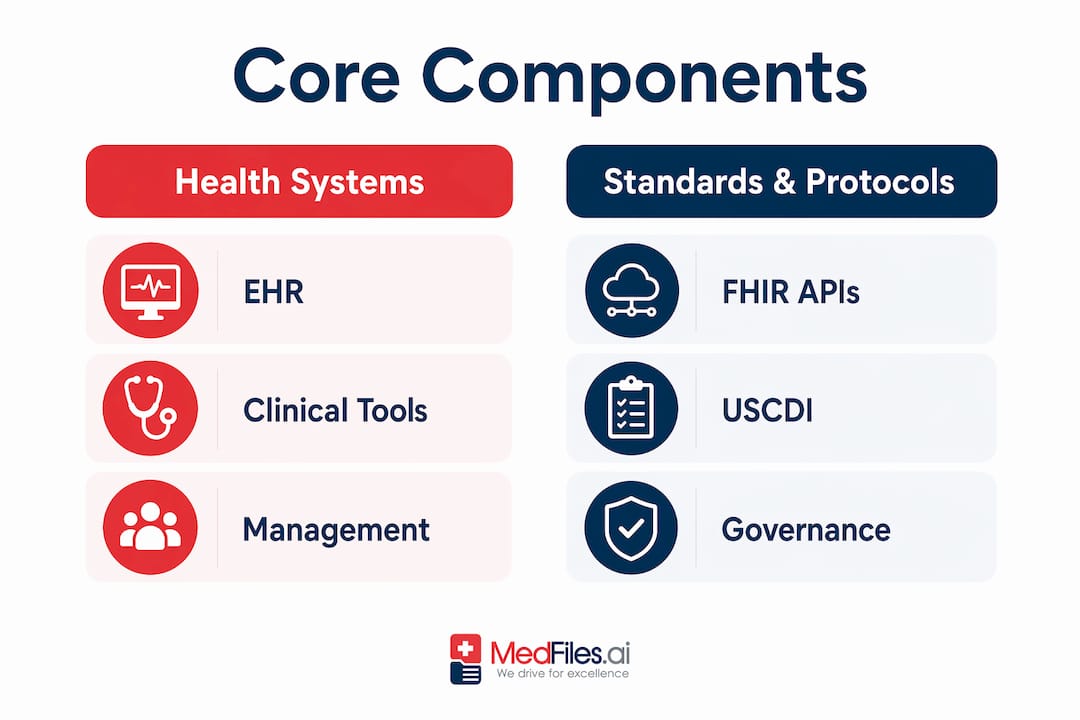
Digital health infrastructure is a layered architecture. Each layer depends on the one beneath it, and removing any layer breaks the chain. The Johns Hopkins Center for Global Digital Health Innovation identifies four foundational layers that every national or institutional system needs to function reliably.
The four core layers
- Health management information systems (HMIS). These are the clinical systems clinicians interact with daily: EHRs, laboratory information systems, pharmacy management tools, and patient registries. They capture structured health data at the point of care. Without them, there is nothing to exchange.
- Interoperability layers and health information exchanges (HIE). This is the translation and routing layer. It uses standards like HL7 FHIR (Fast Healthcare Interoperability Resources) to move data between systems that were built by different vendors. HIEs in the United States, such as CommonWell Health Alliance and Carequality, operate at this layer.
- Foundational Digital Public Infrastructure (DPI). DPI includes digital identity systems, consent frameworks, and payment infrastructure. The WHO and ITU Reference Architecture for DPI for Health supports countries at varying digital maturity levels, giving them modular building blocks for people-centered health architectures.
- Governance and policy structures. Rules about who can access data, under what conditions, and with what accountability. This layer includes HIPAA in the United States, information blocking rules, and network-level agreements like TEFCA.
The table below compares the two most commonly confused components.
| Component | Primary function | Key standard or example |
|---|---|---|
| EHR system | Capture and store clinical data | Epic, Oracle Health, MEDITECH |
| Interoperability layer | Exchange data between systems | HL7 FHIR, USCDI, CommonWell |
Pro Tip: When evaluating a digital health platform, check whether it supports HL7 FHIR APIs and USCDI data elements. A system that cannot export structured data in a recognized format is a dead end for interoperability.
Understanding the components of digital health at this level of specificity helps clinicians and policymakers ask better procurement questions and avoid vendor lock-in.
How do governance frameworks shape digital health infrastructure?
Governance is not bureaucratic overhead. It is the mechanism that makes data exchange trustworthy enough for clinicians to act on it and patients to consent to it.

The United States has built its governance architecture around two complementary instruments. First, the ONC’s USCDI (United States Core Data for Interoperability) sets the baseline data standard for nationwide health information exchange, updated annually with input from the healthcare community. USCDI version 3 becomes required in health IT certification programs from 2026 onward, defining the exact data elements and terminology standards that certified systems must support. CMS and HHS-funded programs require USCDI data exchange for participation and reporting compliance, which means the standard carries real financial weight.
Second, TEFCA (Trusted Exchange Framework and Common Agreement) governs network-to-network exchange. The Federal Register finalized rules codifying provisions for Qualified Health Information Networks (QHINs), onboarding requirements, and governance structures that operationalize TEFCA. In plain terms, TEFCA creates a set of rules that any participating network must follow, so that a hospital in Texas and a clinic in Maine can exchange records without negotiating a bilateral agreement.
The governance sequence works like this:
- USCDI defines what data must be exchangeable and in what format.
- HL7 FHIR defines how that data is structured and transmitted technically.
- TEFCA defines under what rules networks can exchange that data across organizational boundaries.
- Information blocking rules prohibit certified health IT developers and providers from obstructing that exchange.
- HIPAA and state privacy laws define patient rights and data protection obligations throughout.
Without both a shared data baseline and an exchange governance layer, reliable cross-network health data exchange remains elusive. Policymakers who invest in EHR adoption without also investing in TEFCA participation and USCDI compliance are building roads that do not connect.
What challenges affect digital health infrastructure adoption?
The adoption gap is larger than most technology optimists acknowledge. A 2023 review by Johns Hopkins found that most COVID-19 digital funding missed strengthening foundational systems. By 2024, only 15% of countries had architectures capable of real-time digital health data exchange. That figure means the vast majority of national health systems are still operating with fragmented, siloed data that cannot support population-level surveillance or coordinated care.
The challenges cluster into four categories:
- Equity gaps. A 2025 JMIR study on digital health technology infrastructure identifies inequities at both the individual and provider levels. Rural clinics, safety-net hospitals, and underserved communities often lack the broadband, devices, or technical staff to participate in interoperable exchange. Infrastructure that only works for well-resourced institutions reproduces existing health disparities at scale.
- Data privacy and security. Connecting systems increases attack surface. Governance frameworks like HIPAA and TEFCA address this, but implementation is uneven. Breaches at one node in an exchange network can expose data from multiple organizations.
- Technology fragmentation. Many health systems deployed telehealth platforms or analytics dashboards during COVID-19 without first building the foundational interoperability layer beneath them. The result is a collection of digital tools that cannot talk to each other, which is the digital equivalent of building floors without a foundation.
- Governance complexity. Navigating USCDI requirements, TEFCA participation agreements, state privacy laws, and information blocking rules simultaneously is genuinely difficult. Smaller organizations often lack the legal and technical capacity to do it correctly.
Pro Tip: Prioritize interoperability infrastructure before deploying specialty applications. A telehealth platform connected to an interoperable EHR backbone delivers far more clinical value than a standalone tool that generates data no one else can read.
The benefits of storing records digitally only materialize when the underlying infrastructure is trustworthy and connected. Fragmented digital records are only marginally better than paper ones.
How does digital health infrastructure improve patient care?
When the foundational layers are in place, the clinical and operational benefits are concrete and measurable.
| Benefit area | Mechanism | Example |
|---|---|---|
| Care continuity | Interoperable EHRs share records across providers | Patient discharged from hospital; primary care physician receives discharge summary automatically |
| Patient empowerment | Direct access to health data via patient portals and apps | Patients review lab results, request prescription refills, and share records with specialists |
| Public health surveillance | Aggregated, real-time data feeds population health dashboards | CDC receives near-real-time syndromic surveillance data from participating health systems |
| Clinical decision support | Structured data triggers alerts and recommendations at point of care | EHR flags a drug interaction when a new prescription is entered |
Interoperable infrastructure also supports research. When data from multiple health systems can be aggregated in de-identified form, researchers can study rare conditions, evaluate treatment outcomes across populations, and identify safety signals faster than any single-site study allows.
For patients, the importance of digital health access is most visible in emergencies. A patient who arrives unconscious at an emergency department in a city they do not live in benefits directly from interoperable infrastructure. The treating team can pull medication lists, allergy records, and prior imaging without waiting for fax transmissions or family members to recall details from memory.
Platforms like Medfiles give individuals a way to participate in this ecosystem from the patient side. By storing test results, prescriptions, imaging reports, and clinical notes in a single encrypted location, users can share accurate, complete records with any provider, anywhere, instantly. That capability is only as strong as the infrastructure around it, but it fills a real gap when institutional systems are not yet connected.
Pro Tip: Encourage patients to maintain their own digital health records as a backup layer. Even in health systems with strong interoperability, patient-held records catch gaps, correct errors, and accelerate care in unfamiliar settings.
Key takeaways
Digital health infrastructure is the combination of clinical systems, interoperability standards, governance frameworks, and foundational digital public infrastructure that makes secure, equitable health data exchange possible at scale.
| Point | Details |
|---|---|
| Layered architecture is non-negotiable | EHRs, interoperability layers, DPI, and governance must all be present for reliable exchange. |
| USCDI and TEFCA work together | USCDI defines what data is exchanged; TEFCA defines the rules governing how networks share it. |
| Adoption gaps remain severe | Only 15% of countries had real-time data exchange architecture by 2024, per Johns Hopkins research. |
| Equity must be designed in | Infrastructure that excludes rural or underserved providers reproduces health disparities digitally. |
| Patient-held records add resilience | Tools like Medfiles give patients a portable, encrypted backup that works across any care setting. |
Why foundational architecture matters more than the apps on top of it
After years of working at the intersection of health policy and digital systems, the pattern I keep seeing is the same: organizations invest in the visible layer and neglect the invisible one. A new telehealth platform gets a press release. A new FHIR API endpoint does not. But the API endpoint is what makes the telehealth platform clinically useful.
The WHO’s four-objective framework is not abstract. It is a checklist. If your organization or your country cannot answer yes to governance, national strategy, global collaboration, and people-centered technology, then the apps you are deploying are running on sand. The COVID-19 era proved this at scale. Billions of dollars went into digital health tools, and yet by 2024, only one in seven countries could exchange health data in real time. That is a governance and architecture failure, not a technology failure.
The other thing I would push back on is the idea that interoperability is a future problem. It is a present one. Every day that a patient’s records sit in a system that cannot share them, care decisions are made with incomplete information. Standardization through USCDI and exchange governance through TEFCA are not optional upgrades. They are the minimum viable infrastructure for a functional digital health system.
Build the foundation first. The applications will follow, and they will actually work.
— Team
Manage your medical records with Medfiles
Understanding digital health infrastructure is one thing. Having your own records organized and accessible within it is another.

Medfiles is built for exactly this gap. The platform lets you store test results, prescriptions, imaging reports, and clinical notes in one HIPAA-ready, encrypted location. You can share records instantly with any provider, whether they use Epic, Oracle Health, or a paper fax machine. For clinicians, the Medfiles for Doctors page shows how the platform fits into existing workflows without requiring IT integration projects. Your patients arrive prepared. Your consultations start with complete information. That is the practical benefit of digital health solutions done right.
FAQ
What is digital health infrastructure in simple terms?
Digital health infrastructure is the combination of clinical systems, data standards, interoperability tools, and governance rules that allow health information to move securely between providers, patients, and public health agencies. It is the foundation that makes connected, coordinated care possible.
What are the main components of digital health infrastructure?
The core components are health management information systems (EHRs and clinical tools), interoperability layers using standards like HL7 FHIR and USCDI, foundational digital public infrastructure such as digital IDs and consent frameworks, and governance structures including TEFCA and HIPAA.
Why do only 15% of countries have real-time health data exchange?
Most COVID-19 digital health funding went to applications rather than foundational architecture, per Johns Hopkins research. Without investment in interoperability layers and governance frameworks, countries end up with disconnected tools that cannot support real-time exchange across organizations.
How does TEFCA differ from USCDI?
USCDI defines the specific data elements and terminology standards that certified health IT systems must support for exchange. TEFCA defines the network-level governance rules, privacy requirements, and trust agreements that allow different health information networks to exchange that data reliably.
How can patients benefit from stronger digital health infrastructure?
Patients gain access to their own records through portals and apps, receive more coordinated care when providers share information automatically, and experience faster, safer treatment in emergencies when clinicians can access complete medical histories. Platforms like Medfiles extend this benefit by giving patients a portable, encrypted record they control directly.