AI-Powered Medical Analysis: A 2026 Patient Guide
Discover what is AI-powered medical analysis in this comprehensive 2026 guide. Learn how AI transforms patient care and diagnostics today.

AI-Powered Medical Analysis: A 2026 Patient Guide
AI-powered medical analysis is the application of machine learning, natural language processing, and predictive analytics to transform complex medical data into clinical insights. In practice, the industry calls this discipline clinical AI or AI-assisted diagnostics. Both terms describe the same core capability: software that reads electronic health records (EHRs), medical imaging, genomic sequences, and wearable data, then surfaces patterns a clinician can act on. Understanding what AI-powered medical analysis means, and what it cannot do, is now essential knowledge for patients, caregivers, and healthcare professionals alike. Systems developed by organizations like IBM, OpenAI, and research teams at Harvard Medical School and Cambridge University are already changing how diagnoses are made and how treatments are designed.
What is ai-powered medical analysis?
AI-powered medical analysis is defined as the use of algorithms to analyze fragmented healthcare data including EHRs, imaging, and genomics to support clinical decision-making. The key word is support. These systems do not replace a physician’s judgment. They process data at a speed and scale no human team can match, then present findings for a clinician to review.
The data sources feeding these systems fall into three broad categories.
Structured data includes lab results, diagnostic codes, and medication records. These are clean, organized, and easy for algorithms to read. Unstructured data covers clinical notes, discharge summaries, and physician dictations. Natural language processing converts this free text into usable signals. Imaging and genomic data requires computer vision and specialized deep learning models to interpret X-rays, MRIs, CT scans, and DNA sequences.
Together, these inputs give clinical AI a richer picture of a patient than any single data source could provide. The result is faster pattern recognition, earlier risk flags, and more consistent diagnostic support across large patient populations.
How does ai-powered medical analysis work?
The technical workflow behind clinical AI follows four steps: data ingestion, model training, inference, and alert generation.

Data ingestion pulls records from hospital systems, labs, imaging archives, and wearable devices. This step is where most real-world projects stall. Data interoperability challenges from siloed and inconsistent clinical records make standardization critical before any model can produce reliable results. The HL7 FHIR protocol is the current standard for harmonizing heterogeneous electronic health data across institutions.
Model training uses historical patient records to teach the algorithm what patterns predict specific outcomes. A model trained on millions of chest X-rays, for example, learns to flag early signs of pneumonia or lung nodules. Inference is the live step: the trained model reads a new patient’s data and generates a prediction or recommendation. Alert generation delivers that output to the clinician, usually inside the existing EHR interface.
Common algorithm types in clinical AI include convolutional neural networks for imaging, transformer-based large language models for text, and gradient boosting models for structured tabular data. Each is suited to a different data type.
Pro Tip: Before trusting any AI output in a clinical setting, ask whether the model was trained on data that reflects your patient population. A model trained predominantly on one demographic group may perform poorly on others.
What are the real-world applications and benefits of AI in medicine?
The benefits of AI in medicine are most visible in four areas: diagnostic support, risk stratification, personalized treatment, and drug discovery.
In diagnostic support, the results are striking. An AI model at Harvard Medical School outperformed experienced physicians in diagnostic accuracy using only EHR data. That finding matters because it shows AI can close the gap between information available and insight extracted, especially in high-volume emergency and internal medicine settings.
In drug discovery, Cambridge researchers used AI to design a “super-antigen” vaccine that protects broadly against coronaviruses. The vaccine trial in 39 people demonstrated safety and induced immune responses. This is the first AI-designed vaccine to reach human trials, and it signals a new era for AI in pharmaceutical development.
Care coordination platforms like Viz.ai use computer vision to detect large vessel occlusions in CT scans and automatically alert stroke teams, cutting treatment delays by hours. These are not theoretical benefits. They are documented, deployed, and saving lives today.
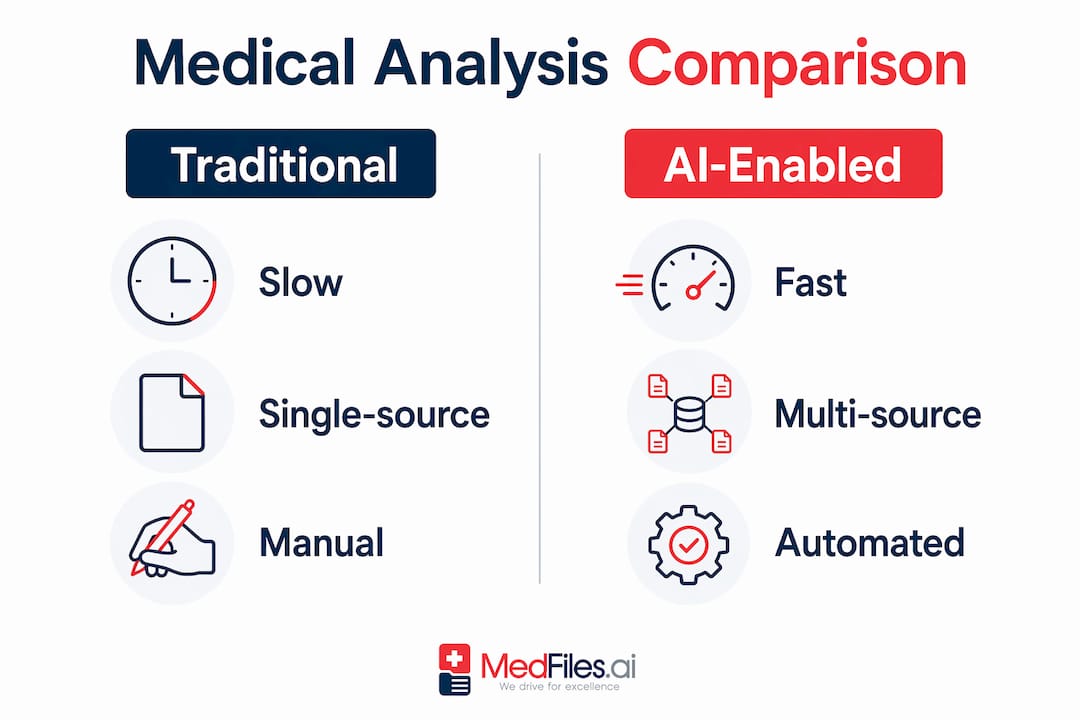
The table below contrasts traditional and AI-enabled medical analysis workflows.
| Dimension | Traditional Analysis | AI-Enabled Analysis |
|---|---|---|
| Speed | Days to weeks for complex data review | Hours or days for large datasets |
| Consistency | Varies by clinician experience | Standardized across patient volume |
| Data scope | Primarily structured records | Structured, unstructured, imaging, genomic |
| Diagnostic accuracy | High for experienced specialists | Matches or exceeds specialists in studies |
| Personalization | General treatment protocols | Trajectory-based, individualized care plans |
Pro Tip: AI recommendations are decision support, not decisions. Always apply clinical judgment before acting on any AI-generated alert or diagnosis, especially for edge cases the model may not have seen during training.
What challenges and ethical issues come with clinical AI?
Clinical AI carries real risks, and understanding them protects both patients and providers.
The first challenge is data quality. Without standardization, AI algorithms struggle to produce meaningful insights from heterogeneous datasets. A model trained on incomplete or biased records will reproduce those biases at scale. Studies have shown AI tools can perform worse on underrepresented demographic groups, which creates equity risks in clinical deployment.
The second challenge is AI hallucinations. Large language models can generate confident-sounding but factually incorrect outputs. Healthcare AI outputs may include errors if the underlying data lacks diversity or quality control. This is why human-in-the-loop verification is not optional. It is a clinical safety requirement.
The third challenge is evaluation. High accuracy scores don’t guarantee better patient outcomes. The biggest barrier to AI adoption is the lack of metrics tied directly to clinical impact. A model can score well on a benchmark and still fail to improve care in practice.
Responsible deployment requires ongoing attention to several factors:
- Algorithmic bias audits conducted regularly across demographic subgroups
- Explainability requirements so clinicians understand why the model flagged a result
- Patient privacy protections aligned with HIPAA and emerging state-level regulations
- Continuous accountability rather than one-time validation at deployment
- Transparent documentation of training data sources and known model limitations
Responsible AI development demands continuous ethical oversight. One-time validation at launch is not sufficient when patient populations, data inputs, and clinical contexts change over time. Understanding your health data privacy rights is part of navigating this landscape as a patient.
How is AI transforming the future of medical analysis?
The next phase of clinical AI is defined by three advances: federated learning, synthetic data generation, and tighter integration with digital health infrastructure.
Federated learning and synthetic data allow AI model training that safeguards patient privacy, enabling collaboration across institutions without transferring sensitive records. A hospital in Boston and a clinic in rural Texas can jointly train a model without either institution ever seeing the other’s patient files. That is a significant shift in how medical AI research can be conducted.
Synthetic data generation creates artificial patient records that mirror real population statistics. These records can fill gaps in training data without exposing any individual’s information, which is critical for building models that perform well across diverse demographics.
The concept of human-machine synergy is also gaining traction. AI handles data-intensive tasks like scanning thousands of imaging studies or flagging medication interactions across a full patient history. Clinicians focus on interpretation, communication, and the judgment calls that require human context. Neither replaces the other.
| Emerging Technology | Potential Clinical Benefit |
|---|---|
| Federated learning | Cross-institution model training without data sharing |
| Synthetic data generation | Diverse training sets that protect patient privacy |
| Multimodal AI models | Simultaneous analysis of imaging, genomic, and EHR data |
| Continuous learning systems | Models that update as new clinical evidence emerges |
| AI-integrated EHR platforms | Real-time decision support embedded in clinical workflows |
Research published in Nature in 2026 found that frontier LLMs consistently outperformed existing specialized clinical AI tools on medical knowledge benchmarks. That finding pushes the field toward independent real-world validation rather than benchmark-only evaluation.
Key takeaways
AI-powered medical analysis accelerates diagnosis and personalizes care, but its clinical value depends entirely on data quality, human oversight, and continuous ethical accountability.
| Point | Details |
|---|---|
| Core definition | Clinical AI uses machine learning and NLP to interpret EHRs, imaging, and genomic data for decision support. |
| Proven diagnostic impact | Harvard Medical School AI outperformed physicians using EHR data alone in a 2026 study. |
| Data quality is foundational | FHIR standardization is required before AI can produce reliable insights from heterogeneous records. |
| Ethics require ongoing work | Bias audits, explainability, and privacy protections must be maintained continuously, not just at launch. |
| Future is collaborative | Federated learning and human-machine synergy define the next generation of clinical AI deployment. |
AI in medicine is a tool, not a verdict
After following clinical AI developments closely, one thing stands out above all the benchmark scores and press releases: the gap between technical performance and real-world clinical value is still wide, and most coverage ignores it.
A model that achieves 95% accuracy on a curated dataset may perform at 78% on the messy, incomplete records that exist in an actual community hospital. That gap is not a minor footnote. It is the difference between a tool that helps and one that misleads. The field needs far more randomized trials measuring patient outcomes, not just diagnostic accuracy scores.
What gives me genuine confidence is the human-machine synergy model. When AI handles the data-heavy scanning and clinicians handle the interpretation, both sides do what they do best. The Cambridge vaccine work is a perfect example. AI designed the antigen structure. Human researchers ran the trial and interpreted the immune response data. Neither could have done it alone.
For patients and caregivers, the practical takeaway is this: ask your provider whether any AI tool used in your care has been validated on populations like yours. That one question will tell you a great deal about how seriously a practice takes responsible AI deployment.
— Team
Manage your medical records with Medfiles
Understanding clinical AI is one thing. Having your medical records organized and ready when AI tools or your care team need them is another.
Medfiles gives you a secure, centralized place to store test results, prescriptions, imaging reports, and clinical notes. The platform uses AI-powered document analysis to organize your records automatically and flag key information. When you see a new specialist or travel abroad, your full history is accessible instantly. Medfiles also supports secure document sharing with providers and family members, backed by HIPAA-ready infrastructure and end-to-end encryption. Your records. Your control. Always ready.
FAQ
What is ai-powered medical analysis in simple terms?
AI-powered medical analysis is software that reads medical data, such as lab results, imaging, and clinical notes, and identifies patterns to help doctors make faster, more accurate decisions.
Can AI diagnose patients better than doctors?
A 2026 Harvard Medical School study showed an AI model matched or outperformed physicians in diagnostic accuracy using EHR data alone, though human oversight remains required for safe clinical use.
What data does clinical AI use?
Clinical AI uses structured data like lab codes and medications, unstructured data like clinical notes, medical imaging such as X-rays and MRIs, genomic sequences, and wearable device readings.
Is AI in healthcare safe for patients?
AI in healthcare carries risks including biased outputs and hallucinations from poor training data. Safe deployment requires human-in-the-loop verification, regular bias audits, and transparent documentation of model limitations.
How does federated learning protect patient privacy?
Federated learning trains AI models across multiple institutions without transferring patient records, keeping sensitive data local while still enabling collaborative model development across health systems.