Confidential Health Sharing: Your Complete 2026 Guide
Explore our comprehensive guide to confidential health sharing. Learn how HIPAA and state laws protect your health information in 2026.

Confidential Health Sharing: Your Complete 2026 Guide
Confidential health sharing in the US means sharing protected health information (PHI) only when the law permits it, with the right people, using the right safeguards. The federal HIPAA Privacy Rule is the primary law governing this, and it applies to every doctor, hospital, pharmacy, and health insurer in the country. PHI covers any individually identifiable information tied to your physical or mental health, your treatment, or your payment for care. It does not include health information in student records governed by FERPA.
Here is what you need to know right away:
- HIPAA permits disclosure without your written consent only for treatment, payment, and healthcare operations, plus specific public health and safety purposes.
- State laws often go further than HIPAA, adding stricter protections for mental health, substance use, and reproductive health records.
- Minors have independent consent rights in many states, meaning parents cannot always access a teen’s health records.
- Sensitive categories get extra protection. Mental health, substance use, and reproductive health records carry heightened confidentiality duties under both federal and state law.
- You have the right to access, amend, and control who sees your health information under HIPAA’s Privacy Rule.
- Unauthorized disclosure carries real legal consequences, including regulatory action and loss of patient trust.
- Digital platforms with HIPAA-ready infrastructure give you the most control over who sees your records and when.
Understanding these rules is not just about legal compliance. It is about knowing your rights, protecting your family, and making sure your health information works for you, not against you.
What does the HIPAA Privacy Rule actually protect?
The HIPAA Privacy Rule, codified at 45 C.F.R. Parts 160 and 164, is the federal standard for protecting health information. It applies to covered entities, which include physicians, dentists, psychologists, hospitals, clinics, pharmacies, and health insurers. Any business associate that handles PHI on behalf of a covered entity is also bound by these rules.
PHI is broadly defined. It includes your medical records, billing information, conversations your doctor has about your care, and health data stored in an insurer’s system. The only carve-out that matters most for schools: health information in student records governed by FERPA falls outside HIPAA’s scope entirely.
When can PHI be shared without your written consent?
HIPAA permits disclosure without authorization under specific, limited circumstances:
- Treatment, payment, and healthcare operations: Your provider can share your records with another treating physician or submit them to your insurer without asking you first.
- Public health activities: Reporting communicable diseases to health authorities is permitted.
- Serious and imminent threats: If disclosure prevents a credible threat to someone’s life or safety, it is allowed.
- Abuse reporting: Providers may report suspected abuse to appropriate agencies.
- Court orders and legal proceedings: A valid court order or subpoena can compel disclosure, provided proper notice or protective steps are taken.
Outside these exceptions, your written authorization is required. And that authorization is not a blank check. HIPAA’s minimum necessary rule requires covered entities to share only the information actually needed for the stated purpose, not your entire medical history.
“Your health information cannot be used or shared without your written permission unless this law allows it. Without your authorization, your provider generally cannot give your information to your employer or use it for marketing or advertising purposes.” — HHS.gov, Your Rights Under HIPAA
What rights do you have under HIPAA?
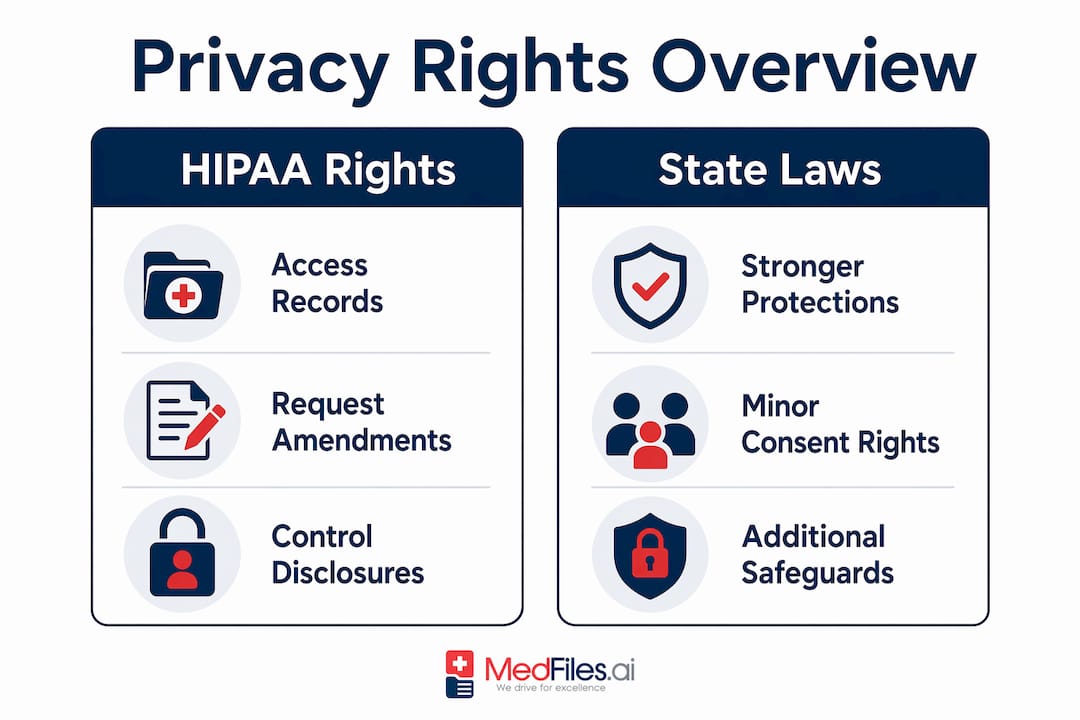
Your rights under the Privacy Rule are concrete and enforceable. Covered entities must comply with your right to:
- Access your records: You can request a copy of your health information, typically within 30 days.
- Request amendments: If you believe your records contain an error, you can ask your provider to correct it.
- Receive an accounting of disclosures: You can ask who has received your PHI and why.
- Request restrictions: You can ask providers to limit how they use or share your information, though they are not always required to agree.
- Receive confidential communications: You can request that your provider contact you only at a specific address or phone number.
Providers also have affirmative obligations. They must put safeguards in place, train employees on privacy practices, and limit internal access to PHI to only those who need it. For healthcare information management, understanding these rights is the foundation of controlling your own care.
How do state laws change your confidentiality rights?
Federal HIPAA sets the floor. State laws frequently raise it. When a state law is more stringent than HIPAA, both laws apply, and providers must comply with whichever is stricter. This matters most in three areas: mental health, substance use, and care for minors.
How state laws vary for minors
State-by-state variability in adolescent privacy is one of the most practically significant aspects of health confidentiality law. In many states, minors can consent to specific health services on their own, which means parents cannot access those records without the minor’s permission. The age thresholds and covered services differ by state.
Washington State is a well-documented example. Under Washington law, minors can consent to care at the following ages:
- Any age: Contraception, abortion services, prenatal care, and emergency care.
- Age 13 and older: Mental health treatment and substance use disorder treatment.
- Age 14 and older: Testing and treatment for sexually transmitted infections.
When a minor consents to their own care, the provider is generally prohibited from sharing that information with parents or guardians without the minor’s permission. This is not a loophole. It is a deliberate policy choice to encourage teens to seek care they might otherwise avoid.
FERPA and school health records
FERPA, the Family Educational Rights and Privacy Act, governs health information held in student education records. A school nurse’s notes kept as part of a student’s education record fall under FERPA, not HIPAA. Parents generally have the right to access those records until the student turns 18, at which point the rights transfer to the student. This distinction matters when a school-based health clinic provides services a minor could consent to independently under state law.
Typical features of state confidentiality laws
| Feature | What it means for you |
|---|---|
| Minor consent statutes | Teens can access specific services without parental approval |
| Mental health confidentiality | Stricter limits on who can see therapy or psychiatric records |
| Substance use protections | State law may mirror or exceed federal 42 C.F.R. Part 2 protections |
| Reproductive health privacy | Records for contraception, abortion, and prenatal care often protected separately |
| Insurance billing safeguards | Clinics may use confidential billing to keep sensitive services off Explanation of Benefits statements |
| Patient portal access tiers | Adolescents and parents often have separate portal logins with different access levels |
Massachusetts offers another instructive example. State law imposes strict confidentiality on Department of Mental Health facilities, permitting disclosure without written consent only in very limited circumstances: at the department’s request, pursuant to a court order, or where disclosure is in the patient’s best interests and written consent is not practicable. General hospitals operate under a somewhat less restrictive standard, but HIPAA still applies as the baseline.
Why do mental health and substance use records get extra protection?
Mental health and substance use records carry a heightened duty of confidentiality that goes beyond standard HIPAA protections. This is not a matter of policy preference. It reflects a legal recognition that stigma around these conditions creates real barriers to care, and that people will not seek help if they fear their records will be disclosed.
Federal protections for substance use disorder records
Federal law under 42 C.F.R. Part 2 (implementing 42 U.S.C. 290dd-2) restricts disclosure of substance use disorder treatment records held by federally assisted programs. The restrictions apply to any information that identifies, or could be used to identify, a patient as having a substance use disorder. Providers may share this information with the patient’s written consent, but that consent must meet detailed requirements spelled out in 42 C.F.R. §2.31, including the name of the program, the name of the person or organization receiving the information, the purpose of the disclosure, and an expiration date.
Critically, anyone who receives information from a substance use disorder treatment program is prohibited from re-disclosing it. The protection travels with the data.
“Providers that treat substance use disorders are subject to a ‘heightened’ duty of confidentiality under both federal and state law. Federal law limits the circumstances under which a provider in a federally assisted program can disclose information obtained in connection with treating a patient with a substance use disorder.” — Mass.gov Guide on Disclosure of Confidential Health Information
Mental health records
Most confidentiality laws covering mental health apply to information acquired by a mental health provider in connection with counseling or providing services. This includes the type of services provided, dates and frequency of sessions, clinical test results, diagnosis, treatment plans, and confidential communications between patient and provider. Mental health providers may disclose this information with written consent and in limited other circumstances, such as consulting with another treating provider or pursuant to a court order.
Reproductive health privacy
Reproductive health records, including contraception, abortion services, and prenatal care, receive separate confidentiality protections in many states. Providers in these states may use confidential billing arrangements to prevent sensitive services from appearing on insurance Explanation of Benefits statements that a parent, spouse, or employer might see.
Key heightened protections at a glance
- Substance use disorder records require consent that meets 42 C.F.R. §2.31’s specific elements.
- Re-disclosure of substance use records by the recipient is prohibited.
- Mental health records are protected even from other providers unless treatment-related consultation is involved.
- Reproductive health records may be billed confidentially to prevent third-party visibility.
- Emergency exceptions exist for imminent safety threats and mandated child abuse reporting.
- Minors’ substance use records cannot be released to parents without the minor’s own consent, even when the parent is otherwise the authorized representative.
What are the consent rights of minor patients?
Consent for minors in healthcare is one of the most nuanced areas of confidentiality law. The default rule under HIPAA is that a minor’s parent or guardian is the authorized representative, meaning they can generally access the minor’s PHI. But that default has significant exceptions, and those exceptions are where adolescent privacy rights live.
When minors control their own records
Under HIPAA, if state law permits a minor to consent to their own medical treatment, then the minor alone holds the authority to consent to the release of information about that treatment. The parent or guardian is not treated as the authorized representative for those services. This means the provider must obtain the minor’s consent before disclosing that information to anyone, including the parent.
Adolescents often assume parents can access all their records, but that assumption is frequently wrong for services the minor consented to independently. Providers are recommended to facilitate confidential discussions starting at preteen ages, and to clearly explain to both teens and parents which records are private and which are not.
Private clinical time for adolescents
Private time during healthcare visits is a standard part of adolescent care, not a sign of a problem. Many clinics bring the teen alone to the exam room first. A staff member may ask questions about safety, sexual health, and substance use. These questions are routine for all teens and are asked privately to support honest answers. After this, parents are typically invited back in for the rest of the visit.
Adolescent private time promotes honest communication. Teens are more likely to share important health information with their provider when they know the conversation is private. This directly improves health outcomes for sensitive issues including mental health, reproductive health, and substance use. For parents concerned about teen mental health, resources like teen crisis prevention guidance can help frame these conversations constructively.
Consent age thresholds and authorized representatives
| Scenario | Who controls the records |
|---|---|
| General medical care, minor under 18 | Parent or guardian as authorized representative |
| Minor consents to own mental health care (age 13+, Washington) | Minor controls disclosure |
| Minor consents to STI testing/treatment (age 14+, Washington) | Minor controls disclosure |
| Substance use disorder treatment, any age | Minor must consent to release, even to parents |
| Minor turns 18 | Rights transfer fully to the patient |
| Caregiver authorization affidavit in place | Designated caregiver may act as authorized representative |
Practical steps for handling minor consent
- Ask the minor directly which contact information (phone, email) to use for follow-up on confidential services.
- Set up separate patient portal logins for teens and parents, with different access levels, and explain the difference at registration.
- Document clearly which services the minor consented to independently, so staff know which records require the minor’s authorization before release.
- Train front desk and clinical staff on state-specific minor consent laws, since these vary and change.
- When a minor wants to share something from private time with a parent, the provider can facilitate that conversation rather than disclosing it unilaterally.
Pro Tip: If you are a parent, after your teen’s appointment ask how the visit went, not what was discussed during private time. Questions like “Did the provider answer your questions?” show you care without pressuring your teen to share more than they are ready to.
How can you exercise your HIPAA rights and share health information safely?
Your HIPAA rights are only as useful as your ability to act on them. Knowing the rules is step one. Using them in practice is where most people fall short.

Accessing and amending your records
You have the right to request a copy of your health records from any covered entity. Providers generally must respond within 30 days, though they may charge a reasonable fee for copies. If you find an error, submit a written amendment request. The provider must respond, and even if they deny the amendment, they must note your disagreement in the record.
Providing and revoking consent
Written authorization for disclosure must specify who can receive your information, what information is covered, the purpose of the disclosure, and an expiration date or event. You can revoke authorization at any time in writing, except where the covered entity has already acted on it. Revocation does not undo past disclosures, but it stops future ones.
Best practices for protecting your privacy
- Request a Notice of Privacy Practices from every new provider. This document explains how they use and share your information and is required by HIPAA.
- Review your Explanation of Benefits statements after every visit. Unexpected entries can signal a disclosure you did not authorize.
- Use confidential communication requests if you need your provider to contact you at a specific address or phone number, not the one on file.
- Ask about patient portal security before uploading sensitive documents. Confirm the portal uses encryption and requires two-factor authentication.
- Check whether your state has a health privacy office or attorney general’s office that handles HIPAA complaints, since state enforcement can sometimes move faster than federal action.
Legal consequences of unauthorized disclosure
Unauthorized disclosure of PHI can trigger regulatory action by the HHS Office for Civil Rights, civil monetary penalties, and in cases of willful neglect, criminal prosecution. Beyond legal penalties, unauthorized disclosure damages the trust that makes healthcare work. Patients who fear their information will be shared without consent delay or avoid care entirely, which leads to worse health outcomes. Proper consent and secure sharing protocols are the practical defense against both outcomes.
Pro Tip: Keep a personal log of every authorization you sign, including the date, the recipient, the purpose, and the expiration. If you ever need to revoke consent or dispute a disclosure, this record is your starting point.
For sharing records with providers, understanding what you are authorizing before you sign is the single most effective way to stay in control of your health information.
How does a secure digital platform help you manage confidential health records?
Managing confidential health information across multiple providers, family members, and care settings is genuinely difficult without a centralized system. Paper records get lost. Emails are not encrypted. Faxes go to the wrong number. A purpose-built digital health platform solves these problems by giving you one secure place to store, organize, and share your records on your terms.
What a HIPAA-ready platform actually provides
A platform built for health record management does more than store files. It organizes documents automatically, tracks who has access to what, and uses end-to-end encryption to protect data in transit and at rest. HIPAA-ready infrastructure means the platform has signed a Business Associate Agreement, maintains audit logs, and limits internal access to PHI. These are not marketing claims. They are contractual and regulatory requirements.
Secure digital health platforms combine HIPAA-level encryption with AI-driven organization, enabling safe storage and controlled sharing of confidential health records. Medfiles is built on exactly this model, offering multi-profile management for families, separate access controls for different family members, and the ability to share specific records with a provider without exposing your entire history.
Features that matter for confidential sharing
- Granular sharing controls: Share a single lab result with a specialist without giving them access to your full record.
- Multi-profile management: Manage records for children, elderly parents, and other family members under one account, with separate privacy settings for each.
- Audit trails: See exactly who accessed which records and when, so you can spot unauthorized access immediately.
- Emergency access: Grant temporary access to emergency responders or a new provider when you cannot communicate directly.
- Document organization: AI-powered categorization keeps test results, prescriptions, imaging reports, and clinical notes sorted and searchable.
Why families benefit most
Families managing care for children and aging parents face the most complex confidentiality challenges. A parent managing a teenager’s care needs to respect the minor’s independent consent rights while still staying involved in general health decisions. A caregiver for an elderly parent needs to access records quickly in an emergency without wading through paper files. Family health records stored in one secure platform give every family member the right level of access, nothing more and nothing less.
For secure health information sharing, the practical advantage of a digital platform is control. You decide what gets shared, with whom, and for how long. That is exactly what HIPAA’s consent framework is designed to protect, and a good platform makes exercising those rights straightforward rather than burdensome.
Pro Tip: When choosing a digital health platform, look for three things: a signed Business Associate Agreement confirming HIPAA compliance, end-to-end encryption for all stored and transmitted files, and granular sharing controls that let you share individual documents rather than your entire record.
Take control of your health information with Medfiles
Your health records are yours. Medfiles gives you the tools to keep them that way. Store every document securely, share exactly what each provider needs, and manage records for your entire family from one encrypted platform built on HIPAA-ready security.
Whether you are managing a teenager’s confidential care, coordinating with multiple specialists, or preparing for an emergency, Medfiles puts you in control. No paper clutter. No unsecured emails. No guessing who has access to what.
Start protecting your health records today and see why families and healthcare providers trust Medfiles to keep confidential health information exactly where it belongs: private, organized, and accessible only to the people you choose.
Key Takeaways
HIPAA sets the federal floor for health information privacy, but state laws, minor consent rights, and heightened protections for sensitive conditions create a layered system that requires active attention from both patients and providers.
| Point | Details |
|---|---|
| HIPAA governs PHI disclosure | Providers may share PHI without consent only for treatment, payment, public health, and specific safety purposes. |
| State laws add stricter rules | Many states impose tighter protections for mental health, substance use, and reproductive health records beyond federal requirements. |
| Minors have independent rights | When state law lets a minor consent to their own care, only the minor can authorize disclosure of those records. |
| Sensitive records get extra protection | Substance use disorder records under 42 C.F.R. Part 2 require specific written consent and prohibit re-disclosure by recipients. |
| Digital platforms support compliance | HIPAA-ready platforms with end-to-end encryption and granular sharing controls give patients the most practical control over their records. |