Health Information Interoperability Explained for 2026
Discover the essentials of health information interoperability explained. Learn how seamless data exchange impacts modern healthcare. Read more!

Health Information Interoperability Explained for 2026
Health information interoperability is the ability of diverse healthcare systems to exchange, interpret, and use patient data securely and without friction. The industry term is “health data interoperability,” and it sits at the center of every major reform effort in U.S. healthcare today. Standards like HL7, FHIR, and C-CDA define how data moves. Regulations like the 21st Century Cures Act and TEFCA define who must share it and when. Understanding how these pieces fit together is no longer optional for clinicians or informed patients. It is the foundation of modern care.
Understanding health information management starts with recognizing that interoperability is not a single technology. It is a capability built from four distinct layers, a web of technical standards, and a governance structure that spans federal policy and local hospital agreements.
What is health information interoperability and why does it matter?
Health data interoperability is defined as the capacity of different information systems, devices, and applications to access, exchange, integrate, and cooperatively use data in a coordinated way. The Office of the National Coordinator for Health Information Technology (ONC) uses this definition as the baseline for all federal policy. 72% of hospitals now use digital interoperability solutions, a figure that reflects how central this capability has become to hospital operations. That adoption rate also signals that the remaining 28% face growing compliance and care quality pressure.
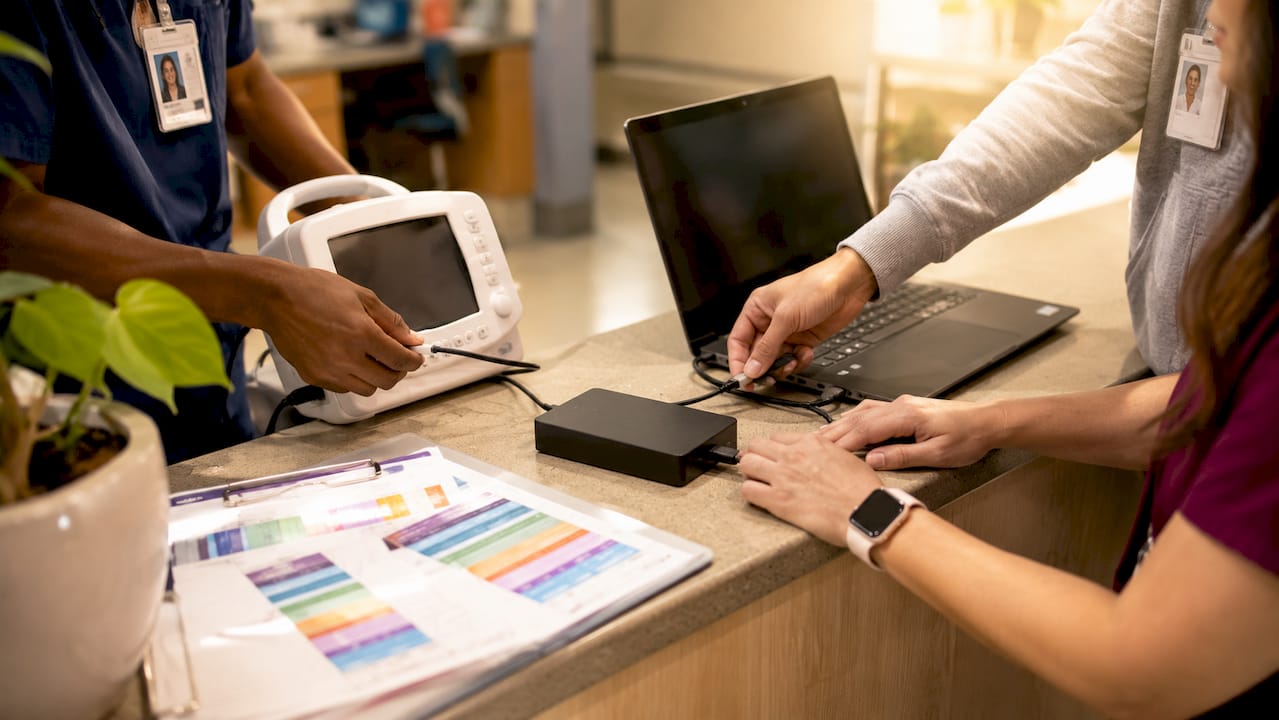
The distinction between interoperability and integration matters here. Integration creates rigid point-to-point connections between specific systems. Interoperability acts as a universal translator, allowing any compliant system to communicate with any other without a custom-built pipeline for each pair. That difference is what makes interoperability scalable across a national health system rather than just a single hospital network.
What are the four levels of interoperability in healthcare?
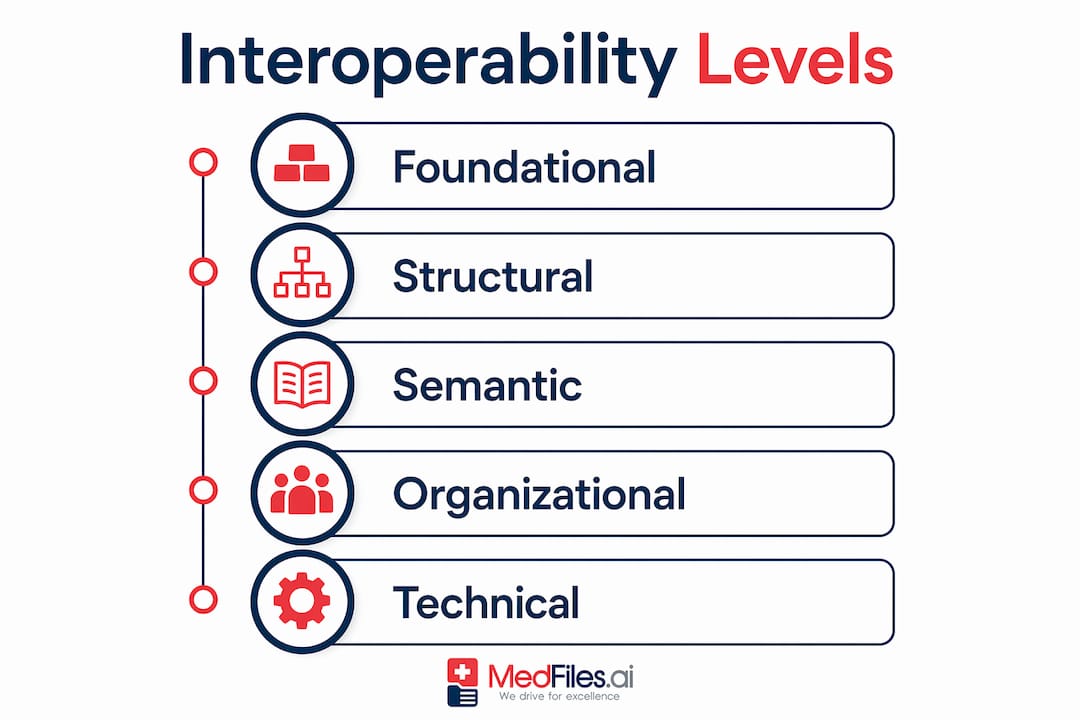
The Healthcare Information and Management Systems Society (HIMSS) defines four levels of interoperability, each building on the last. Skipping any level produces gaps that cause real clinical harm.
-
Foundational interoperability is the baseline. One system can send data to another and receive it without errors. No interpretation happens at this level. Think of it as establishing a reliable postal service before worrying about whether the recipient can read the language.
-
Structural interoperability adds format. Data is packaged in a standardized structure so the receiving system knows where each field belongs. HL7 v2 messages and FHIR resources both operate at this level. A lab result arrives with the value in the correct field, not buried in a free-text note.
-
Semantic interoperability is where meaning is preserved. Shared vocabularies like SNOMED CT and LOINC, along with RxNorm for medications, ensure that “myocardial infarction” in one system maps to the same concept in another. Without this layer, semantic friction occurs even when two systems use the same technical standard but map data fields differently.
-
Organizational interoperability is the governance layer. It covers the legal agreements, trust frameworks, and policies that allow organizations to share data across institutional boundaries. TEFCA, the Trusted Exchange Framework and Common Agreement, operates at this level by establishing a nationwide network of networks with common policies and standards.
Pro Tip: If your organization has achieved structural interoperability but still sees data mismatches, the problem is almost always at the semantic level. Audit your vocabulary mappings against SNOMED CT and LOINC before investing in new infrastructure.
Which technical standards and regulations drive healthcare interoperability in 2026?
The standards and regulations shaping health data interoperability today did not arrive all at once. They evolved over decades, and several now coexist in production environments.
| Standard or Regulation | Primary Role | Current Status |
|---|---|---|
| HL7 v2 | Legacy messaging for labs, ADT, pharmacy | Still dominant in hospital back-end systems |
| FHIR R4 | API-driven clinical data exchange | Federally mandated for certified EHRs |
| C-CDA | Structured clinical documents (discharge summaries, referrals) | Required for transitions of care |
| X12 | Administrative and billing transactions (claims, eligibility) | Required under HIPAA |
| 21st Century Cures Act | Mandates open APIs, prohibits information blocking | Enforcement active |
| TEFCA | Nationwide trust framework for HIE networks | Operational and expanding |
The 21st Century Cures Act mandates that certified electronic health records (EHRs) support FHIR R4 APIs by 2026. This is the single most consequential technical requirement in U.S. healthcare right now. It means your EHR vendor must expose patient data through a standardized API that third-party apps can query directly, with patient consent.
FHIR R4 paired with SMART on FHIR authorization is the current gold standard for real-time data access. FHIR RESTful APIs enable on-demand queries for medication lists, lab results, and clinical notes across systems. That capability transforms care delivery in emergency settings where a patient’s full history must be available in minutes, not days.
On the payer side, CMS has proposed that impacted payers comply with new interoperability implementation guides by October 1, 2027. This extends the interoperability mandate beyond providers into insurance operations, covering prior authorization workflows that currently cause significant care delays.
Pro Tip: HITRUST CSF and SOC 2 Type II certifications are voluntary but increasingly expected by health system partners. If your organization exchanges data with large health systems, these certifications reduce the friction of trust negotiations significantly.
What challenges hinder achieving full health information interoperability?
Full interoperability remains out of reach for most organizations. The barriers are technical, semantic, organizational, and regulatory, and they compound each other.
-
Legacy system fragmentation. Most hospitals run HL7 v2 interfaces built over 20 years. Replacing them wholesale is not financially viable. Pragmatic solutions use standards-based translation layers that sit between legacy systems and modern FHIR endpoints, converting messages without replacing the source system.
-
Semantic friction at scale. Two systems can both claim HL7 compliance and still exchange meaningless data if their vocabulary mappings differ. A “blood pressure reading” coded one way in Epic and another way in Oracle Health Millennium requires normalization before either system can act on it reliably.
-
Organizational silos and trust gaps. Interoperability is not merely a software feature. It requires business agreements, data use contracts, and liability frameworks between organizations. Many data-sharing initiatives stall at the legal review stage, not the technical one.
-
Regulatory complexity. Effective interoperability requires alignment of technology, regulation, and governance. Compliance with the 21st Century Cures Act, HIPAA, state privacy laws, and CMS payer rules simultaneously demands legal and technical resources that smaller practices often lack.
-
Information blocking. The ONC’s information blocking rules prohibit practices that unreasonably restrict access to electronic health information. Enforcement actions are increasing, but identifying blocking behavior in complex multi-vendor environments remains difficult.
The shift from point-to-point integration to API-driven, open architectures addresses many of these challenges by design. A network-of-networks model means adding a new participant does not require a new bilateral agreement with every existing participant.
How does interoperability improve care delivery and patient outcomes?
The practical benefits of health information exchange are concrete and measurable. Here is how interoperability changes care at the point of delivery.
-
Faster clinical decisions. When a patient arrives in an emergency department unconscious, FHIR-enabled queries can pull their medication list, allergy history, and recent lab results from their primary care EHR in seconds. That data prevents contraindicated treatments and reduces time to diagnosis.
-
Reduced duplicate testing. A patient who sees three specialists in a year may have the same blood panel ordered three times if those specialists cannot access prior results. Interoperable systems eliminate that redundancy, saving patients money and reducing unnecessary procedures.
-
Improved care coordination. Chronic disease management across primary care, cardiology, and pharmacy requires all three to see the same current data. Interoperability makes that shared view possible without phone calls or fax transmissions.
-
Patient empowerment. Patients who can access and share their own records through FHIR-enabled apps make better decisions and engage more actively in their care. The 21st Century Cures Act specifically protects patients’ right to access their data through third-party applications.
-
Administrative efficiency. Prior authorization, eligibility verification, and claims processing all benefit from automated data exchange. Reducing manual steps in these workflows cuts administrative costs and speeds up care approvals.
Digital health solutions that support these workflows give both providers and patients a practical entry point into the interoperability ecosystem without requiring a full EHR replacement. Patient data that is organized, accessible, and shareable is the raw material that makes all five of these benefits possible.
Key takeaways
Health information interoperability requires four aligned layers: foundational connectivity, structural formatting, semantic vocabulary, and organizational governance. No single layer is sufficient on its own.
| Point | Details |
|---|---|
| Four levels are all required | Foundational, structural, semantic, and organizational interoperability each address a distinct failure mode. |
| FHIR R4 is now federally mandated | Certified EHRs must support FHIR R4 APIs in 2026, making this the baseline technical requirement. |
| Semantic friction is the hidden barrier | Systems using the same standard can still exchange meaningless data without shared vocabularies like SNOMED CT and LOINC. |
| Governance is as important as technology | TEFCA and organizational trust frameworks resolve the legal and policy gaps that technical standards cannot fix alone. |
| Patients benefit directly | Interoperability reduces duplicate testing, speeds diagnosis, and gives patients control over their own health data. |
Why the governance gap is the real interoperability problem
The healthcare industry has spent two decades solving the technical side of interoperability. HL7, FHIR, and SNOMED CT are mature, well-documented, and widely implemented. What consistently breaks real-world data sharing is not the technology. It is the absence of trust.
I have watched organizations spend months negotiating data use agreements that should take days, not because the legal issues are genuinely complex, but because no one has established a shared framework for resolving them quickly. TEFCA exists precisely to fix this. It creates a common set of policies that participating networks agree to upfront, so individual organizations do not have to renegotiate trust from scratch every time they want to share data with a new partner.
The National Academy of Medicine’s vision of a fully interoperable national health data architecture is not science fiction. It is an engineering and governance problem, and the governance piece is closer to solved than most people realize. What it needs now is consistent adoption and enforcement.
My advice to clinicians: do not wait for your EHR vendor to solve this for you. Engage with your regional health information exchange, understand what TEFCA participation means for your practice, and start asking your vendors for their FHIR R4 compliance documentation. The organizations that engage proactively now will have a significant operational advantage as CMS enforcement timelines approach.
For patients: you have a legal right to your health data. Use it. Apps built on FHIR APIs can aggregate your records from multiple providers into a single view. That capability exists today, and it is free to use.
— Team
How Medfiles helps you put interoperability to work
Interoperability standards define how data should move. Medfiles gives you the tools to actually move it, securely and on your terms.
Medfiles is built for both doctors and patients who need a reliable, HIPAA-ready system for storing, organizing, and sharing medical records. Upload test results, prescriptions, imaging reports, and clinical notes. Share them instantly with any provider, anywhere, without fax machines or phone tag. For clinicians, Medfiles supports the kind of structured data exchange that interoperability standards demand. For individuals, it puts your complete medical history in your pocket, accessible the moment a new provider or emergency room needs it. Start organizing your records at Medfiles.ai today.
FAQ
What is health information interoperability?
Health information interoperability is the ability of different healthcare systems to exchange, interpret, and use patient data without custom connections between each pair of systems. It operates across four levels: foundational, structural, semantic, and organizational.
How is interoperability different from integration?
Integration creates fixed, point-to-point connections between specific systems. Interoperability acts as a universal translator, allowing any compliant system to communicate with any other, making it scalable across large networks rather than just paired systems.
What is FHIR and why does it matter?
FHIR (Fast Healthcare Interoperability Resources) is a modern API standard developed by HL7 that enables real-time, on-demand queries for clinical data like medication lists and lab results. The 21st Century Cures Act mandates that certified EHRs support FHIR R4 APIs by 2026.
What is TEFCA?
TEFCA, the Trusted Exchange Framework and Common Agreement, is a federal initiative that establishes a nationwide network of networks for health information exchange. It provides the governance and policy framework that allows organizations to share data without negotiating bilateral agreements from scratch.
Why do patients need to understand interoperability?
Patients have a legal right under the 21st Century Cures Act to access their electronic health data through third-party apps. Understanding interoperability helps patients use that right to consolidate records, reduce duplicate testing, and share accurate histories with every provider they see.