How AI is transforming pet healthcare for the better
Discover the role of AI in pet healthcare and how it enhances diagnostics, ensures faster treatments, and improves your pet's health today!
How AI is transforming pet healthcare for the better
Most pet owners assume that great veterinary care comes down to a skilled vet, a trustworthy clinic, and regular checkups. That assumption is not wrong. But it is incomplete. Right now, artificial intelligence is quietly changing every layer of pet healthcare, from how X-rays are read to how your dog’s heart rate is tracked while you sleep. These changes are not coming. They are already here. This article walks you through what AI is doing in veterinary medicine today, what it means for your pet, and how you can use these tools to stay ahead of health problems before they become serious.
Table of Contents
- AI-powered diagnostics: Enhancing accuracy and speed
- Wearable devices and telehealth: Monitoring pets beyond the clinic
- AI in medical records: Streamlining documentation and reducing burnout
- Predictive analytics and personalized pet care
- Ethics, transparency, and the limits of AI in pet healthcare
- Our take: AI is a game-changer, but pet healthcare still needs human wisdom
- Ready to experience AI-enhanced pet care?
- Frequently asked questions
Key Takeaways
| Point | Details |
|---|---|
| Rapid, accurate diagnostics | AI systems interpret pet radiographs quickly, often matching a top radiologist’s accuracy for faster results. |
| Continuous home monitoring | AI wearables let pet owners track vital signs and symptoms from home, enabling earlier intervention. |
| Smarter, safer recordkeeping | Automated documentation creates more detailed pet health records but still needs a vet’s review for accuracy. |
| Personalized care via predictive analytics | AI forecasts disease risks and sends targeted alerts, helping owners take action before problems escalate. |
| Ethical oversight required | Despite AI’s potential, expert supervision remains essential to prevent bias, ensure transparency, and protect privacy. |
AI-powered diagnostics: Enhancing accuracy and speed
Let’s start with the core of veterinary care: diagnostics. Getting a correct diagnosis quickly is the single most important factor in treatment success. Delays cost time, money, and sometimes lives. Traditional diagnostics depend heavily on the experience of the individual vet or radiologist reading an image. That creates variability. Two professionals looking at the same X-ray might reach different conclusions.
AI changes that equation significantly. AI enhances veterinary diagnostics through image analysis using convolutional neural networks (CNNs), support vector machines (SVMs), and random forests, with applications spanning clinical practice, research, public health, and administration. These algorithms are trained on millions of labeled images, so they recognize patterns that are difficult for the human eye to catch consistently.
Here is a practical comparison of traditional versus AI-driven diagnostic methods:
| Factor | Traditional diagnostics | AI-assisted diagnostics |
|---|---|---|
| Speed | Hours to days | Minutes to seconds |
| Consistency | Varies by individual | Standardized output |
| Availability | Specialist required | Available 24/7 remotely |
| Cost | Often high | Increasingly affordable |
| Error rate | Human fatigue possible | Consistent, no fatigue |
Platforms like SignalPet, Imagyst, and CoVet are already being used in real clinics to analyze radiographs and flag abnormalities. A vet can upload an X-ray and receive a detailed report in minutes, flagging everything from bone fractures to early signs of lung disease. That kind of speed is not just convenient. It is clinically meaningful.
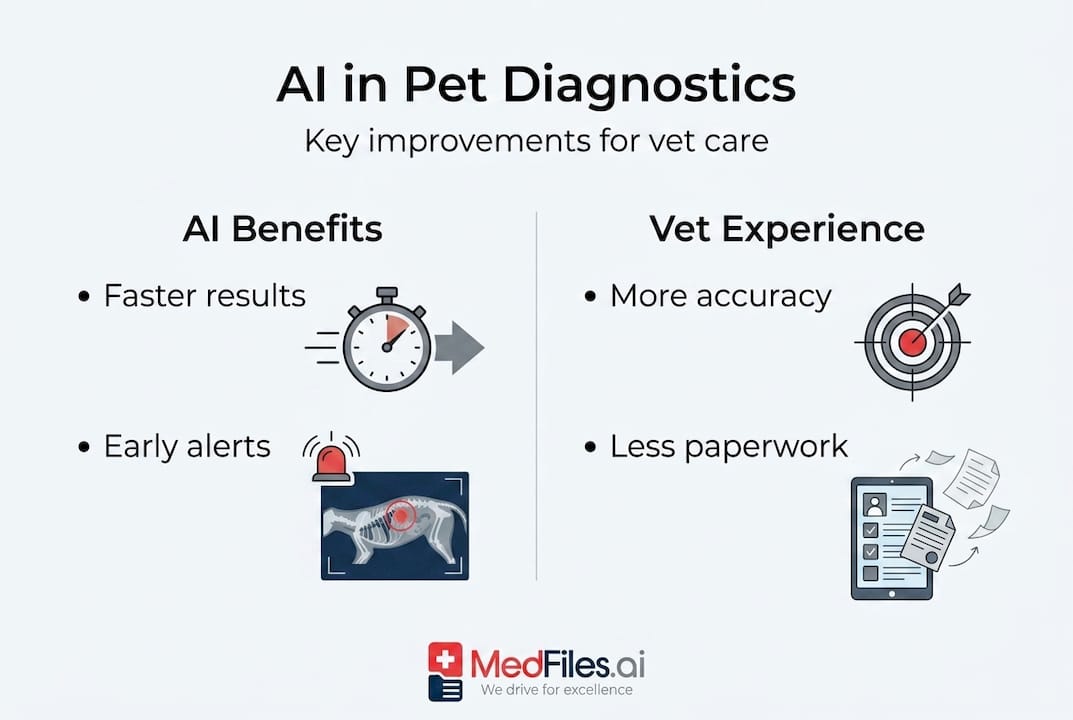
The accuracy is equally impressive. Commercial AI radiology software matches top radiologist accuracy with no statistically significant difference, and is more specific, though slightly less sensitive, than the median radiologist. In practical terms, this means AI catches confirmed abnormalities reliably and avoids over-diagnosing false positives at a rate that rivals the best human specialists.
Key benefits of AI-driven diagnostics for your pet include:
- Faster turnaround so treatment starts sooner
- Standardized analysis regardless of clinic size or location
- Accessible specialist-level review even in rural or under-resourced clinics
- Reduced diagnostic gaps when a generalist vet needs a second opinion
- Consistent tracking of changes across multiple imaging sessions over time
You can explore how AI for veterinary diagnostics is being integrated into modern practice, and compare pet healthcare software options if you want to understand the tools your clinic might already be using.
Wearable devices and telehealth: Monitoring pets beyond the clinic
Building on faster diagnostics, AI also helps pet owners stay proactive through at-home monitoring and telehealth. The clinic visit is a snapshot. What happens during the other 364 days of the year matters just as much. AI-enabled wearables are turning continuous monitoring from a luxury into a practical reality for everyday pet owners.
Devices like the PetPace smart collar represent a major shift in how we think about pet health. AI-powered wearables like PetPace monitor vitals including heart rate, respiration, and temperature in real time, and can detect signs of pain and epilepsy while sharing that data directly with veterinary teams for telehealth consultations. That is not a fitness tracker. That is a clinical-grade monitoring device you can put on your dog or cat at home.
Here is a look at key metrics these devices track and why they matter:
| Metric | Why it matters |
|---|---|
| Heart rate | Detects cardiac irregularities early |
| Respiratory rate | Flags breathing problems or infections |
| Body temperature | Identifies fever or hypothermia |
| Activity level | Tracks mobility changes linked to pain |
| Sleep patterns | Signals neurological issues or discomfort |
Connecting a wearable to a telehealth platform takes only a few steps:
- Set up the device according to manufacturer instructions and create an account in the companion app.
- Link the app to your veterinary clinic’s telehealth portal or share access directly with your vet.
- Allow the device to collect baseline data for 5 to 7 days before your first consultation.
- Review the trend data with your vet during a scheduled video appointment.
- Adjust monitoring settings or alert thresholds based on your pet’s specific health conditions.
Telehealth removes the barrier of travel and allows continuous data review instead of point-in-time assessments. This is especially valuable for senior pets with chronic conditions, post-surgical recovery cases, or animals that experience extreme stress during clinic visits.
Pro Tip: When choosing a wearable device for your pet, prioritize models that offer verified integration with licensed veterinary telehealth platforms. Devices that only send data to a general wellness app may not meet the standards needed for clinical decision-making.
Explore how AI health monitoring for pets can support your pet’s care between appointments, and learn more about the broader pet health management benefits of staying digitally connected to your pet’s health data.
AI in medical records: Streamlining documentation and reducing burnout
Monitoring and diagnostics are crucial, but seamless information management is just as vital. AI now plays a major role here too. Veterinary burnout is a real and growing crisis. One major contributor is administrative workload. Vets spend enormous amounts of time writing up visit notes, updating records, and processing paperwork that takes them away from actual patient care.
AI scribes are changing that. AI scribes automate record generation directly from appointments, capturing more clinical detail than manual records typically contain, but they do require vet review to catch potential errors or hallucinations. A hallucination in this context means the AI confidently generates incorrect information, such as inventing a medication dosage or misrecording a symptom. It is rare, but real.
The practical benefits are significant:
- Richer records with more clinical detail captured automatically during the appointment
- Faster documentation so vets spend less time on paperwork and more with patients
- Fewer transcription errors compared to rushed manual note-taking at the end of a long shift
- Consistent formatting that makes records easier to search, share, and review
- Reduced burnout for veterinary staff, which improves overall care quality
“AI scribing has genuinely changed how I end my workday. I’m not staying two hours late to finish notes. But I still review every record before it goes final. The AI is very good, but it’s not infallible. There have been a couple of cases where it got a detail wrong that would have caused problems if I hadn’t caught it.” — Dr. Sarah Connelly, small animal practitioner, quoted by the Veterinary Information Network
Pro Tip: Always review AI-generated records yourself before sharing them with specialists, insurance providers, or other clinics. Even excellent AI tools can make subtle errors that only a knowledgeable professional would catch.
Understanding the digital pet record benefits of organized, accurate documentation helps you see why this matters beyond the clinic. And if you want to manage your pet’s complete medical history in one secure place, digital medical history tools make that possible for everyday pet owners too.
Predictive analytics and personalized pet care
Accurate records and monitoring feed directly into something powerful: predictive care shaped by AI insights. This is where AI moves from reactive to proactive. Instead of waiting for a symptom to appear, predictive analytics work to flag risk before your pet ever shows signs of illness.
Predictive analytics forecast disease risks and enable personalized treatment plans by drawing on population-level data from thousands of similar animals. That means your pet’s care plan is informed not just by their own history, but by patterns identified across an entire population of pets with similar genetics, environments, and lifestyles.
AI uses many types of data to make these predictions:
- Symptom history including previous illnesses and recurring complaints
- Genetic risk factors where breed-specific disease tendencies are factored in
- Environmental data such as geographic location and seasonal disease patterns
- Dietary information and known intolerances or deficiencies
- Activity and sleep patterns gathered from wearable devices
Real-world impact is already visible. A dog owner who learned that their Labrador had an elevated risk of joint disease was able to start a targeted supplement and exercise program two years before any symptoms appeared, avoiding the need for surgical intervention. This kind of early action, guided by data rather than guesswork, is exactly what AI makes possible. One compelling example of how diet and environment intersect with pet health can be seen in cases like this account of chronic digestive issues, where identifying food triggers earlier through data tracking could have reduced years of discomfort.
Personalized alerts mean you get a notification relevant to your specific pet, not a generic reminder. If your cat’s breed has a higher incidence of hypertrophic cardiomyopathy, AI can prompt cardiac screening at the right age, not just whenever it happens to come up. That is genuinely personalized care.
Ethics, transparency, and the limits of AI in pet healthcare
While AI offers incredible advantages, there are critical points pet owners must understand before relying fully on tech-enabled healthcare. The same tools that make diagnostics faster and records richer also carry real risks when used without proper oversight.
The most significant concern is the black box problem. Many AI tools lack transparency, meaning they cannot explain why they reached a particular conclusion. When an AI flags a suspicious lesion on an X-ray, the algorithm cannot always tell the vet exactly which features triggered that flag. That opacity makes it difficult to assess reliability or challenge the output.
Other risks pet owners should be aware of include:
- Training data bias: If an AI was trained primarily on data from certain breeds, regions, or clinic types, it may perform poorly on animals outside that profile
- Privacy risks: Health data shared with AI platforms may be stored, analyzed, or sold in ways that are not always transparent to the user
- Liability gaps: When an AI-assisted diagnosis contributes to a bad outcome, accountability can be unclear
- Over-reliance: Pet owners or even vets who trust AI outputs without critical review may miss errors that a more skeptical approach would catch
“Veterinarians must remain the final decision-makers. AI is a tool, not a clinician. The ethical responsibility for patient outcomes stays with the professional, regardless of what the algorithm suggests.” — American Journal of Veterinary Research, 2024 special issue on AI ethics
None of this means AI should be avoided. It means it should be used thoughtfully, with human expertise always in the loop. Your vet’s judgment, clinical experience, and knowledge of your specific pet remain irreplaceable.
Our take: AI is a game-changer, but pet healthcare still needs human wisdom
Here is our honest view. The excitement around AI in veterinary medicine is warranted. The speed, accuracy, and personalization it offers are genuinely valuable. But the conversation too often swings toward either uncritical enthusiasm or unfounded fear. The truth sits in the middle.
AI performs brilliantly on well-defined tasks with clear data. Radiograph reading. Vital sign monitoring. Record generation. It struggles with ambiguous cases, rare breeds, and situations where context and intuition matter as much as data. A senior vet who has treated a specific breed for twenty years brings something no algorithm currently replicates.
Smart pet owners use AI tools to sharpen their awareness, not to replace the relationship with a trusted veterinarian. Ask your clinic which platforms they use and how results are reviewed. Understand what data your pet’s wearable is collecting and who has access to it. Stay engaged. Learn more about AI health benefits for your pets so you can have informed conversations with your vet about integrating these tools thoughtfully.
Pro Tip: Ask your vet directly which AI-powered tools your clinic uses and how the results are interpreted. A clinic that can explain its AI workflow clearly is one that is using it responsibly.
Ready to experience AI-enhanced pet care?
If this article has shown you anything, it is that managing your pet’s health data is now just as important as the clinic visit itself. Wearables generate data. AI creates records. Diagnostics produce images and reports. All of that information needs to be stored securely, organized clearly, and accessible when it matters most.

MedFiles.ai gives you a secure digital home for your pet’s complete medical history. Upload records, share them instantly with any vet or specialist, and keep everything organized without the paperwork chaos. Whether you are tracking ongoing conditions, preparing for a specialist visit, or just want to be ready for any emergency, explore how AI for pet owners and AI for veterinary professionals can work together through a platform built for exactly this kind of modern care.
Frequently asked questions
How does AI improve diagnostic accuracy for pets?
AI analyzes medical images using advanced algorithms, and commercial AI radiology software matches or exceeds the accuracy of the median radiologist in certain cases, with stronger specificity than most human reviewers.
What kinds of pet health issues can AI wearables detect?
AI-enabled wearables like PetPace track heart rate, respiration, temperature, and movement patterns, and can detect pain signals and epilepsy indicators while sending the data directly to your veterinary team.
Are AI-generated medical records reliable for pets?
AI-generated veterinary records typically capture more clinical detail than manual notes, but vets must review them carefully because hallucinations and minor factual errors do occur and can affect care decisions.
What ethical concerns should pet owners know about AI in healthcare?
AI tools in veterinary settings carry risks including lack of decision transparency, potential bias from unrepresentative training data, privacy concerns around health data, and unclear liability when errors occur. Human oversight is always required.
Can AI help with personalized pet care and early-warning alerts?
Yes. Predictive analytics draw on population-wide health data to identify breed-specific and individual risk factors, sending targeted alerts that prompt early intervention before symptoms develop.