Medical Records Centralization: A Complete 2026 Guide
Discover what is medical records centralization and how it improves patient care. Learn to streamline health information for better outcomes.

Medical Records Centralization: A Complete 2026 Guide
Medical records centralization is defined as the consolidation of a patient’s complete health information into one secure, unified system accessible across all care settings. The UK government describes it as a framework unifying patient data regardless of where care is delivered, so clinicians always have the full picture. For healthcare professionals, patients, and families, understanding what is medical records centralization means understanding why fragmented records cause real harm. A lab result buried in one system and a prescription sitting in another can delay treatment, duplicate tests, and put patients at risk. Centralized health records solve that problem directly.
What is medical records centralization and how does it work?
Medical records centralization is the process of pulling electronic health records (EHRs), lab results, imaging, prescriptions, and clinical notes into one integrated platform. The goal is a single, accurate snapshot of a patient’s health history that any authorized provider can access instantly.
The process works in four connected layers:
- Data collection. Records from hospitals, clinics, pharmacies, and diagnostic labs are digitized and imported into a central repository. Paper documents are scanned; digital files are transferred via secure data exchange protocols.
- Standardization. Raw data arrives in different formats. Standardization tools convert records into common formats so systems can read and compare them. Without this step, a lab result from one hospital cannot be interpreted by a system at another.
- Interoperability integration. Interoperable platforms connect previously siloed systems. AI-assisted data matching identifies duplicate records, reconciles discrepancies, and flags missing information.
- Unified dashboard delivery. Clinicians access a single dashboard showing a patient’s complete timeline. Some institutions manage over 40 affiliated locations under one unified patient record. That scale shows how centralization prevents fragmentation across large, complex health networks.
The result is not just a bigger file folder. A well-built centralized system surfaces the right data at the right moment, giving clinicians context rather than clutter.
Pro Tip: When evaluating a centralized records platform, ask specifically whether it offers a contextual dashboard view. A system that simply aggregates files without organizing them by clinical relevance will slow providers down rather than speed them up.

What are the benefits of centralized medical records?
Centralized health records deliver measurable advantages for every person involved in a patient’s care.
- Faster clinical decisions. Providers see a complete record immediately. No phone calls to retrieve old labs. No waiting for faxed imaging reports. Decisions happen faster and with better information.
- Fewer duplicate tests. When a provider can see that a blood panel was already run last month, they do not order it again. That saves patients money and reduces unnecessary procedures.
- Reduced care fragmentation. Patients who see multiple specialists often fall through the gaps between systems. Centralized records keep every provider on the same page, reducing conflicting treatments and missed diagnoses.
- Enhanced patient safety. A unified medication list prevents dangerous drug interactions caused by one provider not knowing what another prescribed.
- Support for legal and insurance claims. Complete, navigable central records speed up personal injury claims and insurance damage calculations. For patients with complex cases, an organized timeline of care can directly affect legal outcomes.
- Administrative efficiency. Staff spend less time hunting for records and more time on direct care. Communication integration ties patient conversations directly to their records, reducing manual note-taking and transcription errors.
“For patients with injury-related or complex chronic cases, centralized records dramatically affect legal outcomes by enabling clear proof of causation and accurate damage assessment.” — Gain Servicing, Medical Records Management Guide
The benefits extend beyond the clinic. Families managing care for elderly parents or children with chronic conditions gain real control when all records live in one place. You can share a complete history with a new specialist in seconds rather than spending hours gathering paperwork.
What challenges come with medical records centralization?
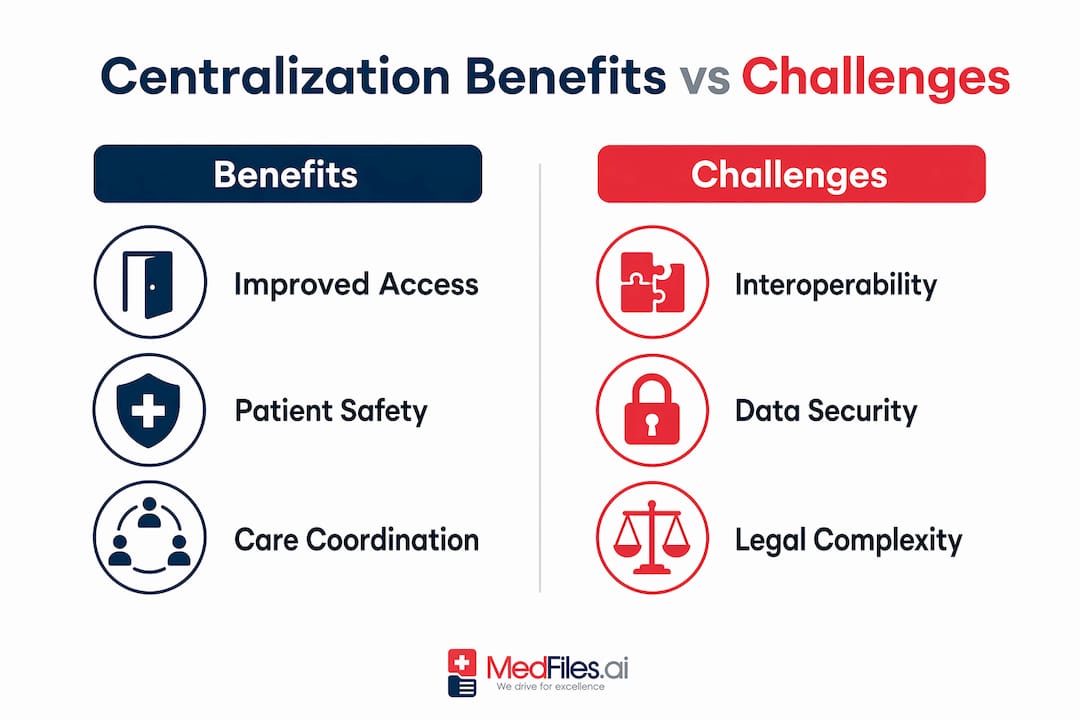
Centralization is not without serious obstacles. Understanding them helps organizations and patients plan realistically.
Interoperability barriers
Digital interoperability is the biggest hurdle in centralization. Health systems run on different software platforms, use different coding standards, and were built at different times. Getting them to share data cleanly requires ongoing standardization work and significant technical investment. Standard exchange of clinical data between providers remains difficult despite the clear benefits.
Data security and compliance
HIPAA-compliant protocols require role-based access controls, end-to-end encryption, audit trails, and secure disposal procedures. Every organization handling centralized records must maintain secure backup and disaster recovery systems. A breach in a centralized system is more damaging than a breach in a siloed one because more data is exposed in a single event. You can learn more about what strong protection looks like in medical record security basics.
The digital junk drawer problem
Aggregating data without structuring it creates a new problem. Without meaningful organization, centralization risks producing a digital junk drawer that impedes clinical efficiency rather than aiding it. A clinician facing 500 unorganized documents is no better off than one with no system at all.
Legal retention complexity
Retention schedules vary by jurisdiction, specialty, and patient type. Keeping records longer than required creates liability. Destroying them too early creates a different liability. Managing these schedules across a centralized system requires dedicated compliance oversight.
| Challenge | Core risk | Mitigation approach |
|---|---|---|
| Interoperability gaps | Data silos persist despite centralization | Adopt common data standards and AI matching |
| Security exposure | Larger breach surface in unified systems | Encryption, role-based access, audit logs |
| Data overload | Clinicians cannot find relevant information | Structured dashboards with clinical context |
| Legal retention errors | Premature destruction or over-retention | Jurisdiction-specific retention schedules |
| Institutional resistance | Low adoption reduces system value | Training, usability testing, provider input |
Pro Tip: Before selecting a centralized platform, map your organization’s specific retention requirements by patient type and jurisdiction. A platform that cannot enforce automated retention rules will create compliance gaps over time.
How is medical records centralization implemented today?
Modern centralization relies on cloud infrastructure, secure digitization workflows, and patient-facing access tools working together.
Cloud platforms enable secure storage and remote access to medical records, supporting centralized workflows across multiple locations. A provider in one clinic can pull a patient’s imaging from a hospital across the city in real time. That capability was not practical before cloud adoption.
Current implementation typically includes these components:
- Secure digitization pipelines. Paper records are scanned, indexed, and imported. Digital records are transferred using HL7 FHIR or similar interoperability standards.
- EHR integration layers. Centralized systems connect to existing EHR platforms rather than replacing them. The integration layer pulls relevant data and presents it in a unified view.
- Patient portals and mobile apps. Patients access their own records, review test results, and share documents with new providers. This gives patients direct control over their health data. Tools for organizing family medical records make this practical for households managing multiple people’s care.
- Audit and access controls. Every record access is logged. Role-based permissions limit who can view, edit, or share specific data types.
| Implementation layer | Function | Example |
|---|---|---|
| Cloud storage | Secure, remote record access | HIPAA-compliant cloud repositories |
| EHR integration | Unified data pull from existing systems | HL7 FHIR-based connectors |
| Patient portal | Direct patient access and sharing | Mobile app with document upload |
| Audit trail | Compliance and access monitoring | Timestamped access logs |
| Retention automation | Enforces legal record lifecycle rules | Jurisdiction-based deletion schedules |
Effective centralized systems layer data meaningfully for clinicians and patients rather than simply storing it. The difference between a useful system and an expensive archive is how well the platform surfaces the right record at the right moment.
Key Takeaways
Medical records centralization delivers its full value only when data is structured, secured, and made accessible through context-aware tools rather than simply aggregated in one place.
| Point | Details |
|---|---|
| Core definition | Centralization unifies EHRs, labs, imaging, and prescriptions into one accessible system. |
| Primary benefit | Faster clinical decisions and fewer duplicate tests improve patient safety directly. |
| Biggest challenge | Interoperability gaps and data overload undermine systems that lack structured organization. |
| Compliance requirement | HIPAA mandates encryption, role-based access, audit trails, and jurisdiction-specific retention rules. |
| Patient empowerment | Centralized records give patients and families direct control over sharing and accessing their health history. |
The part most organizations get wrong
The conversation around medical records centralization tends to focus on technology. Which platform. Which standard. Which vendor. That focus misses the harder problem.
The systems that fail are not the ones with the wrong software. They are the ones where data lands in a central location and stops there. A clinician who opens a centralized record and sees 400 unsorted documents has not gained anything useful. The balance between coordination gains and administrative burden is real, and it tips the wrong way when organizations treat aggregation as the finish line.
The systems that work treat structure as the product. They ask: what does a cardiologist need to see first? What does an emergency physician need in 90 seconds? What does a patient need to share with a new specialist? Those questions drive the design of dashboards, access layers, and sharing tools.
The other thing organizations consistently underestimate is legal retention complexity. Retention schedules are not uniform. A pediatric record has different requirements than an adult psychiatric record. A centralized system that cannot enforce those rules automatically will eventually create serious liability.
My honest view: centralization is worth the investment, but only if the organization commits to structuring data, not just storing it. The technology is mature enough. The discipline around using it well is where most implementations fall short.
— Team
How Medfiles supports centralized medical record access
Medfiles is built for exactly what centralization promises: one secure place for all your health documents, accessible when you need them most.

Medfiles stores test results, prescriptions, imaging reports, and clinical notes in a HIPAA-ready environment with end-to-end encryption. You can share records securely with any provider or family member in seconds, without printing a single page. Healthcare professionals get a clean view of a patient’s complete history through tools built for clinical workflows. Whether you are managing your own records, coordinating care for a parent, or preparing for an emergency, Medfiles keeps your health data organized, protected, and ready. Create a free account at Medfiles.ai and put your records where they belong.
FAQ
What is the difference between centralized and decentralized health records?
Centralized health records store all patient data in one unified system accessible across care settings. Decentralized systems keep records at individual facilities, requiring manual transfers and creating fragmentation risks.
How does medical records centralization improve patient safety?
A unified medication list and complete clinical history prevent duplicate tests, drug interaction errors, and missed diagnoses caused by providers working from incomplete information.
What does HIPAA require for centralized medical records?
HIPAA requires role-based access controls, end-to-end encryption, audit trails, secure backup, and jurisdiction-specific retention schedules for all centralized health record systems.
Can patients access their own centralized records?
Yes. Patient portals and mobile apps give individuals direct access to their records, the ability to review results, and tools to share documents with new providers or family members.
What types of records are included in a centralized system?
A complete centralized system includes all types of medical records: EHRs, lab results, diagnostic imaging, prescriptions, clinical notes, and insurance documentation.