Best MediscanAI Alternatives for Clinical AI in 2026
Explore top mediscanai.me alternatives for 2026, including DeepCura and Suki AI. Find the right clinical AI solution for your needs!

Best MediscanAI Alternatives for Clinical AI in 2026
If you’re searching for mediscanai.me alternatives, the strongest options in 2026 are DeepCura, Freed AI, Nuance DAX Copilot, Suki AI, Abridge, MedChartScan, and DeepScribe. Each one targets a different slice of the clinical AI market, from ambient scribing in small practices to real-time HCC coding in hospital systems. Here’s a quick orientation before you dig into the details:
- DeepCura — Best for medium to large practices needing an all-in-one clinical AI platform with diagnostic support
- Freed AI — Best for small to midsize clinics wanting affordable, real-time note synthesis
- Nuance DAX — Best for large practices and hospital systems requiring voice-enabled documentation
- Nuance DAX Copilot — Best for hospitals with complex documentation needs and AI-assisted editing
- UpToDate AI — Best for clinicians who need real-time, evidence-based clinical references at the point of care
- Suki AI — Best for enterprise clinical documentation teams using ambient scribing powered by natural language processing
- Abridge — Best for providers who prioritize real-time summarization of doctor-patient conversations
- MedChartScan — Best for practices focused on coding accuracy, risk adjustment, and real-time note validation
- ChatGPT / GPT-4 — Best for clinicians and legal professionals needing flexible, customizable NLP summaries with human oversight
- DeepScribe — Best for clinics that want fully automated note-taking with direct EHR integration
- Heidi Health — Best for specialty practices that need workflow optimization alongside documentation
- Tali — Best for busy physicians who want faster note creation via voice and text
- NoteMD — Best for telehealth providers and clinicians who work primarily on mobile devices
- Nabla — Best for medical professionals integrating AI into both documentation and patient communication workflows
All of these tools are HIPAA-compliant or offer Business Associate Agreements. Most provide a free trial or demo. Pricing ranges from free tiers for individual clinicians to custom enterprise contracts.
How do the top MediscanAI competitors compare on features and integration?
The 14 alternatives above split into two broad categories: clinical documentation and ambient scribing tools versus diagnostic imaging analysis platforms. For healthcare professionals and med-legal practitioners replacing MediscanAI, the clinical documentation category is almost always the right fit, as demonstrated by tools like the Peace Health AI — AI-Powered Symptom Checker that exemplify AI’s transformative role in healthcare.
| Tool | Best For | Pricing | EHR Integration | Note Accuracy | Support Options | Trial Access |
|---|---|---|---|---|---|---|
| DeepCura | Medium to large practices | Custom enterprise pricing | Deep EHR integration | High, with diagnostic support | Dedicated support team | Demo available |
| Freed AI | Small to midsize clinics | — | Broad EHR compatibility | High, real-time synthesis | Email and chat | Free trial |
| Nuance DAX | Large practices, hospitals | Custom enterprise pricing | Deep EHR integration | Very high, voice-enabled | Enterprise support | Demo available |
| Nuance DAX Copilot | Hospitals with complex needs | Custom enterprise pricing | Deep EHR integration | Very high, AI-assisted editing | Enterprise support | Demo available |
| UpToDate AI | Clinicians needing references | Subscription tiers | Moderate integration | High, evidence-based | Standard support | Trial available |
| Suki AI | Enterprise documentation teams | Custom pricing | Strong EHR integration | High, NLP-powered | Dedicated support | Demo available |
| Abridge | Patient encounter summarization | Custom pricing | Moderate integration | High, conversation-based | Dedicated support | Demo available |
| MedChartScan | Coding accuracy, risk adjustment | Per-member rates + add-ons | Deep EHR integration | Very high, real-time validation | 24/7 HIPAA-compliant support | Demo available |
| ChatGPT / GPT-4 | Flexible NLP, legal and clinical | Free tier to custom enterprise contracts | Manual or API-based | Variable, needs oversight | Community and paid support | Free tier |
| DeepScribe | Fully automated note-taking | Custom pricing | Seamless EHR integration | High, real-time scribing | Dedicated support | Demo available |
| Heidi Health | Specialty workflow optimization | Free and paid tiers | Moderate integration | High | Standard support | Free tier |
| Tali | Busy physicians, fast notes | Subscription-based | Moderate integration | High, voice and text | Standard support | Trial available |
| NoteMD | Telehealth, mobile clinicians | Subscription-based | Moderate integration | High, mobile-optimized | Standard support | Trial available |
| Nabla | Documentation and patient comms | Custom pricing | Moderate integration | High | Dedicated support | Demo available |

DeepCura and Freed AI: two different scales
DeepCura is built for practices that need more than a scribe. It combines clinical documentation with diagnostic decision support, making it a genuine all-in-one platform for medium to large groups. Freed AI takes the opposite approach: fast, affordable, and designed to get a solo or small-group clinician up and running in minutes. Its real-time note synthesis is one of the cleaner implementations in this price range.

Nuance DAX and DAX Copilot: the enterprise standard
Nuance DAX has been the benchmark for voice-enabled clinical documentation for years. DAX Copilot adds AI-assisted editing on top of that foundation, which matters most in hospital environments where note complexity and volume are both high. Both products require custom pricing conversations, but they integrate deeply with Epic, Cerner, and other major EHR platforms.
Suki AI and Abridge: ambient scribing specialists
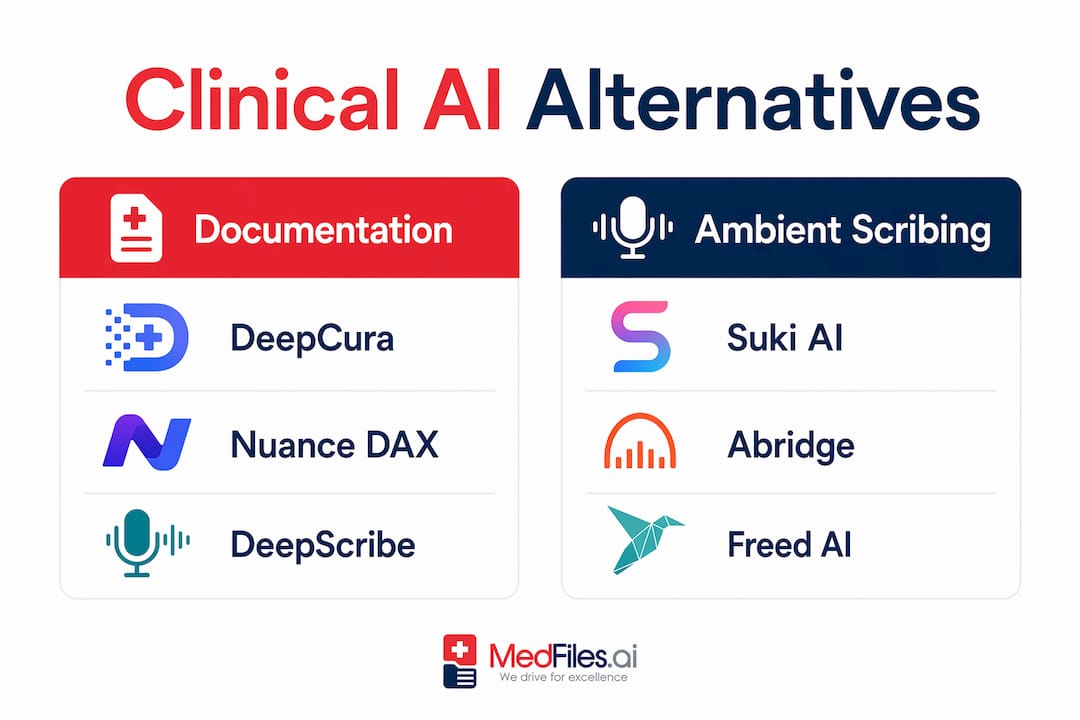
Suki AI uses natural language processing to capture clinical conversations and convert them into structured notes without the clinician touching a keyboard. Abridge goes a step further by summarizing the full doctor-patient conversation in real time, producing a structured encounter summary that feeds directly into the chart. Both are enterprise-grade and require a demo before pricing is disclosed.
MedChartScan: real-time coding intelligence
MedChartScan stands apart from the scribing-focused tools. It functions as a clinical intelligence engine that validates note quality and assigns HCC and E/M codes the moment a note is finalized. Med-legal practitioners and risk-adjustment teams find it particularly useful because it turns documentation into a real-time compliance asset rather than a retrospective task. Its 24/7 HIPAA-compliant support and dedicated onboarding team are concrete differentiators for practices that cannot afford downtime during implementation.
ChatGPT / GPT-4: flexible but requires oversight
ChatGPT and GPT-4 are not purpose-built for clinical documentation, but they are genuinely useful for med-legal professionals who need to summarize large volumes of records quickly and can apply their own quality review. The trade-off is that accuracy depends heavily on how prompts are constructed, and a Business Associate Agreement is not available through the standard consumer interface. OpenAI does offer a HIPAA-eligible API tier for enterprise customers, which changes the compliance picture significantly.
DeepScribe, Heidi Health, Tali, NoteMD, and Nabla
DeepScribe automates note-taking end to end and pushes completed notes directly into the EHR, with no manual copy-paste step. Heidi Health adds scheduling and workflow tools alongside documentation, which suits specialty practices juggling multiple administrative functions. Tali focuses on speed: voice commands and text input combine to cut the time a physician spends on notes after each encounter. NoteMD is optimized for mobile, making it the practical choice for telehealth providers who move between platforms throughout the day. Nabla connects documentation with patient communication tools, so the same AI layer that writes the note can also draft a patient-facing summary or follow-up message.
How to choose the right AI medical record and clinical documentation tool
The right tool depends on three things: what you actually document, how your practice is structured, and what compliance standards your contracts require.
Start with your primary use case. Clinical scribing tools like Freed AI, Suki AI, and Abridge are built for real-time encounter documentation. Coding and validation tools like MedChartScan are built for risk adjustment and audit defense. Med-legal professionals summarizing records for personal injury or insurance claims need a different capability set entirely, closer to what MediscanAI itself offered: structured chronologies, plain-language search across large record sets, and defensible output.
Evaluate EHR integration carefully. Deep integration with Epic or Cerner is a selling point for large hospital systems, but it can slow down adoption for smaller practices. Tools that accept standard document uploads, including PDFs, faxes, and CCDA files, let you start immediately without a months-long IT project. For practices in early adoption, that flexibility often matters more than a native EHR plugin.
Check compliance credentials before anything else. Every tool on this list claims HIPAA compliance, but the specifics vary. Ask whether the vendor offers a signed Business Associate Agreement, whether patient health information is processed in memory only and never stored on vendor servers, and whether your records are used to train the vendor’s underlying AI models. A vendor that cannot answer all three questions clearly is a compliance risk.
Match pricing structure to your volume. Per-note pricing works well for low-volume practices. Monthly subscription tiers suit steady-volume clinics. Enterprise contracts with custom pricing are standard for hospital systems. Avoid locking into a long-term contract before you have run at least one real caseload through the tool.
- Confirm the vendor offers a signed BAA
- Verify PHI is not used to train public AI models
- Test the tool on a real case before committing
- Ask about onboarding support and training timelines
- Check whether the tool integrates with your specific EHR version
Pro Tip: Prefer AI tools that embed a physician correction loop directly into the product. When a clinician edits or refines AI output, the system learns from that feedback in real time, improving accuracy with every case. Tools that rely on outsourced manual QA instead introduce delays, privacy exposure, and inconsistent results.
What AI tools actually do for medical record management
AI tools for medical record management split into two distinct categories, and picking the wrong one is a real workflow problem. Clinical documentation and ambient scribing tools, including Suki, Abridge, and Heidi Health, are built to capture and structure what happens during a clinical encounter. Diagnostic imaging analysis tools, such as Qure.ai and Paige, are built to interpret scan data. If you are replacing MediscanAI for record synthesis, chronology creation, or coding validation, you want the first category.
Within clinical documentation AI, the most useful capabilities in 2026 are:
- Real-time note generation from ambient audio or voice commands, eliminating after-hours charting
- Medical record synthesis that pulls key facts from large, unstructured record sets and organizes them into a structured timeline
- HCC and E/M coding validation that checks note quality and assigns codes the moment a note is finalized, as MedChartScan does
- Plain-language search across an entire case record, so you can ask “when did symptoms first appear?” and get an instant, sourced answer
- Drag-and-drop document upload for PDFs, faxes, and CCDA files, which removes the need for complex EHR integration during early adoption
Security architecture matters as much as features. The strongest tools process patient health information in memory only, never writing it to persistent storage on vendor servers. They also explicitly prohibit using your records to train their underlying AI models. A signed Business Associate Agreement is the minimum bar; in-memory processing and a clear data-use policy are what separate genuinely secure platforms from ones that only claim compliance.
Med-legal practitioners have an additional layer to consider. Tools built for clinical scribing produce notes optimized for the treating physician’s workflow. Tools built for record review and summarization, the category MediscanAI occupied, produce structured chronologies and defensible summaries optimized for attorneys, insurers, and independent medical evaluators. Those are different outputs, and the distinction between imaging-focused AI and clinical-record AI is just as sharp as the distinction between scribing and summarization. Matching the tool to the actual task is the single most important decision in this evaluation.
You can also explore a broader overview of AI for medical documents to understand how different platforms approach record synthesis and clinical accuracy before committing to a vendor.
Medfiles gives you secure, organized access to your medical records
If the tools above feel like they are built for large clinical operations, that is because most of them are. Medfiles takes a different approach: a secure, personal medical records platform designed for individuals, families, and healthcare professionals who need organized, instant access to health information without the complexity of an enterprise deployment.
Medfiles stores your complete medical history in one place, from test results and prescriptions to imaging reports and specialist notes. Every document is encrypted end to end, and the platform runs on HIPAA-ready infrastructure with full Business Associate Agreement availability. AI-powered document analysis organizes your uploads automatically, so you are not manually tagging files or hunting through folders when you need a record fast.
For healthcare professionals and med-legal practitioners, Medfiles offers secure document sharing with providers, attorneys, and family members, along with multi-profile management for practices that handle records across multiple patients or household members. Subscription tiers cover solo users through multi-provider groups, with flexible storage and sharing options at each level. Live support is available on all plans. Your records stay yours: Medfiles does not use your health data to train AI models.
Key takeaways
The strongest MediscanAI alternatives in 2026 are purpose-built for specific clinical tasks, and matching the tool to your actual workflow is more important than any single feature comparison.
| Point | Details |
|---|---|
| Match tool to task | Clinical scribing tools differ fundamentally from record synthesis and coding tools; choose based on your actual workflow. |
| Compliance is non-negotiable | Require a signed BAA, in-memory PHI processing, and a clear policy against using your records for AI model training. |
| Physician feedback loops improve accuracy | Tools that learn directly from clinician edits outperform those relying on outsourced manual QA over time. |
| Trial access before commitment | Test any tool on a real caseload before signing a contract; most leading alternatives offer a demo or free tier. |
| Medfiles for secure record storage | Medfiles provides HIPAA-ready, encrypted medical record management with AI-powered organization and flexible plans for individuals and practices. |