Methods for Protecting Patient Information: 2026 Guide
Explore the top method for protecting patient information in our 2026 guide, ensuring compliance and improving data security in healthcare.

Methods for Protecting Patient Information: 2026 Guide
Protecting patient information means securing protected health information (PHI) and electronic PHI (ePHI) against unauthorized access, disclosure, and breach. The most effective method for protecting patient information combines three layers: strong encryption using AES-256 and TLS 1.3, strict access controls including multi-factor authentication (MFA) and role-based permissions, and data de-identification under HIPAA’s Safe Harbor provisions. The 2026 HIPAA Security Rule updates tighten these requirements further, making compliance a moving target for healthcare organizations. Understanding each layer, and how they interact, is the difference between a defensible security posture and a costly breach.
What encryption standards and practices protect patient information effectively?
Encryption is the technical foundation of every patient data security method. HIPAA requires AES-256 for data at rest and TLS 1.2 or higher for data in transit, with TLS 1.3 as the preferred standard. This matters because older protocols are now audit failures. Deprecated protocols including SSL v2/v3, TLS 1.0/1.1, RC4, 3DES, MD5, and SHA-1 all fail under 2026 HIPAA guidance.
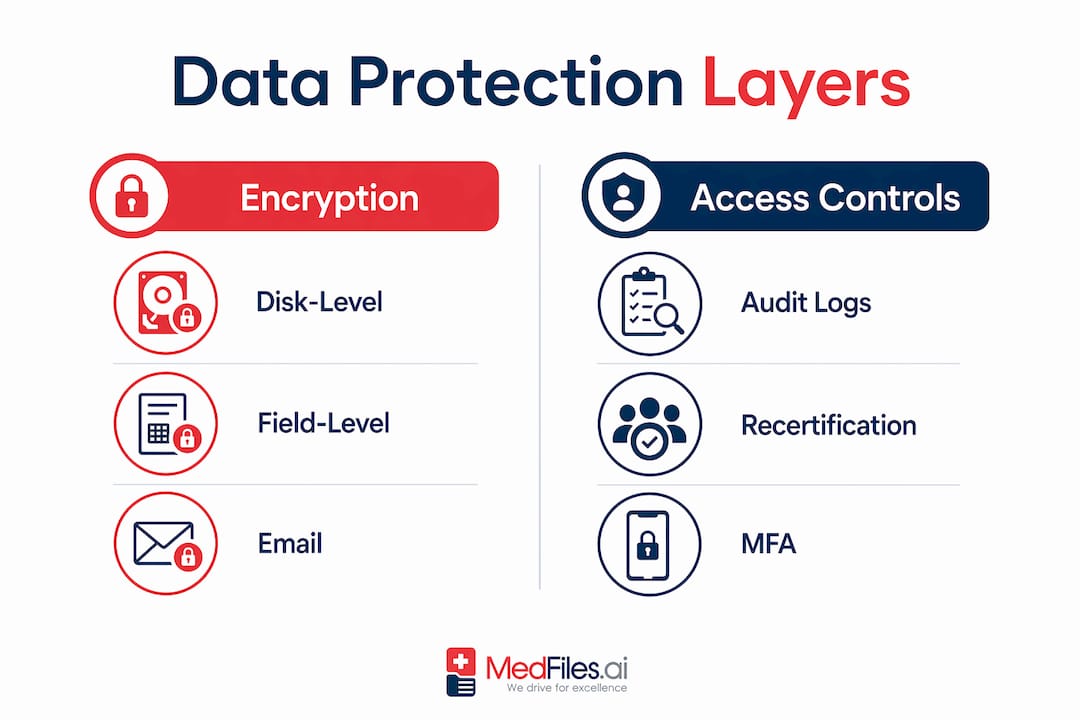
Disk-level encryption alone is not enough. Field-level encryption for sensitive PHI fields such as Social Security Numbers and clinical notes is necessary because disk encryption does not protect against over-privileged accounts or SQL injection attacks. Application-level and field-level encryption add a separate barrier that stops attackers who have already bypassed perimeter defenses.

Key management is where many organizations fall short. Envelope encryption uses a data encryption key (DEK) encrypted by a key encryption key (KEK), allowing key rotation without re-encrypting the underlying data. Store keys separately from the data they protect. Rotate keys on a defined schedule and document every rotation event for audit purposes.
Encrypted email communication is another critical control. HIPAA-compliant email encryption prevents unauthorized reading of ePHI in transit. Any email service provider handling ePHI must sign a Business Associate Agreement (BAA) before you transmit patient data through their platform.
Pro Tip: Never rely on a single encryption layer. Combine disk encryption, field-level encryption, and TLS 1.3 in transit. Each layer catches what the previous one misses.
| Encryption layer | Standard | Protects against |
|---|---|---|
| Data at rest | AES-256 | Physical theft, unauthorized storage access |
| Data in transit | TLS 1.3 | Network interception, man-in-the-middle attacks |
| Field-level | AES-256 per field | Over-privileged accounts, SQL injection |
| Key management | Envelope encryption (DEK/KEK) | Key compromise, unauthorized decryption |
How do access controls and administrative safeguards enhance patient data protection?
Encryption secures data. Access controls determine who can reach it in the first place. Effective patient data protection requires a layered defense that includes patch management, MFA for all privileged access, and physical controls to prevent unauthorized facility or workstation access. These are not optional additions. They are the administrative backbone of HIPAA compliance.
Role-based access control (RBAC) assigns permissions based on job function, not individual preference. A billing clerk does not need access to clinical notes. A radiologist does not need access to payroll records. Keeping permissions scoped to job requirements limits the blast radius of any single compromised account.
Common pitfalls in access management include:
- Privilege creep: Misaligned access rights accumulate over time as employees change roles. Regular access recertification, at minimum quarterly, corrects this drift before it becomes a liability.
- Weak authentication: MFA is mandatory for all privileged access. Password-only authentication fails against phishing and credential stuffing attacks.
- Unpatched systems: Mandatory patch management closes known vulnerabilities before attackers exploit them. Unpatched systems are the most common entry point in healthcare breaches.
- Physical gaps: Unlocked workstations, unattended terminals, and unsecured server rooms all create exposure that no software control can fix.
Regular audit logging detects credential misuse, insider threats, and unauthorized data exports. Logs should capture who accessed what record, when, and from which device. Review logs automatically with alerting rules, not just during incident response.
Pro Tip: Schedule access recertification reviews on your compliance calendar, not just after a security incident. Catching privilege creep early costs far less than investigating a breach.
What are the de-identification methods to protect patient identity under HIPAA?
De-identification is the process of removing or obscuring identifiers from PHI so the data can no longer be linked to a specific individual. HIPAA recognizes two accepted methods: Safe Harbor and Expert Determination.
The Safe Harbor method requires removal of 18 specific identifiers. These include all names, geographic subdivisions smaller than a state, all date elements except year, phone numbers, fax numbers, email addresses, Social Security Numbers, medical record numbers, health plan beneficiary numbers, account numbers, certificate and license numbers, vehicle identifiers, device identifiers, web URLs, IP addresses, biometric identifiers, full-face photographs, and any other unique identifying number or code. Ages over 89 must be aggregated into a single category (90 or older) to reduce re-identification risk.
The Expert Determination method takes a statistical approach. A qualified expert certifies that the risk of re-identifying any individual in the dataset is very small. This method requires documented analysis and is typically used when Safe Harbor removal would destroy the research utility of the data.
| Method | Approach | Best used for |
|---|---|---|
| Safe Harbor | Remove all 18 specified identifiers | Standard research datasets, public health reporting |
| Expert Determination | Statistical certification of minimal re-identification risk | Complex datasets where identifier removal reduces utility |
De-identified patient data supports medical research and public health objectives without violating privacy. Natural language processing (NLP) tools and expert review improve the accuracy of automated de-identification, catching identifiers that rule-based systems miss. Re-identification risk is real even in de-identified datasets, so organizations should validate their process before releasing data externally.
How can healthcare IT teams manage emerging risks like device vulnerabilities and insider threats?
Legacy medical devices are one of the most underestimated risks in healthcare IT. Medical devices often run legacy software that cannot be patched, and the Department of Health and Human Services recommends isolating these devices from critical data networks as a compensating control. Network segmentation keeps a vulnerable infusion pump or imaging system from becoming a gateway to your EHR.
Insider threats are harder to detect than external attacks because they originate from trusted accounts. Behavioral analytics monitoring for anomalies such as impossible travel for admin accounts or unusual record export volumes detects credential abuse that standard endpoint security misses. Static defenses alone cannot catch a legitimate user who has gone rogue or whose credentials have been stolen.
A dynamic, risk-based framework is the right model for managing these threats:
- Continuous risk analysis: Treat HIPAA Security Rule safeguards as living controls that require regular reassessment, not a one-time compliance checkbox. Document every risk analysis and every decision made in response.
- Network isolation: Segment IoT and legacy medical devices into separate network zones with strict firewall rules. Limit their outbound communication to only what is operationally required.
- Behavioral baselines: Establish normal usage patterns for each user role. Flag deviations automatically and route alerts to your security team for review.
- Vendor risk management: Third-party vendors with access to your systems are a common breach vector. Require BAAs, conduct vendor security assessments, and limit vendor access to only the systems they need.
The shift from a static fortress model to a dynamic, risk-based approach is the single most important strategic change a healthcare organization can make. Threats evolve faster than static controls can respond. Your security program must evolve with them.
Pro Tip: Treat your medical device inventory the same way you treat your software asset list. If you do not know what devices are on your network, you cannot protect them.
Key takeaways
The most effective approach to protecting patient information requires layered encryption, strict access controls, and continuous risk reassessment working together, not as separate programs.
| Point | Details |
|---|---|
| Encryption is multi-layered | Combine AES-256 at rest, TLS 1.3 in transit, and field-level encryption for sensitive PHI fields. |
| Access controls prevent most breaches | Implement MFA, RBAC, and quarterly access recertification to limit exposure from compromised or over-privileged accounts. |
| De-identification enables safe data use | Apply Safe Harbor or Expert Determination methods before sharing PHI for research or secondary purposes. |
| Legacy devices need isolation | Segment unpatchable medical devices from critical networks and document compensating controls in your risk plan. |
| Static compliance is not enough | Reassess safeguards continuously through documented risk analyses rather than treating HIPAA as a one-time audit. |
The security layer most healthcare teams underestimate
After working closely with healthcare data security challenges, the pattern I see most often is not a failure of technology. It is a failure of consistency. Organizations invest in AES-256 encryption and MFA, then leave quarterly access reviews undone for 18 months. They deploy behavioral analytics but never act on the alerts.
The uncomfortable truth is that medical record security is not a technology problem at its core. It is a process and culture problem. The best encryption in the world does not protect a patient whose records are accessed by a former employee whose account was never deactivated.
I also see organizations treat HIPAA compliance as the ceiling rather than the floor. Compliance tells you the minimum. Actual security requires going further, especially with zero trust security models gaining traction in 2026. Zero trust assumes every access request is potentially hostile, which is the right posture for a threat environment where insider threats and credential theft are the leading causes of healthcare breaches.
The organizations that get this right share one trait: they make security a standing agenda item at the leadership level, not just an IT department concern. When the CFO and CMO understand why behavioral analytics matter, budget and buy-in follow. That cultural commitment is what turns a technically sound security program into one that actually holds.
— Team
How Medfiles helps you secure patient records from day one
Medfiles is built on HIPAA-ready infrastructure with end-to-end encryption, giving healthcare providers and patients a secure place to store, organize, and share medical records. Every document you upload is protected with strong encryption at rest and in transit. Secure document sharing lets you transmit records to providers, specialists, and family members without exposing sensitive data through unsecured channels.
For healthcare organizations looking to reduce the risk of data exposure while improving workflow, Medfiles offers a practical starting point. Explore Medfiles for doctors to see how the platform fits into your existing clinical processes. Your patients’ data deserves more than a folder on a shared drive.
FAQ
What is the most effective method for protecting patient information?
The most effective method combines AES-256 encryption for data at rest, TLS 1.3 for data in transit, multi-factor authentication, and role-based access controls. No single control is sufficient on its own.
What are the two HIPAA de-identification methods?
HIPAA recognizes Safe Harbor, which requires removing 18 specific identifiers, and Expert Determination, which uses statistical analysis to certify minimal re-identification risk. Both methods allow de-identified data to be used for research without violating privacy rules.
How does field-level encryption differ from disk encryption?
Disk encryption protects data if physical storage is stolen. Field-level encryption protects individual data fields, such as Social Security Numbers or clinical notes, from over-privileged accounts and application-layer attacks like SQL injection.
Why are legacy medical devices a security risk?
Legacy medical devices often run software that cannot be updated or patched, making them permanently vulnerable. HHS recommends isolating these devices from critical data networks using network segmentation as a compensating control.
How often should healthcare organizations reassess their security safeguards?
HIPAA compliance experts recommend treating security safeguards as dynamic controls requiring continuous reassessment through documented risk analyses, not just annual reviews. Threats change faster than annual audit cycles can track.