Prepare emergency medical information for fast response
Ensure your family's safety with effective emergency medical information preparation. Learn how to organize vital health details for quick access.

Prepare emergency medical information for fast response
Paramedics arrive at your door. Your family member is unconscious. The first question they ask: “Does she have any allergies? What medications is she taking?” You freeze. The information is somewhere, maybe in an old email, maybe on a sticky note, maybe in a doctor’s office file. Those lost seconds cost real outcomes. Research consistently shows that having copies of personal documents and pertinent medical information ready before a disaster or emergency dramatically improves the speed and quality of care responders can deliver. This guide shows you exactly how to build, organize, and maintain emergency medical information so your family is never caught unprepared.
Table of Contents
- Understand the essentials: What emergency medical information must include
- Choose your format: Paper, digital, and identity-linked solutions
- Step-by-step: How to prepare and update your emergency medical information kit
- Responding to emergencies: When and how to use your prepared information
- The overlooked truth: Kits are crucial, but recognition and communication matter most
- Simplify your emergency medical preparation with MedFiles.ai
- Frequently asked questions
Key Takeaways
| Point | Details |
|---|---|
| Critical details matter | Include key diagnoses, allergies, medications, and contacts for fast emergency response. |
| Multiple formats | Use a paper sheet, digital backup, and medical ID if possible for redundancy. |
| Don’t neglect updates | Keep information current by reviewing after health events and at least every few months. |
| Recognize emergencies | Immediate symptom recognition is as important as documentation; know common triggers. |
| Practice and prepare | Ensure all family members know where information is stored and how to use it in a crisis. |
Understand the essentials: What emergency medical information must include
Now that you know why it’s urgent to have medical data ready, let’s clarify exactly what information belongs in your emergency kit.
Not all medical information is equally urgent in a crisis. Responders need a tight, accurate snapshot, not a full medical history. The goal is to give them what they must know in the first two minutes.
Core data every emergency sheet needs
Every family member’s emergency sheet should include these non-negotiable items:
- Full legal name and date of birth
- Primary diagnoses (diabetes, heart disease, epilepsy, asthma, etc.)
- Known allergies, especially to medications, latex, or foods that cause anaphylaxis
- Current medications with dosages and frequency
- Emergency contacts with names, phone numbers, and relationships
- Primary care physician and any relevant specialists with contact numbers
- Blood type, if known
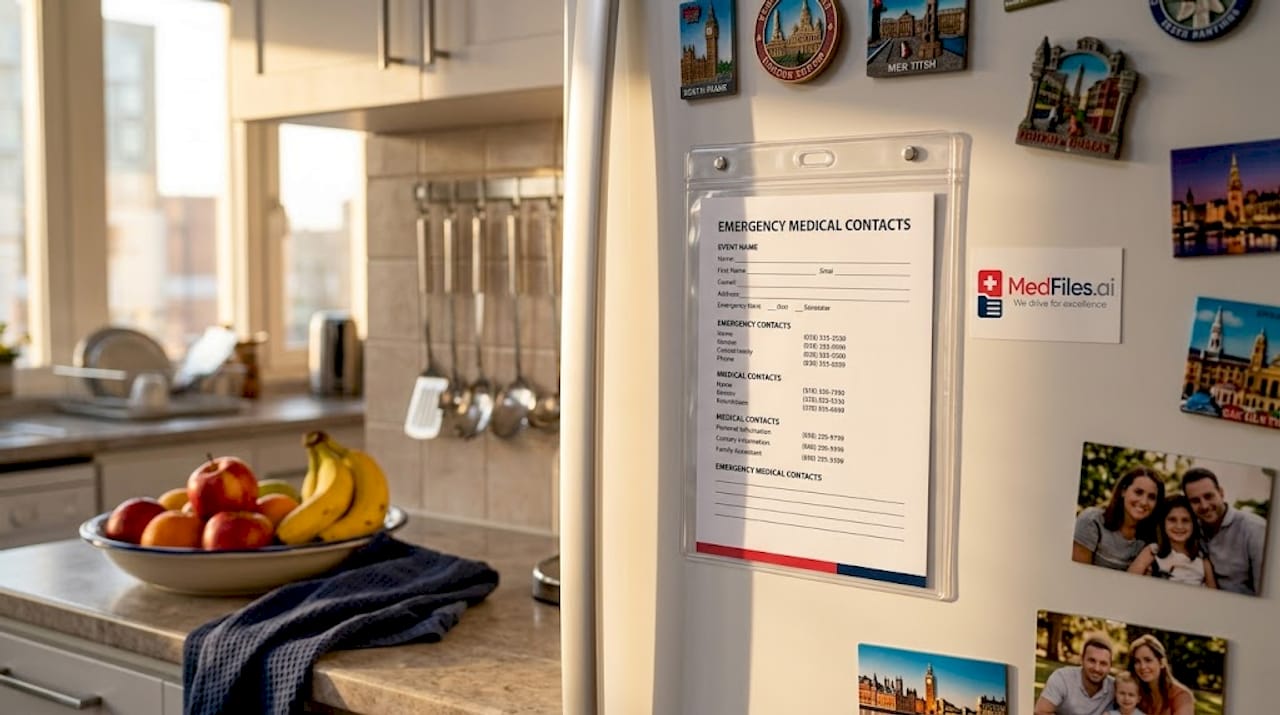
A practical emergency medicine approach is to keep a one-page medical information sheet with key health details and place it where EMTs and ER staff can quickly find it. Think near the front door, on the refrigerator, or inside an evacuation bag.
Supplemental documents to include
Beyond the one-page summary, your kit should also contain:
- Insurance cards and policy numbers
- A complete medication list (including over-the-counter drugs and supplements)
- Recent lab results or imaging reports relevant to chronic conditions
- Advance directives or a living will
- Vaccination records, especially tetanus and COVID-19 status
Understanding the full range of types of medical records helps you decide what to include and what can wait.
| Document type | Who needs it most | Priority level |
|---|---|---|
| One-page emergency summary | Everyone | Critical |
| Medication list with dosages | Chronic illness patients | Critical |
| Insurance card copy | All adults | High |
| Advance directive / living will | Adults 60+ or seriously ill | High |
| Recent lab/imaging results | Patients with active conditions | Medium |
| Vaccination records | Children, travelers | Medium |
Pro Tip: Print your one-page emergency sheet on bright colored paper, like yellow or orange, so it stands out immediately when a responder opens your kit or enters your home.
Choose your format: Paper, digital, and identity-linked solutions
You’ve gathered the essentials. Now let’s explore the best ways to make this information accessible and portable for any scenario.
Paper alone is not enough. Phones die. Bags get left behind. People lose consciousness before they can hand anything over. The smartest approach uses multiple layers.
Paper records
A printed sheet is immediately visible and requires no device, password, or internet connection. EMTs are trained to look for medical information on or near the patient. A laminated card in a wallet or a sheet inside an evacuation kit takes seconds to hand over.
The downside: paper gets outdated fast. If a medication changes and you forget to reprint the sheet, the information becomes a liability rather than an asset.
Digital backups
A digital copy stored securely on your phone, in a protected cloud account, or on a USB drive gives you redundancy. If your paper kit is destroyed in a fire or flood, the digital version survives. Platforms built for secure medical record access let you retrieve your family’s full records from any device in seconds.
For true resilience, also look at secure document storage solutions that encrypt your files and allow controlled sharing with healthcare providers.
Medical identity and ID services
Special populations benefit significantly from portable medical identity products, like MedicAlert, which link a worn bracelet or tag to a database that first responders can access even when a person cannot speak. This is especially important for individuals with dementia, severe allergies, or neurological conditions.
For those with serious or terminal illness, POLST forms (Portable Medical Orders) go further than a standard advance directive. A POLST translates your end-of-life wishes into actionable medical orders that emergency personnel can follow immediately in the field.
| Format | Best for | Key advantage | Key risk |
|---|---|---|---|
| Paper summary sheet | All families | No device needed | Can become outdated |
| Digital cloud storage | All adults | Always current, accessible anywhere | Requires device and login |
| Medical ID bracelet | Vulnerable individuals | Works when patient can’t communicate | Limited detail |
| POLST form | Seriously ill or elderly | Legally actionable by EMS | Must be updated with condition |
Pro Tip: Use both paper and digital backups simultaneously, and strongly consider a medical ID bracelet for any family member with a condition that affects consciousness or communication, including young children.
Step-by-step: How to prepare and update your emergency medical information kit
With your format selected, here’s exactly how to build and keep your emergency kit ready to use.
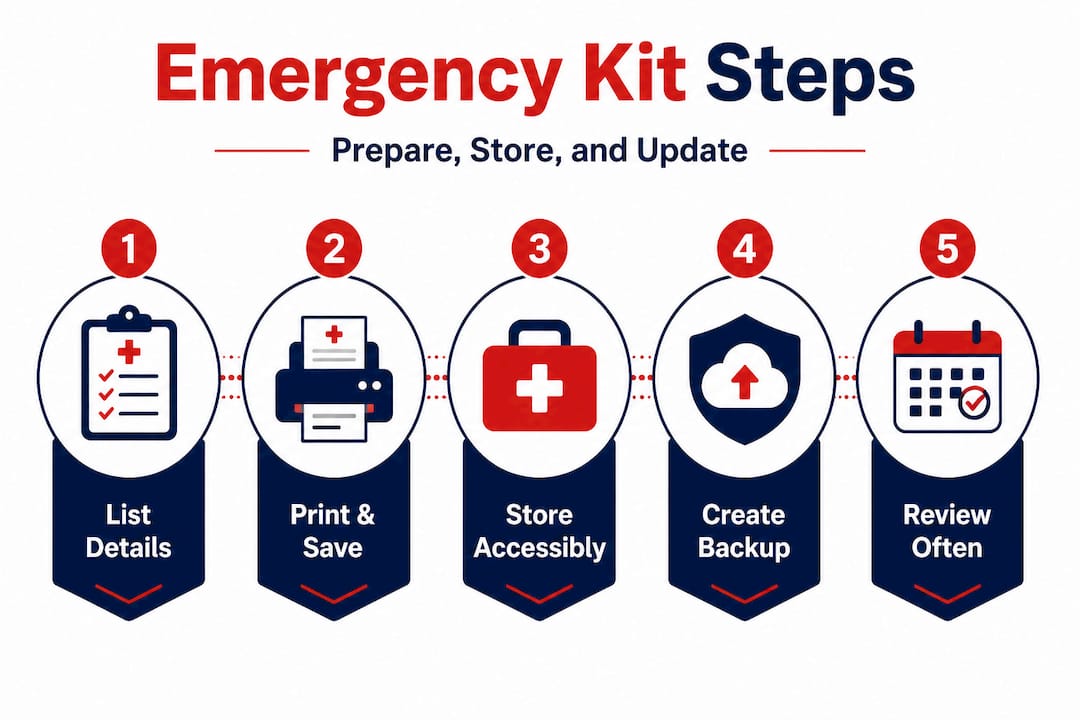
The biggest mistake families make is treating the kit as a one-time project. It’s not. It’s a living document that needs regular maintenance. Here’s how to build it right and keep it that way.
-
Gather information for every family member. Sit down with each person’s actual medication bottles, insurance cards, and recent doctor visit summaries. Do not rely on memory for dosages or diagnosis names.
-
Create a one-page summary for each person. Use a standard template or a clean document. Include the core data listed in the section above. Keep it to one printed page, front side only, so a responder can scan it in seconds.
-
Print and laminate wallet-sized cards. For each adult and older child, create a smaller card version with name, allergies, key conditions, and a single emergency contact number.
-
Scan everything and store it digitally. Upload scanned copies to a secure platform. A digital records workflow ensures your documents are organized and searchable rather than buried in a folder.
-
Add emergency contacts and provider information. Include your primary care physician, relevant specialists, and a trusted neighbor or family friend who can access your home if needed.
-
Place physical copies in key locations. Near the front door, inside the refrigerator door (a known location for EMTs), inside each person’s go-bag, and in your car’s glove compartment.
-
Schedule updates every three to six months. Set a recurring calendar reminder. Review the kit after any health event: a new diagnosis, a medication change, a surgery, or a new family member.
NIH guidance on evacuation preparedness specifically recommends keeping medications and medical documents ready in accessible formats and maintaining the kit over time, not just assembling it once. Similarly, family disaster planning resources emphasize including emergency contacts and a plan for getting information to responders even if communications go down during a major event.
“Kits should be easy to carry, regularly maintained, and designed for quick responder access.”
| Update trigger | Action required |
|---|---|
| New prescription or dose change | Update medication list immediately |
| New diagnosis | Add to conditions section, update physician contacts |
| New emergency contact | Replace old contact information |
| After any ER visit or hospitalization | Add discharge summary, update kit |
| Every 3-6 months (routine) | Full review of all sections |
For families who want to be really diligent, reviewing guidance on long-term medical record storage helps you understand how to preserve these documents well beyond a single emergency.
Responding to emergencies: When and how to use your prepared information
Your kit is built and maintained. Now learn how to use it effectively and spot life-threatening cues.
Having a great kit is only useful if you know when to activate it. Recognizing the signs that require immediate emergency help is just as important as the paperwork itself.
Symptoms that require immediate emergency action
Call 911 without hesitation for any of the following:
- Sudden, new chest pain, especially with sweating, nausea, or arm pain
- Difficulty breathing or sudden shortness of breath
- Loss of consciousness or sudden unresponsiveness
- Severe, uncontrolled bleeding
- Sudden severe headache described as “the worst of my life”
- Stroke symptoms: facial drooping, arm weakness, slurred speech
- Allergic reaction with throat tightening or difficulty swallowing
Mayo Clinic advises seeking immediate emergency medical help for new or sudden chest pain and a range of associated symptoms, many of which overlap with conditions your emergency sheet will directly address for responders.
Using your prepared information at the scene
When paramedics arrive, hand them the one-page sheet immediately. Tell them where additional documents are located. Do not wait to be asked. Responders are moving fast, and a clear handoff of your printed sheet saves them critical minutes.
For situations involving severe bleeding, programs like the Stop the Bleed campaign train bystanders to provide immediate assistance before EMS arrives. This kind of community-level preparation works in tandem with having accurate medical history ready for the EMS handoff that follows.
“Immediate access to accurate medical information can save precious minutes and lives.”
Pro Tip: Practice scenario drills at home. Walk every adult family member through where the emergency kit is kept, what it contains, and what to hand the paramedics when they arrive. Do this at least once a year.
The overlooked truth: Kits are crucial, but recognition and communication matter most
While your kit is a powerful tool, let’s talk about what actually makes the difference when seconds count.
Here is something most emergency preparedness guides won’t tell you: the kit is the second most important thing. The first is knowing when to call for help, and doing it fast.
We’ve seen families who had beautifully organized medical kits but hesitated for twenty minutes before calling 911 because they weren’t sure the symptoms were “serious enough.” And we’ve seen responders arrive within minutes because a family member recognized a stroke immediately and called without delay. The paperwork helped the ER team, but the fast call saved the life.
Clinical triage depends on what responders observe when they arrive plus the information you hand them. The forms accelerate their work. They don’t replace the eyes and ears of someone who recognized something was wrong and acted immediately.
Family drills are deeply underused. Teaching your children what a seizure looks like, what to say to a 911 dispatcher, and where the emergency kit lives is more valuable than most parents realize. Even a ten-year-old can tell a responder, “Mom has diabetes and takes metformin,” if they’ve been taught to do so.
Good healthcare information management gives you the foundation. But it has to be paired with the human piece: knowing when to act, how to act, and how to communicate clearly under pressure.
“Clinical triage starts with what responders see. Your prep works best when paired with fast, informed action.”
Your kit and your knowledge work together. Neither alone is enough. And Mayo Clinic’s first-aid guidance on symptoms like chest pain makes clear that immediate recognition is the trigger, and your documentation supports everything that comes after.
Pro Tip: Maintain your kit religiously, but also rehearse crisis scenarios twice a year. Teach every family member at least three critical symptom triggers that mean: call 911 right now, no hesitation.
Simplify your emergency medical preparation with MedFiles.ai
Ready to put your preparation into action? Modern solutions can automate and secure the entire process for you.
Building and maintaining an emergency medical kit manually takes real effort. Remembering to update it after every medication change, reprinting sheets, re-scanning documents—it adds up. MedFiles.ai was built specifically to remove that friction.
With MedFiles.ai, you can store, organize, and instantly access your family’s complete digital medical history from any device. Upload test results, prescriptions, reports, and images in one place. The platform automatically organizes your records, supports multi-profile management for your whole family, and lets you securely share documents with any healthcare provider in seconds. Everything is protected with HIPAA-ready, end-to-end encrypted infrastructure, so your data stays private and protected. Explore pricing and plans to find the right fit for your individual or family needs, and take the worry out of emergency preparedness starting today.
Frequently asked questions
What information should I include in my emergency medical sheet?
Include your name, birth date, key conditions, allergies, current medications with dosages, and emergency contacts. A one-page format works best so responders can scan it instantly.
How often should I update my emergency medical documents?
Update any time your health status, medications, or emergency contacts change, and review the full kit at least every three to six months as a routine practice. A solid emergency medical information system always includes a mechanism to keep information current.
Where should I keep my emergency medical information for quick access?
Store your one-page sheet near your entryway, on the inside of your refrigerator door, and inside your evacuation kit. EMTs are trained to look in those locations, so placing it there follows established emergency practice.
Are digital records or ID bracelets helpful in emergencies where I cannot speak?
Yes. Medical identity products and digital backups give responders critical health details when a patient cannot communicate, which is especially important for those with dementia, epilepsy, or severe allergies.
What symptoms signal I should call for emergency help?
Call 911 immediately for new or sudden chest pain, difficulty breathing, loss of consciousness, or severe bleeding. Mayo Clinic’s first-aid guidance is clear: do not wait and do not drive yourself. Call right away.