The Role of Data Analysis in Healthcare: A Practical Guide
Explore the role of data analysis in healthcare to boost patient outcomes, enhance efficiency, and ensure compliance with HIPAA standards.

The Role of Data Analysis in Healthcare: A Practical Guide
Data analysis turns clinical and operational data into timely, actionable decisions that reduce harm, lower costs, and improve patient outcomes. For U.S. healthcare teams, that means fewer missed diagnoses, smarter resource use, and care that reaches the right patient at the right time.
Three core benefits drive the case for analytics in healthcare:
- Better patient outcomes: Predictive models flag high-risk patients before conditions escalate.
- Operational efficiency: Scheduling, staffing, and supply chain decisions become data-driven rather than reactive.
- Population health: Risk stratification across patient registries supports proactive, preventive care.
Any analytics project in the U.S. must treat HIPAA compliance and protected health information (PHI) safeguards as prerequisites, not afterthoughts. Without HIPAA-ready infrastructure, your analytics program carries legal and patient-safety risk from day one. Without clean, governed data, analysts can spend up to 80% of project time on cleaning alone.
The bottom line: Healthcare analytics only delivers value when the data is trustworthy, the infrastructure is secure, and the insights reach the clinicians who can act on them.
Table of Contents
- What does data analysis actually do in healthcare?
- What data sources do you need, and what are their limits?
- Which analytics techniques and technical building blocks matter most?
- How do you meet HIPAA and data-quality requirements?
- How do you move from pilot to production safely?
- What barriers will you face, and how do you overcome them?
- How do you measure whether analytics is working?
- A HIPAA-ready record platform in an analytics workflow
- Key Takeaways
- What the Medfiles team prioritizes when building analytics-ready records
- Medfiles supports your analytics workflow with secure, organized records
- Useful sources and further reading
What does data analysis actually do in healthcare?
The role of data analysis in healthcare spans four high-impact use cases, each connecting a specific data type to a clinical or operational action.
- Clinical decision support (CDS): EHR-driven alerts flag drug interactions, abnormal lab trends, or sepsis risk in real time. The output is a prompt at the point of care, not a report reviewed days later.
- Population health management: Population registries and claims data identify patients overdue for screenings or at high risk for readmission. Care managers can then prioritize outreach before a crisis occurs.
- Personalized medicine: Genomics-enabled precision medicine matches treatment pathways to a patient’s genetic profile, reducing trial-and-error prescribing. AI-supported approaches are accelerating this in oncology and rare disease.
- Operational efficiency: Predictive scheduling models use historical admission patterns to optimize staffing and bed allocation, cutting wait times and overtime costs.
Big data analytics supports all four use cases by applying machine learning (ML) and natural language processing (NLP) to large patient datasets, surfacing patterns no manual review could catch.
What data sources do you need, and what are their limits?
Modern analytics synthesizes diverse data streams into a single clinical narrative. Each source contributes something distinct and carries its own quality risks.

| Source | What it contributes | Typical limitations |
|---|---|---|
| Electronic health records (EHRs) | Diagnoses, medications, notes, orders | Incomplete fields, free-text variability, inconsistent coding |
| Claims data | Utilization, cost, payer mix | Billing-driven; lags 30–90 days |
| Labs and imaging | Objective biomarkers, DICOM studies | Siloed systems; DICOM integration complexity |
| Genomics | Variant data, pharmacogenomics | High volume; requires specialized pipelines |
| Wearables and patient-generated data | Continuous vitals, activity, sleep | Unvalidated devices; high missingness |
| Social determinants of health (SDoH) | Housing, income, food access | Non-standardized; often self-reported |
Common quality risks include missing fields, inconsistent ICD or SNOMED codes, and free-text clinical notes that resist structured analysis. Short mitigation tactics: enforce mandatory fields at data entry, run automated code-validation checks, and apply NLP to extract structured concepts from notes.
For PHI compliance and reproducibility, capture at minimum: data source identifier, extraction timestamp, de-identification method applied, and the analyst who accessed the dataset.
Pro Tip: Run a quick data-profiling pass using open-source tools like Apache Griffin or Great Expectations before any modeling work. A 15-minute completeness and uniqueness check on your key fields will surface the gaps that would otherwise derail a three-month project.
Which analytics techniques and technical building blocks matter most?
Healthcare analytics moves through four levels, each adding decision power.
- Descriptive: Summarizes what happened. Example: monthly readmission rate by DRG.
- Diagnostic: Explains why. Example: root-cause analysis of ED overcrowding by time of day and acuity.
- Predictive: Forecasts what will happen. Example: ML model scoring 30-day readmission risk from EHR features.
- Prescriptive: Recommends what to do. Example: automated care-gap alerts routed to the right care manager.
Supporting those techniques requires a technical stack: ETL pipelines to ingest and normalize data, feature stores to reuse engineered variables across models, model operations (MLOps) tooling for deployment and versioning, and visualization dashboards that surface insights to clinical and administrative users.
Interoperability is the toughest technical bottleneck. FHIR-based standards connect disparate data types, including clinical notes, imaging, and lab results, into unified environments where analytics can run reliably.
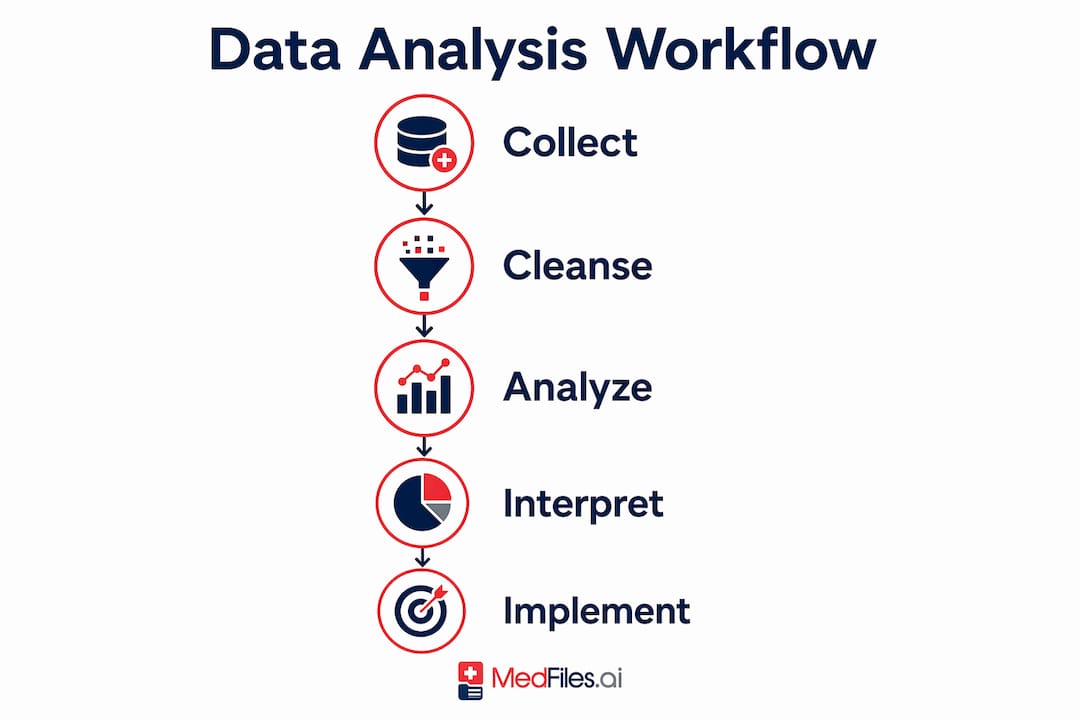
Explainability matters as much as accuracy for clinical deployment. A model clinicians cannot interpret will be ignored or, worse, misapplied.
Pro Tip: Before deploying any predictive model to a live clinical workflow, run a 90-day shadow test where the model scores patients but clinicians make decisions independently. Compare outcomes, then use discrepancies to calibrate alert thresholds and reduce alert fatigue before go-live.
How do you meet HIPAA and data-quality requirements?
Effective healthcare data management is required to meet HIPAA obligations. Poor data quality limits both auditing and clinical usefulness. Every U.S. analytics program needs a compliance checklist.
HIPAA and PHI safeguards:
- Classify all data assets by PHI status before any analytics work begins.
- Apply de-identification (Safe Harbor or Expert Determination) or use a limited dataset with a data-use agreement.
- Encrypt data at rest and in transit; enforce role-based access controls.
- Log all PHI access with user, timestamp, and purpose.
- Execute business-associate agreements (BAAs) with every vendor touching PHI.
- Maintain a documented breach-response plan tested at least annually.
Healthcare data governance requires organization-wide cultural change and interdisciplinary leadership. IT alone cannot own it. Clinical subject-matter experts must co-lead governance alongside technical teams.
Track four data-quality dimensions continuously: completeness (% of required fields populated), accuracy (% matching source-of-truth), timeliness (lag from event to availability), and consistency (% of records with no conflicting values). Set a baseline in month one, then target 5% improvement per quarter.
How do you move from pilot to production safely?
A phased roadmap reduces risk and builds clinical trust.
- Scope the use case (weeks 1–4): Define the clinical question, success metrics, and data requirements. Confirm data-access agreements and BAAs.
- Data access and preparation (weeks 5–10): Profile sources, resolve quality issues, build ETL pipelines, and document provenance.
- Pilot and retrospective validation (weeks 11–20): Train and validate the model on historical data. Measure sensitivity, specificity, and calibration against a held-out test set.
- Prospective shadow testing (weeks 21–32): Run the model in parallel with current practice. Collect clinician feedback and refine alert logic.
- Deployment (weeks 33–40): Integrate with the EHR workflow. Train end users. Establish a rollback plan.
- Monitoring and lifecycle management (ongoing): Track model drift, outcome KPIs, and alert acceptance rates monthly. Retrain when performance degrades.
Adoption barriers are often organizational, not technical. Staff training, policy clarity, and funding matter as much as the model itself. Budget for change management from day one.
What barriers will you face, and how do you overcome them?
- Data quality and silos: Fragmented EHRs and inconsistent coding block analysis. Mitigation: appoint a data steward per domain and enforce coding standards at the source system.
- Staff skill gaps: Most clinical teams lack data literacy. Mitigation: pair analysts with clinician champions and run monthly 90-minute data literacy sessions.
- Funding and prioritization: Analytics competes with direct care for budget. Mitigation: tie every analytics project to a measurable ROI metric before seeking approval.
- Model adoption and alert fatigue: Clinicians ignore alerts they do not trust. Mitigation: involve end users in threshold-setting and limit CDS alerts to high-specificity signals.
Pro Tip: Identify one respected clinician in each department to serve as an analytics champion. Their peer credibility does more to drive adoption than any training deck. Give them early access to pilot results and let them present findings to their own teams.
How do you measure whether analytics is working?
Track KPIs across four dimensions and assign ownership for each.
- Clinical outcomes: 30-day readmission rate, in-hospital mortality, complication rate, time to diagnosis. Reviewed monthly by clinical quality leadership.
- Process KPIs: Time-to-intervention for flagged patients, diagnostic test turnaround, care-gap closure rate. Reviewed weekly by care management teams.
- Operational KPIs: Average length of stay, bed utilization rate, staff overtime hours. Reviewed biweekly by operations.
- Financial KPIs: Cost per case, revenue cycle accuracy, ROI per analytics initiative. Reviewed quarterly by finance and analytics leadership.
Set a baseline before launch, target a 10% improvement in your primary KPI within 12 months, and report results to governance committees quarterly.
A HIPAA-ready record platform in an analytics workflow
Consider a mid-size ambulatory practice that wants to reduce preventable ED visits through population health analytics. The data flow looks like this:
- Patient records (labs, prescriptions, visit notes) are stored in a HIPAA-ready platform with end-to-end encryption and audit trails.
- A de-identified or limited dataset is extracted under a signed data-use agreement and loaded into the analytics environment.
- A risk-stratification model scores patients by ED-visit likelihood.
- Care managers receive a prioritized outreach list and document interventions back in the record system.
- Governance checkpoints: BAA in place, access logs reviewed monthly, model performance reviewed quarterly.
Key governance requirement: Every step in this flow needs a documented audit trail, a named data steward, and a tested breach-response procedure before any PHI moves.
Platforms like Medfiles supply the upstream layer: secure record storage, organized document access, and HIPAA-ready infrastructure that feeds clean, traceable data into analytics workflows. Medfiles is not an enterprise analytics stack; it is the patient-record foundation that makes analytics possible. Learn more about patient data and outcomes on the Medfiles resource hub.
Key Takeaways
Data analysis in healthcare delivers measurable clinical and operational value only when PHI governance, validated models, and interdisciplinary ownership are in place from the start.
| Point | Details |
|---|---|
| Governance is not optional | HIPAA compliance, BAAs, and audit trails must be in place before any PHI enters an analytics workflow. |
| Data quality is the bottleneck | Without standards, analysts spend up to 80% of project time on cleaning rather than analysis. |
| Validate before deploying | Shadow-test every predictive model for at least 90 days before live clinical integration. |
| Measure four KPI dimensions | Track clinical outcomes, process, operational, and financial KPIs with assigned owners and review cadences. |
| Medfiles as the record foundation | Medfiles provides HIPAA-ready storage and secure sharing that supplies clean, traceable data for analytics teams. |
What the Medfiles team prioritizes when building analytics-ready records
The team at Medfiles thinks about three things constantly: security, clinician usability, and interoperability. Every feature decision starts with the question of whether a clinician can trust the data they are looking at and whether a patient can share it without friction. That sounds obvious, but most record platforms optimize for storage volume and stop there.
What gets overlooked is provenance. Knowing where a record came from, when it was last updated, and who accessed it is not just a compliance checkbox. It is what makes a dataset usable for analytics. A lab result with no timestamp or source identifier is noise, not signal. Medfiles is built to capture that context automatically, so the records that flow into your analytics environment are clean and traceable from the start.
Medfiles supports your analytics workflow with secure, organized records
Your analytics program is only as good as the records feeding it. Medfiles gives you HIPAA-ready medical document storage with end-to-end encryption, automatic organization, and full audit trails, so your team spends less time chasing down records and more time acting on insights.
Medfiles is not a replacement for your enterprise analytics stack. It is the patient-record layer that keeps your data clean, secure, and ready to share. Clinicians can securely share records with analytics teams or specialists in seconds, with every access logged and every document traceable. Start with a free account at medfiles.ai and see how organized records change what your analytics team can do.
Useful sources and further reading
- Healthcare Analytics, StatPearls, NCBI Bookshelf — Foundational overview of data sources, analytic types, and the 80% cleaning-time finding.
- Big data analytics in healthcare: current practices, innovations, and future prospects, Springer — Synthesis of 35 peer-reviewed studies on ML, NLP, and adoption barriers.
- AHIMA Healthcare Data Governance Practice Brief — Authoritative guidance on interdisciplinary governance and organizational accountability.
- The use of Big Data Analytics in healthcare, PMC — Analytical overview of structured and unstructured data use in clinical settings.
- Requirements of Health Data Management Systems, PMC — Scoping review of security, privacy, and real-time access requirements.
- Healthcare analytics: a literature review and proposed research agenda, Frontiers in Big Data — Research agenda covering technical, legislative, and societal barriers.
- HIPAA and genetic data handling, Gene Matrix — Practical guidance on HIPAA and GDPR compliance for genomic data.
- Medfiles.ai resource hub — Platform-level perspective on patient data, outcomes, and secure record management.
This article is general information for educational purposes. Consult your organization’s legal counsel, compliance officer, or a qualified HIPAA professional before implementing any analytics program involving PHI.