Secure Patient Data Workflow: A Healthcare Admin Guide
Learn how to establish a secure patient data workflow. Protect ePHI with essential controls and meet HIPAA requirements for healthcare success.

Secure Patient Data Workflow: A Healthcare Admin Guide
A secure patient data workflow is defined as the complete set of technical controls, policies, and audit mechanisms that protect electronic protected health information (ePHI) from creation through deletion, while keeping that data accessible to authorized care teams. Healthcare professionals know this concept by its formal regulatory name: the HIPAA Security Rule framework, specifically 45 CFR §164.312. Getting this right requires more than encryption. It demands layered architecture, interoperability standards like TEFCA and FHIR, and continuous audit logging across every system that touches patient records.
What are the core access control requirements for a secure patient data workflow?
HIPAA access control requirements define four mandatory technical safeguards for any system handling ePHI: unique user identification, emergency access procedures, automatic logoff, and encryption and decryption mechanisms. The first two are required. The second two are “addressable,” meaning you must implement them or document a risk-based reason for not doing so. This distinction trips up many healthcare administrators who assume “addressable” means optional.
Unique user identification is the foundation of every compliant workflow. Shared generic accounts violate HIPAA because they make it impossible to attribute access events to a specific person. Every clinician, administrator, and support staff member needs an individual login. That individual login is what makes audit trails legally defensible.
Emergency access procedures, often called “break-glass protocols,” allow authorized staff to access ePHI during a system failure or urgent clinical event. These procedures must be documented in advance, not improvised. The access event must be logged automatically and reviewed after the fact.
Audit logging is where most organizations fall short. HIPAA Security Rule §164.312(b) requires mandatory audit controls that log all ePHI access, modification, authentication, authorization, and emergency access events, retained for a minimum of 6 years. Logs must capture user identity, timestamps, event type, and patient identifiers. That level of detail is what enables incident reconstruction when a breach occurs.
Common failures in access control include:
- Generic shared accounts used by nursing stations or administrative desks
- Insufficient log review where logs are collected but never analyzed
- Missing emergency access documentation that leaves break-glass events unattributed
- No automatic logoff on workstations in patient care areas
- Audit gaps in downstream systems such as document processors, export tools, and imaging platforms
Pro Tip: Extend your audit logging beyond the EHR user interface. Every system that reads, writes, or exports ePHI needs its own event-attributed audit trail, not just the primary EHR.
How can interoperability standards improve secure data accessibility during care?
Interoperability is as much a security problem as an engineering problem. TEFCA, the Trusted Exchange Framework and Common Agreement, provides a national framework enabling qualified health information networks (QHINs) to exchange patient data under one unified set of policies and technical standards. Before TEFCA, healthcare organizations negotiated individual data sharing agreements with each partner network. That ad-hoc approach created inconsistent security controls and audit gaps at every boundary.
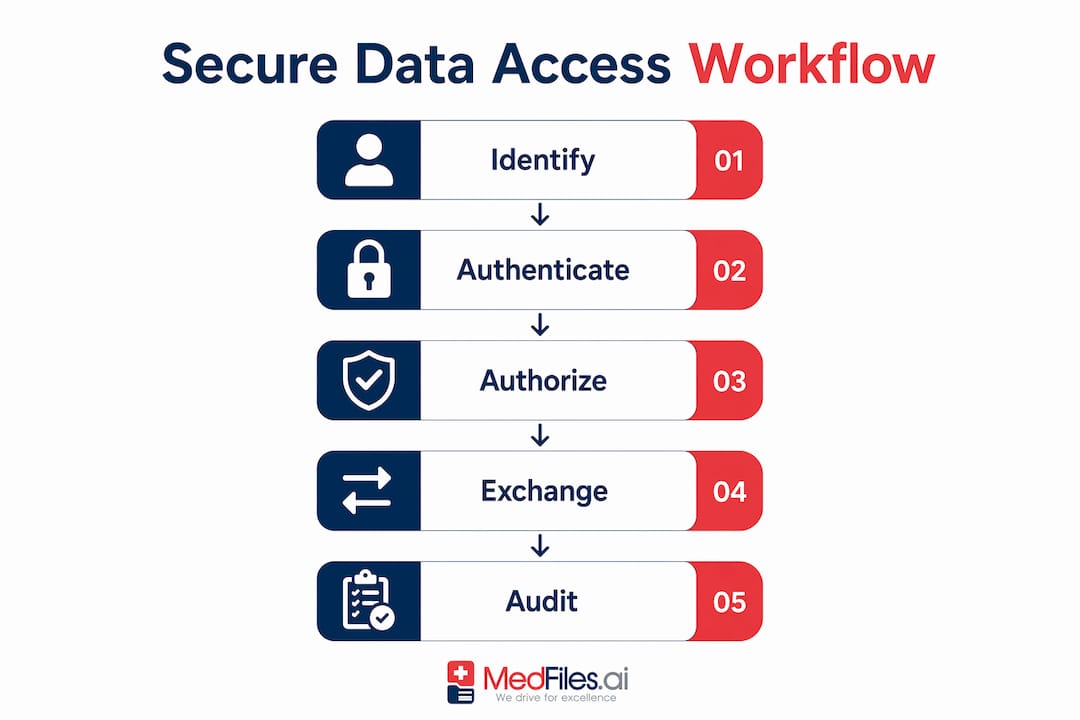
FHIR RESTful APIs are the technical mechanism TEFCA uses for granular clinical data access. FHIR allows systems to request specific data elements, such as a medication list or a lab result, rather than transferring entire records. That granularity reduces ePHI exposure during each exchange.
Expanding data access through TEFCA introduces new trust boundaries that require identity, authorization, and auditability to extend across all network participants, not just within a single organization’s EHR credentialing system. A patient accessing their own records through an individual access service is a different trust scenario than a specialist querying records during a referral. Both require distinct authorization policies.
The security advantages of standardized exchange over ad-hoc transfers are significant:
- Consistent identity verification across all QHINs and Participants in the TEFCA network
- Standardized audit requirements that apply to every data exchange event, regardless of which organization initiates it
- Patient-initiated access through individual access services, giving patients control over their own data requests
- Reduced attack surface because FHIR API calls expose only the requested data elements, not full record exports
- Network-wide governance that holds all participants to the same security baseline
The practical implication for healthcare administrators is clear. Adopting TEFCA-aligned exchange eliminates the need to negotiate and maintain separate security agreements with every partner organization. One framework governs all.
What are best practices for designing secure cloud-based upload workflows?
Secure cloud-based patient data workflows require layered architecture that isolates ePHI from AI inference components, model processing layers, and general application infrastructure. AWS HIPAA-ready architecture demonstrates this with private routing, content filtering, and logging that supports data minimization at each layer. Simply encrypting storage is not sufficient. Network isolation and key management must operate as separate controls.

The upload pipeline is a frequent vulnerability point. Secure upload pipelines use short-lived presigned upload tokens, client-side encryption, virus scanning, DICOM validation for imaging files, and metadata stores with role-based access control (RBAC). Each of these controls addresses a different attack vector. Presigned tokens expire quickly, limiting the window for interception. Client-side encryption means data is protected before it leaves the user’s device.
A critical but often overlooked tactic: store patient identifiers in a separate, encrypted metadata layer behind RBAC, and use opaque keys for stored objects. Separating patient identifiers from storage keys prevents sensitive data leakage through logs or object store metadata. This design means that even if an attacker accesses the storage layer, they cannot link files to specific patients without also breaching the metadata store.
| Control Layer | What it protects | Implementation example |
|---|---|---|
| Client-side encryption | Data in transit from device | AES-256 before upload |
| Presigned short-lived tokens | Upload authorization window | Tokens expire in 15 minutes |
| Virus and DICOM validation | Malicious file ingestion | Server-side scanning on receipt |
| RBAC metadata store | Patient identity linkage | Separate encrypted metadata database |
| Immutable audit trail | Upload and download accountability | Append-only log with key management system integration |
| Lifecycle controls | Retention and deletion compliance | Automated deletion policies per data class |
Pro Tip: Apply AI inference-layer redaction before ePHI enters any foundation model. Post-inference sanitization is far less reliable and leaves patient identifiers exposed in intermediate outputs and logs.
How does a zero-trust transfer workflow protect patient records between organizations?
Zero-trust transfer methodology treats every record transfer as untrusted by default, regardless of whether the sender is a known partner. Zero-trust transfer workflows require classification before transfer, recipient authorization, encrypted transmission with mutual authentication, data-loss prevention inspection, time-limited post-transfer access, and tamper-proof audit trails. Each step is a checkpoint, not a formality.
The controls operate in sequence:
- Pre-transfer classification: Confirm the record contains ePHI and apply the correct data handling policy before initiating any transfer
- Recipient authorization: Verify the receiving organization or individual holds current, valid authorization for the specific data being sent
- Mutual authentication and TLS encryption: Both sender and receiver authenticate each other before the connection opens; all data moves over encrypted channels
- Malware and data-loss prevention inspection: Scan outbound transfers for malicious content and confirm no unauthorized data elements are included
- Time-limited access post-transfer: Recipient access expires automatically; no indefinite access grants for transferred records
- Tamper-evident audit logging: Every access, download, and forwarding event after transfer is logged with user identity and timestamp
Operationalizing these controls reduces breach risk and enforces accountability throughout the full lifecycle of a record transfer. The audit trail created by this process is also your primary evidence during a HIPAA investigation or breach notification review.
Key takeaways
A secure patient data workflow requires layered access controls, standardized interoperability, encrypted cloud pipelines, and zero-trust transfer protocols working together across every system that touches ePHI.
| Point | Details |
|---|---|
| Unique user IDs are non-negotiable | Shared accounts violate HIPAA and make audit trails unenforceable. |
| TEFCA standardizes secure exchange | One national framework replaces dozens of ad-hoc partner agreements with consistent security governance. |
| Upload pipelines need layered controls | Presigned tokens, client-side encryption, and RBAC metadata stores each address a distinct vulnerability. |
| Zero-trust applies to every transfer | Classify, authenticate, inspect, and time-limit access before and after every record transfer. |
| Audit logs must cover all ePHI systems | Logging only the EHR UI leaves downstream processors, exports, and imaging platforms unmonitored. |
What I’ve learned about audit gaps that most guides miss
The most common failure I see in healthcare data security is not a technical one. It is the assumption that logging the EHR covers the audit requirement. Clinical environments require logging across every system that touches ePHI, including upload processors, export tools, and imaging platforms, with event-attributed trails capturing both operational actions and permission changes. Most organizations audit the front door and leave the back windows open.
The second challenge is managing trust boundaries as interoperability expands. When your organization joins a TEFCA network, your security perimeter extends to every QHIN participant. That is a significant governance shift. Your identity and authorization controls must now work at network scale, not just within your own systems.
AI redaction is genuinely useful in healthcare workflows, but only when applied at the right point. Redacting ePHI before it enters a foundation model prevents exposure in outputs and intermediate logs. Attempting to clean up after inference is unreliable. I have seen organizations invest heavily in post-processing sanitization and still find patient identifiers surfacing in model outputs. The architecture decision matters more than the cleanup effort.
Continuous monitoring is the discipline that ties all of this together. Collecting logs is table stakes. Reviewing them on a defined schedule, with automated alerts for anomalous access patterns, is what actually catches incidents before they become breaches.
— Team
How Medfiles supports compliant patient data management
Healthcare administrators need a place where encrypted records are organized, accessible, and ready to share securely with care teams.
Medfiles is built for exactly that. The platform uses HIPAA-ready infrastructure with end-to-end encryption to store medical documents, test results, prescriptions, and imaging files in one centralized location. Providers can use secure document sharing to exchange records with colleagues and specialists without relying on fax or unencrypted email. For clinical teams managing multiple patients, the Medfiles for Doctors workflow supports organized, auditable record access that fits directly into your existing care processes. Start protecting your patients’ records at MedFiles.ai.
FAQ
What is a secure patient data workflow?
A secure patient data workflow is the complete set of access controls, encryption mechanisms, audit logging, and transfer protocols that protect ePHI throughout its lifecycle. It covers every system that creates, stores, processes, or transmits patient information.
What does HIPAA require for audit logging of patient data?
HIPAA §164.312(b) requires audit controls that log all ePHI access, modification, authentication, and emergency access events, retained for a minimum of 6 years, with user identity and timestamps captured for each event.
How does TEFCA improve patient data security?
TEFCA replaces ad-hoc data sharing agreements with a single national framework that enforces consistent identity, authorization, and audit requirements across all qualified health information network participants.
Why are shared accounts a HIPAA violation?
Shared accounts make it impossible to attribute ePHI access to a specific individual, which breaks the audit trail required by the HIPAA Security Rule and eliminates accountability during incident investigations.
What is the safest way to transfer patient records between organizations?
Zero-trust transfer protocols, which include pre-transfer classification, mutual authentication, TLS encryption, malware inspection, and time-limited post-transfer access, provide the most defensible and compliant method for moving patient records between organizations.