Step-by-Step Pet Health Documentation for Families
Learn step by step pet health documentation to create a comprehensive digital record. Access vital health info anytime for your furry friend.

Step-by-Step Pet Health Documentation for Families
Your pet’s health history is only useful if you can access it at 11 PM on a Sunday when your regular vet is closed. Step-by-step pet health documentation means building a complete, organized digital record that covers every vaccination, medication, diagnosis, and emergency contact, stored securely and shareable in seconds. Here is exactly what that system looks like.
Your digital pet health record should include:
- Identification: name, breed, date of birth, microchip number, coat markings, and a current photo
- Vaccinations: date administered, vaccine name, lot number, expiry, and next due date
- Medications: name, dose, frequency, start and stop dates, prescribing vet
- Allergies and adverse reactions: specific trigger, severity, and date first noted
- Diagnoses and chronic conditions: date, condition name, current management plan
- Weight history: monthly minimum, logged with date
- Lab results and imaging: CBC, urinalysis, X-rays, ultrasound reports
- Surgical history: date, procedure, surgeon notes, discharge instructions
- Emergency contacts: your primary vet, nearest 24-hour clinic, and the ASPCA Animal Poison Control Center
- Pet insurance details: policy number, provider, and coverage summary
Organize these categories in a digital records system rather than a folder of PDFs. A structured record is queryable; a folder of scans is not. If you have multiple pets or family members, keep all profiles in one platform so nothing gets siloed.
1. How to build a one-page emergency health summary
The emergency summary is the single most important document in your pet’s file. It gives any vet, pet sitter, or emergency clinic the critical facts they need in under 60 seconds, without digging through years of records.
Include these fields on one page:
- Pet name, species, breed, age, and weight
- Microchip number and registration database
- Known allergies and adverse drug reactions (list specific drugs or foods)
- Current medications with dose and frequency
- Active diagnoses and chronic conditions
- Primary vet name, clinic, and phone number
- Emergency vet clinic name and phone number
- Owner contact (primary and backup)
Format it with large, bold section headers so anyone can scan it under stress. A functional pet health record should include exactly this kind of one-page summary for urgent clarity.
Update the summary every time a medication changes, a new diagnosis is made, or your contact information shifts. Do not wait for the annual vet visit.

Pro Tip: Start with what matters most: allergies, current meds, and the microchip number. Backfill older history gradually over the following weeks rather than trying to reconstruct everything at once.
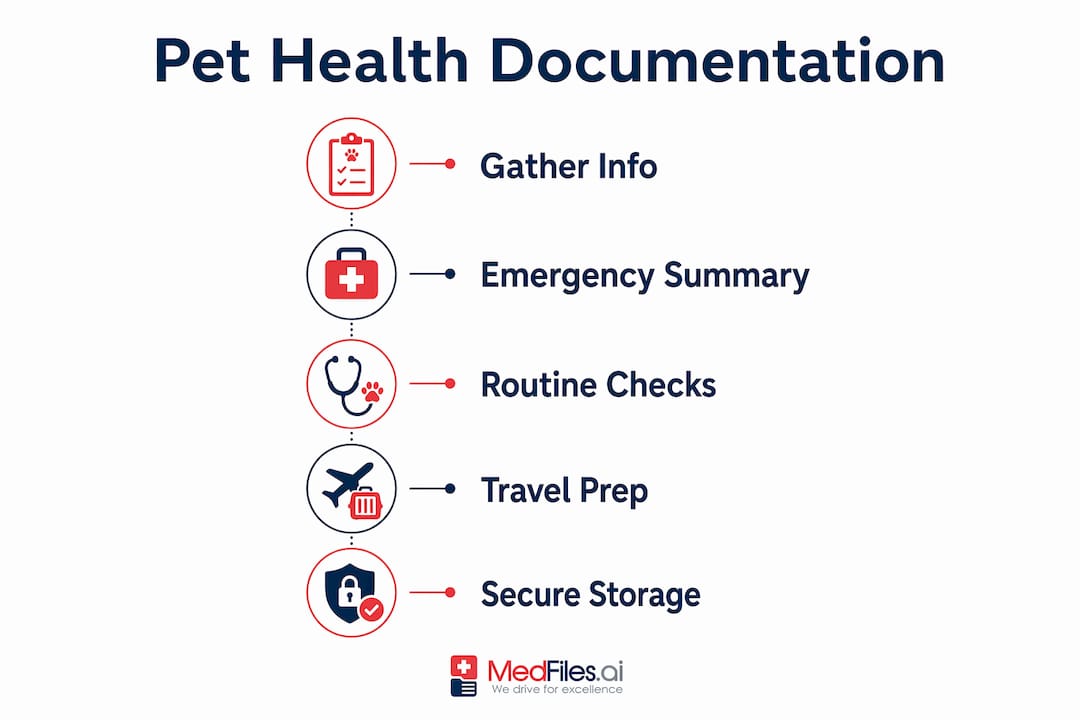
2. Documenting routine veterinary visits and home check-ins
Routine documentation is where most pet owners fall short. The goal is a chronological, queryable record, not a stack of receipts.
Log these details after every vet visit:
- Date, clinic name, and attending vet
- Reason for visit and findings
- Vaccinations given (with lot number and expiry)
- Diagnostic tests ordered and results
- Weight recorded at the visit
- Medication changes or new prescriptions
- Next recommended appointment date
Veterinary exams are recommended yearly for healthy adult pets; for puppies, kittens, and senior pets, schedule visits more frequently according to your vet’s guidance. WSAVA guidelines reinforce that wellness tracking works best when owners and vets collaborate using medical records as the shared foundation, not just a reactive tool for illness.
Between visits, log monthly home check-ins to track nutrition, weight, grooming, dental health, parasite prevention, and behavioral changes. Monthly routines that include weight monitoring and parasite medication on a fixed date each month catch early problems before they escalate. Set a recurring calendar reminder on the same date every month so the habit sticks.
3. Preparing pet health documentation for international travel
International pet travel requires specific documents with strict timing requirements. Missing one step can mean your pet is turned away at the border.
Documents you will need:
- Microchip: ISO 15-digit chip implanted before the rabies vaccine
- Rabies vaccination certificate: administered at least 21 days before travel, not more than one year old
- International health certificate: issued by a USDA-accredited vet, typically valid for 10 days from the date of issue
- USDA endorsement: required for most international destinations; your vet submits paperwork to APHIS on your behalf
- Blood titer test: required by some countries (Japan, Australia, and others) to confirm rabies immunity
- Destination-specific treatments: tick or tapeworm treatment required by countries including the UK, Ireland, and Finland
The USDA APHIS recommends contacting a USDA-accredited vet as soon as you decide to travel internationally. International preparation typically takes 1–4 months depending on the destination’s requirements. Verify destination rules every time you travel, because they change.
Keep both a digital copy and a printed copy of all travel documents. Customs officials sometimes require paper, and digital access can fail at the worst moments.
4. How to store and manage digital pet health records securely
Paper records get lost in moves, floods, and fires. Digital record management platforms built for health data offer something paper never can: instant access, secure sharing, and a record that does not degrade.
Best practices for digital storage:
- Choose a platform with end-to-end encryption and HIPAA-ready infrastructure
- Use multi-profile management to keep all pets and family members in one place
- Set calendar reminders for annual exams, monthly weigh-ins, and medication refills
- Organize records by document type (vaccinations, labs, imaging, medications) and by date
- Enable secure sharing so you can send records to a new vet or emergency clinic without printing anything
- Store both the full record and the one-page emergency summary in the same system
Structured digital platforms outperform simple cloud folders because they allow querying, not just storage. A vet receiving a clean, organized record can find what they need in seconds. A PDF dump wastes everyone’s time. For families managing both human and pet records, a single secure storage system eliminates the risk of records living in five different places.
5. Why thorough documentation improves your pet’s care
Medical records are legal documents that detail your pet’s entire health history. Zoetis Petcare notes that these records ensure consistency and accuracy across every veterinary professional who treats your pet. That legal status is a reason to treat documentation seriously, not as optional paperwork.
Complete records improve diagnostic accuracy, reduce appointment time when switching vets, and give emergency clinics the context they need to act fast. The AVMA encourages owners to educate themselves and work closely with their vets, describing the most engaged owners as “Most Valuable Pet Owners” who catch health changes early because they are paying attention and keeping records.
For pets with chronic conditions, detailed documentation is the difference between a vet who understands the full picture and one who is guessing. For travel and boarding, up-to-date records with proof of vaccinations are often legally required. The practical outcomes of good documentation include faster treatment, smoother travel, better insurance claims, and less stress for you and your pet.
6. Recommended tools for managing pet health records
The right tool depends on how much structure you want and whether you are managing records for one pet or an entire family.
Options by category:
- Dedicated pet health apps: platforms like PetDesk and Pawprint offer structured fields for vaccinations, medications, and vet visits, with reminders for upcoming doses and appointments
- General cloud storage (Google Drive, Dropbox): free and accessible, but no structure; a vet receiving a folder of PDFs still has to search manually
- Your vet’s patient portal: convenient for records from that clinic only; does not consolidate history from multiple providers
- Integrated family health platforms: systems like Medfiles that manage both human and pet profiles in one HIPAA-ready environment, with AI-powered analysis, secure sharing, and multi-profile management
For families already managing digital medical records for themselves, adding pet profiles to the same platform is the most practical approach. You get one login, one sharing workflow, and one encrypted system covering everyone in the household. Holistic health tracking across the whole family, including routine health exam schedules, fits naturally into this kind of centralized system.
Whatever tool you choose, the structure matters more than the storage. A queryable record with consistent fields beats a well-labeled folder every time.
Medfiles keeps your pet’s records secure and ready

Medfiles is built for exactly this situation: families who want one secure, organized place for every health record, human and pet alike. Instead of scattered PDFs, paper folders, and app-specific silos, Medfiles gives you a single HIPAA-ready platform with end-to-end encryption, multi-profile management, and AI-powered document analysis.
Upload your pet’s vaccination records, lab results, emergency summary, and travel certificates. Share them instantly with any vet using secure digital sharing, without printing or faxing. Set reminders for annual exams and monthly check-ins so nothing slips. And when you travel internationally, your documents are accessible from any device, with printed copies just a tap away.
Your pet’s entire health history. Organized, encrypted, and ready when you need it. Start your free account and add your first pet profile today.
Key takeaways
Comprehensive digital pet health documentation, built step by step and updated consistently, gives every vet your pet sees the full picture they need to provide accurate, fast care.
| Point | Details |
|---|---|
| Start with the emergency summary | Build a one-page document covering allergies, current meds, microchip number, and emergency contacts first. |
| Log every vet visit in full | Record exam date, vaccinations with lot numbers, weight, test results, and medication changes after each appointment. |
| Plan international travel well in advance | Health certificates have a short validity period; USDA endorsement and blood titer tests can extend preparation time. |
| Choose structure over storage | A queryable digital platform with consistent fields outperforms a cloud folder of PDFs for both daily use and emergencies. |
| Medfiles centralizes everything | Medfiles manages pet and family records together in one HIPAA-ready system with secure sharing and AI-powered organization. |