The Role of Data Security in Health: What You Need to Know
Discover the vital role of data security in health to protect patient information. Learn how to safeguard your healthcare data effectively.

The Role of Data Security in Health: What You Need to Know
Healthcare data security is the practice of protecting sensitive patient information from unauthorized access, alteration, or disruption to preserve privacy and ensure safe care delivery. Your medical records contain permanent identifiers, clinical histories, and financial details that make them highly valuable to cybercriminals far beyond what a stolen credit card number offers. The role of data security in health extends across electronic health records (EHRs), cloud platforms, Internet of Medical Things (IoMT) devices, and third-party vendor systems. Standards like the HIPAA Security Rule set the legal floor, but effective protection demands far more than compliance checkboxes.
What are the common threats to healthcare data security today?
Healthcare is one of the most targeted sectors for cybercrime, and the reasons are straightforward. Patient records hold permanent data that cannot be changed the way a password can. That permanence makes every breach a long-term liability for patients and providers alike.
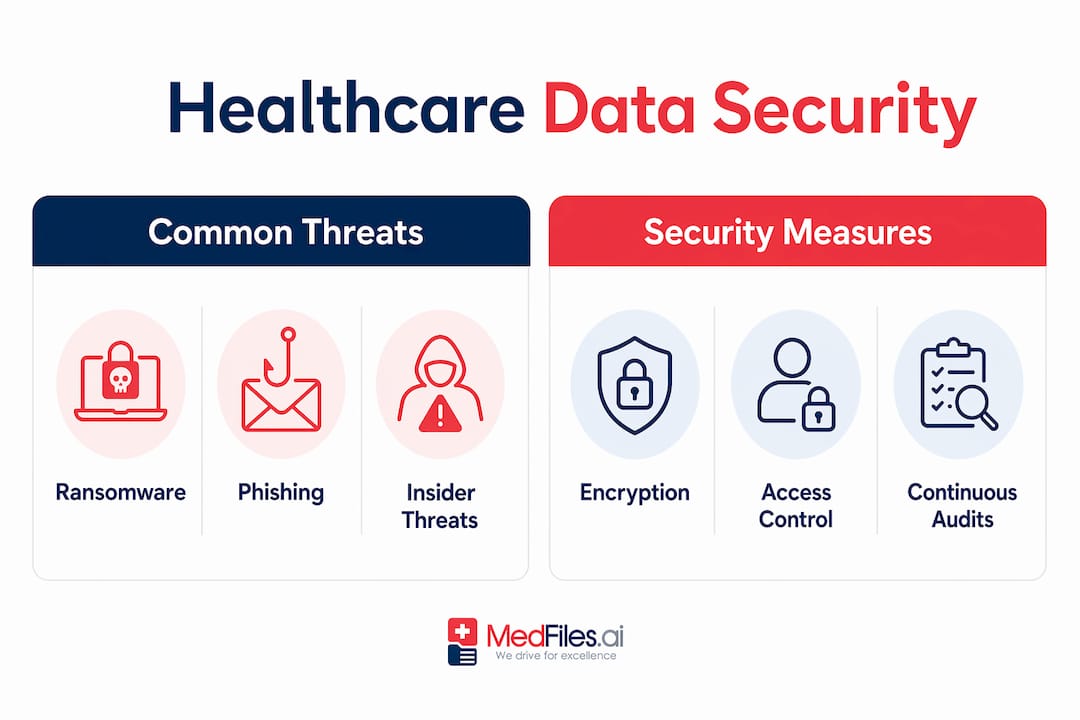
The threat categories you need to understand:
- Ransomware attacks lock EHR systems and halt clinical workflows entirely. The 2024 Change Healthcare attack caused multi-week delays in clinical operations and affected millions of patients across the United States.
- Phishing schemes target hospital staff through deceptive emails that harvest login credentials. A single click by one employee can expose an entire network.
- Insider threats arise from human error or deliberate misuse. A nurse accessing records outside her patient panel, a contractor copying files to a personal drive. These incidents are more common than most organizations admit.
- Legacy system vulnerabilities leave older hospital infrastructure exposed. Many hospitals still run software that vendors no longer support or patch.
- IoMT device risks multiply as connected devices like infusion pumps, cardiac monitors, and imaging equipment join hospital networks without adequate security controls.
- Third-party vendor access creates entry points that hospitals cannot directly monitor. Vendor portals and cloud services represent growing attack surfaces where unauthorized access risks increase significantly.
“Cyberattacks on healthcare systems can cause emergency room gridlocks and disrupt vital medical services.” The European Commission classifies healthcare as critical infrastructure because the consequences of a successful attack extend directly to patient safety, not just data privacy.
Understanding these threats is the first step. Knowing how organizations defend against them is what separates reactive victims from resilient systems.
How do healthcare organizations implement effective data security measures?
Strong healthcare cybersecurity is not a single tool or policy. It is a layered defense model that combines technology, governance, and people. Multi-layered defense strategies using encryption, multi-factor authentication (MFA), blockchain, and AI-driven anomaly detection significantly reduce data exposure risks.
Here is how effective organizations build that defense:
- Encrypt everything in transit and at rest. End-to-end encryption means that even if data is intercepted, it cannot be read without the decryption key. This applies to EHRs, lab results, imaging files, and any record shared between providers.
- Enforce multi-factor authentication. Passwords alone are not sufficient. MFA requires a second verification step, which blocks the majority of credential-based attacks even when login details are compromised.
- Map and control all data paths. This includes cloud storage, vendor portals, and remote access points. Ongoing vendor risk management and access control are critical because most breaches enter through secondary systems, not the hospital’s primary servers.
- Train every staff member, not just IT. Clinical teams, administrative staff, and even patients who access patient portals are part of the security perimeter. Shared responsibility across all stakeholders is what effective security culture looks like in practice.
- Build and test incident response plans. Knowing what to do in the first 24 hours of a breach determines how quickly care can resume. Organizations that rehearse their response recover faster and with less patient impact.
Compliance with the HIPAA Security Rule and NIST Cybersecurity Framework provides the structural baseline. But compliance alone does not equal security. Policies must be tied to active technical controls, not just documented procedures.
Pro Tip: Run continuous evidence-based audits that test whether your controls actually work, not just whether they are documented. A firewall rule that exists on paper but is misconfigured offers zero protection.

What role does healthcare data security play in patient safety and care continuity?
Most people think of data breaches as a privacy problem. The reality is that cybersecurity failures cause operational disruptions that are often more damaging than the breach itself. When a hospital cannot access its EHR system, clinical care stops.
The direct patient safety consequences include:
- Delayed diagnostics. Physicians cannot review imaging results, lab values, or prior records when systems are locked. Decisions get delayed or made with incomplete information.
- Disrupted medication delivery. Pharmacy systems that rely on EHR data cannot verify dosages or flag dangerous drug interactions during an outage.
- Cancelled surgeries. Operating rooms depend on pre-operative records, consent forms, and anesthesia histories. Without access, elective and even urgent procedures get postponed.
- Broken clinical scheduling. Appointment systems, referral workflows, and care coordination tools all depend on connected data. A breach can collapse an entire outpatient operation for days or weeks.
- IoMT device interference. Security lapses in connected medical devices can affect monitoring accuracy or device functioning, creating direct physical risks for patients in critical care.
Recovery from a major cyberattack often takes weeks or months. That timeline translates directly into delayed treatments, missed diagnoses, and eroded patient trust. The practical examples of healthcare data disruptions seen in recent hospital attacks make clear that cybersecurity is a patient safety issue, not just an IT concern.
For patients and families, this means your ability to receive timely, accurate care depends on the security of the systems holding your records. That is why understanding the importance of health data security matters to everyone, not just hospital administrators.
How are emerging technologies shaping the future of healthcare data security?
The threat environment evolves faster than traditional security tools can respond. AI and machine learning are now central to the next generation of healthcare cybersecurity, providing proactive real-time threat detection especially in complex IoMT environments.
| Technology | Function | Key challenge |
|---|---|---|
| AI and machine learning | Detects anomalies and zero-day threats in real time | Adversarial attacks can fool detection models |
| Deep learning | Identifies complex attack patterns across large datasets | High computational overhead in clinical settings |
| Reinforcement learning | Adapts defenses based on evolving threat behavior | Requires significant training data and expertise |
| Blockchain | Ensures data integrity and enables secure, auditable sharing | Integration complexity with existing EHR systems |
| Behavioral analytics | Flags unusual user activity before a breach occurs | Privacy concerns around monitoring clinical staff |
The shift from reactive patching to proactive adaptive security is the defining challenge for healthcare IT in 2026. Traditional signature-based tools catch known threats. AI-powered systems can identify patterns that suggest an attack before it executes. That difference matters enormously when the target is a hospital network where downtime costs lives.
Blockchain deserves specific attention for its role in data integrity. When a patient record is stored on a distributed ledger, any unauthorized modification is immediately visible. This protects both the accuracy of clinical data and the chain of custody for sensitive records shared across providers.
Pro Tip: Do not deploy AI security tools in isolation. Integrate them with your existing SIEM platform and clinical workflow systems so that alerts reach the right people in time to act. An alert that goes to an unmanned inbox offers no protection.
The future of digital security in health data depends on organizations building adaptive, technology-forward defenses while keeping clinical usability at the center of every decision.
Key takeaways
Healthcare data security protects patient safety, clinical continuity, and privacy by combining encryption, access controls, staff training, and AI-powered threat detection across every system that touches health data.
| Point | Details |
|---|---|
| Threats are multi-vector | Ransomware, phishing, insider threats, and vendor risks all require separate but coordinated defenses. |
| Defense must be layered | Encryption, MFA, access controls, and incident response plans work together, not as standalone fixes. |
| Breaches disrupt care directly | Cancelled surgeries and delayed medications are the real cost of a healthcare cyberattack. |
| AI is reshaping detection | Machine learning and behavioral analytics catch threats that traditional tools miss, especially in IoMT environments. |
| Security is everyone’s responsibility | Clinical staff, patients, vendors, and IT teams all play a role in protecting health data. |
Why data security in healthcare can’t stay in the IT department
After years of working closely with healthcare data management, the pattern I keep seeing is the same. Organizations invest heavily in firewalls and compliance audits, then lose a breach through a phishing email that a front-desk coordinator clicked on a Tuesday afternoon. The technology was fine. The culture wasn’t.
Human factors remain the largest security challenge in healthcare cybersecurity. When security protocols are too cumbersome, clinical staff find workarounds. They share login credentials to save time. They access records from personal devices. These are not malicious acts. They are predictable responses to systems that prioritize security over usability.
The uncomfortable truth is that a security policy nobody follows is worse than no policy at all. It creates false confidence while leaving real gaps. The organizations that get this right build security into clinical workflows rather than bolting it on top. They treat training as ongoing, not a one-time onboarding checkbox. They measure whether controls actually work, not just whether they exist.
For patients and families, the takeaway is equally direct. You have a role too. Use strong, unique passwords for patient portals. Review your records for errors. Ask your providers how they protect your data. Your health information is yours, and understanding how it is protected is part of managing your health.
The medical record security basics that protect you start with awareness. Security is not a destination. It is a practice.
— Team Medfiles
Take control of your health records with Medfiles
Your medical records deserve the same level of protection that hospitals spend millions trying to achieve. Medfiles gives you that protection in a platform built for real people.
Medfiles stores your test results, prescriptions, imaging reports, and clinical notes in one encrypted, HIPAA-ready environment. You control who sees your records and when. Share securely with any doctor, specialist, or family member in seconds. Access everything instantly during an emergency, while traveling, or when switching providers. Medfiles also supports doctors and clinical teams with secure data exchange that fits directly into their workflows. Explore subscription plans designed for individuals, families, and multi-user groups.
Your entire medical history. In your pocket. Always protected.
FAQ
What is the role of data security in health?
Healthcare data security protects patient records from unauthorized access, alteration, and disruption to preserve privacy and ensure safe, uninterrupted clinical care. It covers EHR systems, cloud platforms, IoMT devices, and third-party vendor access points.
Why do healthcare data breaches affect patient safety?
Breaches lock EHR systems and disrupt clinical workflows, causing delayed diagnostics, cancelled surgeries, and medication errors. Operational disruptions often last weeks and directly harm patient outcomes beyond the privacy violation itself.
What are the most effective ways to secure healthcare data?
The most effective approach combines end-to-end encryption, multi-factor authentication, strict access controls, continuous staff training, and AI-driven anomaly detection. Multi-layered defense models that address both technology and organizational culture reduce exposure risk most significantly.
How does HIPAA relate to healthcare data security?
HIPAA’s Security Rule sets the legal minimum for protecting electronic health information in the United States. It requires covered entities to implement administrative, physical, and technical safeguards, but compliance with HIPAA alone does not guarantee protection against modern cyber threats.
Can patients do anything to protect their own health data?
Patients can use strong, unique passwords for all health portals, review their records regularly for unauthorized changes, and choose platforms with end-to-end encryption and HIPAA-ready infrastructure. Storing and managing your own records through a secure platform like Medfiles gives you direct control over who accesses your information.