The Role of Healthcare Data Portability for Families
Discover the vital role of healthcare data portability for families. Learn how to access and use your health information effectively.

The Role of Healthcare Data Portability for Families
Healthcare data portability is defined as your legal right to access, move, and use your electronic health information across providers and platforms without barriers. The industry term for this concept is health information portability, and it sits at the center of modern patient rights law in the United States. The role of healthcare data portability goes far beyond convenience. It determines whether your doctor sees your full medical history or only a fragment of it. Laws like the HIPAA Privacy Rule and the 21st Century Cures Act establish this right with specific timelines and penalties. Understanding how these rules work puts you in control of your own care.
What legal rights and regulations shape healthcare data portability?
Your right to access your medical records is not a courtesy. It is federal law. The HIPAA Privacy Rule requires healthcare providers to give you access to your electronic health information in a usable format, and providers must respond within 30 days of your request, with one 30-day extension permitted.
The 21st Century Cures Act added a sharper edge to these protections. It introduced the Information Blocking Prohibition, which prevents providers, health IT developers, and networks from unreasonably withholding your data. Violations carry serious consequences. Penalties for information blocking can reach up to $1,000,000 per violation for health IT developers under 45 CFR Part 171. That figure signals how seriously regulators treat this issue.
The Office of the National Coordinator for Health Information Technology (ONC) also requires certified health IT systems to support FHIR APIs and standardized data classes defined by the United States Core Data for Interoperability (USCDI). These requirements exist so your data moves in a format that other systems can actually read and use.
Key patient rights under current law include:
- Right of access: Request your full electronic health record, not just a summary.
- Right to direct transmission: Ask your provider to send records directly to another provider or app.
- Right to usable formats: Receive data in formats like FHIR JSON or C-CDA, not just paper printouts.
- Right to contest blocking: File a complaint if a provider or vendor unreasonably delays or denies access.
Knowing these rights changes how you interact with the healthcare system. You are not asking for a favor when you request your records. You are exercising a legal right.
What technical and practical challenges affect effective healthcare data portability?
Legal rights and technical reality do not always match. Large health networks often run multiple incompatible EHR systems, creating silos of data that cannot talk to each other. Your records from a hospital visit may be completely invisible to your primary care physician if they use a different platform.
Even when data transfers do happen, the result is not always useful. Regulatory compliance alone does not guarantee that transferred data is clinically meaningful. A file can be technically compliant yet stripped of the context a doctor needs to act on it. Lab values without reference ranges, medication lists without dosage history, and notes without clinical narrative all create gaps in care.
Patient awareness compounds the problem. Fragmented health coordination drives duplicate testing and inefficient care, yet most patients in developed countries remain unaware of their right to online access. Many accept paper printouts or partial summaries without realizing they can request a complete, machine-readable record.
Common situations where data mobility breaks down include:
- Moving to a new city and switching primary care providers
- Seeing a specialist who uses a different hospital network
- Transitioning a teenager from pediatric to adult care
- Filing an insurance claim that requires records from multiple providers
- Seeking a second opinion from an out-of-network physician
Pro Tip: When requesting records, specifically ask for your “designated record set” in electronic format. This legal term covers the full scope of your health information, not just a visit summary.
Vendor-neutral platforms and cloud-based storage help close these gaps. They sit outside any single provider’s system and give you a place to collect, organize, and share records on your own terms. Families managing care for children, elderly parents, or members with chronic conditions benefit most from this kind of centralized access. You can read more about real-world data portability scenarios to see how these challenges play out in practice.
How do data standards and APIs facilitate healthcare data exchange?
Standards are what make health data exchange possible at scale. HL7 FHIR (Fast Healthcare Interoperability Resources) is the backbone of modern healthcare data exchange. FHIR and USCDI data classes create a framework for machine-readable, meaningful data transfer by defining resource types like Patient, Observation, and MedicationRequest in a consistent structure.
Other formats serve specific purposes within the broader exchange ecosystem.
| Standard | Purpose | Common Use Case |
|---|---|---|
| HL7 FHIR | Machine-readable resource exchange | Patient portals, third-party health apps |
| C-CDA | Clinical document architecture | Discharge summaries, referral packets |
| DICOM | Medical imaging format | X-rays, MRIs, CT scans |
| X12 | Administrative transactions | Insurance claims, eligibility checks |
| SNOMED CT / LOINC / RxNorm | Clinical terminology | Diagnoses, lab results, medications |
Patient-facing portals and third-party apps connect to these standards through OAuth 2.0 and SMART on FHIR frameworks. These protocols let you authorize an app to pull your records from a provider’s system without sharing your password. Think of it like logging into a website using your Google account. The provider authenticates you, and the app receives only the data you approve.
Data normalization and provenance matter just as much as the format itself. A lab result transferred without its original reference range or collection date loses clinical value. Validation processes that check data completeness and accuracy before transfer protect you from receiving records that look complete but are missing critical details. Dental records follow similar principles. Digital dental records in specialized care settings face the same portability challenges as general medical records, and patients benefit from understanding how to request them in usable formats.
What practical roles do patients and families play in managing health records?
Patients are increasingly becoming coordinators of their health information across telehealth visits, specialist appointments, and insurance claims. This is not a future prediction. It is already happening, and families who understand this shift get better care.
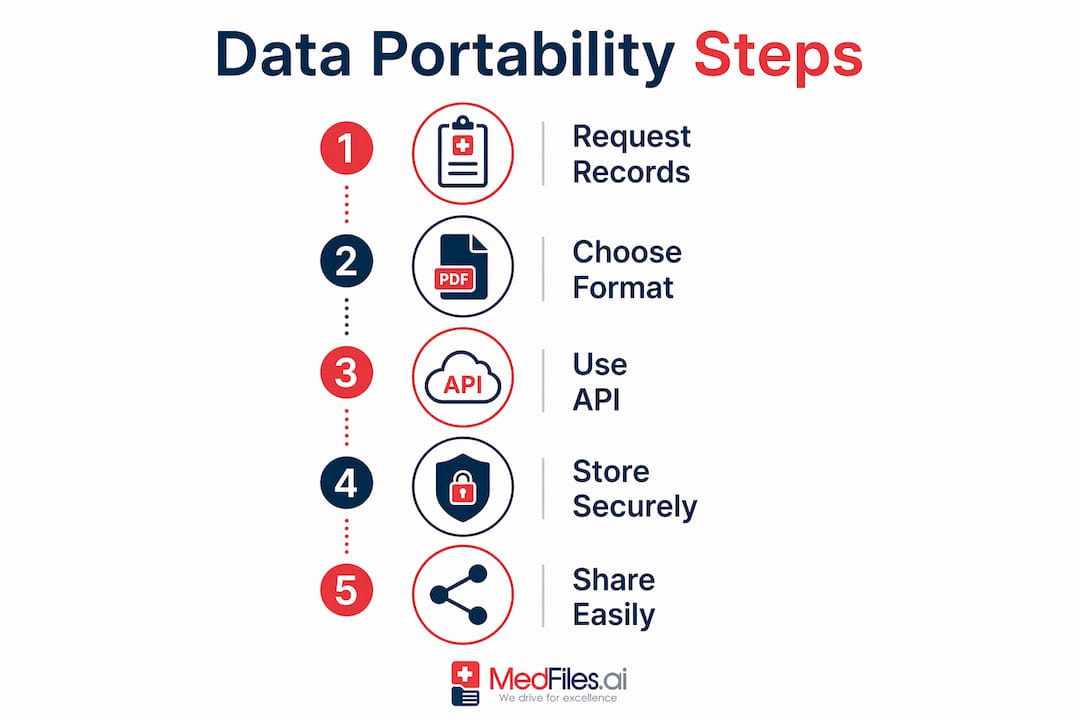
Here is how to take an active role in managing your health information:
- Request your full designated record set. Ask for the complete record, not a visit summary. Patients who request full longitudinal records get a more complete picture of their health history than those who accept partial summaries.
- Specify the format. Ask for FHIR JSON or C-CDA if you plan to use a digital health app. Ask for PDF if you need a readable document for a new provider.
- Know your timeline. Providers have 30 days to respond. If they miss the deadline, you can file a complaint with the Office for Civil Rights (OCR).
- Address delays directly. Patients who understand their rights can push back on administrative delays and avoid being handed paper copies when electronic formats are available.
- Organize records in one place. Use a secure platform to store records from every provider, so you are never starting from scratch at a new appointment.
Families managing care for multiple members face a specific challenge: records are scattered across pediatricians, specialists, dentists, and urgent care clinics. A parent coordinating a child’s care transition from pediatric to adult medicine needs years of records in one accessible place. The same applies to adult children managing an aging parent’s care across multiple specialists.
Pro Tip: Create a shared digital folder or use a family health record platform to store key documents for every family member. Include vaccination records, allergy lists, and current medication lists so any provider can get up to speed instantly.

Understanding how patient data affects healthcare outcomes helps you see why staying organized is not just administrative. It directly influences the quality of care you receive.
Key Takeaways
Healthcare data portability gives patients legal control over their records, but exercising that right requires knowing the rules, the formats, and the tools available to you.
| Point | Details |
|---|---|
| Legal rights are enforceable | HIPAA and the 21st Century Cures Act give you the right to electronic records within 30 days. |
| Compliance does not equal usability | Transferred data must include clinical context to be useful, not just technically formatted. |
| Standards enable real exchange | HL7 FHIR, USCDI, and SMART on FHIR make data readable and shareable across systems. |
| Patients must be proactive | Request your full designated record set and specify electronic formats to get complete records. |
| Centralized storage reduces gaps | Organizing records in one secure place prevents fragmentation across providers and visits. |
Why data portability is the most underused patient right
Most patients treat their medical records as something that belongs to their doctor’s office. That assumption costs them. Records get lost in transitions, duplicate tests get ordered, and critical history goes unseen by the specialist who needs it most.
The gap between what the law guarantees and what patients actually receive is almost entirely an awareness problem. The legal framework is solid. HIPAA, the 21st Century Cures Act, and ONC certification requirements together create a strong foundation. The technical standards exist. FHIR APIs are widely deployed. What is missing is the patient who knows to ask.
Families with complex medical histories, chronic conditions, or members who see multiple specialists feel this gap most acutely. A child with a rare diagnosis may have records spread across five different systems by age ten. A parent managing that child’s care while also coordinating their own and an elderly grandparent’s records is doing the work of a health information manager without any of the tools.
The shift from passive recipient to active coordinator is real and it is already underway. Patients shifting to active health data coordinators represents a significant cultural change in how healthcare works. The families who make that shift earliest will have better continuity of care, fewer redundant tests, and stronger relationships with their providers.
Digital health tools exist precisely to support this shift. The combination of law, standards, and the right platform makes genuine data portability achievable for any family willing to take it seriously.
— Team
Medfiles makes your medical records portable and secure
Your records should be where you need them, when you need them. Medfiles is built for exactly that. It gives individuals and families a single, secure place to store, organize, and share medical documents across every provider and care setting.
Medfiles supports secure document sharing with HIPAA-ready infrastructure, end-to-end encryption, and audit logging that meets HIPAA, SOC 2, and HITRUST standards. You can store test results, prescriptions, imaging reports, and clinical notes in one place and share them instantly with any provider. The platform handles medical document storage for individuals and entire families, including multi-profile management for children, parents, and even pets. Whether you are preparing for a specialist visit, traveling abroad, or managing a care transition, Medfiles keeps your full health history accessible and protected.
FAQ
What is health data portability?
Health data portability is your legal right to access, receive, and direct the transfer of your electronic health information to any provider or platform you choose. Federal laws including HIPAA and the 21st Century Cures Act establish and enforce this right.
How long does a provider have to send my records?
Providers must fulfill electronic record requests within 30 days under the HIPAA Privacy Rule, with one 30-day extension allowed. Violations can be reported to the Office for Civil Rights.
What format should I request my health records in?
Request FHIR JSON or C-CDA format if you plan to use a digital health app or platform. Request PDF if you need a readable document to share directly with a new provider.
Why do my records sometimes seem incomplete after a transfer?
Compliance with data transfer rules does not guarantee clinical usefulness. Records can be technically formatted but missing context like reference ranges, dosage history, or clinical notes, which reduces their value to a receiving provider.
Can families manage health records for multiple members in one place?
Yes. Platforms like Medfiles offer multi-profile management, letting one account holder store and organize records for children, parents, and other family members in a single secure location.