What Is a Digital Health Vault? Your 2026 Guide
Discover what is a digital health vault and how it empowers you to securely manage your health data. Control your health narrative today!

What Is a Digital Health Vault? Your 2026 Guide
A digital health vault is a secure, patient-controlled platform that stores, organizes, and shares your personal health information in one place. The industry term for this concept is a Personal Health Record (PHR), and digital vaults represent its most advanced form. These platforms consolidate scattered health data including lab reports, prescriptions, vaccination records, and imaging summaries, replacing the fragmented paper files and disconnected portals most people rely on today. The core philosophy is patient sovereignty: you own your medical narrative, and you decide who sees it, when, and why.
What is a digital health vault and how does it work?
A digital health vault is built around one principle: you control your health data, not your doctor’s office or your insurance company. Patient-controlled access models use explicit consent flows and cryptographic identity verification to give you granular control over every document you share. That means you can grant a specialist access to your imaging results without exposing your full medication history.
These platforms pull data from multiple sources. You can upload documents manually, sync results from labs and specialists, or connect wearable devices that track blood pressure, sleep, and activity. The result is a single, unified record that follows you across every provider you ever visit.

AI-powered analysis is a standout feature in modern vaults. AI tools highlight out-of-range lab parameters and visualize trends over time, making it easier to understand your results before a doctor’s appointment. This supplements your health literacy without replacing professional interpretation.
Key features you should expect from a quality digital health vault:
- Document storage: Lab reports, prescriptions, imaging files, vaccination records, and specialist notes in one location
- AI-powered summaries: Automated analysis that flags abnormal values and tracks health trends
- Consent-based sharing: You choose exactly which documents to share and with whom
- Emergency access protocols: Predesignated contacts can view critical documents during a crisis
- Multi-profile management: One account can cover your entire family, including children and pets
- Secure identity verification: Encrypted login and role-based access prevent unauthorized entry
Pro Tip: Test your emergency access settings before you need them. Designate a trusted contact, walk them through the process, and confirm they can access your critical documents without your password.
How do digital vaults compare to traditional health records?
Traditional health records live inside provider systems. Your primary care doctor holds one set of files, your cardiologist holds another, and your urgent care clinic holds a third. None of them automatically talk to each other. Digital health vaults differ fundamentally because you manage the record, not the provider, and you can integrate data from every source into a single lifetime document.
The advantages over conventional systems are concrete and significant:
- You own the data. Provider-controlled Electronic Health Records (EHRs) are legally the property of the healthcare organization. Your PHR vault belongs to you, regardless of which clinic you visit next.
- One record, every provider. Moving to a new city or switching doctors no longer means starting from scratch. Your complete history travels with you.
- Faster, better communication. Interoperability transforms your medical history into a portable dataset that supports more precise treatment decisions. Doctors spend less time asking for records and more time acting on them.
- Wearable and wellness data included. Clinical EHRs rarely capture your Fitbit readings or home blood pressure logs. Vaults accept this data and give it context alongside your formal medical records.
- Reduced paper dependency. Physical records get lost, damaged, or left behind during emergencies. A digital vault is accessible from any device, anywhere in the world.
The shift from provider-controlled records to patient-owned health data is not just a convenience upgrade. It is a structural change in how care continuity works, especially for people managing chronic conditions or coordinating care across multiple specialists.
How are digital health vaults secured?
Security in a digital health vault operates at multiple layers, and understanding those layers helps you evaluate any platform you consider using.
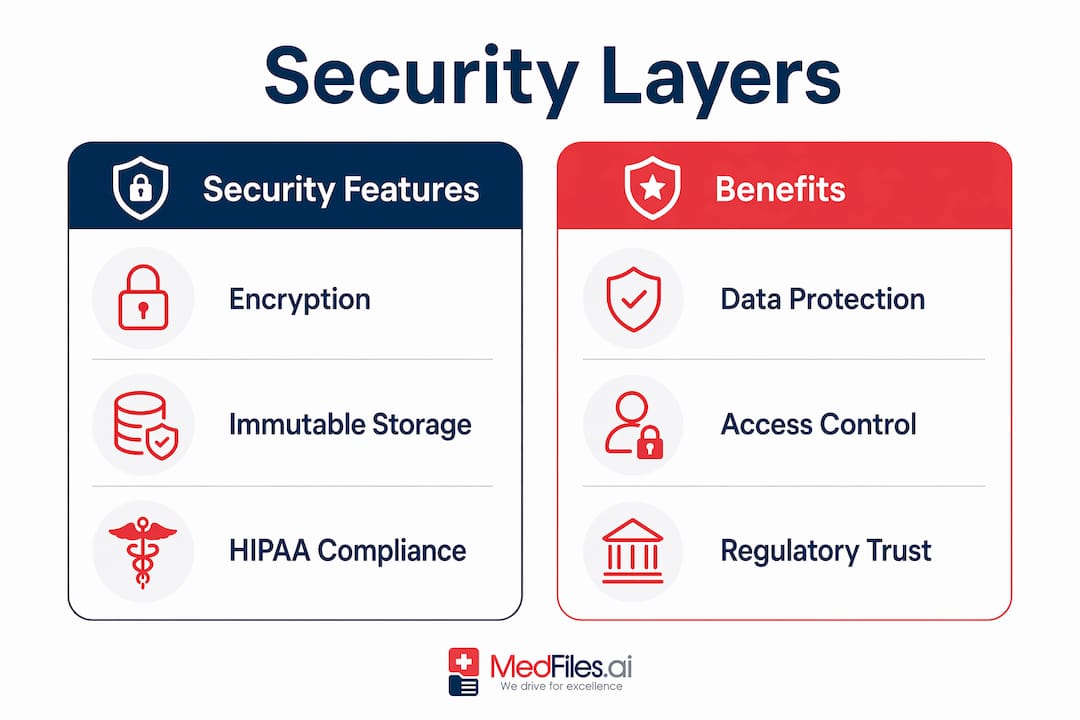
| Security layer | What it does | Why it matters |
|---|---|---|
| End-to-end encryption | Encrypts data in transit and at rest | Prevents interception during sharing |
| Immutable data architecture | Prevents alteration or deletion of stored records | Protects against ransomware and accidental loss |
| Role-based access control | Limits document visibility by user role | Stops unauthorized access within shared accounts |
| Cryptographic identity verification | Confirms user identity before granting access | Blocks credential-based attacks |
| HIPAA compliance | Meets federal standards for health data privacy | Provides legal accountability for data handling |
| Break-glass emergency access | Allows predesignated contacts to access records in a crisis | Ensures care continuity when you cannot respond |
HIPAA-compliant cloud storage adds another layer of protection by requiring audit trails, predictable cost structures, and long-term retention policies. This matters because health data is not a short-term asset. You may need records from a decade ago to inform a diagnosis today.
Advanced platforms go further by using decentralized frameworks that ensure zero unauthorized access even by the platform provider itself. That level of architecture means your data is genuinely yours, not just nominally yours.
Pro Tip: When evaluating any digital vault, ask specifically about immutable storage and HIPAA compliance. A platform that cannot confirm both should not hold your medical records.
Practical tips for using a digital health vault effectively
Getting value from a digital health vault requires more than uploading a few documents. These practices make the difference between a useful tool and a genuinely reliable health management system.
- Start with your most critical records. Upload your current medication list, known allergies, vaccination history, and any chronic condition documentation first. These are the records that matter most in an emergency.
- Organize by category, not by date. Group documents by type (lab results, imaging, prescriptions) so you and your providers can find what they need quickly. Platforms like Medfiles handle this automatically with AI-powered organization.
- Always verify AI-generated summaries. AI summaries require professional oversight to avoid misinterpretation. Use them to prepare questions for your doctor, not to replace the conversation.
- Set up and test emergency access. Break-glass protocols must be tested ahead of time to confirm your trusted contacts can access necessary data in a real crisis. Do not assume the feature works without verifying it.
- Use family profiles for everyone in your household. Managing records for children, elderly parents, or even pets under one account gives you a complete picture of your family’s health without juggling multiple platforms.
- Share records with new providers before appointments. Use secure document sharing to send relevant records ahead of a visit. This saves time and leads to more informed consultations.
- Review and update regularly. Add new lab results, prescriptions, and specialist notes within a week of receiving them. A vault is only as useful as it is current.
Families managing multiple members’ health benefit most from organized family health records in a single platform. Coordinating care for a child with a chronic condition, an aging parent, and your own annual checkups becomes far less complicated when everything lives in one place.
Key Takeaways
A digital health vault gives you permanent, secure, patient-controlled access to your complete medical history, replacing fragmented records with a single portable platform you own.
| Point | Details |
|---|---|
| Core definition | A digital health vault is a patient-controlled PHR platform that consolidates lab results, prescriptions, and imaging in one secure location. |
| Security foundation | HIPAA compliance, end-to-end encryption, and immutable storage protect your data from loss, tampering, and unauthorized access. |
| Ownership advantage | You own your medical narrative, not your provider. Your records travel with you across every doctor, city, and life change. |
| AI with oversight | AI-powered summaries highlight trends and flag abnormal values, but always require review by a medical professional. |
| Emergency readiness | Break-glass access protocols must be set up and tested in advance so trusted contacts can reach critical records in a crisis. |
Why patient sovereignty changes everything
The conventional healthcare system was never designed with you as the data owner. Records were built for billing, liability, and provider workflows. Patients were largely passengers in their own medical history.
Digital health vaults flip that model. When you control your data, you become the consistent thread connecting every provider, every specialist, and every emergency room you ever visit. That continuity is not just convenient. It is clinically meaningful. Providers who see your complete history make better decisions than those working from a partial picture.
What I find most underappreciated is the long-term value of a single lifetime record. Most people think about their health records reactively, when they need them. The real power comes from building that record proactively, year after year, so that when a serious diagnosis arrives, you have a decade of context to offer your care team.
Interoperability is the feature that will define the next phase of digital health management. Vaults that connect to labs, pharmacies, wearables, and provider systems without manual uploads will become the standard. Platforms that require you to do all the data entry manually will fall behind. Choose a platform built for that future, not just for today’s storage needs.
The shift toward patient-owned health data is already underway. The people who build their vaults now will have a significant advantage when their health demands it most.
— Team
Medfiles makes secure health record management simple
Your medical records deserve better than a shoebox of papers or a portal you can only access through one provider’s website. Medfiles is built to give you a single, secure home for your entire medical history, from lab results and prescriptions to imaging files and vaccination records.

Medfiles uses HIPAA-ready infrastructure with end-to-end encryption, AI-powered document organization, and privacy controls you manage directly. You can create profiles for every member of your family, share records securely with any provider, and access everything instantly from any device. Explore medical document storage options and pricing plans to find the tier that fits your needs.
FAQ
What is a digital health vault in simple terms?
A digital health vault is a secure, personal platform where you store and manage all your medical records in one place. You control who can access your data and when.
How is a digital health vault different from a patient portal?
A patient portal is controlled by a single provider and only shows records from that practice. A digital health vault is owned by you and can consolidate records from every provider, lab, and device you use.
Is my data safe in a digital health vault?
Quality platforms use end-to-end encryption, immutable storage, and HIPAA-compliant infrastructure to protect your records. Role-based access and cryptographic credentials prevent unauthorized viewing.
Can I share my health records with a doctor using a digital vault?
Yes. Digital vaults include consent-based sharing tools that let you send specific documents to any provider securely. You choose exactly what to share and can revoke access at any time.
What should I store in a digital health vault first?
Start with your current medications, known allergies, vaccination records, and any chronic condition documentation. These are the records most likely to be needed in an emergency or at a new provider visit.