Why Centralize Health Documents for Your Family
Discover why centralizing health documents is essential for your family. Streamline access, reduce errors, and enhance care with a unified system.

Why Centralize Health Documents for Your Family
Centralizing health documents is the practice of unifying all your medical records into one accessible system so every provider, caregiver, and family member works from the same complete picture. Fragmented records spread across clinics, hospitals, and paper files create real risks: missed diagnoses, repeated tests, and critical gaps during emergencies. Governments recognize this problem at scale. The UK’s NHS is building a single patient record to eliminate fragmented care by 2027, and the CDC’s One CDC Data Platform already consolidates six core public health sources into one location. The case for individuals and families to do the same is just as strong.
Why centralize health documents: the core benefits
Centralized health records eliminate the single biggest source of medical error: incomplete information. When a specialist sees only part of your history, they order tests you have already had, prescribe medications that conflict with existing ones, or miss patterns that only appear across years of data. Centralizing health documents reduces this risk by preventing redundant testing and lowering the administrative overhead of every clinical encounter.
The operational gains are concrete:
- Faster patient intake. Providers access your full history instantly instead of waiting for faxed records from another office.
- Simpler insurance claims. Complete documentation reduces back-and-forth with insurers and speeds reimbursement.
- Fewer repeated tests. Providers see prior lab results and imaging, so they order only what is genuinely new.
- Better care coordination. Every specialist on your care team works from the same record, not isolated fragments.
- Reduced administrative burden. You stop filling out the same intake forms from scratch at every new practice.
The NHS single patient record initiative frames this directly: a single, centralized version of the truth is a safety necessity, not a convenience. That principle applies equally to your personal records.
Pro Tip: Scan and upload every discharge summary, specialist letter, and lab result you receive. These documents are the hardest to reconstruct later and the most valuable in an emergency.
Centralized records also support continuity of care. When you change doctors, move cities, or travel abroad, your complete history travels with you. That continuity protects you from the gaps that cause the most preventable harm.

How does centralized health data improve patient and family experience?
Patients with centralized records stop repeating their medical histories at every appointment. That repetition is not just annoying. It is a source of error. Details get omitted, timelines blur, and providers make decisions on incomplete context. A complete, accessible record removes that dependency on memory entirely.
For families, the benefit multiplies. Consider these everyday scenarios:
- A parent managing a child’s asthma, allergies, and school vaccination records in one place instead of three separate folders.
- An adult child coordinating care for an aging parent across a cardiologist, a primary care physician, and a home health aide.
- A family traveling internationally who needs to show a local emergency room the patient’s full medication list and allergy history.
- A caregiver tracking a dependent’s mental health appointments, prescriptions, and therapy notes without losing anything between providers.
The practical examples of digital health records show how this plays out in real life. Families who centralize records report fewer missed appointments, faster emergency responses, and less stress during transitions between care settings.
Pro Tip: Create a separate profile for each family member, including children and elderly dependents. Mixing records across profiles creates the same confusion you are trying to eliminate.
The transition from basic electronic health records to centralized digital systems is essential for enabling better care quality across entire families. That shift starts with a deliberate decision to gather and organize what you already have.
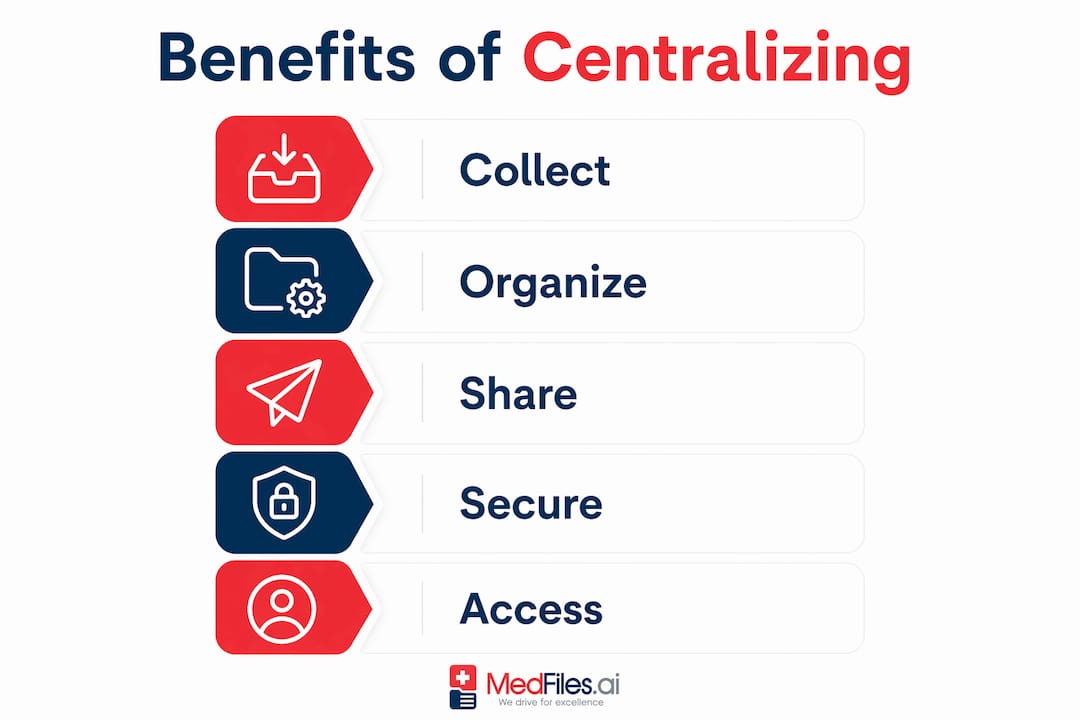
What are the key security and privacy considerations?
Security is the most common reason people hesitate to centralize health documents digitally. The concern is legitimate. Health data is among the most sensitive personal information you hold, and a breach carries consequences far beyond a compromised password.
The standard governing health data privacy in the United States is HIPAA, the Health Insurance Portability and Accountability Act. Any platform handling your health records should operate on HIPAA-ready infrastructure. That means end-to-end encryption for data in transit and at rest, strict access controls, and audit logs that track who viewed what and when. Centralized platforms that meet these standards use encryption and regulatory compliance to protect sensitive health information from unauthorized access.
Key security practices for individuals:
- Choose encrypted platforms. End-to-end encryption means only you and the people you authorize can read your records.
- Use strong, unique passwords. A password manager removes the temptation to reuse credentials.
- Enable two-factor authentication. This single step blocks the majority of unauthorized account access attempts.
- Control sharing permissions. Share records with specific providers for specific purposes, not broadly.
- Review access logs regularly. Reputable platforms show you exactly who accessed your records and when.
Secure sharing tools are critical for safeguarding patient privacy within centralized systems. Encryption and regulatory compliance are not optional features. They are the foundation of any trustworthy health document platform.
The risk of not centralizing also carries a security cost. Paper records get lost, stolen, or destroyed. Scattered digital files across email attachments and USB drives have no access controls at all. A purpose-built, encrypted platform is safer than the fragmented alternative most families currently use.
How can you practically centralize your health documents?
The process of centralizing your family’s health records is straightforward when you break it into steps. The main obstacle is not technology. It is the initial effort of gathering documents that currently live in multiple places.
Follow this sequence:
- Audit what you have. List every provider, hospital, clinic, and specialist your family has seen in the past five years. Note what records each one holds.
- Request your records. Under HIPAA, you have the right to request copies of all your medical records from any US provider. Most practices now offer digital downloads through patient portals.
- Gather physical documents. Scan paper records using your phone’s camera or a dedicated scanner app. Save files in PDF format for universal compatibility.
- Organize by person and category. Sort records by family member, then by type: lab results, imaging, prescriptions, vaccination records, surgical reports, and specialist letters.
- Upload to a centralized platform. Choose a platform with HIPAA-ready infrastructure, automatic organization, and secure document sharing built in.
- Set sharing permissions. Grant your primary care physician access to your full record. Grant specialists access to relevant sections only.
- Update after every encounter. Add new records within a week of each appointment so the system stays current.
Understanding the difference between centralized and federated systems matters here. A centralized system copies all documents into one repository you control. A federated system accesses documents from their original locations without copying them. For personal use, a centralized approach gives you full control and offline access, which is critical during emergencies when internet connectivity to third-party systems may be unreliable.
Healthcare document management systems replace paper workflows with secure, automated processes that enable faster document retrieval. The same principle applies to your personal records. Automation removes the ongoing maintenance burden so the system stays useful without constant manual effort.
Pro Tip: After uploading records to Medfiles, use the AI-powered analysis feature to flag medication interactions or missing vaccination records across your family profiles. It catches gaps you would not notice manually.
The transition to centralized digital ecosystems also positions your records for future integration with wearable technology and predictive health tools. The records you organize today become the data foundation for better care decisions tomorrow.
Key Takeaways
Centralizing health documents is the single most effective step a family can take to improve care coordination, reduce medical errors, and protect health information during emergencies.
| Point | Details |
|---|---|
| Centralization prevents errors | Complete records stop duplicate tests and medication conflicts that fragmented files cause. |
| Families benefit most | Multi-profile systems let caregivers manage children, elderly parents, and dependents from one place. |
| Security requires encryption | Choose HIPAA-ready platforms with end-to-end encryption and two-factor authentication. |
| Start with a records audit | List every provider, request digital copies, and scan paper documents before uploading. |
| Keep records current | Add new documents within a week of each appointment to maintain an accurate, complete history. |
The case for taking this seriously now
Most families treat health record management as something to sort out later. Later usually means a hospital waiting room at 2:00 AM, a new specialist asking for records that exist somewhere but not here, or a medication error that a complete history would have prevented.
I have watched families go through exactly that scenario. The records existed. They were just scattered across three patient portals, a filing cabinet, and an old email account. The information was there. The access was not.
The argument for centralizing your health documents is not about technology adoption. It is about having the right information available at the moment it matters most. That moment rarely announces itself in advance.
The security concern is real but manageable. HIPAA-ready platforms with end-to-end encryption are now accessible to individuals, not just hospital systems. The risk of a breach on a purpose-built encrypted platform is substantially lower than the risk of losing a paper file or having records scattered across unsecured email attachments.
The future of personal health management points toward patient-centered data ecosystems that integrate wearables, AI analysis, and real-time provider sharing. Families who build centralized records now will be positioned to use those tools as they arrive. Families who wait will spend that future doing what they are doing today: reconstructing histories from memory in moments of crisis.
Start with one family member’s records. Get them organized and uploaded. Then add the next. The system does not need to be perfect on day one. It needs to exist.
— Team
Medfiles makes family health records simple and secure
Your family’s health history deserves better than a stack of folders and scattered patient portals. Medfiles is a HIPAA-ready platform built for individuals and families who want their medical records organized, encrypted, and accessible the moment they need them.
Upload test results, prescriptions, imaging reports, and vaccination records for every family member, including children and pets. Medfiles automatically organizes each document and lets you share records securely with any provider in seconds. AI-powered analysis flags gaps and potential issues across your family profiles. Explore family health record management on Medfiles and see which plan fits your household.
FAQ
Why centralize health documents instead of using patient portals?
Patient portals are provider-specific and do not share data with each other. A centralized personal system gives you one complete record that travels with you across every provider, clinic, and emergency.
What is centralized health data for individuals?
Centralized health data means all your medical records, lab results, prescriptions, and imaging are stored in one place you control, rather than scattered across multiple providers and systems.
How does centralizing records improve patient safety?
Complete records prevent duplicate tests, catch medication conflicts, and give every provider full context. The NHS single patient record initiative cites this as a core safety benefit, not just an administrative one.
Is it safe to store health documents digitally?
Yes, when you use a platform with end-to-end encryption, HIPAA-ready infrastructure, and two-factor authentication. These protections make a purpose-built platform safer than paper files or unsecured email attachments.
How do I start centralizing my family’s health documents?
Request digital copies from every provider under your HIPAA rights, scan any paper records, and upload everything to an encrypted platform like Medfiles. Organize by family member and document type, then update after each new appointment.