Why Instant Medical Access Can Save Your Life
Discover the importance of instant medical access. Improve your survival odds with immediate access to your health records in emergencies.

Why Instant Medical Access Can Save Your Life
Instant medical access is defined as the immediate availability of your personal health records and emergency care when you need them most. The importance of instant medical access goes far beyond convenience. Mortality rates for elderly patients rise from 9.6% to 10.8% when medical helpline wait times stretch between 30 and 60 seconds. That single statistic shows how seconds, not minutes, determine survival. Digital health platforms like Medfiles now make it possible for anyone to carry their complete medical history and share it instantly with any provider.
How does instant medical access impact emergency outcomes?

Rapid medical response reduces complications and improves survival by cutting the time between symptom onset and treatment. Every minute of delay narrows the window for effective intervention. The medical community calls this the “golden hour,” the period immediately after a medical event when treatment produces the best results.
The numbers behind delay are stark. Ambulance dispatch rates drop 50% after a 10-minute wait on a medical helpline. That drop means fewer patients reach definitive care in time. For cardiac events, strokes, and traumatic injuries, that gap is often fatal.
The 10-minute rule is not a guideline. It is a hard clinical threshold. Research shows that emergency evaluations conducted within this window provide baseline data that supports every future medical decision, even when the initial finding turns out to be non-serious. Speed of access shapes the entire arc of a patient’s care.
Digital health tools sharpen this response further. Wearables and AI help identify abnormal health signs earlier, prompting faster emergency calls. Even a few minutes of earlier intervention substantially improves cardiac arrest survival. When your health data is organized and accessible, emergency responders can act on accurate information from the first moment of contact.
What are common barriers to rapid access to healthcare?
Access to emergency care is not equal. Geography, infrastructure, and patient behavior all create delays that cost lives.
- Non-urgent ER use. About 60% of ER visits in the U.S. are non-urgent. This volume clogs emergency departments and delays care for patients with genuine emergencies.
- Spatial inequity. Poor spatial access to emergency cardiac care in Georgia correlates directly with higher cardiovascular mortality rates. Rural patients face longer transport times and fewer specialized facilities.
- Last-mile delays. In urban settings, in-building navigation adds 3–7 minutes to emergency response times. Elevators, locked doors, and unclear building layouts create delays that most patients never anticipate.
- Fragmented records. When a patient arrives at an ER without their medical history, providers must repeat tests, ask redundant questions, and make decisions with incomplete data. This fragmentation raises both cost and risk.
- Fear and hesitation. Patients often delay calling for help because they fear “it’s nothing.” That hesitation is one of the most preventable causes of poor outcomes.
Spatial access disparities require targeted policy interventions. Individual patients, however, can address the other barriers right now through better preparation and smarter care choices.
How do digital health technologies improve quick medical assistance?
Digital tools have fundamentally changed what “instant access” means for patients and providers alike.
-
AI-powered triage. AI smart triage systems give patients access to an average of 61 appointment slots, reducing wait times to 3–7 days. That capacity shift moves non-urgent cases out of emergency rooms and into appropriate care settings.
-
Wearable sensors. Devices that monitor heart rate, blood oxygen, and irregular rhythms detect abnormal states before a patient feels symptoms. Earlier detection means earlier calls, and earlier calls improve survival in cardiac emergencies.
-
Digital medical records. Organized, accessible records give clinicians accurate information at the point of care. A provider who can see your full medication list, allergy history, and prior diagnoses in seconds makes better decisions than one working from memory or a handwritten summary.
-
Virtual urgent care. Digital urgent care platforms connect patients with licensed providers within minutes for non-emergency concerns. This reduces ER congestion and gets patients appropriate guidance faster.
-
Centralized record platforms. Medfiles stores test results, prescriptions, imaging reports, and clinical notes in one encrypted location. Providers and family members receive access instantly through secure sharing, without fax machines or phone calls.
Pro Tip: Upload your most recent lab results, medication list, and allergy information to a digital record platform before your next appointment. Providers who receive this data in advance spend less time on intake and more time on your actual care.
The benefits of digital health management extend beyond emergencies. Families who maintain organized records report fewer duplicate tests, faster specialist referrals, and better continuity of care across providers.
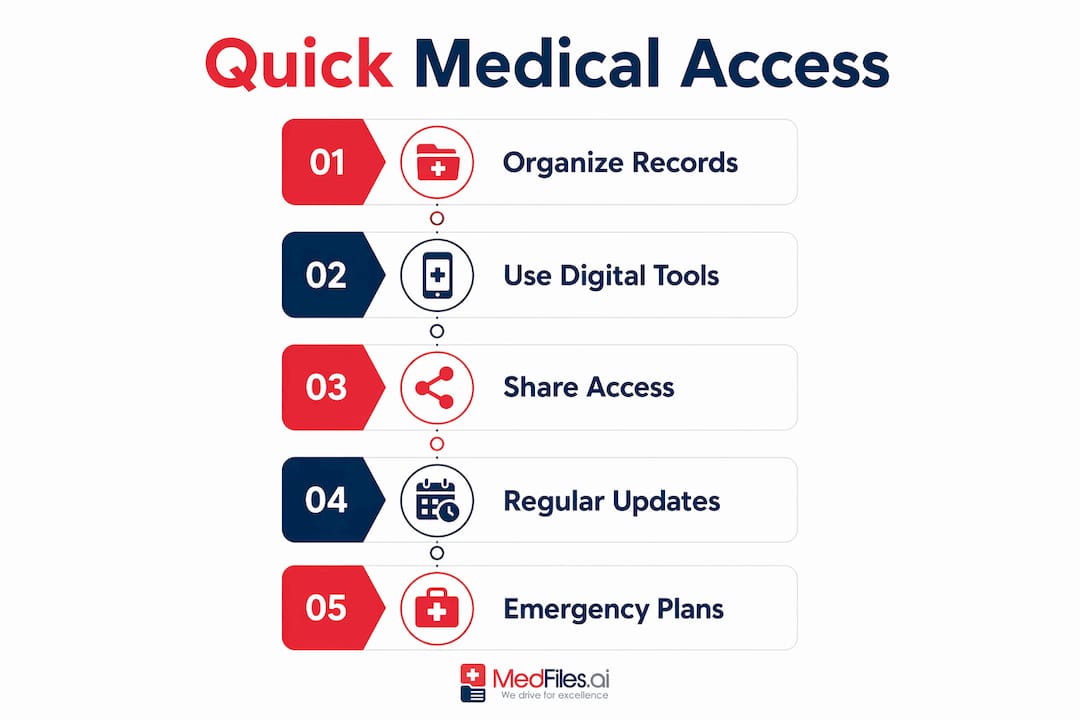
What practical steps ensure instant medical access when it matters?
Preparation is the most reliable way to guarantee that your health information reaches the right person at the right moment.
- Keep your records current. Update your digital health file after every appointment, procedure, or prescription change. Outdated records mislead providers and slow decisions.
- Choose the right care setting. Urgent care centers handle most non-emergency conditions faster and at lower cost than ERs. Strategies to reduce unnecessary ER use include using telehealth for minor concerns and calling your primary care provider before heading to the hospital.
- Share access proactively. Give your emergency contacts and primary care provider access to your digital records before a crisis occurs. Medfiles supports secure medical document sharing with any provider or family member in seconds.
- Know your baseline. Emergency evaluations provide valuable baseline data even when findings are non-serious. Storing those results digitally means every future provider starts with accurate context.
- Communicate clearly in emergencies. Tell responders your current medications, known allergies, and relevant diagnoses immediately. A digital record on your phone makes this automatic.
Pro Tip: Set a calendar reminder every three months to review and update your digital health records. Treat it the same way you treat renewing a prescription. Consistency is what makes the record useful in a real emergency.
Organizing your medical records workflow as a family reduces confusion during high-stress moments. When everyone knows where the records are and how to share them, response time drops and care quality rises.
Key Takeaways
Instant medical access is the single most controllable factor in improving your personal emergency outcomes, and digital record management is the most direct way to act on it.
| Point | Details |
|---|---|
| Delays cost lives | Mortality rises measurably when helpline wait times exceed 30 seconds; act before the 10-minute threshold. |
| ER overuse creates barriers | 60% of U.S. ER visits are non-urgent; choosing the right care setting protects access for true emergencies. |
| Digital tools close the gap | AI triage, wearables, and centralized records each reduce the time between a health event and effective treatment. |
| Preparation is the best protection | Updated digital records shared with providers and family members eliminate the most common access delays. |
| Records have long-term value | Even non-urgent emergency visits produce baseline data that improves every future clinical decision. |
Why I think most people underestimate the records problem
The conversation around emergency medical access almost always focuses on response times and hospital capacity. Those factors matter. But the records problem is just as serious, and far more within your control.
Care fragmentation is the quiet cost of disorganized health information. Instant access to patient records reduces fragmented, costly care by guiding patients to appropriate facilities and preventing unnecessary escalation. When a provider in an unfamiliar city cannot see your cardiac history, they order tests you have already had. They prescribe medications that interact with drugs you are already taking. They make decisions in the dark.
The technology to fix this exists right now. Encrypted, HIPAA-ready platforms can hold your entire medical history and share it with any provider in seconds. The barrier is not technology. It is the habit of treating medical records as something the hospital manages rather than something you own.
Patients who take ownership of their health data arrive at every appointment, urgent care visit, and emergency room with a measurable advantage. Their providers spend less time gathering information and more time delivering care. That shift in time directly improves outcomes.
The ongoing challenge is equity. Spatial disparities in emergency care access require policy solutions that individuals cannot solve alone. But within that constraint, every person can control whether their records are ready when they need them.
— Team
Medfiles makes your medical records ready for any moment
Your health records should work for you, not against you, especially when time is critical.
Medfiles gives you a single, encrypted location for every test result, prescription, imaging report, and clinical note you have ever received. The platform organizes documents automatically, supports medical document storage across multiple family profiles, and lets you share any record securely with a provider or family member in seconds. HIPAA-ready infrastructure and end-to-end encryption protect every file. Whether you are managing a chronic condition, preparing for travel, or building an emergency plan for your family, Medfiles keeps your complete medical history accessible and ready. Create your free account and put your health data where it belongs: in your hands.
FAQ
What is instant medical access?
Instant medical access is the immediate availability of your personal health records and emergency care at the moment you need them. It covers both physical access to emergency services and digital access to your medical history.
Why does response time matter so much in emergencies?
Mortality rates rise measurably with even short delays. Research shows ambulance dispatch rates drop 50% after a 10-minute helpline wait, and survival in cardiac events depends heavily on how quickly treatment begins.
How can I improve my own emergency medical access?
Store your medical records digitally, share access with your primary care provider and emergency contacts, and choose urgent care over the ER for non-emergency conditions to keep emergency departments available for critical cases.
What role do digital health tools play in faster care?
AI triage systems, wearable health monitors, and centralized record platforms each reduce the time between a health event and effective treatment by giving providers accurate information faster.
Does going to the ER for a minor issue hurt other patients?
Yes. About 60% of U.S. ER visits are non-urgent, which creates delays for patients with genuine emergencies and increases the risk of care denials and billing disputes for the patients who did not need emergency-level care.