What Is Medical Record Compliance? A 2026 Guide
Discover what medical record compliance means and why it’s essential for healthcare operations. Improve your knowledge and practices today!

What Is Medical Record Compliance? A 2026 Guide
Medical record compliance is defined as the systematic adherence to federal, state, and institutional regulations governing the creation, maintenance, security, and disposal of patient documentation. It covers the full record lifecycle from the moment a clinician enters a note to the day a record is securely destroyed. For healthcare providers, compliance officers, and administrators, this is not a background function. It is a daily operational requirement with direct consequences for billing, legal standing, and patient safety. Key regulatory frameworks include HIPAA, Centers for Medicare and Medicaid Services (CMS) documentation standards, and The Joint Commission. Noncompliance leads to claim denials, audit penalties, and malpractice exposure.
What is medical record compliance and why does it matter?
Medical record compliance is the process of rigorously following all legal and regulatory requirements to ensure patient documentation is accurate, secure, and legally sound. The industry term used across regulatory bodies and accreditation organizations is “documentation compliance,” though “medical record compliance” is the phrase most commonly used by compliance officers and administrators in daily practice.
The importance of medical record compliance extends well beyond avoiding penalties. Medical records are a visible expression of professionalism and patient dignity, and they are fundamental to education, research, and care continuity. A record that fails compliance standards does not just create a billing problem. It can compromise a patient’s treatment trajectory if the next provider cannot trust or interpret the documentation.

Noncompliance also carries direct financial risk. Incomplete notes, missing signatures, and absent medical necessity documentation are among the leading causes of claim denials and regulatory penalties. For a mid-size hospital system, a single failed audit cycle can trigger CMS recoupments running into the millions.
What federal and state regulations govern medical record compliance?
Medical record regulations operate at multiple levels simultaneously, and understanding each layer is the foundation of any compliance program.
Federal frameworks:
- HIPAA Privacy and Security Rules govern patient privacy and establish requirements for safeguarding protected health information, including access controls, secure storage, and restrictions on unauthorized disclosures.
- CMS documentation standards set billing and clinical documentation requirements for Medicare and Medicaid providers, including specifics on medical necessity, authentication, and timeliness of entries.
- CMS Comprehensive Error Rate Testing (CERT) program audits provider records annually to identify improper payments linked to documentation failures.
- The Joint Commission standards apply to accredited hospitals and health systems, covering clinical recordkeeping, authentication requirements, and retention timelines.
State-level considerations:
State laws frequently impose stricter retention periods than federal minimums. California, for example, requires adult patient records to be retained for a minimum of seven years from the date of service, while federal Medicare standards set a five-year minimum for certain records. When state and federal standards conflict, providers must follow whichever standard is more protective of the patient or more stringent in its requirements. Compliance officers must map both layers for every record type their organization manages.
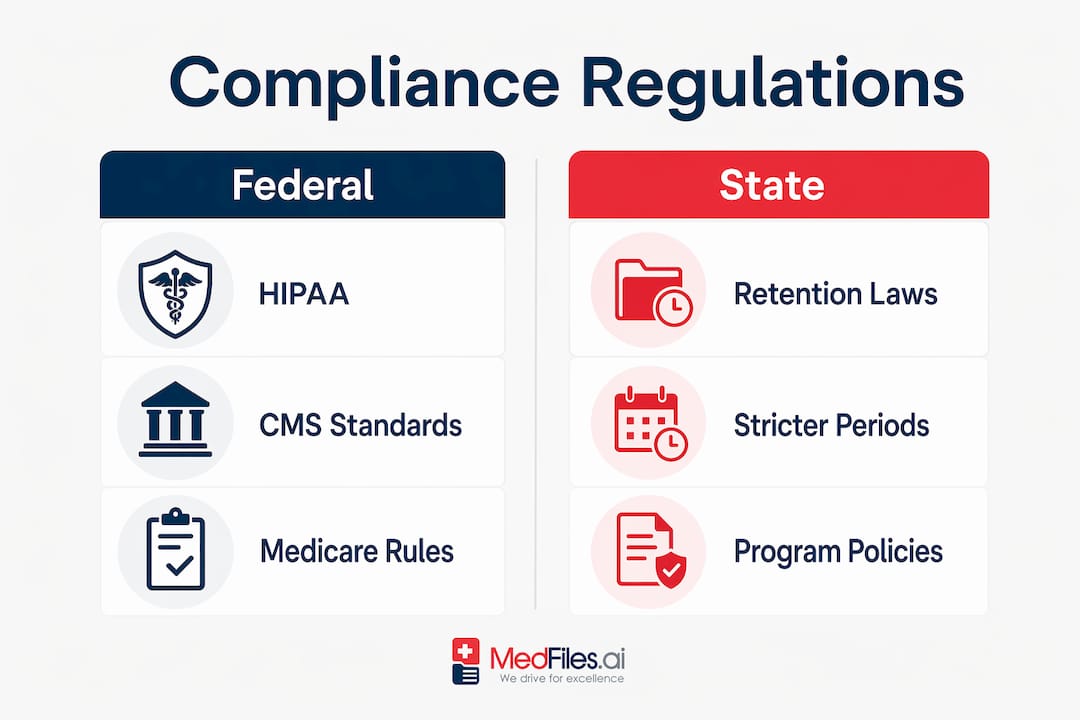
Program-specific and institutional policies add a third layer. A federally qualified health center (FQHC) operates under Health Resources and Services Administration (HRSA) requirements in addition to HIPAA and CMS. Knowing which programs your organization participates in determines the full scope of your compliance obligations.
What are the key elements required for compliant medical records?
A compliant medical record is not simply a collection of clinical notes. It is a structured, authenticated, and legally defensible document. The following elements are required across virtually all regulatory frameworks:
- Accurate patient demographics and identification. Every record must contain verified patient name, date of birth, and a unique identifier such as a medical record number. Errors here cascade into billing failures and patient safety events.
- Complete medical histories and progress notes. Notes must reflect the actual clinical encounter, including subjective findings, objective data, assessment, and plan. Vague or templated notes that do not reflect individualized care are a primary audit target.
- Medical necessity documentation. CMS requires that every service billed to Medicare or Medicaid be supported by documented clinical reasoning. The record must show why the service was ordered, not just that it was performed.
- Authentication. Every entry requires a signature, credential, and date/time stamp. Timestamped signatures and valid electronic attestations are essential because unsigned or misdated documents undermine evidentiary value and can lead to disciplinary actions.
- Proper corrections and addenda. Errors must never be deleted or overwritten. The correct method is a dated addendum that identifies the original entry, the correction, and the author. This applies equally to paper and electronic health record (EHR) systems.
- Retention and secure disposal. Retention schedules must balance federal and state laws. Both early disposal and excessive retention increase liability, and organizations must document secure destruction to maintain compliance.
Pro Tip: Build a record element checklist into your EHR templates so clinicians are prompted for each required field before a note can be finalized. This single workflow change reduces authentication failures and missing necessity documentation without adding time to the encounter.
Understanding secure medical record handling is equally critical at the storage and access level, not just at the point of documentation.
What are common medical record compliance challenges and pitfalls?
Most compliance failures are predictable. They cluster around a small set of recurring documentation errors that auditors know to look for.
The most frequent pitfalls include:
- Incomplete or illegible records. Handwritten notes that cannot be read, or EHR entries that are truncated, create gaps that auditors treat as proof the service was not rendered.
- Missing or invalid signatures. A note signed by the wrong provider, or signed days after the encounter without explanation, loses its legal and billing validity.
- Failure to document medical necessity. This is the single largest driver of Medicare claim denials. The clinical reasoning must appear in the record, not just the diagnosis code on the claim.
- Incorrect or missing date and time entries. Entries without accurate timestamps cannot establish the sequence of care, which matters enormously in litigation and in audits of concurrent billing.
- Over-retention or premature disposal. Over-retention or premature destruction of records increases liability. Organizations must prove secure, documented disposal to maintain compliance.
- Unauthorized access and inadequate audit trails. HIPAA requires that every access to a patient record be logged. Missing access logs are a direct violation, regardless of whether a breach occurred.
“Non-compliant or improperly authenticated records reduce legal standing and increase liability risks during audits and investigations. Unsigned or misdated documents undermine evidentiary value and can lead to disciplinary actions.” — Accountable HQ
The operational impact of these failures is significant. A single denied claim requires staff time to appeal, and a pattern of denials triggers a payer audit. That audit can expand into a full CMS review, with recoupment demands covering multiple years of billing.
How can healthcare organizations achieve and maintain medical record compliance?
Medical record compliance is a daily operational responsibility requiring integration into workflows rather than periodic audits. Defined accountability at all stages of the record lifecycle prevents the common failures that surface during external reviews.
The following comparison shows the difference between reactive and proactive compliance approaches:
| Approach | Reactive compliance | Proactive compliance |
|---|---|---|
| Audit preparation | Scrambles to gather records when notified | Maintains real-time audit logs and access controls |
| Staff training | Trains after a violation occurs | Runs quarterly training with role-specific modules |
| Documentation review | Reviews records only when denied | Conducts monthly internal audits by record type |
| Technology use | Relies on basic EHR defaults | Uses structured templates and ambient AI capture |
| Retention management | Disposes records on an ad hoc basis | Follows a documented retention and destruction schedule |
Practical strategies that work:
Continuous staff training is the foundation. Compliance officers at organizations like Cleveland Clinic and Kaiser Permanente embed documentation standards into onboarding and run annual refreshers tied to audit findings. Training must be role-specific. A hospitalist’s documentation requirements differ from those of a physical therapist or a home health aide.
Structured templates and ambient AI tools reduce documentation burden and improve completeness and accuracy. These technologies automate capture of necessary clinical details, supporting compliance without increasing clinician workload. Tools like Nuance DAX and similar AI documentation solutions capture encounter details in real time, reducing the risk of incomplete notes caused by time pressure.
Audit readiness requires continuous compliance proof via access logs, role-based controls, and monitoring of medical record interactions. Proactive systems minimize the risk of unauthorized access and document tampering. Role-based access controls inside your EHR, combined with automated alerts for unusual access patterns, satisfy both HIPAA Security Rule requirements and CMS audit expectations.
Pro Tip: Schedule a quarterly internal audit using a random sample of 20 to 30 records across different service lines. Score each record against your compliance checklist and track trends over time. This gives you a defensible audit trail and surfaces training gaps before an external reviewer does.
For long-term record management, following safe retention protocols protects your organization from both premature disposal liability and the cost of storing records beyond their required period.
What are the legal and operational consequences of non-compliant records?
The consequences of medical record noncompliance are direct, measurable, and often severe. They fall into four categories:
- Financial penalties. CMS recoupments, payer claim denials, and Office of Inspector General (OIG) civil monetary penalties can reach hundreds of thousands of dollars per violation cycle. HIPAA fines range from $100 to $50,000 per violation, with annual caps up to $1.9 million per violation category.
- Legal liability. Improperly authenticated or incomplete records reduce a provider’s ability to defend against malpractice claims. Courts treat a missing or altered record as evidence of negligence, shifting the burden of proof onto the provider.
- Professional consequences. State medical boards and credentialing bodies can suspend or revoke licenses based on documentation failures. A pattern of noncompliance identified during a CMS audit can trigger a corrective action plan that restricts billing privileges.
- Operational disruption. External audits and corrective action plans consume significant administrative resources. A hospital placed under a Corporate Integrity Agreement (CIA) by the OIG faces years of mandatory reporting, independent review, and restricted operations.
The common thread across all four categories is that the damage is almost always preventable. The records that trigger audits and lawsuits are not complex edge cases. They are notes with missing signatures, claims without necessity documentation, and records accessed without authorization.
Key takeaways
Medical record compliance requires daily integration into clinical workflows, supported by HIPAA, CMS, and state regulations, to protect patients, providers, and organizational finances.
| Point | Details |
|---|---|
| Compliance is a lifecycle obligation | Records must meet standards from creation through secure disposal, not just at the point of care. |
| Authentication is non-negotiable | Every entry needs a timestamped signature or electronic attestation to hold legal and billing validity. |
| Proactive audits prevent penalties | Monthly internal record reviews catch documentation gaps before external auditors or payers do. |
| Technology reduces human error | Structured EHR templates and ambient AI tools capture required clinical details without adding clinician workload. |
| Noncompliance costs are compounding | Claim denials, HIPAA fines, and malpractice exposure all stem from the same preventable documentation failures. |
The compliance culture gap no one talks about
From where we sit at Medfiles, the biggest compliance risk in most healthcare organizations is not a missing signature or an outdated retention policy. It is the assumption that compliance is someone else’s job.
Clinicians are trained to treat patients, not to think about evidentiary standards or audit trails. That gap between clinical training and compliance reality is where most documentation failures originate. The physician who dictates a note three days after the encounter is not being careless. They are overwhelmed. The administrator who disposes of records without a destruction log is not being reckless. They were never trained on the requirement.
The organizations that get this right treat compliance as a shared operational value, not a back-office function. They put compliance officers in the room during EHR implementation, not after go-live. They use AI documentation tools to reduce the burden on clinicians rather than adding more checkboxes to an already long workflow. And they run internal audits not to catch people out, but to find systemic gaps before they become systemic failures.
The technology exists to make this easier than it has ever been. Ambient AI, structured templates, and automated access logging remove the manual burden from compliance. What still requires human effort is the decision to build a culture where accurate, complete, and secure documentation is treated as part of patient care, not separate from it.
— Team Medfiles
How Medfiles supports compliant medical record management
Managing compliant records does not have to mean managing more complexity. Medfiles is built to give healthcare professionals and their patients a secure, organized, and always-accessible record system that aligns with HIPAA-ready infrastructure and CMS documentation expectations.

With Medfiles, records are stored with end-to-end encryption, organized automatically, and accessible instantly when you need them for audits, referrals, or emergencies. The platform supports secure digital record management for individuals, families, and clinical teams, reducing the manual burden of paper-based systems and the compliance risk that comes with disorganized records. If you work in a clinical setting, explore how Medfiles for doctors supports your documentation workflow and audit readiness. Start securing your records today.
FAQ
What is the medical record compliance definition?
Medical record compliance is the systematic adherence to federal, state, and institutional regulations governing the creation, maintenance, security, and disposal of patient records. It covers the full record lifecycle and is required under HIPAA, CMS standards, and The Joint Commission.
What are the most common causes of medical record noncompliance?
The most frequent failures include incomplete progress notes, missing or invalid signatures, absent medical necessity documentation, and incorrect date and time entries. These errors are the leading causes of claim denials and CMS audit findings.
How long must healthcare providers retain medical records?
Retention requirements vary by state and program. Federal Medicare standards require a minimum of five years for certain records, while states like California require seven years from the date of service. Organizations must follow whichever standard is more stringent.
What HIPAA penalties apply to medical record violations?
HIPAA fines range from $100 to $50,000 per violation, depending on the level of culpability, with annual caps reaching $1.9 million per violation category. Willful neglect that is not corrected carries the highest penalty tier.
How does technology improve medical record compliance?
Structured EHR templates and ambient AI documentation tools automate the capture of required clinical details, reducing incomplete notes and authentication failures. Audit log monitoring and role-based access controls satisfy HIPAA Security Rule requirements and support real-time audit readiness.