Health Information Security: A Practical 2026 Guide
Discover this essential guide to health information security, covering HIPAA regulations, best practices, and emerging trends for 2026. Secure patient...

Health Information Security: A Practical 2026 Guide
Health information security is the comprehensive protection of patient data through administrative, physical, and technical safeguards to prevent unauthorized access, use, or disclosure. The formal industry term is “health information security,” and it applies to any organization that creates, stores, or transmits electronic Protected Health Information (ePHI). This guide to health information security covers the HIPAA Security Rule, risk analysis, best practices, and the emerging regulations reshaping the field in 2026. The U.S. Department of Health and Human Services (HHS) and its Office for Civil Rights (OCR) enforce compliance, and civil penalties reach $50,000 per individual violation, with annual caps of $1.9 million per violation category. That financial exposure alone makes security a business priority, not just a regulatory checkbox.
What are the essential safeguards in a guide to health information security?
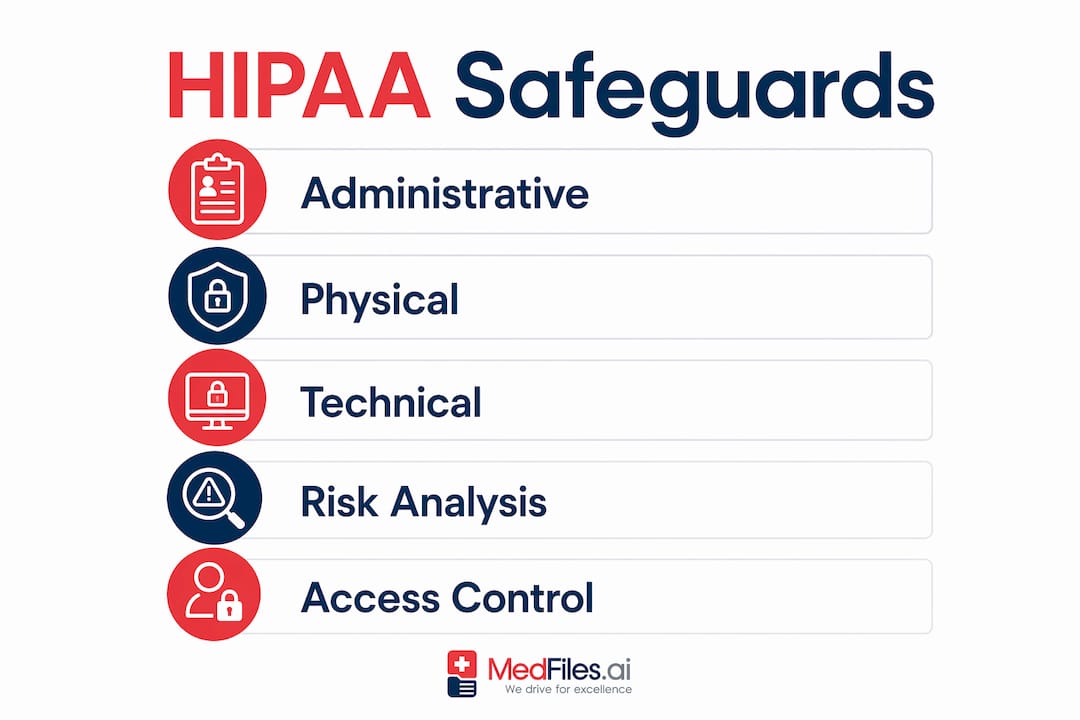
The HIPAA Security Rule organizes its requirements into three categories: administrative, physical, and technical safeguards. Each category contains both “required” specifications, which you must implement, and “addressable” specifications, which you must implement or document why an equivalent alternative is sufficient. Understanding this distinction saves organizations from over-engineering solutions and from under-protecting data.
Administrative safeguards
Administrative safeguards are the policies and procedures that govern how your organization manages ePHI. They include:
- Security Risk Analysis (SRA): A formal, documented assessment of threats and vulnerabilities to all ePHI systems. This is required, not optional.
- Risk management: A written plan to reduce identified risks to a reasonable level.
- Workforce training: Regular education on privacy policies, acceptable use, and the legal consequences of breaches.
- Sanction policy: Documented consequences for employees who violate security rules.
- Contingency planning: Procedures for data backup, disaster recovery, and emergency access.
Physical safeguards
Physical safeguards control who can physically access your facilities and devices. They cover facility access controls, workstation use policies, and device disposal procedures. A locked server room and a clear-desk policy are both physical safeguards. Organizations must also manage how portable devices like laptops and tablets are used and retired.
Technical safeguards
Technical safeguards are the technology controls that protect ePHI directly. The HIPAA Security Rule requires access controls so only authorized people can view records. It also requires audit controls, which means recording who accessed what and when. Encryption of ePHI during transmission is an addressable specification, but OCR treats it as a standard best practice. Integrity controls verify that data has not been altered without authorization.

| Safeguard category | Key requirements | Required or addressable |
|---|---|---|
| Administrative | Risk analysis, workforce training, sanction policy | Required |
| Physical | Facility access controls, device disposal | Required |
| Technical | Access controls, audit logs, encryption | Mix of both |
| Contingency | Data backup, disaster recovery plan | Required |
How to conduct a thorough HIPAA security risk analysis
Security Risk Analysis is the foundational HIPAA compliance activity most frequently cited in OCR enforcement cases. Failing to perform one thoroughly is the top cause of OCR fines. An SRA is not a one-time project. It is an ongoing process that must be updated whenever your environment or operations change significantly.
Follow these steps to conduct a defensible SRA:
- Inventory all ePHI locations. Document every system, device, and application that creates, receives, maintains, or transmits ePHI. This includes cloud storage, email servers, mobile devices, and medical equipment.
- Identify threats and vulnerabilities. A threat is anything that could exploit a weakness in your systems. A vulnerability is the weakness itself. Examples include unpatched software, weak passwords, and unsecured Wi-Fi networks.
- Analyze likelihood and impact. Rate each threat-vulnerability pair by how likely it is to occur and how severe the damage would be. This prioritizes your remediation work.
- Document your findings. Write down every finding, the risk level assigned, and the rationale. OCR expects written documentation, not verbal agreements.
- Build a remediation plan. Assign a responsible person, a deadline, and a budget to each identified risk. Track progress formally.
- Review and update regularly. Conduct a new SRA after major system changes, mergers, or significant operational shifts.
Pro Tip: The most common SRA mistake is treating it as a checklist rather than an analysis. OCR expects you to show your reasoning, not just check boxes. Document why you rated each risk as you did.
What best practices help protect patient information beyond HIPAA compliance?
HIPAA sets the floor, not the ceiling, for health data protection. Organizations that stop at compliance leave significant gaps in their security posture. The most effective programs layer technical controls on top of a culture of accountability.
Insider curiosity is a larger security threat than most organizations acknowledge. An employee accessing a celebrity patient’s record out of curiosity is a prosecutable breach, not a harmless mistake. This reality demands controls that go beyond locking the front door.
Practical measures that reduce insider and external risk include:
- Role-based access controls: Grant each staff member access only to the records they need for their specific job. A billing clerk does not need access to clinical notes.
- Active audit log monitoring: Audit logs must be actively monitored, not just recorded. Real-time and random reviews create accountability and deter unauthorized access before a breach occurs.
- Regular staff training: Train every employee, including contractors, on privacy policies and the legal consequences of violations. Annual training is a minimum; quarterly refreshers are better.
- Medical device security: Security baselines for medical devices must be established using FDA labeling guidance and updated regularly. Devices connected to your network are attack surfaces.
- Encryption at rest and in transit: Encrypt ePHI stored on servers and devices, and encrypt all data moving across networks.
- Minimum necessary standard: Apply the HIPAA “minimum necessary” rule to every data request. Share only what is needed for the stated purpose.
Pro Tip: Post your audit log review schedule internally. When staff know that access logs are reviewed weekly, not just after incidents, unauthorized access drops significantly.
For individuals managing their own health records, secure long-term record keeping follows the same principles: limit who can access your records, use encrypted storage, and review access history regularly.
How to prepare for and respond to common security challenges and breaches
The most frequent security failures in healthcare share a common thread: they were preventable. Unpatched software, misconfigured systems, and insider access without legitimate need account for a large share of reported breaches. Preparation is the only reliable defense.
Effective breach response is not about reacting faster. It is about having a written plan before the breach happens, so your team knows exactly what to do in the first 24 hours. Organizations without a tested incident response plan consistently make costly mistakes under pressure.
An effective incident response plan covers these components:
- Detection and containment: Identify the breach, isolate affected systems, and stop further data exposure.
- Assessment: Determine what data was accessed, by whom, and for how long.
- Notification: Notify affected patients, HHS, and, in some cases, the media, within required timeframes.
- Documentation: Record every action taken during the response for regulatory and legal purposes.
- Post-incident review: Identify the root cause and update policies to prevent recurrence.
Patient rights are a critical part of breach response. Healthcare providers have 30 days to respond to patient requests for records or corrections. That deadline applies even during an active incident. Audit logging plays a central role in investigations, helping organizations reconstruct exactly what happened and demonstrate due diligence to OCR.
What emerging regulations and trends affect health information security in 2026?
Health information privacy law is expanding well beyond HIPAA. New York’s Health Information Privacy Act addresses consumer health data generated by digital health apps and wearables that fall outside HIPAA’s scope. This matters because millions of people use fitness trackers and symptom checkers that collect sensitive health data without any HIPAA obligation.
Health data regulation is moving toward integrated, multi-level governance. HIPAA now operates alongside frameworks like the GDPR, the European Health Data Space (EHDS), and the EU AI Act. Organizations with international patients or partners must account for all applicable frameworks simultaneously.
Key trends shaping security programs in 2026:
- AI and secondary data use: AI-driven analysis of patient data creates new risks around secondary use. Data collected for treatment may be used to train algorithms without patients’ knowledge.
- State-level legislation: Multiple states are filling gaps left by HIPAA, particularly for consumer health apps and data brokers.
- Dynamic data life-cycle management: Emerging security programs now track data from creation through deletion, not just during active use.
- Privacy in niche health contexts: Even specialized health services, such as medical privacy in cosmetic treatments, now face heightened scrutiny under new state laws.
Organizations that future-proof their security programs treat compliance as a baseline and build governance structures that can absorb new regulations without a full rebuild.
Key Takeaways
Effective health information security requires layering HIPAA’s administrative, physical, and technical safeguards with a culture of accountability, active monitoring, and readiness for emerging state and international regulations.
| Point | Details |
|---|---|
| HIPAA sets the floor | Civil penalties reach $50,000 per violation; compliance is the minimum, not the goal. |
| SRA is non-negotiable | Failing to conduct a documented Security Risk Analysis is the top cause of OCR fines. |
| Insider threats are real | Role-based access and active audit log monitoring reduce unauthorized access more than perimeter defenses alone. |
| Breach response needs a plan | A written incident response plan, tested before a breach occurs, prevents costly mistakes under pressure. |
| Regulations are expanding | State laws and international frameworks now cover health data that HIPAA does not, requiring broader governance. |
Why compliance alone will never be enough
I have seen organizations pass HIPAA audits and suffer breaches in the same quarter. The audit confirmed their paperwork. The breach exposed their culture. Those two things are not the same.
The most underestimated risk in health information security is the employee who genuinely does not believe that accessing a coworker’s record is a serious offense. Training fixes knowledge gaps. Culture fixes attitude gaps. You need both. The organizations I have seen handle breaches well are the ones where security is a standing agenda item in department meetings, not just an annual compliance training.
Active audit log monitoring is the single most underused control in healthcare. Most organizations record logs and review them only after a complaint. Reviewing logs proactively, and letting staff know you do, changes behavior before a breach happens. That is the difference between deterrence and detection.
The shift toward multi-level governance is real and accelerating. If your security program is built entirely around HIPAA, it is already behind. Building a program that can absorb new state laws and international frameworks without starting over is the work that separates mature security programs from reactive ones. Start that work now, not after the next regulation drops.
— Team
Medfiles: secure storage for your health records
Your health records deserve the same protection that healthcare organizations are required to provide. Medfiles gives individuals and families a HIPAA-ready platform to store, organize, and share medical documents securely.
Medfiles uses end-to-end encryption and access controls that mirror the technical safeguards described in the HIPAA Security Rule. You can share records securely with doctors, specialists, or family members without sending unprotected files by email. Every document you upload is organized automatically and accessible instantly, whether you are at a routine appointment or managing a medical situation away from home. Medical document storage on Medfiles means your records are protected, organized, and always within reach.
FAQ
What is health information security?
Health information security is the protection of electronic Protected Health Information (ePHI) through administrative, physical, and technical safeguards. The HIPAA Security Rule defines the minimum standards all covered entities must meet.
What are the HIPAA civil penalties for a security breach?
HIPAA civil penalties range from $100 to $50,000 per violation, with annual caps of $1.9 million per violation category. The penalty tier depends on the level of negligence involved.
How often must a Security Risk Analysis be updated?
A Security Risk Analysis must be reviewed and updated whenever significant environmental or operational changes occur, such as new systems, mergers, or major software upgrades. Annual reviews are a widely accepted minimum standard.
How long does a provider have to respond to a patient records request?
Healthcare providers have 30 days to respond to a formal patient request for records or corrections. This deadline applies regardless of other ongoing security or operational issues.
Does HIPAA cover health data from fitness apps and wearables?
HIPAA does not cover most consumer health apps and wearables. States like New York have enacted laws specifically to protect this category of health data, filling the gap left by federal regulation.