Medical Document Classification: What You Need to Know
Discover what is medical document classification and how it enhances healthcare efficiency. Streamline your records with AI-driven solutions.

Medical Document Classification: What You Need to Know
Medical document classification is the automated process of organizing healthcare documents into predefined categories using artificial intelligence, natural language processing, and machine learning. The industry standard term for this practice is clinical document classification, though both terms are used interchangeably across healthcare and health informatics. Understanding how to classify medical documents matters for everyone from individual patients managing their own records to hospital administrators processing thousands of files daily. Classification systems built on standards like ICD-10 codes and the MeSH ontology form the backbone of modern health information management.
What is medical document classification and why does it matter?
Medical document classification is defined as the systematic assignment of healthcare documents to one or more predefined categories based on their content, metadata, or both. The goal is simple: make the right document findable at the right moment. Without classification, a patient’s lab report from three years ago sits buried in a folder alongside unrelated billing statements and referral letters.
The process applies to every format a medical record can take. That includes typed clinical notes, scanned handwritten prescriptions, radiology images with attached reports, discharge summaries, and insurance claim forms. Each document type carries different information, and each serves a different purpose in a patient’s care history.

Classification also underpins compliance. Structured, categorized records make it far easier to meet HIPAA requirements, respond to audit requests, and share data securely with authorized providers. A disorganized record set is not just inconvenient. It is a liability.
What are the common types of medical documents and classification categories?
Healthcare generates a wide range of medical document types, and each fits into a distinct classification category. Knowing these categories helps you understand what a classification system is actually sorting.
The most common document types include:
- Progress notes: Clinician observations recorded during a visit, capturing symptoms, assessments, and treatment plans
- Lab reports: Results from blood panels, urinalysis, cultures, and other diagnostic tests
- Radiology reports: Interpretations of X-rays, MRIs, CT scans, and ultrasounds
- Discharge summaries: End-of-stay documents summarizing diagnosis, treatment, and follow-up instructions
- Prescriptions: Medication orders, including dosage and refill instructions
- Billing and coding records: Documents tied to ICD-10 codes and insurance claims
- Referral letters: Communications between providers directing a patient to a specialist
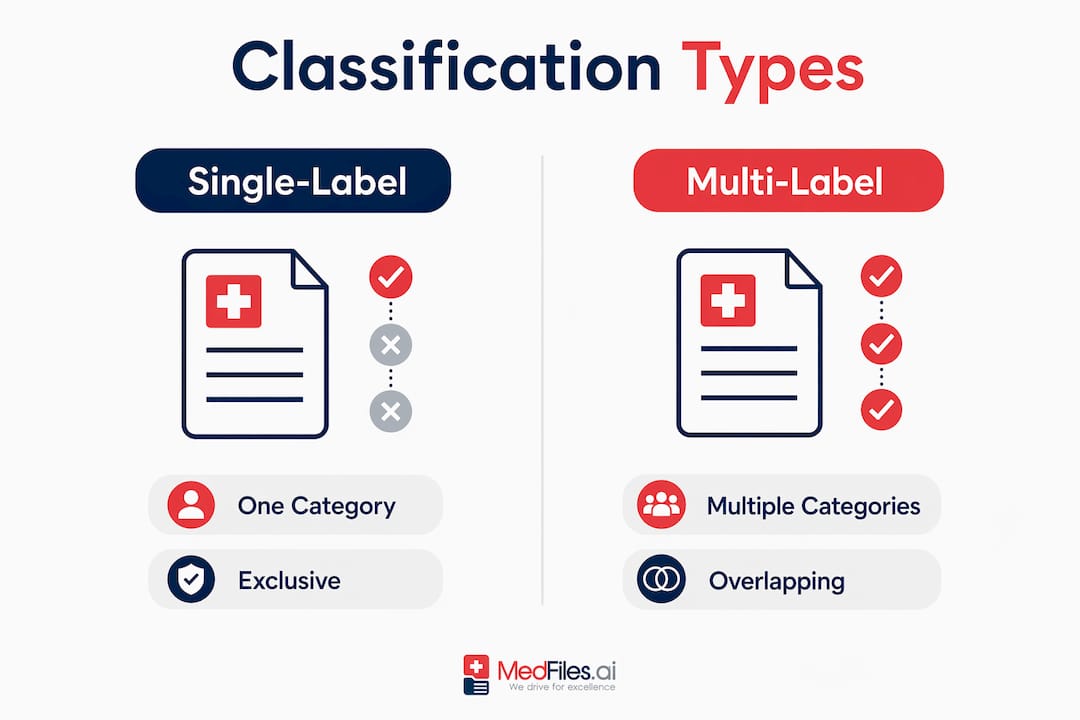
Classification categories often mirror these document types, but the relationship is not always one-to-one. A single discharge summary can reference multiple diagnoses, procedures, and medications. That overlap creates what researchers call multi-label classification, where one document belongs to several categories simultaneously.
| Document type | Primary classification category | Multi-label possibility |
|---|---|---|
| Progress note | Clinical notes | Yes (diagnosis + procedure) |
| Lab report | Diagnostic results | Sometimes |
| Radiology report | Imaging | Yes (finding + recommendation) |
| Discharge summary | Administrative + clinical | High |
| Prescription | Medication records | Rarely |
Handwritten and scanned documents add another layer of complexity. A handwritten prescription requires optical character recognition (OCR) before any classification algorithm can read it. That extra step is standard in modern systems, but it does add processing time and potential for error.
How does medical document classification work?
Medical document classification relies on three broad technology layers: traditional machine learning, natural language processing (NLP), and large language models (LLMs).
Traditional machine learning
Algorithms like Logistic Regression, Support Vector Machines (SVM), and Random Forest remain widely used for medical text classification. A comparative study on medical notes using 9,633 labeled clinical notes across four disease categories found that these models are computationally efficient and interpretable. Interpretability matters in healthcare. A clinician needs to understand why a document was classified a certain way, not just accept a black-box output.
Natural language processing and domain ontologies
NLP converts raw medical text into structured data a machine can analyze. The MeSH ontology (Medical Subject Headings), maintained by the National Library of Medicine, is one of the most widely used domain-specific vocabularies in medical NLP. Using MeSH-based classification improves performance by 30% over traditional stem-based methods. That is a significant gain, and it comes entirely from using the right vocabulary framework rather than a more powerful algorithm.
Deep learning and large language models
Deep learning architectures, including attention-based networks, allow a model to weigh different parts of a document differently. A discharge summary’s final diagnosis line carries more classification weight than its administrative header. Multi-label clinical classification research has developed architectures like the Enhanced Effective Convolutional Attention Network (EECAN) specifically to handle this challenge.
LLMs take this further. Domain-specific LLMs trained with the QLoRA technique have reached 96.26% accuracy in classifying medical records by hospital department. That level of accuracy approaches what a trained medical coder achieves manually.
Pro Tip: When evaluating any AI classification tool, ask specifically whether it was trained on clinical data or general text. Generic NLP models applied to medical records produce significantly higher error rates, especially in specialty areas like oncology.
For scanned and handwritten documents, OCR combined with text mining195) is the standard pipeline. The document is scanned, OCR converts the image to text, and then the classification algorithm processes that text. Each step introduces potential errors, which is why document quality matters so much at the input stage.
What are the benefits and importance of medical document classification?
Organized, classified records directly improve patient care. When a physician can retrieve a patient’s complete allergy history in seconds rather than minutes, clinical decisions get faster and safer. That speed compounds across thousands of patient interactions every day.
The practical benefits of AI-driven classification195) include:
- Reduced manual workload: Automated sorting eliminates hours of administrative filing per week
- Fewer errors: Consistent algorithmic classification outperforms manual sorting for repetitive, high-volume tasks
- Faster information retrieval: Categorized records surface the right document immediately during a clinical encounter
- Better billing accuracy: Correct ICD-10 code assignment reduces claim rejections and speeds reimbursement
- Epidemiological research support: Classified datasets allow researchers to query across large patient populations efficiently
- Regulatory compliance: Structured records simplify HIPAA audits and data sharing agreements
“Metadata extraction, including dates and patient identifiers, must be combined with content classification to construct a complete, chronologically accurate patient history electronically.” — Journal of Medical Management
That last point is often overlooked. A document classified by type but not anchored to a date and patient ID is still hard to use. Effective classification systems capture both dimensions at once.
What challenges and limitations exist in medical document classification?
Medical document classification is not a solved problem. Several real obstacles limit accuracy and adoption.
- Institution-specific abbreviations: Every hospital develops its own shorthand. Generic NLP models fail when they encounter abbreviations they were not trained on. Domain-specific training on clinical terminology reduces this error rate significantly.
- Multi-label complexity: A single document covering a patient with diabetes, hypertension, and a recent surgery belongs to multiple categories. Models must handle overlapping labels without forcing a single assignment.
- Data heterogeneity: Clinical datasets mix typed notes, scanned forms, structured fields, and free text. Adaptive models with attention mechanisms handle this better than fixed-architecture systems.
- Annotated dataset scarcity: Training a high-quality classifier requires thousands of accurately labeled documents. Most healthcare institutions lack the resources to build these datasets from scratch.
- Black-box interpretability: LLMs in healthcare face scrutiny because their decision logic is opaque. A clinician cannot easily audit why a model assigned a specific code.
- Privacy risks: Any system processing patient data must meet strict security standards. Sending records to external AI services without proper data agreements creates HIPAA exposure.
Pro Tip: Never deploy a classification model in a clinical setting without a validation phase on your own institution’s documents. A model trained elsewhere may perform well on benchmark datasets but poorly on your specific record formats.
Combining metadata extraction with content analysis addresses several of these challenges at once. A system that reads both the document text and its associated date, provider name, and patient ID produces far more reliable classifications than one relying on text alone.
How can you effectively use medical document classification?
Whether you are a healthcare professional managing patient records or an individual organizing your own health history, classification tools are most useful when applied consistently from the start.
For healthcare professionals:
- Integrate classification into the document intake workflow, not as an afterthought
- Choose platforms trained on clinical data, not general-purpose text models
- Validate classification outputs against a sample of manually coded records before full deployment
- Use AI for medical documents to automate department-level routing and reduce administrative bottlenecks
- Pair classification with metadata tagging so records are both categorized and chronologically ordered
For individuals managing personal health records:
- Start by grouping documents into broad categories: lab results, imaging, prescriptions, visit notes, and insurance records
- Use a secure digital platform that applies automatic classification on upload, so you do not have to sort manually
- Store documents with consistent naming conventions that include the date and provider name
- Apply medical information organization strategies to build a record set that any new provider can navigate quickly
- Keep a classified, shareable record set ready for emergencies, specialist visits, or travel
The single most impactful step for individuals is moving from paper to a structured digital system. A classified digital record is searchable. A paper folder is not.
Key takeaways
Medical document classification is the foundation of any functional health information system, and its accuracy depends on matching the right technology to the right document type and institutional context.
| Point | Details |
|---|---|
| Classification definition | Medical document classification assigns healthcare documents to categories using AI, NLP, and machine learning. |
| Document types covered | Progress notes, lab reports, radiology, discharge summaries, prescriptions, and billing records all require classification. |
| Technology options | Traditional ML models offer interpretability; LLMs reach up to 96.26% accuracy with domain-specific training. |
| Key challenge | Multi-label classification and institution-specific abbreviations are the most common sources of error. |
| Practical first step | Combining metadata extraction with content analysis produces the most reliable and usable classified records. |
The case for getting classification right from the start
The conversation around medical document classification has shifted fast. Three years ago, the practical choice was between a basic rule-based system and a fine-tuned SVM. Now, domain-specific LLMs trained on clinical knowledge bases are hitting accuracy rates that rival trained coders. That progress is real, and it matters.
What concerns me is the gap between benchmark performance and real-world deployment. A model that scores 96% on a curated test set can still fail badly on a community hospital’s handwritten intake forms from 2019. The black-box nature of LLMs makes that failure hard to detect until something goes wrong clinically or legally.
My view: the right approach is not to pick the most powerful model available. It is to pick the most appropriate model for your specific documents, validate it rigorously on your own data, and keep traditional interpretable models in the mix for high-stakes classification decisions. The choice between traditional ML and LLMs should always be driven by interpretability needs and task complexity, not by what sounds most advanced.
For individuals, the message is simpler. You do not need to understand attention mechanisms to benefit from classification. You need a secure platform that does the sorting for you, keeps your records private, and makes them accessible when you actually need them.
— Team
Medfiles makes medical document organization simple and secure
Your health records deserve more than a drawer full of paper or a folder of unsorted PDFs. Medfiles is built to give you exactly what classification promises: every document in the right place, accessible in seconds, and protected with HIPAA-ready encryption.
Upload your records once and Medfiles automatically organizes them by document type, date, and provider. The platform supports secure medical document storage for individuals and families, with multi-profile management so you can keep your entire household’s health history in one place. When you need to share records with a new specialist or during an emergency, secure sharing gets the right documents to the right provider instantly. No faxing. No hunting through folders. Just your records, organized and ready.
FAQ
What is medical document classification?
Medical document classification is the process of automatically assigning healthcare documents to predefined categories using AI, NLP, and machine learning. It applies to document types including lab reports, clinical notes, radiology reports, and billing records.
What are the main types of medical document classification?
The main types include single-label classification, which assigns one category per document, and multi-label classification, which assigns multiple categories to documents covering overlapping conditions or procedures.
How accurate is AI-based medical document classification?
Domain-specific LLMs trained on clinical data have reached 96.26% accuracy in classifying records by hospital department. Accuracy drops significantly when generic NLP models are used without clinical domain training.
Why does medical document classification matter for patients?
Classified records make your health history searchable, shareable, and usable during emergencies or new provider visits. Disorganized records slow clinical decisions and increase the risk of errors.
What is the biggest challenge in classifying medical documents?
Multi-label classification and institution-specific abbreviations are the most common sources of error. Models trained on general text fail on clinical shorthand without domain-specific training on real clinical datasets.