Medical Records and Travel Preparedness: A Traveler's Guide
Discover the crucial role of medical records in travel preparedness. Learn how organized health documentation keeps you safe abroad.

Medical Records and Travel Preparedness: A Traveler’s Guide
Medical records are defined as the complete documented history of your health, and their role in travel preparedness is to give any doctor anywhere in the world the information they need to treat you accurately and fast. When you travel abroad, your regular physician is not in the room. A foreign emergency team has no idea what medications you take, what you are allergic to, or what conditions you manage. Your records fill that gap. Travelers and expatriates who carry organized health documentation reduce the risk of dangerous diagnostic errors and avoid delays that can turn a manageable situation into a serious one.
What types of medical records are essential for travelers?
The standard industry term for what travelers should carry is a portable medical health kit, and it covers far more than a list of prescriptions. Travelers with chronic conditions should carry both digital and hard copies of their records, because hard copies remain accessible in areas with poor connectivity while digital copies allow instant sharing with clinicians.
Your kit should include:
- Medication list: Drug names (generic and brand), dosages, and timing schedules
- Chronic condition summary: A one-page overview of each diagnosed condition and its current management plan
- Allergy list: Medications, foods, and environmental triggers, with reaction descriptions
- Vaccination records: Including the International Certificate of Vaccination or Prophylaxis (ICVP), commonly called the Yellow Card, which some countries require at the border
- Insurance card and policy number: With a 24-hour emergency contact number
- Physician letter: Signed documentation explaining your conditions, devices, and controlled medications
- Emergency contacts: Your home doctor, a family member, and your country’s embassy in the destination
The ICVP Yellow Card is not optional for travel to certain regions in Africa and South America. Countries can deny entry without it.
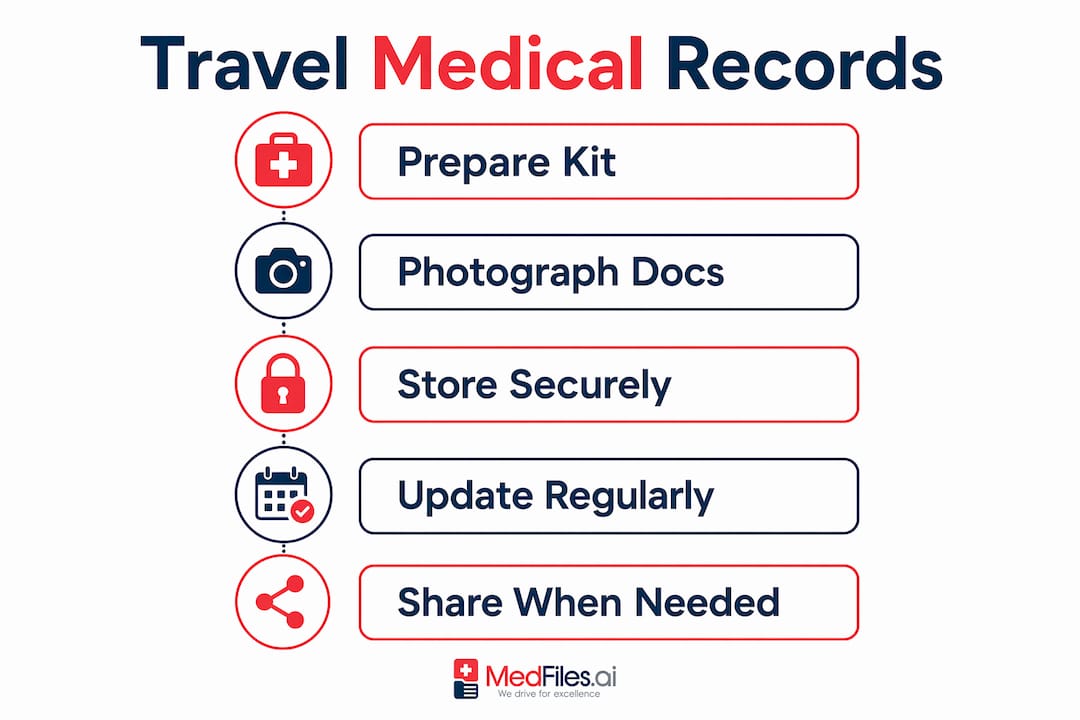
Pro Tip: Photograph every document in your kit and store the images in a secure cloud folder before you leave home. If your bag is stolen, you still have access to everything.

How do medical records prevent risks during travel emergencies?
Accurate health documentation is the single most effective tool for preventing medication errors and misdiagnosis when you cannot speak for yourself. Medical records preserve clinical truth, replacing guesswork with precise information at the exact moment it matters most. An unconscious traveler cannot tell an emergency physician about a penicillin allergy or a blood thinner prescription. The record does it instead.
“Having medical records accessible via health apps during international travel reduces fatal diagnostic or medication errors by enabling immediate, accurate information access to clinicians. Preparation diminishes reliance on patient memory or contacting home physicians during emergencies.” — CDC Yellow Book, Travelers with Chronic Illnesses
The continuity benefit extends beyond emergencies. When you visit a clinic abroad for a routine issue, a foreign doctor with access to your full history can avoid duplicated diagnostics and conflicting treatments. That means fewer unnecessary tests, lower costs, and faster care. Medical records also link healthcare stages across countries, so the treatment you receive in Bangkok or Lisbon fits logically into your ongoing care at home.
Language barriers add another layer of risk. A traveler who suffers a severe allergic reaction in a country where they do not speak the local language needs their allergy information in a format the local medical team can read immediately. Written medical summaries in English and the destination’s local language give foreign staff immediate understanding without waiting for a translator.
Best practices for organizing and updating your travel medical history
Good document management is not complicated, but it requires a system you actually follow before every trip. The goal is to make your health information findable in under 60 seconds by someone who has never met you.
Follow these steps before each trip:
- Schedule a pre-travel medical assessment. Travel medicine assessments differ from annual checkups. They focus on trip-specific risks, required vaccines, standby prescriptions, and DVT prevention for long flights. Book this visit at least four to six weeks before departure.
- Update every document. Add any new medications, recent diagnoses, or changed dosages. An outdated record is nearly as dangerous as no record.
- Prepare a multilingual medical summary. A one-page document with your key conditions, medications, and allergies translated into the primary language of your destination. Many travel medicine clinics offer this service.
- Organize a physical folder. Use a waterproof folder with labeled sections: medications, conditions, vaccines, insurance, and emergency contacts.
- Back up digitally. Upload all documents to a secure platform before you leave. Verify that you can access them from your phone without a home network.
- Verify medication legality. Physician letters describing your conditions and devices help you pass customs and security checkpoints without your medications being confiscated.
Pro Tip: Set a calendar reminder two months before any international trip to review and update your medical kit. Conditions and medications change, and your documents need to reflect your current health.
The table below shows which document formats work best in different travel scenarios.
| Scenario | Best format | Reason |
|---|---|---|
| Remote or rural travel | Hard copy folder | No reliable internet or cell service |
| Urban travel with smartphone | Digital app with offline access | Fast sharing with clinicians |
| Border crossing with controlled meds | Physician letter (hard copy) | Customs requires physical documentation |
| Long-term expatriate living | Both digital and hard copy | Ongoing care across multiple providers |
| Emergency room visit abroad | Digital record with QR access | Instant, shareable, and complete |
How does technology improve access to travel medical records?
Digital health platforms have changed what it means to carry your records. Instead of a folder of photocopies, you can store your entire medical history in an encrypted app and share it with a clinician in seconds. Digital integrated medical records improve patient outcomes by providing cross-border accessible health histories and reducing duplicated diagnostics. That is a direct benefit for any traveler who sees multiple providers across a trip.
Key advantages of digital record platforms for travelers:
- Instant access: Pull up your full history from any device, anywhere in the world
- Secure sharing: Send records to a foreign clinic or specialist without faxing or carrying paper
- Offline availability: Quality platforms store records locally on your device for use without internet
- Emergency ID features: A digital emergency ID displays your critical information on a locked screen, so first responders can read it without needing your password
- Automatic organization: Uploaded documents are sorted by type, date, and provider
Privacy is a real concern when storing health data digitally. Choose platforms that use end-to-end encryption and meet HIPAA-ready standards. Avoid free general-purpose cloud storage for sensitive medical files. The security standard matters as much as the convenience.
Paper records still have a place. Carry a one-page emergency summary as a hard copy in your wallet or travel bag. Digital systems can fail, batteries die, and some clinics in lower-resource settings cannot accept digital files. The best approach combines both formats.
What do travelers with chronic conditions need to know about medical records?
Travelers managing chronic illnesses face a higher documentation burden, and the stakes for getting it right are higher too. Pre-travel consultations with primary care providers reduce complications abroad. These visits produce emergency plans that connect home-based care with what foreign providers need to know.
Specific documentation needs for travelers with chronic conditions include:
- Medication timing plans across time zones: Your records should note how to adjust dosing schedules when crossing multiple time zones, especially for insulin, anticoagulants, and psychiatric medications
- Standby prescriptions: Standby medications for common illnesses should be documented in your records and included in your kit, so you can treat predictable flares without finding a local doctor
- Device documentation: Pacemakers, insulin pumps, CPAP machines, and similar devices need physician letters for airport security and customs
- Nearest hospital list: Your emergency plan should name the closest hospitals with relevant specialty care at each destination
- Home provider contact protocol: Document how and when to contact your home physician, including time zone differences and after-hours emergency lines
For travelers managing conditions like diabetes, epilepsy, or heart disease, submitting complete medical records before a trip to any specialist you plan to see abroad is worth doing in advance. Life IVF Center’s medical records submission process is a useful example of how pre-travel healthcare providers expect documentation to be organized and delivered before your first appointment.
Key Takeaways
Organized, accessible medical records are the most effective tool a traveler has for ensuring safe, accurate healthcare anywhere in the world.
| Point | Details |
|---|---|
| Carry a portable medical health kit | Include medications, conditions, allergies, vaccines, insurance, and emergency contacts in both formats. |
| Prepare multilingual summaries | Translate your key health information into the destination’s language before departure. |
| Use digital platforms with encryption | Choose HIPAA-ready tools that offer offline access and emergency ID features. |
| Schedule a pre-travel assessment | Book a travel medicine consultation four to six weeks before departure to update your records. |
| Chronic condition travelers need more | Document medication timing across time zones, standby prescriptions, and device letters for customs. |
Why travelers consistently underestimate medical record preparation
Most travelers I talk with think of medical records as something hospitals manage, not something they carry. That assumption is the most common and most costly mistake in travel health. The moment you board a plane, you become the sole custodian of your own health history. No one else is going to hand it to the ER doctor in a foreign country at 2:00 AM.
The second misconception is that a list of medications is enough. It is not. A medication list without dosages, conditions, and allergy details leaves a foreign clinician with half the picture. I have seen travelers with well-managed conditions at home face serious complications abroad simply because the treating physician did not know about a drug interaction or a contraindication buried in their history.
My honest recommendation: treat your medical kit with the same seriousness as your passport. Update it before every trip, not just the first one. Health changes. Medications change. Your records need to reflect who you are right now, not who you were two years ago. The effort takes about an hour per trip. The protection it provides is worth far more than that.
— Team
Your medical records, organized and ready for any trip
Medfiles gives you a secure place to store, organize, and share your complete medical history, so your records are ready the moment you need them, whether that is at a clinic in Tokyo or an emergency room in São Paulo.
Upload your documents once and access them from any device, anywhere in the world. Medfiles uses HIPAA-ready infrastructure with end-to-end encryption, so your data stays private. The secure document sharing feature lets you send records directly to a foreign provider in seconds, without printing or faxing. For families traveling together, digital medical document storage keeps every family member’s records organized in one place. Your health history should travel with you. Medfiles makes sure it does.
FAQ
What medical records should I carry when traveling internationally?
Carry a medication list, chronic condition summary, allergy list, vaccination records including the ICVP Yellow Card, insurance information, and a physician letter for any controlled medications or medical devices. Both digital and hard copies are recommended.
How do medical records help in a travel emergency?
Accurate medical records give emergency physicians immediate access to your medication history, allergies, and conditions, preventing dangerous errors when you cannot communicate. They replace reliance on patient memory during high-stress situations.
What is the ICVP Yellow Card and do I need one?
The International Certificate of Vaccination or Prophylaxis (ICVP) is an official WHO document proving your vaccination status. Some countries in Africa and South America require it for entry, particularly for yellow fever vaccination.
How should I store medical records digitally for travel?
Use a platform with end-to-end encryption and HIPAA-ready standards that offers offline access. Avoid storing sensitive health files in general-purpose cloud services. A digital emergency ID feature allows first responders to access critical information from a locked screen.
When should travelers with chronic conditions see a travel medicine specialist?
Book a pre-travel consultation at least four to six weeks before departure. Travel medicine assessments address trip-specific risks, required vaccines, standby prescriptions, and emergency plans tailored to your condition.