The Role of Patient Controlled Data in Your Health
Discover the crucial role of patient controlled data in managing your health. Gain autonomy and improve your healthcare experience today!

The Role of Patient Controlled Data in Your Health
Patient-controlled data is defined as the ability of individuals to manage, share, and restrict access to their own health records across any care setting. The role of patient controlled data has shifted from a niche policy debate to a practical reality that affects every doctor visit, emergency room trip, and specialist referral you make. Regulatory frameworks like HIPAA in the United States and GDPR in the European Union have expanded access rights, and OECD research confirms that person-centered care scores drop sharply when patients cannot access their own records. The industry term for this concept is patient data stewardship. It means you act as the primary gatekeeper of your health information, not a passive recipient of care.
How patient-controlled data improves care quality
Patient data autonomy directly improves clinical outcomes. Person-centered care scores were 20 percentage points lower for patients who lacked continuous access to their own records, and trust ratings fell by 15 percentage points in the same group. Those numbers reflect a real pattern: when you repeat your medical history to every new provider, critical details get lost, misremembered, or omitted entirely.
Centralized, patient-accessible records produce measurable system benefits too. A UK initiative using a single patient record model resulted in 20,000 fewer unnecessary emergency visits annually. The same program saved 500,000 doctor hours per year and avoided more than £20 million in unnecessary medicines expenditure. Those savings came directly from giving patients and providers access to the same accurate, up-to-date record.
The impact of patient data access on care coordination is equally significant. When you control your records, you become the connective tissue between fragmented care systems. A cardiologist, a primary care physician, and an urgent care clinic rarely share data automatically. You can fill that gap by carrying verified, organized records and sharing them on your terms.
Key outcomes linked to patient data stewardship include:
- Fewer repeated tests. Providers order duplicate labs when they cannot see prior results. Your records prevent that waste.
- Faster specialist care. A well-documented history gets you to the right treatment faster than a verbal summary.
- Reduced medication errors. Accurate, complete medication lists lower the risk of dangerous drug interactions.
- Higher trust. Patients who control their data report stronger confidence in their care teams.
What technologies enable effective patient control of health data?
Digital personal health records (PHRs) are the foundation of patient data stewardship. A PHR is a patient-managed digital file that aggregates records from multiple providers into one accessible location. Unlike a hospital’s internal electronic health record (EHR), a PHR belongs to you and travels with you.

Blockchain-based health information exchanges take this further by using permission-based protocols that let patients grant or revoke access at the record level. These systems place the interoperability burden on software rather than on providers or patients. That shift matters because decentralized storage reduces fragmentation and prevents the loss of critical information when you change providers, move to a new city, or travel internationally.
Effective patient data platforms share several core features:
- Granular sharing controls. You choose which provider sees which document, not a blanket release of everything.
- Audit trails. You can see who accessed your records and when.
- Cross-provider portability. Records move with you regardless of which hospital system generated them.
- Secure encryption. End-to-end encryption protects data in transit and at rest.
Pro Tip: When choosing a platform to manage your health records, prioritize one that offers document-level sharing permissions rather than all-or-nothing access. Granular control protects your privacy without creating friction when you need to share quickly.
One caution worth noting: granular data-sharing settings can overwhelm patients when the interface is poorly designed. The best platforms balance fine-grained control with a simple, clear experience. If a platform requires a manual to share a single document, it will not get used consistently.
What are the legal and ethical limits of patient data ownership?
Most patients assume they own their medical records. The legal reality is more complicated. Neither the United States nor most EU jurisdictions explicitly recognize patients as legal owners of their medical data. What you have are access rights and opt-out rights for secondary uses, not property rights.
The practical distinction matters in three specific ways:
- Access vs. ownership. You can request, view, and copy your records under HIPAA. You cannot prevent a hospital from retaining its own copy or dictate how it stores that copy internally.
- Secondary use opt-outs. Many jurisdictions allow you to restrict your data from being used in research or commercial analytics, but the process varies by country and provider.
- Data portability. GDPR Article 20 gives EU residents the right to receive their data in a machine-readable format. HIPAA provides a similar right in the US, though enforcement timelines differ.
The ethical dimension adds another layer. Future patient-controlled systems require a balance between individual control and collective benefit. Researchers call this “data solidarity.” Your records, in aggregate with millions of others, can accelerate drug discovery and disease surveillance. Absolute individual control could slow that progress. The ethical tension is real and unresolved.
Accountability on the provider side is equally clear. Unauthorized access to patient data can lead to prosecution, loss of professional accreditation, and severe legal penalties. Healthcare workers who access records without clinical need violate both professional standards and data protection law. That accountability framework is what makes patient data stewardship credible. Your records are protected not just by technology but by enforceable legal consequences.
How can you manage your health data for better outcomes?
Proactive patients who organize and curate their medical records see better care and reduce the interoperability burden on their providers. Well-labeled, summarized records lead to more effective specialist consultations than an unorganized collection of scanned pages. The difference between a useful health record and a useless one is structure.
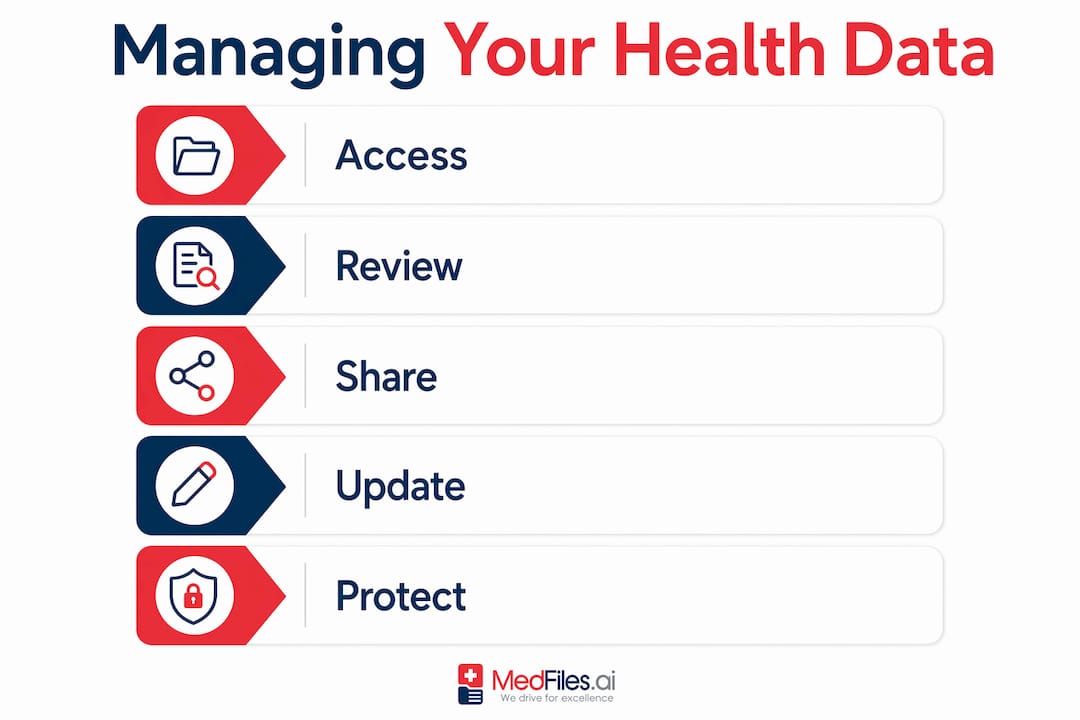
Start with these practical steps:
- Collect everything. Request records from every provider you have seen in the past five years. Include lab results, imaging reports, discharge summaries, and prescription histories.
- Label clearly. Name files by date, provider, and document type. “2024-03-cardiology-echocardiogram” is infinitely more useful than “scan001.”
- Review for errors. Mistakes in medical records are more common than most patients realize. Check diagnoses, medication lists, and allergy records for inaccuracies.
- Update regularly. A record that is two years out of date can mislead a provider as much as no record at all.
- Share selectively. Use permission-based sharing to give each provider access to only what they need for that specific visit.
Digital literacy is the underlying skill that makes all of this work. You do not need to understand how encryption works, but you do need to know how to upload a document, set sharing permissions, and revoke access when a provider relationship ends.
Pro Tip: Set a calendar reminder every six months to review your health records, update your medication list, and check that your emergency contacts and primary care provider details are current. Consistent maintenance takes less than 30 minutes twice a year and prevents serious gaps.
The importance of patient data extends beyond individual benefit. When you arrive at an emergency room with a complete, organized record, you protect yourself from medication errors, duplicate procedures, and misdiagnosis. That is not a theoretical benefit. It is a documented, measurable outcome.
Key Takeaways
Patient data stewardship is the most practical form of patient empowerment available today: it requires organized records, selective sharing, and consistent maintenance to deliver real clinical benefits.
| Point | Details |
|---|---|
| Stewardship, not ownership | Patients have access and sharing rights, not legal ownership of medical records. |
| Organized records improve care | Well-labeled, complete records reduce duplicate tests and speed specialist referrals. |
| Centralized access saves lives | Single patient record models cut unnecessary emergency visits and reduce medication errors. |
| Legal accountability protects you | Unauthorized provider access to your data carries prosecution risk and professional penalties. |
| Platform usability matters | Choose tools with granular sharing controls and simple interfaces to maintain consistent use. |
The shift I keep watching in patient health management
The most underrated change in healthcare over the past decade is not a drug or a device. It is the quiet transfer of information authority from institutions to individuals. Patients who once waited for a provider to summarize their history now arrive at appointments with organized digital records, specific questions, and the ability to share a document in seconds. That shift changes the entire dynamic of a clinical encounter.
What I find striking is how much of this comes down to preparation rather than technology. The technology exists. HIPAA-compliant platforms, encrypted storage, and permission-based sharing are all available and affordable. The gap is behavioral. Most patients still do not request their records, do not review them for errors, and do not carry them to appointments. The patients who do are consistently better served.
The ethical debate around data solidarity is worth taking seriously. Individual control and collective benefit are not always compatible goals. But that tension should not paralyze individuals. You can participate in research programs and still maintain meaningful control over your day-to-day clinical data. The two are not mutually exclusive.
My honest view is that the next five years will reward patients who treat their health records the way they treat their financial records: organized, reviewed regularly, and shared only with people who have a legitimate reason to see them. The tools to do that are already here.
— Team
Your health records, organized and secure with Medfiles
Managing your medical records does not have to be complicated. Medfiles gives you a centralized, HIPAA-ready space to store, organize, and share your health documents with the providers who need them.
With Medfiles, you upload your records once and access them anywhere. The platform’s secure document sharing lets you grant specific providers access to specific files, with full control over what you share and when. Whether you are preparing for a specialist visit, traveling abroad, or managing records for your family, Medfiles keeps everything in one place and ready to share. Explore medical document storage with Medfiles and put your health history where it belongs: in your hands.
FAQ
What is patient-controlled data in healthcare?
Patient-controlled data refers to health records that individuals can access, manage, and share on their own terms. The industry term is patient data stewardship, and it covers everything from lab results to imaging reports and prescription histories.
Do patients legally own their medical records?
Patients do not legally own their medical records in the United States or most EU jurisdictions. Current laws grant access and portability rights, not property rights, meaning providers retain their own copies regardless of patient preferences.
How does patient data access improve health outcomes?
Continuous access to personal health records raises person-centered care scores by up to 20 percentage points and reduces unnecessary emergency visits. Organized, shareable records also lower the risk of medication errors and duplicate procedures.
What is the safest way to share medical records with providers?
Permission-based sharing platforms that offer document-level access controls are the safest option. These tools let you grant a specific provider access to a specific file without releasing your entire medical history.
Can healthcare workers access my records without my permission?
Accessing patient records without clinical need is illegal under data protection law and professional standards. Unauthorized access carries prosecution risk and can result in loss of professional accreditation.