Medical Record Interoperability: What It Means for You
Learn what is medical record interoperability and how it improves your healthcare. Discover the benefits of seamless data exchange for patients and...

Medical Record Interoperability: What It Means for You
Medical record interoperability is defined as the ability of different healthcare IT systems to securely access, exchange, interpret, and use patient health data across organizational boundaries, regardless of vendor or platform. The industry term for this capability is “health information interoperability,” and it relies on standardized data formats like FHIR (Fast Healthcare Interoperability Resources) to function. Regulatory frameworks such as TEFCA (Trusted Exchange Framework and Common Agreement) and USCDI (United States Core Data for Interoperability) set the rules for how systems share and protect that data. Understanding what is medical record interoperability matters whether you are a patient, a caregiver, or a clinician, because it directly shapes the quality and safety of care you receive.
How does medical record interoperability work in healthcare systems?
Interoperability works through four distinct levels, each building on the last. Understanding these levels explains why some systems share data well and others fail completely.
- Foundational interoperability allows one system to send data to another. The receiving system can store it, but cannot necessarily read or use it meaningfully.
- Structural interoperability defines the format and syntax of the data. Standards like HL7 and FHIR ensure the data arrives in a predictable structure.
- Semantic interoperability ensures the receiving system correctly interprets the data. Uniform vocabularies like SNOMED CT, ICD-10-CM, and RxNorm are essential here. Without them, a medication listed as “ASA” in one system might not be recognized as aspirin in another.
- Organizational interoperability covers the policies, governance, and trust agreements that allow institutions to share data legally and securely.
TEFCA serves as the nationwide policy floor for secure health information exchange, empowering patient data access and standardization via USCDI. USCDI mandates the standardized health data classes that certified systems must support. Together, these frameworks give hospitals, clinics, and labs a common language and a legal basis for sharing records.
Pro Tip: Ask your provider whether their system is TEFCA-compliant or connected to a Health Information Exchange (HIE). If it is, your records can follow you across care settings automatically.
Interoperability also differs from integration. Integration joins systems into one, while interoperability allows independent systems to communicate and share data without merging. Interoperability is more flexible and works across organizations that will never share the same software platform.

What are the core benefits of record interoperability for patients and providers?
Interoperable health records deliver measurable benefits at every point in the care process. The gains are clearest when you look at what happens without them.
- Fewer redundant tests. When your full history is visible, your doctor does not order a blood panel you had last month at a different clinic. Lack of interoperability increases costs, wasted services, and care delays.
- Fewer medication errors. A complete medication list reduces dangerous drug interactions, especially for patients who see multiple specialists.
- Better care coordination. When a cardiologist, a primary care physician, and a pharmacist all see the same record, they make decisions together instead of in isolation.
- Faster emergency care. In an emergency, a clinician with access to your allergies, current medications, and prior diagnoses can act immediately instead of guessing.
- Patient empowerment. You can access, review, and share your own records. That access makes you an active participant in your care, not a passive recipient.
“Interoperable systems improve clinical workflows by providing timely, real-time data to health providers across care settings, enhancing efficiency and patient experience. Leading health organizations demonstrate clear benefits when data exchange is connected and complete.”
The benefits extend to AI tools as well. AI diagnostic tools rely on comprehensive, interoperable patient data to function at scale. A system that cannot access your full history cannot give a clinician reliable decision support. Interoperability is the foundation that makes AI in healthcare actually useful.
What challenges impede achieving true medical record interoperability?
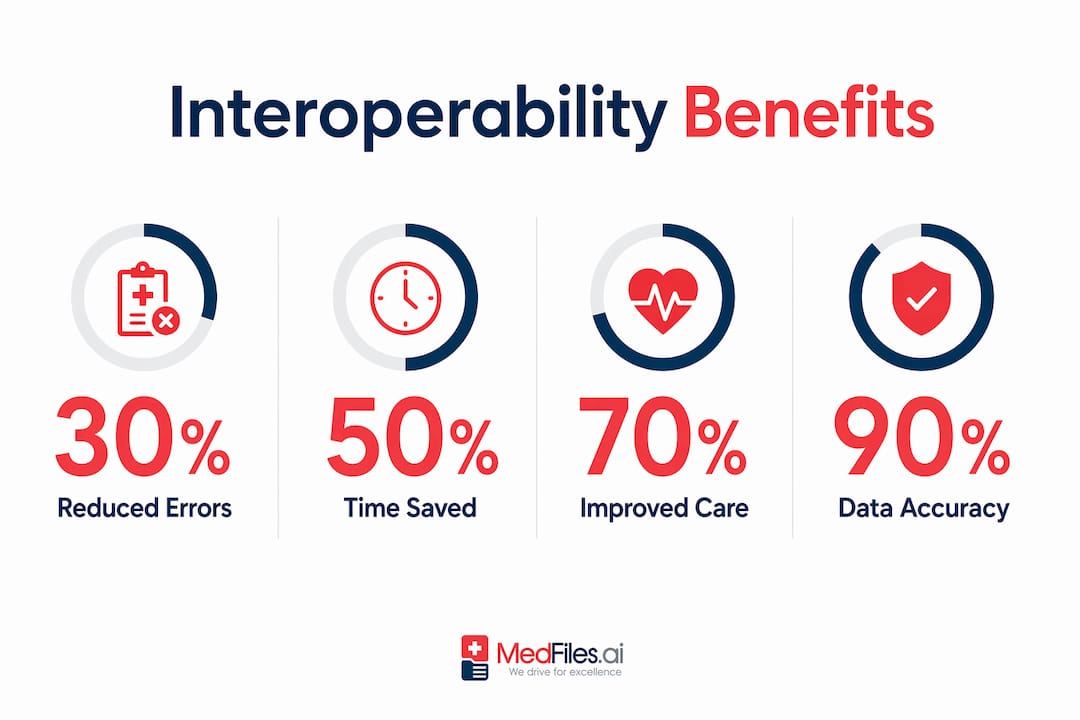
Progress is real but uneven. Ninety-six percent of hospitals and 78% of office-based physicians use certified EHRs, yet less than half of hospitals can fully integrate external health data into their systems. Adoption and true interoperability are not the same thing.
The barriers fall into several clear categories:
- Data silos and legacy systems. Older hospital software was built to store data, not share it. Replacing or connecting these systems is expensive and slow.
- Semantic gaps. Even when data transfers successfully, the receiving system may misread it. Semantic interoperability failures can cause misinterpretation of critical clinical data, leading to medication or diagnostic errors despite a technically successful exchange.
- Data quality and completeness. Incomplete or inconsistently formatted records create noise. Clinicians facing information overload from unstructured data cannot act on it effectively, even when the data technically arrived.
- Organizational and cultural resistance. Some institutions treat patient data as a competitive asset. Policy alignment and trust agreements take time to build.
- Patient confusion about record types. Many patients assume their doctor’s system shares records automatically. EMRs are not designed for interoperability by default. An EMR is limited to one provider’s practice, while an EHR is built to support cross-organization data sharing. The distinction matters when you change providers or seek specialist care.
Pro Tip: When you visit a new provider, ask specifically whether they can receive records electronically from your previous clinic. If not, request a copy of your medical records in a standard format like a CCDA (Consolidated Clinical Document Architecture) file.
Fragmented systems cause real harm. Disconnected EHR systems force patients to repeat their medical history at every new appointment and push clinicians to reorder tests already completed elsewhere. That repetition is not just frustrating. It delays diagnosis and wastes resources.
How does interoperability support emerging healthcare technologies?
Interoperability is the infrastructure layer that makes advanced healthcare tools possible. Without it, even the most sophisticated software operates on incomplete information.
| Technology | How interoperability enables it | Current status |
|---|---|---|
| AI diagnostics | Requires complete, structured patient data across visits and providers | Dependent on FHIR-based data access |
| Population health analytics | Aggregates data across large patient groups to identify trends | Requires standardized data from multiple sources |
| Clinical decision support | Delivers real-time alerts based on full patient history | Functions only with connected, current records |
| Care transition management | Tracks patients moving between hospital, rehab, and home care | Needs cross-setting data sharing |
| Pandemic response | Enables rapid surveillance and resource allocation | Requires near-real-time interoperable reporting |
Behavioral health is one area where connected records make a particularly significant difference. Providers working within behavioral health networks that share data across disciplines can coordinate psychiatric, medical, and social care in ways that isolated systems cannot support.
Patients are also taking a more active role. Access to interoperable data through patient portals and personal health record apps means you can review your own lab results, share records with a new specialist, and track trends over time. The shift from patient as passive recipient to patient as informed participant is one of the most significant changes interoperability enables. Policy trends in 2026 continue to push in this direction, with TEFCA expanding its network of qualified health information networks and USCDI adding new data classes each year.
Key Takeaways
Medical record interoperability is the technical and policy foundation that allows healthcare systems to share, interpret, and act on patient data safely and accurately.
| Point | Details |
|---|---|
| Core definition | Interoperability lets different healthcare IT systems exchange and correctly interpret patient data across organizational boundaries. |
| Four levels matter | Foundational, structural, semantic, and organizational interoperability each solve a different part of the data-sharing problem. |
| Real benefits | Connected records reduce redundant tests, prevent medication errors, and give clinicians a complete picture at the point of care. |
| Barriers remain | Legacy systems, semantic gaps, and organizational resistance mean that certified EHR adoption does not equal full interoperability. |
| Patients have a role | Asking providers about HIE connections and keeping your own organized records closes gaps that technology alone has not yet solved. |
Why interoperability is about more than technology
The technical standards are the easy part. FHIR, USCDI, and TEFCA give the industry a shared language. What they cannot mandate is the cultural shift required to make that language work in practice.
I have seen patients arrive at a specialist appointment with a stack of paper records because their primary care clinic and the specialist’s office use systems that technically could share data but organizationally never set up the connection. The infrastructure existed. The will to use it did not. That gap is where most interoperability failures actually live.
The patients who navigate this best are the ones who treat their own records as something they own and manage, not something that exists only inside a clinic’s server. Keeping a complete, organized copy of your health history, including lab results, imaging reports, and medication lists, gives you a safety net that no policy framework can fully replace yet. It also makes you a better partner for every provider you see.
The future I find genuinely encouraging is one where interoperability shifts from a technical achievement to a patient right. TEFCA’s expansion and the growing adoption of patient-facing FHIR APIs are moving in that direction. The gap between what the standards allow and what patients actually experience is closing. But closing it completely requires patients to ask questions, providers to prioritize connection, and platforms to make data access simple enough that no one needs to carry a paper folder to a specialist appointment.
— Team
Medfiles makes your health data work for you
Managing your own records is the most reliable way to fill the gaps that system-level interoperability has not yet closed.
Medfiles is a HIPAA-ready digital platform that lets you store, organize, and securely share your medical records with any provider, anywhere. Upload lab results, prescriptions, imaging reports, and clinical notes in one place. Share them instantly with a new specialist or an emergency room team. Medfiles also uses AI to help you understand your documents, so you arrive at every appointment informed and prepared. Whether you are managing your own care or coordinating records for your family, Medfiles gives you the control that fragmented systems cannot.
FAQ
What is the definition of medical record interoperability?
Medical record interoperability is the ability of different healthcare IT systems to securely exchange and correctly interpret patient health data across organizational and technological boundaries. It relies on standards like FHIR, USCDI, and regulatory frameworks like TEFCA.
What is the difference between an EMR and an EHR?
An EMR (Electronic Medical Record) is limited to a single provider’s practice and is not designed for data sharing. An EHR (Electronic Health Record) is built to support cross-organization data exchange and is the foundation of interoperable health records.
Why does semantic interoperability matter?
Semantic interoperability ensures the receiving system correctly understands the data it receives. Without shared vocabularies like SNOMED CT or ICD-10-CM, a medication or diagnosis can be misread, leading to clinical errors even when the data transfer itself succeeded.
How can patients benefit from interoperable health records?
Patients with interoperable records avoid repeated tests, experience fewer medication errors, and can share their full history with any provider instantly. They also gain direct access to their own data through patient portals and personal health record platforms.
What is TEFCA and why does it matter?
TEFCA is the Trusted Exchange Framework and Common Agreement, the nationwide policy framework that sets the rules for secure health information exchange in the United States. It gives healthcare organizations a legal and technical basis for sharing patient data across systems.