Telehealth Documentation: What Patients and Providers Must Know
Learn what is telehealth documentation and why it's crucial for compliance and accurate billing. Protect yourself and ensure quality care.

Telehealth Documentation: What Patients and Providers Must Know
Telehealth documentation is the structured recording of clinical and technical details from a virtual healthcare visit, capturing everything required to meet 2026 compliance, reimbursement, and legal standards. The industry term for this practice is “telemedicine documentation,” though both terms are used interchangeably across CMS guidelines and payer policies. What is telehealth documentation in practical terms? It means recording not just the clinical encounter, but also the technology platform used, patient and provider locations, consent confirmation, and any technical issues that affected the visit. Getting this right protects providers from audit risk, supports accurate billing, and gives patients a clear, complete medical record they can rely on.
What are the mandatory elements in telehealth documentation?
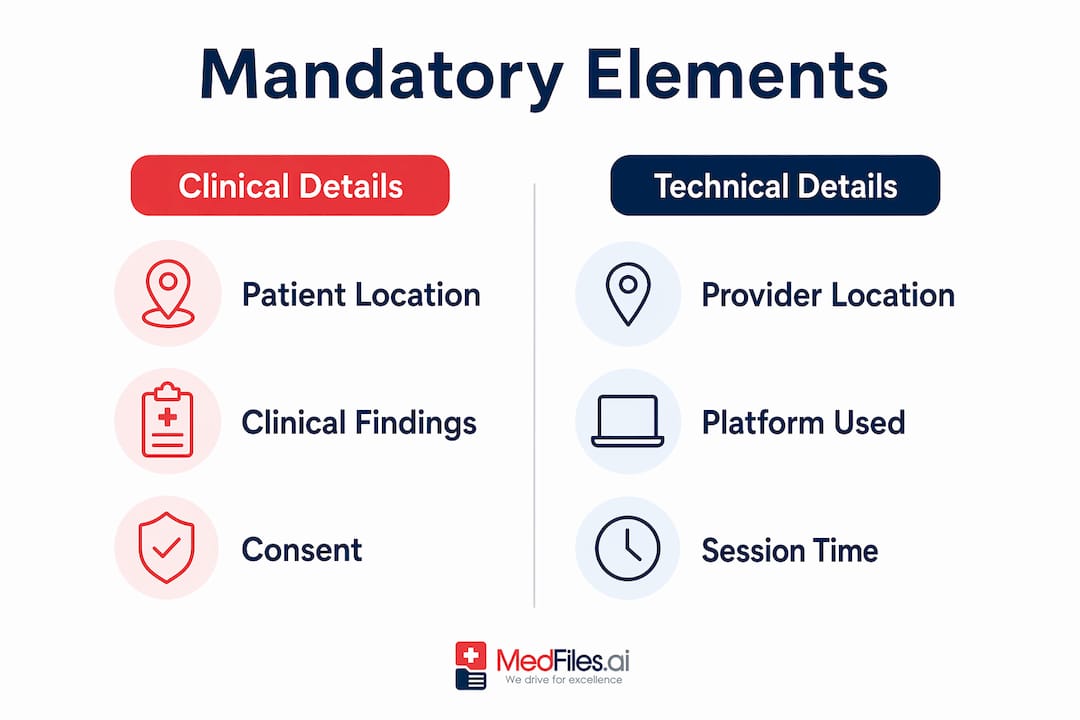
Telehealth documentation requires at least 8 essential elements beyond a standard clinical note. These requirements reflect CMS and commercial payer audit standards now that public health emergency waivers have expired. Missing even one element can trigger a claim denial or audit flag.
The required elements are:
- Patient location: City and state. Generic terms like “at home” are insufficient for billing and licensure compliance.
- Provider location: City and state at the time of the visit.
- Technology platform and modality: Name the platform and specify whether the visit was audio-video or audio-only.
- Patient identity verification: Confirm how identity was verified at the start of the session.
- Informed consent: Document that the patient consented to telehealth, including its limitations.
- Visit start and end times: Required to support time-based billing codes.
- Examination limitations: Note any clinical assessments that could not be completed due to the virtual format.
- Technical difficulties: Record any connectivity issues, platform failures, or modality transitions with timestamps.
| Element | Why it matters |
|---|---|
| Patient and provider location | Satisfies originating site and licensure requirements |
| Technology platform | Justifies billing modifiers and modality codes |
| Informed consent | Protects against malpractice and audit rejection |
| Visit timing | Supports time-based CPT code selection |
| Examination limitations | Documents clinical reasoning in a virtual context |
Pro Tip: Make patient location and consent fields mandatory in your EHR template. Required fields in EHR templates prevent incomplete notes and reduce audit risk significantly.
How does telehealth documentation differ from in-person visit records?
A standard clinical note documents the patient’s history, exam findings, assessment, and plan. A telehealth note does all of that and more. The virtual format introduces a layer of technical and logistical details that in-person visits simply do not require.
Here is what sets telehealth records apart:
- Technology encounter narrative. Document the platform used, audio-video quality, and any transition to audio-only with the exact time. This narrative justifies billing modifiers and clarifies what the provider could and could not assess.
- Modality distinction. Synchronous and asynchronous services must be clearly distinguished. Auditors check whether two-way audio-video was functional and whether timing was recorded.
- Consent documentation per visit. A one-time consent on file is not enough for most payers. Each note should include a “standing consent confirmed” notation to maintain a complete audit trail.
- Clinical reasoning tailored to the visit. Auditors reject cloned notes that appear identical across visits. Each note must reflect the specific encounter, including what the provider observed, what they could not assess, and why.
- Mental health-specific requirements. For mental health telehealth, CMS requires documentation of an in-person visit within 6 months prior to continued telehealth reimbursement. Missing this detail results in claim denials.
The billing impact is real. Vague or templated notes give auditors grounds to deny claims and demand repayment. Detailed, individualized notes are your best defense.
Pro Tip: After every telehealth visit, add one sentence describing a specific clinical observation unique to that encounter. It takes 10 seconds and makes your note audit-proof.
What are the security and privacy requirements for telehealth records?

Telehealth must be treated as a full digital infrastructure project, not just a video call. 2026 HIPAA updates classify session logs as critical audit assets, requiring encryption at rest, multi-factor authentication, and access logging across all platforms and devices.
The core security requirements for telehealth documentation include:
- Encryption at rest and in transit: All session recordings, transcripts, and AI-generated summaries must be encrypted. Access logs must be maintained.
- Retention for six years: Session logs and recordings must be kept for approximately six years to support breach investigations and audits.
- Multi-factor authentication (MFA): Providers must use MFA on all devices and platforms used for telehealth.
- Business Associate Agreements (BAAs): Annual BAA verification with every telehealth vendor is required. Outdated BAAs are a direct audit risk. BAAs must cover breach notification timelines, right-to-audit clauses, and proper PHI return or destruction.
- Device compliance: The provider’s own devices must meet security standards, not just the telehealth platform itself.
“Telehealth security documentation is not optional. Every provider must verify that their platform, their devices, and their vendor agreements meet 2026 HIPAA standards. A gap in any one of these areas creates liability across the entire encounter record.”
Medfiles uses end-to-end encryption and HIPAA-ready infrastructure to protect stored records. That level of protection aligns directly with what 2026 standards require from any system handling telehealth documentation.
How can providers and patients improve telehealth documentation?
Good telehealth record keeping does not happen by accident. It requires deliberate workflows on both sides of the virtual visit.
For providers, the most effective practices are:
- Build telehealth-specific fields into your EHR. Make patient location, consent confirmation, and modality required fields. This prevents incomplete notes before they happen.
- Document clinical reasoning, not just findings. Explain why you reached your assessment given the virtual format. Note what you could not examine and how that affected your plan.
- Record technical issues with timestamps. If a session dropped from audio-video to audio-only, note the exact time. This justifies any billing modifier you apply.
- Avoid note cloning. Templates and AI tools are valuable, but every note must reflect the specific encounter. Identical notes across visits are a red flag for auditors.
- Include follow-up instructions. Document what the patient was told to do next, including any referrals, prescriptions, or in-person follow-up required.
For patients, understanding telehealth record keeping matters too. You have the right to access your telehealth visit notes. Reviewing them helps you catch errors, track your care over time, and prepare for follow-up appointments. Keeping your own organized copy of telehealth records, including consent forms and visit summaries, gives you a complete picture of your virtual care history. Resources like documenting patient symptoms effectively can help patients and caregivers build better personal health records alongside their provider’s notes.
Pro Tip: Use AI-powered document tools to organize and analyze your telehealth visit summaries. AI can flag missing information and help you ask better questions at your next appointment.
Key Takeaways
Telehealth documentation requires both clinical and technical detail to satisfy 2026 CMS audit standards, protect against malpractice, and support accurate reimbursement.
| Point | Details |
|---|---|
| Eight mandatory elements | Every telehealth note must include location, platform, consent, identity verification, modality, timing, and exam limitations. |
| Individualized notes are required | Cloned or templated notes are rejected by auditors; each visit needs unique clinical reasoning. |
| HIPAA security extends to devices | Encryption, MFA, and six-year retention apply to all platforms and provider devices, not just the EHR. |
| Patients have a role too | Reviewing and storing your own telehealth records supports care continuity and catches documentation errors. |
| BAAs need annual review | Outdated vendor agreements create direct audit liability; verify BAAs every year. |
The documentation gap most providers still miss
The standard of care for telehealth equals in-person care. That fact is not debated. Yet the documentation gap between the two remains wide in practice.
The most common failure I see is not a missing field. It is a missing mindset. Providers treat telehealth notes as a lighter version of an office visit note. They fill in the required fields, copy a template, and move on. That approach works until an auditor pulls the chart and finds three months of notes that read identically. At that point, the documentation does not just fail the audit. It becomes a liability.
The second failure is consent. Automatic template filling without provider confirmation of consent is one of the most cited documentation errors in malpractice cases. A checkbox is not consent documentation. A sentence confirming that the patient verbally agreed, understood the limitations, and had questions answered is consent documentation.
The third failure is underestimating the technical narrative. Providers document what they found clinically but skip the technology encounter entirely. If the video dropped and you switched to audio-only, that transition changes what you could assess. It changes the billing code. It changes the legal record. Document it every time.
The good news is that all three failures are fixable with a well-built EHR template and a five-minute workflow review. The providers who get this right are not spending more time on documentation. They are spending it more deliberately.
— Team
Medfiles and your telehealth records
Managing telehealth documentation does not end when the visit does. You need a secure place to store visit summaries, consent forms, test results, and follow-up instructions so they are ready when your next provider asks for them.
Medfiles gives patients and providers a centralized medical record platform built for exactly this. Upload telehealth visit notes, prescriptions, and lab results. Share them securely with any provider in seconds. Medfiles uses HIPAA-ready encryption and supports the six-year retention standards that 2026 compliance requires. Providers can explore dedicated tools at Medfiles for doctors to manage documentation workflows and patient record sharing in one place. Your telehealth records deserve the same security and organization as any other part of your medical history.
FAQ
What is telehealth documentation?
Telehealth documentation is the structured recording of clinical and technical details from a virtual healthcare visit, including patient and provider locations, platform used, consent, identity verification, and clinical findings. It meets the same legal and billing standards as in-person visit records.
What are the required elements in a telehealth note?
A compliant telehealth note must include patient and provider city and state, technology platform and modality, patient identity verification, informed consent, visit start and end times, examination limitations, and any technical difficulties with timestamps.
How long must telehealth records be retained?
Session logs, recordings, and transcripts must be retained for approximately six years under 2026 HIPAA standards to support breach investigations and payer audits.
Why do auditors reject telehealth notes?
Auditors reject notes that are cloned across visits, lack individualized clinical reasoning, or are missing required elements like patient location or consent confirmation. Each note must reflect the specific encounter.
Can patients access their telehealth documentation?
Patients have the right to access their telehealth visit notes and records. Storing copies in a secure platform like Medfiles ensures you have instant access to records during follow-up visits, emergencies, or when switching providers.