What Is Healthcare Data Analytics: A Clear Guide
Discover what healthcare data analytics is and how it enhances patient care, drives better decisions, and lowers costs in healthcare.

What Is Healthcare Data Analytics: A Clear Guide
Healthcare data analytics is the systematic collection and analysis of diverse health information to generate actionable insights that improve patient care and healthcare operations. It integrates electronic health records, imaging, claims data, wearable device inputs, and genomic data using five core analytical types: descriptive, diagnostic, predictive, prescriptive, and discovery analytics. Modern health data analytics also applies machine learning and AI to process data at a scale no human team can match. The result is better clinical decisions, lower costs, and measurably improved patient outcomes. If you work in healthcare or health data, understanding these fundamentals is the foundation for everything that follows.
What is healthcare data analytics and why does it matter?
Healthcare data analytics is defined as the systematic process of collecting, organizing, and analyzing health data from multiple sources to produce insights that guide clinical and operational decisions. The industry term for this practice is “health informatics analytics,” though “healthcare data analytics” is the widely accepted working phrase across clinical and administrative settings. Both terms describe the same discipline.
The importance of health data analytics comes down to one fact: healthcare generates enormous volumes of data every day, and most of it goes unused. A single hospital system collects data from lab results, physician notes, billing codes, imaging scans, and patient-reported outcomes. Without a structured analytical process, that data sits in silos and delivers no value. Analytics converts raw data into decisions.

The role of analytics in healthcare extends beyond clinical care. It shapes staffing models, supply chain decisions, financial forecasting, and public health surveillance. Organizations that apply health analytics consistently outperform those that rely on intuition alone, particularly in managing chronic disease populations and reducing preventable readmissions.
What types of healthcare data are analyzed?
Healthcare analytics draws from a wide range of data sources, each with different structures, formats, and quality levels. The main categories include:
- Electronic health records (EHRs): Structured clinical notes, diagnoses, medications, lab values, and visit histories.
- Medical imaging: Radiology scans, pathology slides, and other visual data requiring specialized processing.
- Claims and billing data: Insurance claims that capture diagnoses, procedures, and costs across large populations.
- Wearable and remote monitoring data: Continuous streams from devices tracking heart rate, glucose, activity, and sleep.
- Genomic data: DNA sequencing results used in precision medicine and population risk modeling.
- Patient surveys and social determinants: Self-reported health status, income, housing, and lifestyle factors.
Structured data, such as lab values and billing codes, fits neatly into databases and is relatively easy to analyze. Unstructured data, such as physician notes and radiology reports, requires natural language processing to extract usable information. This distinction matters because unstructured data makes up the majority of clinical documentation.
Data interoperability is the technical ability for different systems to exchange and use data. Without it, analytics teams spend most of their time cleaning and reconciling data rather than analyzing it. The HL7 FHIR standard (Fast Healthcare Interoperability Resources) is the current benchmark for enabling data exchange across platforms. Organizations that adopt FHIR early gain a significant analytical advantage. You can see how digital records support this by making patient data consistently accessible and structured.
What are the five types of analytics used in healthcare?
Each analytical type serves a distinct purpose. Understanding how they differ helps you apply the right method to the right problem.
| Analytics type | Core question | Typical technique | Output |
|---|---|---|---|
| Descriptive | What happened? | Aggregation, reporting | Dashboards, summary reports |
| Diagnostic | Why did it happen? | Root cause analysis, drill-down | Explanations, correlations |
| Predictive | What will happen? | Machine learning, regression | Risk scores, forecasts |
| Prescriptive | What should we do? | Optimization algorithms, AI | Recommended actions |
| Discovery | What patterns exist? | Data mining, clustering | New hypotheses, research leads |
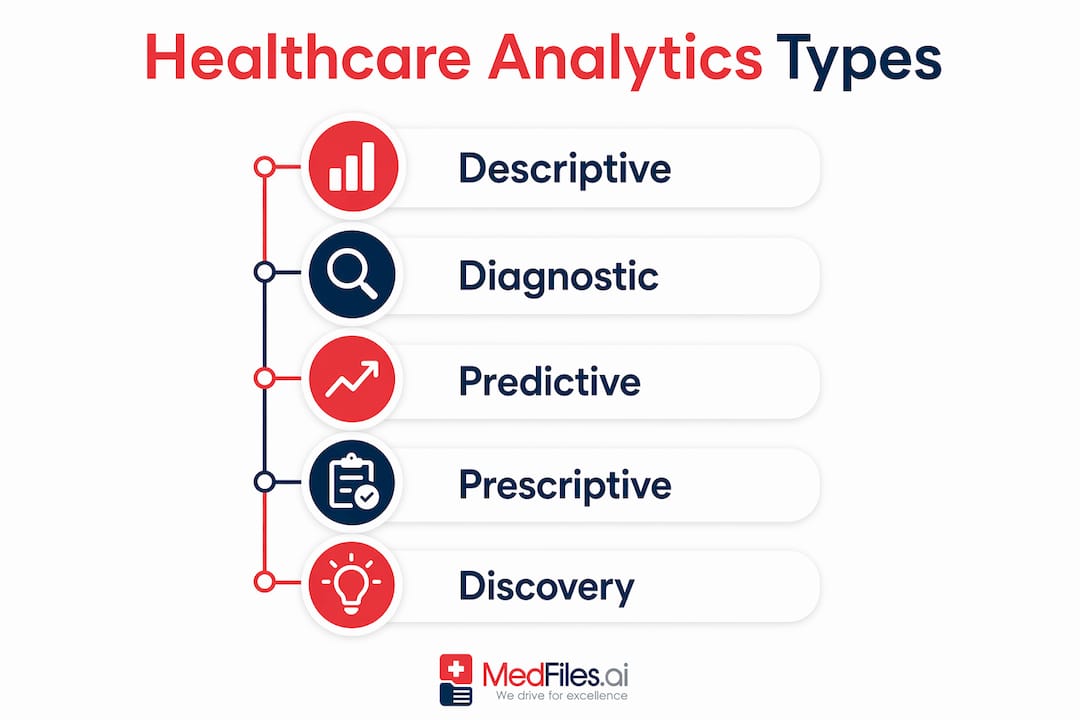
Descriptive analytics is the starting point for most organizations. It answers “what happened” by summarizing historical data into reports and dashboards. A hospital tracking monthly readmission rates by unit is using descriptive analytics.
Diagnostic analytics goes one level deeper. It identifies why a pattern occurred. If readmissions spiked in one unit, diagnostic analytics pinpoints whether the cause was discharge timing, medication adherence, or patient acuity.
Predictive analytics uses statistical models and machine learning to forecast future events. Predictive modeling helps clinical teams identify high-risk patients before a crisis occurs, enabling earlier intervention and better resource allocation. This is where health analytics delivers its most direct patient benefit.
Prescriptive analytics goes further still. It does not just predict an outcome. It recommends a specific action. A prescriptive model might tell a care coordinator to schedule a follow-up call within 48 hours for a specific patient based on their discharge profile and risk score.
Discovery analytics drives research and innovation. It finds patterns in large datasets that no one was specifically looking for, which is how new disease correlations and treatment pathways get identified.
Pro Tip: Start with descriptive analytics to build organizational trust in data, then layer in predictive and prescriptive capabilities once your data quality and staff confidence are solid.
How does healthcare data analytics improve patient care?
The practical benefits of healthcare analytics fall into two categories: clinical outcomes and operational performance. Both matter, and the best analytics programs address both simultaneously.
On the clinical side, data-driven decision-making improves patient management by enabling precise risk classification. Predictive models identify patients at risk of quality-of-life decline in neurological conditions and flag cardiology patients likely to be readmitted within 30 days. Nurses and physicians receive this information through clinical decision support dashboards, which translate complex model outputs into clear, prioritized actions.
Key operational benefits include:
- Staffing optimization: Predictive models forecast patient volume by unit and shift, reducing both overstaffing and dangerous understaffing.
- Supply chain management: Analytics tracks consumption patterns and predicts shortages before they affect care delivery.
- Length-of-stay reduction: Diagnostic analytics identifies bottlenecks in discharge workflows that extend hospital stays unnecessarily.
- Cost reduction: Identifying high-cost, high-risk patients early allows targeted interventions that reduce expensive acute episodes.
Healthcare analytics has shifted from reactive problem-solving to proactive, data-driven prevention. Prescriptive analytics now recommends exact actions to clinicians in real time. This shift is not incremental. It represents a fundamental change in how care decisions get made.
Pro Tip: The value of analytic outputs depends entirely on how they are presented. Clinicians act on clear, visual dashboards. They ignore dense statistical reports. Invest in visualization as seriously as you invest in the models themselves.
The role of patient data in driving these improvements is direct. Better data quality produces better models, which produce better recommendations. You can read more about how patient data shapes outcomes and why data completeness is a clinical priority, not just an administrative one.
What are the main challenges in adopting healthcare data analytics?
Adoption barriers are real, and most organizations underestimate them. The technical challenges are solvable. The human and organizational challenges are harder.
The most common barriers include:
- Data privacy and compliance: HIPAA regulations govern how patient data can be collected, stored, and used. Any analytics program must build privacy protections into its architecture from the start, not as an afterthought.
- Data fragmentation: Patient data lives across EHR systems, billing platforms, labs, and external providers. Reconciling these sources requires significant technical effort and ongoing governance.
- Staff training gaps: Technical skill gaps commonly hinder analytics adoption. Training healthcare staff to manage and interpret data is as critical as selecting the right software.
- Financial constraints: Building an analytics infrastructure requires upfront investment in tools, integration, and personnel. Smaller practices often lack the budget to do this at scale.
- Ethical and algorithmic bias: Models trained on incomplete or unrepresentative data can produce biased recommendations that harm specific patient populations.
Many analytics failures occur because organizations focus on algorithms while neglecting data accuracy at the source, human workflows, and ethical guidelines. This is the socio-technical reality of analytics adoption. Technology alone does not produce results. People, processes, and data quality determine whether an analytics program succeeds or fails.
What are the best practices for implementing healthcare data analytics?
Successful implementation follows a clear sequence. Skipping steps creates problems that are expensive to fix later.
- Establish data governance first. Define who owns each data type, how it is collected, and how errors are corrected. Without governance, analytics produces unreliable outputs.
- Adopt interoperability standards. Unified data standards like FHIR and documented policies for managing sensitive patient data are critical prerequisites before deploying any analytical model.
- Invest in staff training continuously. Analytics capabilities evolve quickly. Clinical and technical staff need ongoing education, not a one-time onboarding session.
- Build for usability, not just accuracy. A model with 95% accuracy that clinicians cannot interpret delivers no value. Design outputs for the end user.
- Integrate AI with transparency. Document how models make recommendations. Clinicians trust systems they understand. Black-box algorithms create resistance.
- Start small and scale deliberately. Pilot analytics in one department or use case. Prove value, refine the process, then expand.
Advanced analytics software is increasingly accessible to small and mid-sized practices. The main barriers are internal culture and data collection quality, not technology costs. This means the path to analytics adoption is open to more organizations than ever before. Understanding data-driven approaches in healthcare also helps organizations align their analytics investments with measurable outcomes.
The real gap in healthcare analytics is not the technology
The most common misconception I encounter is that healthcare analytics is primarily a technology problem. Organizations spend months evaluating platforms and negotiating software contracts, then launch with poor data quality and no training plan. The technology works. The implementation fails.
Predictive and prescriptive analytics are genuinely powerful. I have seen risk stratification models identify patients who would have been missed entirely by standard clinical review. That is not a small improvement. That is a different standard of care. But those results only happen when the underlying data is clean, the clinical team trusts the output, and the workflow is designed so that acting on a recommendation takes seconds, not minutes.
The cultural shift required in healthcare organizations is significant. Clinicians trained to rely on experience and judgment do not automatically trust a model’s recommendation. Building that trust takes time, transparency, and consistent proof that the analytics is right more often than it is wrong. The organizations that get this right treat analytics as a team sport, not a data science project running in the background.
My honest recommendation: before you invest in any advanced analytics capability, audit your data collection practices. Fix the source before you build the model. The technology will wait. Bad data will not get better on its own.
— Team
Medfiles and your healthcare data
Healthcare analytics depends on complete, accessible, and well-organized medical records. That is exactly what Medfiles is built to support.
Medfiles gives healthcare professionals and patients a secure, HIPAA-ready platform to store, organize, and share medical records digitally. From lab results and imaging reports to prescriptions and clinical notes, every document is encrypted and instantly accessible. For clinicians, that means complete patient records available at the point of care, not scattered across systems. For patients, it means control over their own health data. Medfiles supports the data completeness that makes analytics work. Get started with Medfiles and put your medical records where they belong.
FAQ
What is healthcare data analytics in simple terms?
Healthcare data analytics is the process of collecting and analyzing health information from sources like EHRs, claims, and wearables to improve patient care and hospital operations. It turns raw data into decisions.
What are the five types of analytics in healthcare?
The five types are descriptive (what happened), diagnostic (why it happened), predictive (what will happen), prescriptive (what to do), and discovery (what new patterns exist). Each serves a distinct clinical or operational purpose.
How does data analytics improve patient outcomes?
Predictive models identify high-risk patients before a crisis occurs, enabling earlier intervention. Prescriptive analytics recommends specific actions to clinicians in real time, reducing readmissions and improving care plan accuracy.
What is the biggest barrier to healthcare analytics adoption?
Socio-technical challenges dominate failures. Poor data quality, inadequate staff training, and misaligned workflows prevent analytics from delivering value, even when the technology itself is sound.
What is FHIR and why does it matter for health analytics?
FHIR (Fast Healthcare Interoperability Resources) is the standard protocol for exchanging health data between different systems. Without it, analytics teams cannot reliably combine data from multiple sources into a unified, analyzable dataset.
Key takeaways
Healthcare data analytics delivers its greatest value when clean data, trained staff, and usable clinical dashboards work together as a system rather than as separate components.
| Point | Details |
|---|---|
| Five analytics types | Descriptive, diagnostic, predictive, prescriptive, and discovery analytics each solve a different clinical or operational problem. |
| Data quality is foundational | Analytics models are only as reliable as the source data; fix collection practices before building models. |
| Interoperability enables scale | FHIR standards and data governance policies must be in place before deploying analytical tools across systems. |
| Usability drives adoption | Clinicians act on clear visual dashboards; complex raw outputs are ignored regardless of model accuracy. |
| Culture determines success | Staff training and organizational trust in data matter more than software selection for long-term analytics impact. |