Why Digitize Pet Health Records: A Pet Owner's Guide
Discover why digitizing pet health records enhances care quality. Improve efficiency, reduce errors, and keep your pet's data secure.

Why Digitize Pet Health Records: A Pet Owner’s Guide
Digitizing pet health records means storing all of your pet’s medical data, including vaccines, prescriptions, lab results, and treatment histories, in a secure, accessible digital system. This is the most reliable way to give your vet a complete picture of your pet’s health at every visit. Electronic pet health records, the standard term used in veterinary practice, reduce medical errors, cut administrative waste, and put you in control of your pet’s care. The benefits of digital pet records extend beyond convenience. They directly affect the quality of care your pet receives.
Why digitize pet health records: the clinical case
Electronic medical records (EMRs) are not just a convenience tool. They are a clinical upgrade. Veterinary EMR systems improve operational efficiency by 30–50%, cutting the administrative overhead that pulls vets away from actual patient care. That efficiency gain means your vet spends more time examining your pet and less time hunting through paper files.
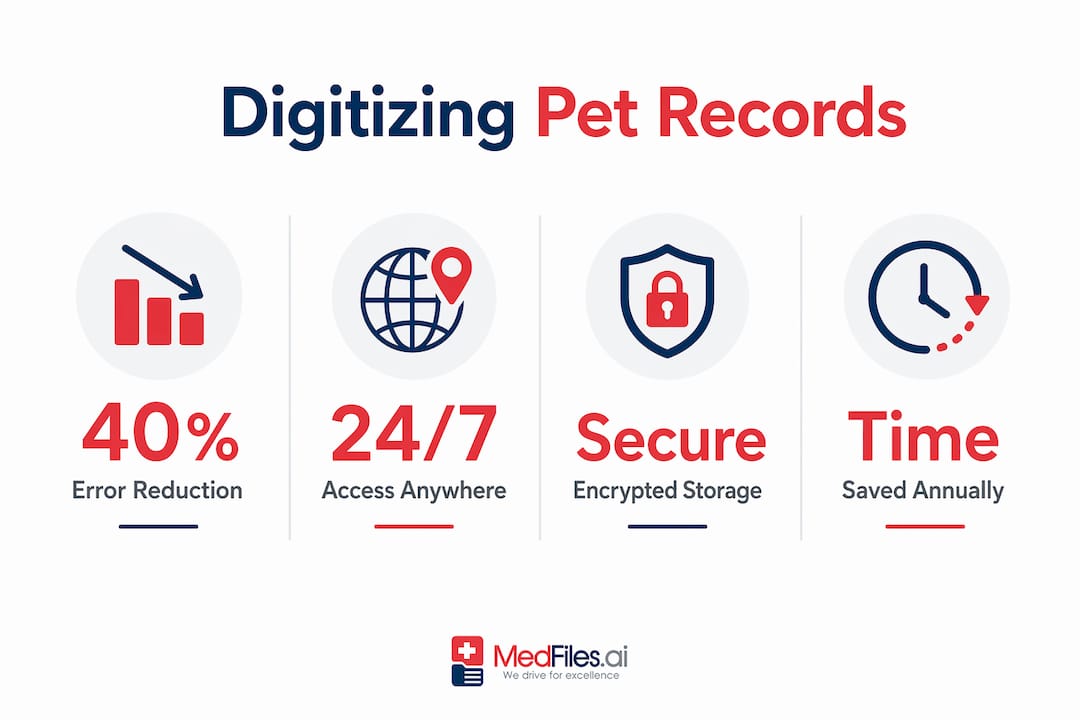
The error reduction numbers are equally significant. Clinics using EMR systems report 40% fewer medical errors and better communication with pet owners. Fewer errors means fewer missed diagnoses, fewer duplicate tests, and fewer dangerous drug interactions.

Digital records also close a critical information gap. Vets see pets only briefly each year, so longitudinal data from a digital record fills in what a single annual visit cannot reveal. A vet reviewing 12 months of weight trends, appetite notes, and medication responses makes a far more informed decision than one working from memory alone.
The benefits show up in day-to-day workflows too:
- Instant access to full history: No waiting for a clinic to locate a paper chart.
- Accurate medication records: Dosage history is visible at a glance, reducing the risk of double-dosing.
- Shared records across providers: A specialist, a groomer, and an emergency clinic can all access the same verified data.
- Timestamped documentation: Every entry carries a date, which matters for tracking chronic conditions and legal accountability.
What are the real risks of paper pet records?
Paper records are not just inconvenient. They are a liability. Manual paper record management wastes about 400 hours annually in vet clinics due to scanning and organizing paper charts. That time cost is passed on indirectly to pet owners through slower service and higher overhead.
The risks go beyond wasted time. Paper records fade, suffer physical damage, and are prone to loss, causing double vaccinations or missing chronic treatment histories. A single house fire, flood, or move can erase years of your pet’s medical history in minutes.
“Paper medical records pose legal and clinical risks due to errors and loss. Digital workflows greatly reduce liability by ensuring accurate, timestamped documentation.” — Today’s Veterinary Business
The practical consequences of lost or illegible records include:
- Repeated vaccinations because a vet cannot confirm prior immunization.
- Delayed treatment when a chronic condition history is unavailable during an emergency.
- Missing consent forms that create legal exposure for clinics and confusion for owners.
- Illegible handwriting that leads to incorrect medication doses or misread diagnoses.
Transitioning to digital pet records eliminates these risks. A digital file does not fade, cannot be misread, and is recoverable even if your phone is lost, because it lives in the cloud with encryption protecting it.
How does digital tracking help with pet medication management?
Medication management is one of the most practical reasons to go digital. Setting medication refill reminders at least two weeks before supply runs out gives your vet time to authorize the refill and the pharmacy time to process it. One week is often not enough, and a lapse in medication can be dangerous for pets managing chronic conditions like epilepsy, diabetes, or heart disease.
A structured digital system handles this automatically. Here is how to set up effective medication tracking:
- Log every prescription at the time of issue. Record the drug name, dosage, frequency, and start date.
- Upload the prescription label or written instructions. A photo of the label stored digitally prevents dosage confusion later.
- Set a refill reminder two weeks before the estimated end date. This is the minimum lead time recommended for vet authorization and pharmacy processing.
- Track each pet separately. In multi-pet households, cross-confusion between medications is a real risk. Separate profiles prevent it.
- Review the medication log at each vet visit. A printed or shared digital summary gives your vet an accurate starting point.
Pro Tip: Smart digital record systems can extract medication data from uploaded prescription documents and set refill reminders automatically. Look for automated medication reminders when choosing a pet health app.
Learning how to digitize pet prescriptions is one of the highest-value steps you can take for a pet on long-term medication. The process takes minutes per prescription and prevents costly, stressful lapses in care.
Best practices for organizing digital pet health records
Digitizing records is only useful if you can find what you need quickly. The structure you build from day one determines how usable your records are in an emergency.
Use a consistent file naming convention
Structured file naming conventions like YYYY-MM-DD_PetName_Reason are the standard for quickly sorting and retrieving digital health documents. A file named “2026-03-15_Luna_AnnualVaccines” is instantly identifiable. A file named “IMG_4823.jpg” is not. Generic phone camera file names make retrieval nearly impossible when you need a record fast.
Choose a dedicated app, not a generic cloud folder
Exclusive cloud storage folders lack structured, queryable data. Dedicated pet health apps enable pattern detection and longitudinal health insights that a static PDF folder cannot provide. The difference matters when you are trying to identify whether your dog’s weight loss started before or after a medication change.
Key features to look for in a pet health record app:
- Offline access with local caching. Apps with local caching maintain access to critical data even without internet. Vet clinics and emergency facilities often have poor cellular connectivity.
- Multi-profile support. One account should handle all pets in your household with separate, clearly labeled profiles.
- Secure sharing. You need to send records to a new vet, a boarding facility, or a specialist without printing anything.
- AI-powered document organization. Automatic categorization of uploaded files saves time and reduces the chance of misfiling.
Pro Tip: Before your next vet visit, scan or photograph every paper record you have and upload them in one session. Use the YYYY-MM-DD_PetName_Reason format from the start. Thirty minutes of setup saves hours of searching later.
Prioritize offline accessibility
Offline access is not optional. It is a safety feature. If your pet has a seizure at a trail parking lot with no signal, your vet needs that medication history immediately. An app that requires internet to display records fails at the exact moment it matters most.
The importance of pet health documentation becomes most obvious in emergencies. A complete, offline-accessible digital record can be the difference between a vet making an informed decision and guessing.
Key Takeaways
Digitizing pet health records reduces medical errors, eliminates the liability of paper records, and gives both owners and vets the longitudinal data needed to make better care decisions.
| Point | Details |
|---|---|
| EMRs reduce errors significantly | Clinics using electronic records report 40% fewer medical errors and better owner communication. |
| Paper records carry real risk | Lost or illegible paper files cause duplicate vaccinations, missed histories, and legal liability. |
| Refill reminders need two weeks | Set medication alerts at least 14 days before supply runs out to allow vet and pharmacy processing time. |
| File naming drives usability | Use YYYY-MM-DD_PetName_Reason format so records are instantly retrievable during emergencies. |
| Offline access is a safety feature | Choose apps with local caching so critical records are available even without internet connectivity. |
The shift I keep seeing pet owners make too late
The most common pattern I see is this: a pet owner manages everything in their head and a shoebox of paper receipts until something goes wrong. A new vet asks for a full vaccination history. An emergency clinic needs to know what medications the dog is on. A specialist wants to see three years of bloodwork. And suddenly, the shoebox is not enough.
Digital pet passports transform scattered care information into a living profile that helps owners notice health patterns and make informed decisions. The word “living” is the key part. A paper file is static. A digital record grows with your pet and surfaces patterns you would never catch by memory alone.
What I find most valuable is not the emergency use case, though that matters. It is the quiet, preventive benefit. When you log your cat’s weight monthly and track her appetite notes, you start to see a trend three months before your vet would. You walk into the appointment with data, not a vague feeling that something seems off. That shift, from memory to data, changes the entire dynamic of the vet relationship.
The owners who get the most from digital records are not the most tech-savvy. They are the most consistent. They log a note after every visit. They photograph every prescription label. They set reminders two weeks out. The technology is secondary to the habit.
— Team
Medfiles makes secure pet record storage simple
Pet owners who want a reliable system for storing, organizing, and sharing their pet’s health records can use Medfiles to do it securely. Medfiles offers medical document storage with automatic organization, multi-profile support for every pet in your household, and AI-powered document analysis that categorizes uploads without manual sorting.
Every record stored in Medfiles is protected by HIPAA-ready infrastructure and end-to-end encryption. You can share records securely with your vet, a boarding facility, or a specialist in seconds, with no printing required. Offline access means your pet’s history is available even when you have no signal. Whether you are managing one pet or five, Medfiles keeps every document organized, protected, and ready when you need it.
FAQ
Why should I digitize my pet’s health records?
Digital pet health records reduce medical errors, prevent loss of critical history, and give vets the longitudinal data needed for accurate diagnoses. Clinics using electronic records report 40% fewer medical errors compared to paper-based systems.
How do I digitize pet prescriptions?
Photograph or scan each prescription label and upload it to a dedicated pet health app immediately after each vet visit. Use a consistent file name format like YYYY-MM-DD_PetName_Medication so you can retrieve it instantly.
What are the risks of keeping paper pet records?
Paper records fade, get lost, and are prone to physical damage. Manual paper management wastes roughly 400 hours annually in vet clinics, and missing records can lead to duplicate vaccinations or dangerous treatment gaps.
How far in advance should I set medication refill reminders?
Set refill reminders at least two weeks before your pet’s medication runs out. One week is often insufficient for vet authorization and pharmacy processing, especially for controlled substances.
Is a generic cloud folder good enough for pet health records?
Generic cloud folders lack structured, queryable data and cannot detect health patterns over time. Dedicated pet health apps with offline access and AI organization provide significantly better usability and safety than a static folder of PDFs.