Why Medical Test History Matters for Your Health
Discover the importance of medical test history in improving your health outcomes. Learn how past tests empower better diagnoses and care.

Why Medical Test History Matters for Your Health
Medical test history is the documented record of every diagnostic test, result, and clinical finding collected throughout your healthcare journey, and accurate history supports diagnosis in up to 74% of patient encounters. That single statistic reframes how you should think about the folder of lab results sitting in your drawer. Your past test data is not administrative paperwork. It is the foundation your doctors use to make safer, faster, and more accurate decisions about your care. The importance of medical test history extends from your first visit with a new physician to emergency care abroad, and understanding it puts you in control of your own health outcomes.
Why medical test history is the backbone of accurate diagnosis
The MSD Manual’s clinical guidance on test ordering is direct: doctors use your history to narrow possible causes before ordering a single test. Without that context, physicians are forced to cast a wide net, and a wide net catches false positives.
Here is why that matters in practice:
- History narrows the differential diagnosis. A patient presenting with fatigue could have anemia, thyroid disease, diabetes, or depression. A prior thyroid panel showing normal TSH levels three months ago removes one branch of that decision tree immediately.
- Targeted testing reduces false positives. When tests are ordered “just in case,” the risk of false positives rises sharply, triggering follow-up procedures, patient anxiety, and sometimes unnecessary treatment.
- Trends matter more than single results. Clinicians gain the greatest benefit from test timelines, not isolated snapshots. A cholesterol reading of 210 mg/dL means something very different if your previous three readings were 180, 190, and 200 versus 230, 220, and 215.
- Genetic test results depend entirely on prior history. According to Mayo Clinic, genetic testing decisions rely on accurate personal and family medical history to interpret results correctly and guide treatment, family planning, and insurance considerations.
The practical implication is clear. Every time you walk into a clinical encounter without your test history, your doctor is working with incomplete data. That gap increases both the cost of your care and the risk of getting it wrong.
Pro Tip: Before any specialist appointment, pull together your last two to three years of relevant test results. Even a simple printed timeline of your CBC, metabolic panel, or imaging reports can cut your consultation time and sharpen the clinical picture your doctor sees.

What to include in a complete medical test history
The Cleveland Clinic distinguishes between two separate concepts that most patients confuse. Your medical history is the personal health information you know and share, including symptoms, medications, and past diagnoses. Your medical record is the formal documentation maintained by your providers. Both are part of understanding your medical records fully, and you need to actively manage both sides.
A complete personal test history should include:
- Symptom timelines. When symptoms started, how they progressed, and what made them better or worse.
- All diagnostic test results. Lab work, imaging reports (X-rays, MRIs, CT scans), biopsies, and pathology findings, with dates.
- Current and past medications. Including dosages, start dates, and any adverse reactions.
- Known allergies. Drug allergies, food allergies, and documented reactions.
- Family medical history. First-degree relatives’ diagnoses, especially for hereditary conditions like heart disease, cancer, and diabetes.
- Vaccination records. Dates and types of immunizations received.
- Surgical and procedure history. Dates, outcomes, and any complications.
The Office of the National Coordinator for Health Information Technology confirms that under HIPAA, patients have the right to access their health records securely. That right is your starting point. Request copies of your records from every provider you have seen and consolidate them into one organized file.
Pro Tip: Ask your primary care physician’s office for a “continuity of care document” or a patient summary at your next visit. This single document often contains your active problem list, medications, allergies, and recent test results in one place, giving you an instant foundation for your personal health file.
How test history supports continuity of care and patient safety
Fragmented care is one of the most preventable sources of medical error. When you see a new specialist, visit an urgent care clinic while traveling, or get admitted to an emergency room, your providers are starting from zero unless you bring your history with you.
StatPearls research identifies documentation and communication between clinicians as critical for continuity of care and preventing medical errors. The problem is that communication between providers is not always reliable. A BMJ Open study found that roughly 19.5% of healthcare encounters face challenges in history-taking that directly impact patient safety and outcomes. That means nearly one in five clinical visits carries a communication risk that an organized, patient-held test history can directly offset.
“Maintaining your own medical test history is a safety net in the roughly one in five clinical encounters where history-taking breaks down.”
The policy world is catching up to this reality. England’s NHS is introducing a single patient record by 2027, designed to eliminate redundant history-telling and improve care coordination across providers. The underlying logic applies everywhere: when your complete test history is available to every clinician who treats you, care becomes safer and more efficient.
| Risk scenario | How test history helps |
|---|---|
| New specialist visit | Provides prior test results so the specialist avoids duplicating workup |
| Emergency room admission | Gives ER physicians your medication list, allergies, and recent labs instantly |
| Travel or urgent care | Prevents dangerous drug interactions when prescribers lack your full record |
| Chronic disease management | Allows trend analysis across years of test data for better treatment adjustments |
The CDC’s guidance on refugee health screening reinforces this point from a different angle. Detailed prior history is critically important in initial health encounters to identify underlying conditions and build patient-provider trust, especially when patients are new to a healthcare system. The same principle applies any time you change providers or move to a new city.
How to access, manage, and use your test history effectively
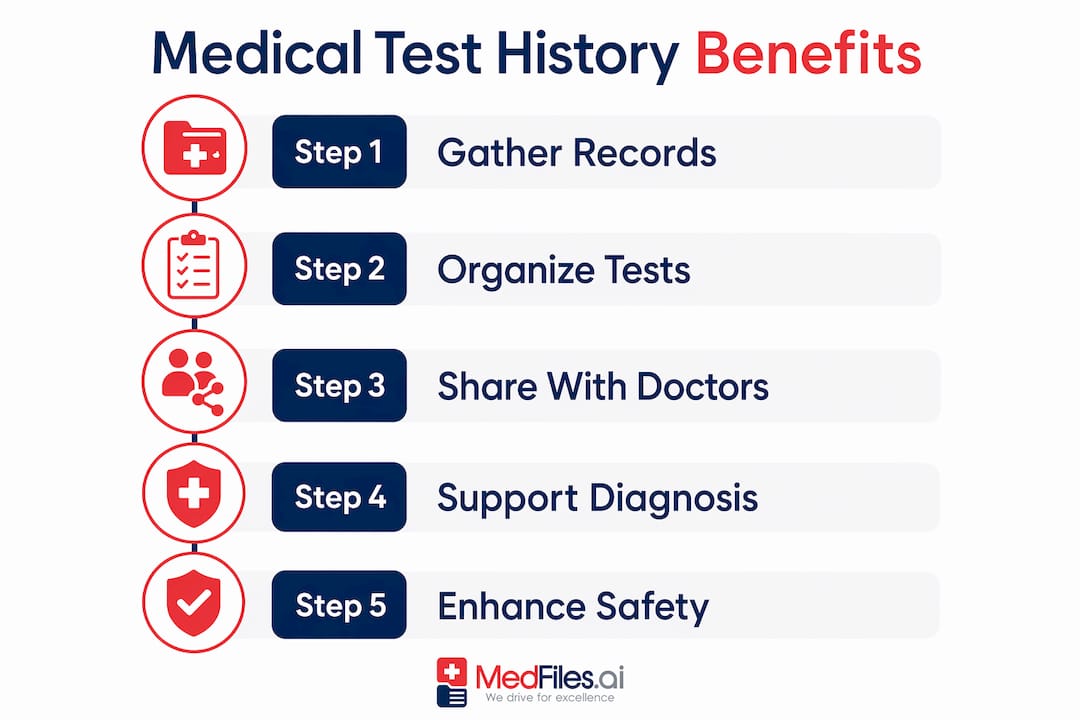
Taking control of your test history does not require a medical degree. It requires a system. Here is what works in practice:
- Request your records proactively. Under HIPAA, providers must give you access to your records, typically within 30 days of your request. Start with your primary care physician, then request records from specialists, labs, and imaging centers.
- Use patient portals. Most major health systems, including those using Epic or MyChart, offer online portals where you can download lab results, visit summaries, and imaging reports directly.
- Organize by category and date. Group records into sections: labs, imaging, specialist notes, medications, and immunizations. Within each section, sort by date so trends are visible at a glance.
- Share records before appointments. Sending your test history to a new provider before your first visit gives them time to review it and arrive prepared. This is especially valuable for sharing records with providers during transitions of care.
- Keep a medication and allergy card. A simple card in your wallet listing your current medications, dosages, and allergies can be lifesaving in an emergency.
- Store digital copies securely. Paper records get lost, damaged, and left at home. Digital storage with encryption protects your data and makes it accessible from anywhere.
The benefits of preserving medical history go beyond convenience. Patients who arrive at appointments with organized records receive more targeted care, ask better questions, and leave with clearer treatment plans. That is not a soft benefit. It is a measurable improvement in the quality of your healthcare experience.
Key takeaways
A complete, organized medical test history is the single most effective tool you have for safer, more accurate, and more coordinated healthcare across every provider you will ever see.
| Point | Details |
|---|---|
| History drives diagnosis | Accurate test history supports diagnosis in up to 74% of cases, making it the foundation of clinical reasoning. |
| Targeted testing prevents harm | Sharing prior results helps doctors avoid redundant tests, false positives, and unnecessary follow-up procedures. |
| Know both documents | Your medical history (what you know) and your medical record (what providers document) both need active management. |
| Safety net in complex encounters | In nearly 1 in 5 clinical visits, history-taking faces challenges. Your own organized records fill that gap. |
| Access is your legal right | HIPAA gives you the right to request and use your health records. Exercise it before every major appointment. |
Why I believe your test history is your most underused health asset
Most people spend more time organizing their financial records than their medical ones. That imbalance is backward. A missed diagnosis or a drug interaction caused by incomplete history can cost you far more than a missed tax deduction.
What I have observed consistently is that patients who maintain organized test histories are better advocates for themselves. They catch when a doctor is about to order a test they had six months ago. They notice when a new medication conflicts with something already in their record. They ask sharper questions because they understand their own data.
The shift toward interoperability, with initiatives like the NHS single patient record and the expansion of HIPAA patient access rights in the United States, signals where healthcare is heading. Providers will increasingly expect patients to arrive with their history accessible and shareable. Patients who build that habit now will benefit from faster, safer, and more personalized care as these systems mature.
The practical step is not complicated. Start with what you have. Gather your last two years of test results, organize them by category, and store them somewhere you can access instantly. Then keep adding to that record every time you see a provider. Your future self, sitting in an emergency room or meeting a new specialist, will have exactly what they need.
— Team
Take control of your health records with Medfiles
Medfiles makes it straightforward to store, organize, and share your complete medical test history in one secure place. Upload lab results, imaging reports, prescriptions, and specialist notes, and Medfiles automatically organizes them so you can find what you need instantly. The platform uses HIPAA-ready infrastructure with end-to-end encryption, so your data stays private and protected. You can share records directly with your doctors before appointments, manage profiles for your entire family, and access everything from your phone whether you are at home or traveling. If you are ready to stop losing track of your health data, get started with Medfiles today. For clinicians looking to improve patient record coordination, explore the Medfiles for Doctors page.
FAQ
What is medical test history?
Medical test history is the documented record of all diagnostic tests, results, and clinical findings collected during your healthcare encounters. It forms the foundation of accurate diagnosis and informed treatment planning.
How does test history help doctors make better decisions?
Doctors use prior test results to narrow possible diagnoses and avoid ordering redundant or unnecessary tests. A complete history reduces false positives and helps clinicians identify trends rather than reacting to isolated results.
What is the difference between medical history and a medical record?
Your medical history is the personal health information you know and share with providers, including symptoms and medications. Your medical record is the formal documentation maintained by your healthcare providers, as defined by Cleveland Clinic.
Do I have the right to access my own test results?
Yes. Under HIPAA, patients have a legal right to access their health records securely and use that information to guide their own healthcare decisions, as confirmed by the ONC.
How should I organize my medical test history at home?
Group records by category, such as labs, imaging, and medications, then sort each category by date. Store digital copies in an encrypted platform like Medfiles so your history is accessible during emergencies, travel, or new provider visits.