Your Healthcare Data Role in Travel: A Practical Guide
Discover the critical role of healthcare data during travel. Create a secure travel file to ensure your health needs are met abroad.

Your Healthcare Data Role in Travel: A Practical Guide
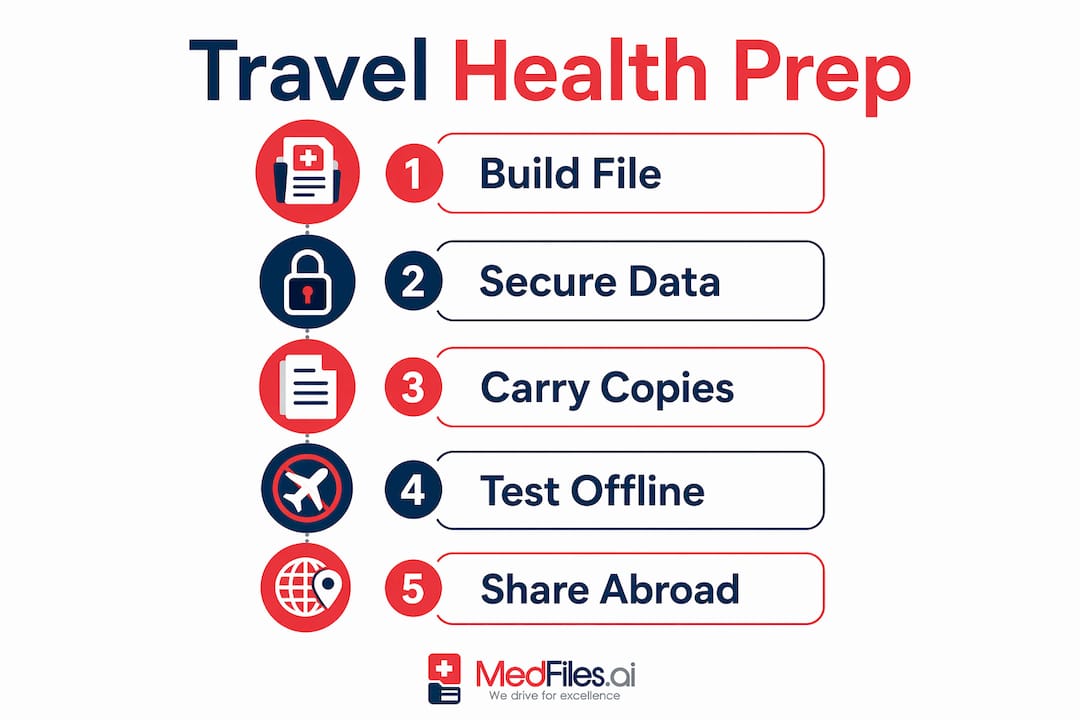
Before you leave, build one encrypted travel file. Include your medications by generic name and dose, known allergies, key test results (ECG if you’re over 50 or have a cardiac history), immunization records, insurance details, and a clinician summary on office letterhead. Grant secure access to a trusted local clinician if needed, and notify your U.S. provider within 12 months after any overseas care to help identify travel-acquired antimicrobial-resistant infections.
The role of healthcare data during travel goes beyond convenience. Paper-based records impede continuity of care and slow down clinician communication across borders. The CDC Yellow Book, WHO travel health guidance, and peer-reviewed travel medicine literature all point to the same conclusion: digital, mobile-accessible records are the standard you should meet before departure.
- Create one encrypted travel file (medications, allergies, test results, immunizations, insurance, emergency contacts, clinician letter)
- Give secure, time-limited access to a local clinician if you receive care abroad
- Notify your U.S. provider within 12 months of any overseas healthcare encounter
Table of Contents
- What to carry when you travel: digital and physical essentials
- How to secure, access, and share your records while traveling
- How to share records with local clinicians abroad and with your U.S. provider after travel
- Concrete steps to prepare your medical data before you leave
- What to do if you need medical care while abroad
- How to choose a travel-ready digital medical record solution
- How Medfiles helps travelers stay prepared and in control
- Key takeaways
- Why your health data is your most important travel document
- Your travel file, secured and ready with Medfiles
- Authoritative sources and further reading
What to carry when you travel: digital and physical essentials
Digital essentials:
- Encrypted travel file with all core records
- Offline encrypted PDF copy stored separately from your device password
- Device passcode and 2FA enabled on your health record account
- Clear sharing permissions set before departure
- Mobile health record app or cloud platform with offline access
Physical essentials:
- Printed clinician letter: diagnoses, medications (generic names and doses), allergies, and your provider’s contact information
- Insurance card and 24/7 assistance number
- International Certificate of Vaccination or Prophylaxis (yellow card) where required
- Spare prescriptions and documentation for any controlled medications
- Medical ID bracelet or card for critical conditions
For families and dependents:
Bundle each family member into a separate profile. Include guardian consent forms for minors, medication schedules for children or older adults, and any relevant specialist letters. A family records workflow that assigns clear permissions to each profile saves critical time at a foreign clinic.
Pro Tip: Keep one printed copy in your carry-on and one encrypted offline copy on a separate device or USB drive stored in checked luggage. Never rely on a single point of access.
| Point | Details |
|---|---|
| Generic medication names | Always list the generic name and dose — trade names differ by country. |
| ECG for cardiac history | Carry a baseline ECG if you are over 50 or have a previously abnormal result. |
| Family profiles | Set up separate profiles with consent forms for each dependent before departure. |
| Offline backup | Store an encrypted PDF offline, separate from your device login credentials. |
How to secure, access, and share your records while traveling
- Build your travel file around the essentials. Medications (generic names and doses), allergies, recent lab results, immunization records, insurance details, and your clinician letter. Keep it concise enough for a clinician to scan in under two minutes.
- Choose an end-to-end encrypted platform. Digital uploads to secure apps are specifically recommended by travel health guidance as a backup to hard copies. Enable strong passcodes and set session timeouts on your device.
- Enable multi-factor authentication. A lost or stolen phone should not mean lost access to your records or, worse, unauthorized access by someone else.
- Keep an encrypted offline copy. Save a password-protected PDF to your device before you leave. Store the decryption password somewhere physically separate, not in the same bag.
- Share via auditable, time-limited links. Avoid emailing attachments or sending screenshots of records. Use secure sharing tokens that expire and leave an audit trail.
- Protect your connection. Avoid public Wi-Fi when accessing or sharing health data. Use cellular data or a trusted VPN. Be aware that some destination countries have rules governing digital transfer of health data across borders, particularly within the EU under GDPR.
Pro Tip: Before you travel, test your offline access. Open your encrypted PDF without an internet connection to confirm it works. A file you cannot open in an emergency is no file at all.

How to share records with local clinicians abroad and with your U.S. provider after travel
At the point of care, hand the clinician your printed summary letter first. Then grant time-limited digital access to your full travel file if they need more detail. Most foreign clinicians can work from a one-page summary; the digital file is your backup for complex cases.
Before you leave any treating facility abroad, ask for written documentation of everything: medications administered, procedures performed, and a discharge summary. Tracking down these records later is difficult and delays continuity of care when you return home. Get it in writing before you walk out the door.
If you are traveling to a non-English-speaking country, prepare a short translated medication list in advance. Free translation tools can handle basic lists, but for complex regimens, ask your clinician’s office to help before departure. Document patient consent for any sharing explicitly, especially if a family member is managing records on your behalf.
After you return, share all foreign care documentation with your primary care provider. CDC guidance specifically advises informing your U.S. clinician within 12 months of an overseas healthcare encounter to detect potential antimicrobial-resistant infections acquired during travel. Telemedicine can help you connect with your U.S.-based provider while still abroad, but both you and your provider should be aware of HIPAA, state licensure rules, and destination country data transfer regulations before sharing records digitally across borders.
Concrete steps to prepare your medical data before you leave
- Schedule a pre-travel consultation 4–6 weeks before departure if you have a chronic condition. CDC guidance recommends this timeline to allow time for vaccine schedules, updated letters, and medication adjustments.
- Scan and consolidate your records. Gather recent lab results, imaging reports, specialist notes, and your current medication list. Save everything to your encrypted travel file.
- Confirm your medication supply. Secure enough for the full trip plus extra. Carry prescriptions and, for controlled substances, a letter from your prescribing clinician explaining the medical necessity.
- Request a clinician letter on office letterhead. It should list diagnoses, medications with generic names and doses, allergies, device or implant IDs, and your provider’s direct contact information.
- Check WHO travel health guidance for destination-specific risks, required vaccinations, and any documentation you need at the border.
- Buy travel medical insurance with 24/7 assistance and emergency evacuation coverage. Record the assistance line number directly in your travel file so it is accessible offline.
Pro Tip: If you have a cardiac history or are over 50, ask your clinician for a copy of your most recent ECG. A baseline ECG helps foreign clinicians distinguish a chronic finding from an acute event — a distinction that can change treatment fast.
What to do if you need medical care while abroad
Act fast and stay organized. Here is what to do immediately:
- Show your travel file and clinician letter first. State your allergies, current medications by generic name, and any recent diagnoses out loud and in writing.
- Request written documentation before leaving the facility. Medications given, procedures performed, and a discharge summary. Do not leave without it.
- Call your travel insurance assistance line as soon as it is safe to do so. They can coordinate care, arrange evacuation if needed, and help with translation.
- Contact your primary care clinician to flag the situation and begin the post-travel notification process.
- If you are incapacitated, your designated emergency contact or advance directive on file should be able to authorize care. Carry a medical ID on your person at all times.
| Situation | Immediate action | Document to present |
|---|---|---|
| Acute illness or injury | Show clinician letter; state allergies and meds | Travel file + printed summary |
| Controlled medication needed | Show prescription + clinician letter | Prescription + authorization letter |
| Incapacitated | Emergency contact activates advance directive | Medical ID + emergency contact card |
| Post-care departure | Request written discharge summary | Discharge summary + medication list |
Pro Tip: Store your emergency contact’s name and phone number on the lock screen of your phone. A clinician who cannot unlock your device can still see who to call.
How to choose a travel-ready digital medical record solution
Not every health record app is built for travel. These are the criteria that actually matter:
- Security and compliance: End-to-end encryption, HIPAA-ready infrastructure, audit logs, and secure sharing tokens. A platform without these is not suitable for sensitive medical data.
- Offline access: You need your records when there is no Wi-Fi. Confirm the platform supports encrypted offline copies or downloadable PDFs.
- Family and multi-profile support: One account should cover your whole family, with separate profiles and permission controls for each member.
- AI-assisted summaries: Platforms with AI-powered document analysis can extract key data from uploaded records and generate clinician-ready summaries fast.
- Clinical review access: The ability to grant a treating clinician direct, time-limited access to your records without handing over your login.
- Transparent privacy policy and support: Know where your data is stored, who can access it, and how to get help if something goes wrong.
| Feature | What to look for |
|---|---|
| Security | End-to-end encryption, HIPAA-ready infrastructure, audit logs |
| Offline access | Encrypted PDF download, no internet required to open |
| Family profiles | Separate profiles, permission controls, guardian consent support |
| Share controls | Time-limited tokens, auditable access, no email attachments |
| AI assistance | Document parsing, auto-organization, clinician summary generation |
How Medfiles helps travelers stay prepared and in control
Medfiles maps directly to every criterion above. The platform runs on HIPAA-ready infrastructure with end-to-end encryption, supports encrypted PDF exports for offline access, and lets you manage separate profiles for every family member, including dependents and pets, from one account.
For travel specifically, the features that matter most:
- AI-powered document parsing extracts key data from uploaded records and organizes them automatically, so your clinician summary is ready before you pack.
- Auditable secure sharing lets you grant time-limited access to a treating clinician abroad without sharing your login or sending unprotected attachments. Every access event is logged.
- Emergency access workflows mean a designated contact can reach your records fast if you cannot act for yourself.
- Multi-profile family management keeps each family member’s records separate, with organized access controls that travel with you.
- Free trial, no credit card required. You can build your travel file and test the full workflow before committing.
Pro Tip: Upload your clinician letter, medication list, and most recent lab results to Medfiles at least one week before departure. Use the AI summary feature to generate a one-page clinician overview, then export an encrypted PDF as your offline backup.
Key takeaways
Your travel file is only useful if it is built, secured, and accessible before you need it. Start with the five actions below.
| Point | Details |
|---|---|
| Build one encrypted travel file | Include medications (generic names and doses), allergies, immunizations, and a clinician letter before departure. |
| Secure your device and backup | Enable 2FA and keep an encrypted offline PDF stored separately from your device password. |
| Share with time-limited links | Grant clinicians auditable, expiring access tokens — never email unprotected attachments. |
| Document all care received abroad | Request a written discharge summary before leaving any foreign facility and share it with your U.S. provider within 12 months. |
| Use Medfiles for the full workflow | Medfiles provides HIPAA-ready storage, AI-powered summaries, and secure sharing in one platform with a free trial. |
Why your health data is your most important travel document
The conventional wisdom is that travel preparation means vaccines and travel insurance. Both matter. But the gap most travelers leave open is documentation: what happens when a clinician in another country needs to understand your medical history in under five minutes, in a language that may not be yours?
Digital records reduce that gap in ways paper cannot. A printed letter gets wet, lost, or left in a hotel room. A digital file with offline access, encrypted and organized, travels with you on your phone and can be shared with a clinician in seconds. The clinical impact is real: faster triage, fewer medication errors from name confusion across countries, and better continuity of care when you return home.
What most travelers underestimate is the post-travel step. Receiving care abroad and not telling your U.S. provider is a genuine public health risk, not just a personal one. Antimicrobial-resistant infections acquired overseas can go undetected for months. The 12-month notification window from CDC guidance exists for exactly this reason.
Medfiles was built for this reality. Not as a document vault, but as a live, shareable, clinician-ready record that works whether you have Wi-Fi or not, whether you speak the local language or not, and whether you are the one presenting it or your emergency contact is.
Your travel file, secured and ready with Medfiles
Your medical records deserve the same protection as your passport. Medfiles gives you a HIPAA-ready, encrypted home for every document your family needs while traveling, with AI-powered organization that turns a folder of uploads into a clinician-ready summary in minutes.

No credit card needed to start. Build your travel file, set up family profiles, and export your offline backup before your next trip. For travelers who want immediate reassurance on security, the security and privacy details are publicly listed. When you are ready to share records with a provider, secure sharing gives you auditable, time-limited access controls that protect your data at every step.
Start your free trial at medfiles.ai and have your travel file ready before you pack.
Authoritative sources and further reading
- CDC Yellow Book: What To Do When Sick Abroad — Supports post-travel notification guidance, generic medication naming, and requesting written documentation from foreign facilities.
- CDC Yellow Book: Travel Health Kits — Supports the pre-travel checklist, ECG recommendation, and documentation items including the International Certificate of Vaccination.
- CDC Yellow Book: Travelers with Chronic Illnesses (NCBI Bookshelf) — Supports the 4–6 week pre-travel consultation timeline and the recommendation to use mobile apps for accessible records.
- What To Do When Sick Abroad (NCBI Bookshelf) — Supports guidance on requesting discharge summaries abroad and telemedicine privacy and licensure considerations.
- WHO: Travel and Health — Supports pre-travel risk assessment and the importance of carrying vaccine and prescription documentation.
- PMC9057227: Travel health and digital documentation — Peer-reviewed evidence that paper-based records impede continuity of care and that digital platforms improve clinician communication across borders.