Defining Health Information Consent: A 2026 Guide
Learn about defining health information consent in 2026. Understand how informed consent protects your medical data and rights in healthcare.

Defining Health Information Consent: A 2026 Guide
Health information consent is defined as a patient’s voluntary, informed authorization for healthcare providers to use or disclose their medical data. Defining health information consent correctly matters because violations carry federal penalties under HIPAA, and patients who misunderstand their rights often lose control of sensitive records. The standard industry term is “informed consent,” and it covers everything from routine treatment decisions to the sharing of records across health systems. This guide explains the core principles, the federal rules that enforce them, and the practical steps both patients and providers must follow to stay compliant.
What is health information consent and why does it matter?
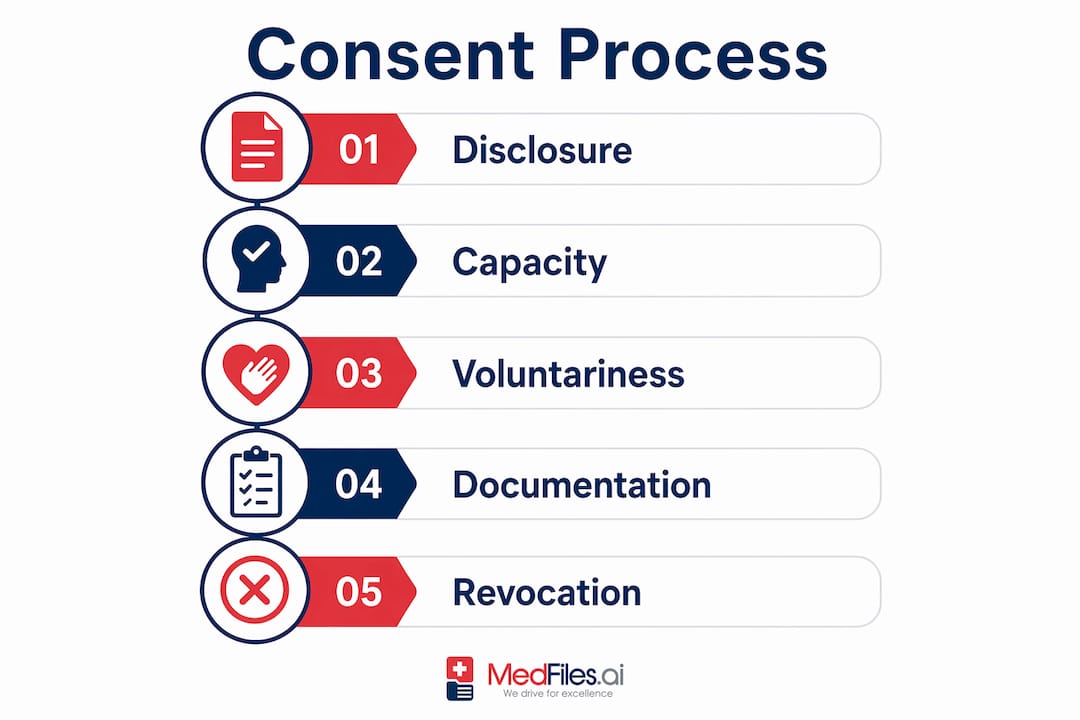
Informed consent is the process by which a patient receives clear information about a proposed use of their health data, understands it, and agrees voluntarily. It is not a single signature on a form. Informed consent is an ongoing communicative process, and patients may update or withdraw their agreement as circumstances change. That distinction changes how providers must operate every day.
Three principles anchor every valid consent: disclosure, capacity, and voluntariness. Disclosure means the provider explains the nature of the data use, the material risks, and the expected benefits. Capacity means the patient has the cognitive ability to understand and decide. Voluntariness means no pressure, coercion, or manipulation influenced the decision.

The “reasonable patient” standard governs whether disclosure was adequate. Under this standard, providers must share information that a reasonable patient would consider material to their decision. Nearly half of US states have adopted this standard, shifting the legal focus from what a provider typically discloses to what the patient actually needs to know. That shift places a higher communication burden on providers.
Express consent vs. implied consent
Express consent is explicit. The patient signs a form, clicks a digital agreement, or states their permission out loud. Implied consent is inferred from behavior, such as a patient extending their arm for a blood draw. Relying on implied consent for disclosures beyond standard treatment, payment, and operations creates real compliance risk. For anything outside routine care, express consent is the only safe choice.
Pro Tip: If you want to withdraw consent, do it in writing. A verbal request does not legally stop data sharing under HIPAA. Submit a written revocation directly to your provider’s privacy officer and keep a copy for your records.
How do HIPAA and 42 CFR Part 2 shape patient information consent?
HIPAA’s Privacy Rule sets the national floor for health information privacy. It defines when providers may use or disclose protected health information without asking for separate permission, and when they must obtain written authorization. HIPAA distinguishes between consent for treatment and authorization for other uses, such as marketing or the release of psychotherapy notes. Routine care falls under the first category. Everything else requires a signed authorization form.
One of HIPAA’s most practical rules is the access timeline. HIPAA-covered entities must provide patients access to their health records within 30 days of a written request. That 30-day window is a federally enforced right, not a courtesy. Providers who miss it face Office for Civil Rights complaints and potential fines.
42 CFR Part 2 goes further for one specific category of data. Providers cannot disclose substance use disorder records without explicit patient consent or a court order, even within integrated electronic health record systems. This rule applies separately from standard HIPAA permissions. A provider who shares SUD records under a routine HIPAA authorization is still in violation of 42 CFR Part 2.
| Regulation | Scope | Consent requirement |
|---|---|---|
| HIPAA Privacy Rule | All protected health information | Authorization required beyond treatment, payment, and operations |
| 42 CFR Part 2 | Substance use disorder records | Explicit, purpose-specific consent for every disclosure |
| HIPAA Access Rule | Patient record requests | Provider must respond within 30 days |
Pro Tip: If you are a caregiver managing records for a family member, confirm whether any records fall under 42 CFR Part 2. Those records need separate consent forms, even when sharing with other treating providers.
What are the challenges in managing health information consent today?
Managing consent across modern healthcare is genuinely hard. Patients interact with primary care doctors, specialists, labs, pharmacies, and insurers. Each relationship may carry different consent requirements. Overlapping federal and state laws create a patchwork that even experienced compliance officers find difficult to track consistently.
Manual consent processes make the problem worse. Paper forms get lost, scanned documents lack structured data, and staff often cannot verify whether a patient’s authorization covers a specific disclosure. The result is either over-sharing, which violates privacy, or under-sharing, which delays care.
Four emerging approaches are changing how healthcare organizations handle consent:
- Dynamic consent frameworks let patients update their preferences over time through digital portals, rather than signing a static form once. Transparency in data reuse is the foundation of these models. Patients who can see how their data is used are far more likely to trust the system.
- Computable consent translates consent terms into structured data fields inside electronic health records. Automated consent management reduces administrative burden and catches compliance gaps before they become violations.
- Data segmentation tags specific record types, such as SUD data or mental health notes, so the EHR system can apply the correct consent rules automatically at the point of disclosure.
- HL7 FHIR standards provide a common technical language for encoding consent parameters across different health IT systems, making cross-organization data sharing both faster and more auditable.
“Patients often misconceive consent as a one-time event rather than a continuing dialogue. The most effective consent frameworks treat it as a living agreement that evolves with the patient’s care needs and personal preferences.”
The role of transparency in therapy and other sensitive care settings shows why this matters beyond compliance. When patients understand how their data moves, they engage more honestly with their providers. That honesty improves clinical outcomes.
What practical steps should patients and providers take?
Patients and providers carry different but equally important responsibilities under healthcare consent guidelines. Getting both sides right prevents disputes, protects privacy, and keeps care moving.
For patients:
- Request a copy of your provider’s Notice of Privacy Practices at every new care relationship. This document explains exactly how your data will be used.
- Review any authorization form before signing. Confirm it specifies the recipient, the type of data, and an expiration date.
- Understand your right to share records selectively. You can authorize sharing with one specialist without authorizing sharing with all providers in a network.
- Submit consent revocations in writing. Written revocation is required for the withdrawal to be legally binding under HIPAA.
- Keep copies of every consent form you sign and every revocation you submit.
For providers:
- Obtain express written authorization for any disclosure outside treatment, payment, and operations.
- Document the date, scope, and recipient of every authorization in the patient’s record.
- Train staff to recognize when 42 CFR Part 2 applies and to handle those records separately from standard HIPAA workflows.
- Use plain language in all consent forms. Written consent forms must use lay language and assess patient understanding conversationally, not just through a signature.
- Respond to patient record requests within the 30-day HIPAA window without exception.
Pro Tip: Store your signed consent forms and revocations in a secure digital location you can access instantly. If a dispute arises, having timestamped copies of your authorizations is the fastest way to resolve it.
Understanding medical record security basics gives patients a stronger foundation for exercising these rights confidently.
Key Takeaways
Valid health information consent requires disclosure, patient capacity, and voluntariness, and it must be documented in writing to be legally enforceable under HIPAA and 42 CFR Part 2.
| Point | Details |
|---|---|
| Consent is a process, not a form | Patients can update or revoke consent at any time, but revocation must be in writing to be binding. |
| HIPAA sets a 30-day access rule | Providers must deliver patient records within 30 days of a written request, by federal law. |
| 42 CFR Part 2 adds extra protection | Substance use disorder records require separate, explicit consent beyond standard HIPAA authorization. |
| Express consent beats implied consent | For any disclosure outside routine care, a signed authorization is the only legally safe option. |
| Digital tools reduce compliance gaps | Computable consent and HL7 FHIR standards automate rule enforcement and reduce manual errors. |
Why consent deserves more attention than it gets
Most patients sign consent forms without reading them. Most providers hand them over without explaining them. That gap is where real harm happens, not through malice, but through habit.
What I find most striking is how rarely consent is treated as a conversation. The law already requires it to be one. The reasonable patient standard, the ongoing-process doctrine, the plain-language requirement for written forms: all of these point toward dialogue, not paperwork. Yet the default in most clinical settings is still a clipboard and a pen.
The technology is catching up faster than the culture. Computable consent and dynamic frameworks are genuinely promising. But they only work if the underlying consent conversation was honest in the first place. Automating a bad process just makes the bad process faster.
For patients, the most underused right is the ability to ask questions before signing. For providers, the most underused tool is a follow-up call to confirm understanding. Neither costs much. Both prevent significant problems down the line.
The future I am optimistic about is one where consent preferences travel with the patient across every care setting, updated in real time, visible to both parties, and enforced automatically. We are not there yet. But the standards, the frameworks, and the regulatory pressure are all pointing in that direction.
— Team
Medfiles makes secure health data sharing straightforward
Managing consent is only half the challenge. The other half is keeping your records organized, accessible, and protected so you can act on your rights when it matters most.
Medfiles gives patients and caregivers a secure place to store, organize, and share medical documents with full control over who sees what. The platform’s secure document sharing tools let you send records to providers with defined access, supporting the kind of consent-based sharing that HIPAA requires. End-to-end encryption and HIPAA-ready infrastructure mean your data stays protected at every step. Whether you are managing records for yourself, a child, or an aging parent, Medfiles keeps everything in one place and ready when you need it.
FAQ
What is the health consent definition under US law?
Health information consent is a patient’s voluntary, informed authorization for a provider to use or disclose their medical data. Under HIPAA, authorization is required for any use beyond treatment, payment, and standard healthcare operations.
How does HIPAA protect patient information consent?
HIPAA requires providers to obtain written authorization before disclosing health information for purposes outside routine care. Patients also have the right to access their records within 30 days of a written request.
What makes informed consent in healthcare valid?
Valid informed consent requires three elements: disclosure of material risks and benefits, patient capacity to understand and decide, and voluntariness free from coercion. A signature alone does not make consent valid if these conditions are not met.
Can a patient revoke consent for medical records?
Yes. Patients can revoke consent at any time, but the revocation must be submitted in writing to be legally binding under HIPAA. A verbal request does not stop data sharing.
What is 42 CFR Part 2 and how does it differ from HIPAA?
42 CFR Part 2 applies specifically to substance use disorder treatment records and requires explicit, purpose-specific consent for every disclosure. This is a higher standard than standard HIPAA authorization, which covers broader categories of health information.