Medical Document Types Explained for Patients and Families
Explore medical document types explained to help you control your healthcare. Understand key records to ask better questions and avoid errors.

Medical Document Types Explained for Patients and Families
Medical documents are the official written records that capture every clinical encounter, test result, and treatment decision in your healthcare history. Understanding the main types of medical documents gives you real control over your health, not just a folder of confusing paperwork. Whether you are managing care for a child, an aging parent, or yourself, knowing what each record contains helps you ask better questions and catch errors before they cause harm. This medical document types explained guide covers the core categories, what they include, how long to keep them, and how to organize them at home.
What are the main types of medical documents?
Medical document types fall into five primary categories, each serving a distinct clinical function. Knowing the difference between them helps you understand what your provider is telling you and what you should keep on file.
| Document Type | Primary Purpose | Common Examples |
|---|---|---|
| Clinical notes | Record the clinical encounter | SOAP notes, progress notes |
| Lab reports | Report body chemistry results | Blood panels, urinalysis |
| Radiology reports | Interpret imaging studies | X-ray, MRI, CT scan reports |
| Consultation notes | Capture specialist assessments | Cardiology, orthopedic letters |
| Discharge summaries | Summarize inpatient care | Hospital stay summaries |

Clinical notes and the SOAP format
Clinical notes are the most common document type you will encounter at any outpatient visit. The SOAP note format has been the standard in outpatient documentation since the 1960s. SOAP stands for Subjective (what you report), Objective (what the clinician measures), Assessment (the diagnosis), and Plan (the treatment steps). This structure keeps communication clear and creates a defensible record for billing and quality review.
Lab reports and how to read them
Lab reports document the results of blood, urine, or tissue tests against a reference range. Values flagged H for high or L for low are the ones to bring up with your doctor first. A normal cholesterol panel, for example, will show each value alongside the lab’s reference range so you can see exactly where you fall. Focus your questions on flagged values rather than trying to interpret every number yourself.
Radiology reports and the impressions section
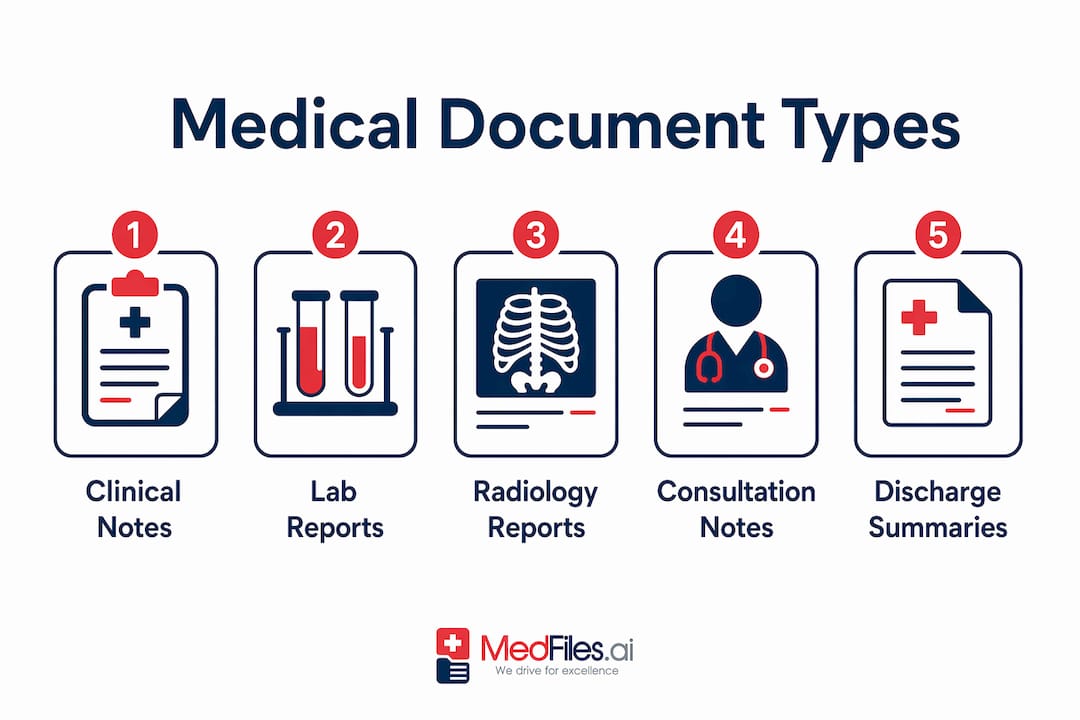
Radiology reports interpret imaging studies such as X-rays, MRIs, and CT scans. The most important section is labeled “Impressions,” which is where the radiologist states their clinical conclusion. The body of the report describes what was seen in technical detail, but the Impressions section is written for the ordering physician and is the part most relevant to your care decisions.
Consultation notes and discharge summaries
Consultation notes are specialist expert opinions. A cardiologist’s consultation note, for instance, will detail their assessment and a treatment plan that may affect your medications for years. Discharge summaries are the documents hospitals generate when you leave inpatient care. They capture your diagnosis, procedures performed, medications prescribed, and follow-up instructions, making them critical for any provider who sees you next.
Pro Tip: Ask your provider’s office for a copy of your consultation note after every specialist visit. Most practices are required to share it, and it often contains details your primary care doctor may not have received yet.
How do medical document types support clinical care?
Medical records collectively represent your personal health story, with each document type adding a chapter that informs the next clinical decision. Lab data from a primary care visit, for example, can directly shape what a specialist writes in their consultation note. Without that chain of documents, providers risk repeating tests, missing diagnoses, or prescribing conflicting treatments.
Clinical documentation improvement (CDI) is the formal practice of ensuring records are accurate, specific, and complete. CDI matters not just for billing but for quality outcomes. A vague note that says “infection” instead of “methicillin-resistant Staphylococcus aureus infection” can affect the care you receive and how your case is reported for quality metrics.
“Proper organization of medical records prevents care gaps and reduces redundant testing, emphasizing the value of accessible, continuous documentation.” — Document Management in Medical Consultations
Each document type serves a specific function in the larger clinical picture:
- Lab reports provide objective data that confirms or rules out a diagnosis.
- Radiology reports add visual evidence that lab values alone cannot supply.
- SOAP notes create a structured record of every clinical decision and its rationale.
- Consultation notes bring specialist expertise into the primary care record.
- Discharge summaries hand off the full inpatient story to outpatient providers.
When these documents are complete and accessible, your care team can make faster, safer decisions. When they are missing or scattered, the gaps show up as repeated blood draws, conflicting prescriptions, or delayed diagnoses.
What are best practices for organizing and retaining medical documents?
Effective document management means organizing clinical information so it is both secure and easy to retrieve. The first step is knowing how long each type of record must be kept.
| Document Category | Minimum Retention Period | Governing Standard |
|---|---|---|
| Adult medical records | 6 years | HIPAA |
| Lab reports | 2 years | CLIA |
| Billing and insurance | 7 years | IRS guidance |
| Minor patient records | Until age of majority plus 6 years | State law varies |
Retention periods vary by record type: 6 years for adult medical records, 2 years for lab reports, and 7 years for billing documents. Keeping records longer than the minimum is rarely a problem and often a good idea, especially for chronic conditions.
Why searchable formats matter
Many clinical documents, including intake forms and referral packets, are stored as image-only PDFs that cannot be searched or analyzed. This creates real problems when you need to find a specific result quickly or share records with a new provider. Converting your records into text-searchable formats makes retrieval faster and allows AI-powered tools to analyze them accurately.
How to build a home filing system
A practical home filing system groups records by category and date. Create separate folders or digital albums for lab reports, imaging reports, clinical notes, and insurance documents. Label each file with the date and the provider’s name so you can find it without opening every document. For families managing multiple people’s records, a platform with multi-profile support keeps everything separated and secure.
Pro Tip: Scan paper records with a mobile scanning app like Adobe Scan or Apple Notes, then save them as searchable PDFs. Store the digital copies in an encrypted, cloud-based system so they are accessible from any device during an emergency or a trip.
Sharing records safely is equally important. When sending documents to a new provider or a family member, use encrypted channels rather than standard email. A HIPAA-ready sharing platform protects your information in transit and gives you a record of who accessed what and when. You can learn more about organizing records for family access to set up a system that works for everyone in your household.
What documents can patients expect in common clinical scenarios?
Different care settings generate different documents. Knowing what to expect helps you track what you should have on file after each encounter.
- Primary care visit: You typically receive or generate an intake form, a SOAP note, and any lab orders or results from that visit.
- Specialist consultation: The specialist produces a consultation note summarizing their findings and plan, plus any imaging or procedure orders.
- Hospital stay: Inpatient care generates progress notes (written daily by the care team), consent forms, procedure reports, and a discharge summary at the end.
- Lab testing: Each test produces a lab report with your results, reference ranges, and flagged values.
- Diagnostic imaging: An MRI or CT scan produces both the raw images and a written radiology report with the radiologist’s interpretation.
- Referral process: Your primary care provider generates a referral letter, and the receiving specialist sends back a consultation note after the visit.
Understanding this sequence helps you notice when a document is missing. If you had an MRI three weeks ago and have not received the radiology report, that is a gap worth following up on. Keeping a running list of expected documents after each encounter is one of the most practical habits you can build as a patient.
Key takeaways
Understanding medical document types is the foundation of effective personal health management, because each record type serves a distinct clinical purpose and requires a specific retention and storage approach.
| Point | Details |
|---|---|
| Five core document types | Lab reports, clinical notes, radiology reports, consultation notes, and discharge summaries each serve a distinct role. |
| SOAP notes are the standard | The SOAP format has structured outpatient clinical documentation since the 1960s. |
| Retention periods differ | Keep adult records for 6 years, lab reports for 2 years, and billing documents for 7 years. |
| Searchable formats matter | Image-only PDFs cannot be analyzed or searched; convert records to text-searchable formats. |
| Complete records prevent gaps | Accessible, organized documentation reduces redundant testing and supports safer care decisions. |
Why knowing your records changes everything
Most patients I have worked with over the years treat medical documents as something to file away and forget. That instinct is understandable. The paperwork is dense, the terminology is unfamiliar, and it feels like the provider’s job to manage it. But that thinking creates a real vulnerability.
The patients who get the best care are the ones who show up to appointments with their records organized and their questions ready. They catch the lab result that was never followed up on. They notice when a new specialist’s plan contradicts what the previous one recommended. They are not playing doctor. They are playing an active role in their own care, which is exactly what providers want from them.
The single most useful habit I have seen is keeping a running document list after every encounter. Write down what was ordered, what was discussed, and what you expect to receive. Then follow up if it does not arrive. That simple practice closes more care gaps than any technology alone.
Asking your provider “Can I have a copy of today’s note?” is not rude or unusual. It is your legal right under HIPAA, and most providers respect patients who ask. The more you understand about what is in your records, the better you can communicate what has changed, what has worked, and what has not. That communication is what drives better outcomes.
— Team
Your medical records, organized and secure with Medfiles
Managing multiple document types across different providers and family members gets complicated fast. Medfiles is built specifically for this problem.
With Medfiles, you can store lab reports, radiology results, consultation notes, and discharge summaries in one encrypted, HIPAA-ready platform. Documents are automatically organized and converted into searchable formats, so you can find any record in seconds. The secure sharing feature lets you send records directly to providers or family members without using standard email. Multi-profile support means you can manage records for your entire family, including children and aging parents, from a single account. Visit Medfiles to set up your medical document storage and keep your health history accessible wherever you are.
FAQ
What are the main types of medical documents?
The five main types are clinical notes, lab reports, radiology reports, consultation notes, and discharge summaries. Each serves a distinct function in documenting your health history and care decisions.
How long should I keep my medical records at home?
Adult medical records should be kept for at least 6 years under HIPAA, lab reports for 2 years under CLIA, and billing documents for 7 years per IRS guidance. Keeping records longer is generally safe and often advisable for chronic conditions.
What is a SOAP note and why does it matter?
A SOAP note is the standard clinical documentation format used in outpatient settings since the 1960s. It organizes each visit into Subjective, Objective, Assessment, and Plan sections to support clear communication and accurate billing.
Why can’t I just scan my records as image PDFs?
Image-only PDFs are not searchable and cannot be analyzed by AI tools or electronic health record systems. Converting records to text-searchable formats makes them easier to retrieve and share accurately with providers.
What documents should I request after a hospital stay?
Request your discharge summary, any procedure reports, and the medication list provided at discharge. These documents contain the information your outpatient providers need to continue your care safely.