Medical Record Security Basics: What You Need to Know
Discover essential medical record security basics to protect your health information. Learn about safeguards and legal obligations today!

Medical Record Security Basics: What You Need to Know
Most people assume that once a doctor’s office goes digital, their health information is automatically safe. That assumption is wrong, and it’s costly. Medical record security basics cover far more than firewalls and passwords. They span legal obligations, organizational policies, physical controls, and technology working together. Whether you’re a patient trying to understand your rights, a family managing records for loved ones, or a healthcare professional responsible for protecting data, this guide gives you the clear, grounded foundation you need.
Table of Contents
- Key takeaways
- Medical record security basics: the legal foundation
- Administrative safeguards: policies, training, and risk management
- Physical safeguards: protecting records you can see and touch
- Technical safeguards: controlling and monitoring digital access
- Emerging challenges: ransomware, AI, and vendor risk
- My take on why compliance alone is not enough
- Take control of your medical records with Medfiles
- FAQ
Key takeaways
| Point | Details |
|---|---|
| Three safeguard types matter | Administrative, physical, and technical safeguards together form the complete security framework for medical records. |
| HIPAA governs electronic records | The HIPAA Security Rule applies specifically to electronic protected health information, not paper or verbal records. |
| Risk analysis is required by law | Covered entities must conduct thorough, ongoing risk assessments under 45 CFR §164.308, not just one-time reviews. |
| Ransomware is a patient safety issue | Cyberattacks on health systems can delay diagnoses and cause medication errors, making cybersecurity a care quality concern. |
| Vendors need formal agreements | Any third party handling your health data must sign a business associate agreement defining permitted access and data use. |
Medical record security basics: the legal foundation
The starting point for any real understanding of health data protection is the HIPAA Security Rule. Most people have heard of HIPAA, but few realize there are actually two distinct rules working in parallel. The Privacy Rule covers all forms of protected health information, including paper and verbal communication. The Security Rule is narrower and more technical. It focuses exclusively on electronic protected health information, what the law calls ePHI.
The HIPAA Security Rule applies to electronic PHI maintained or transmitted electronically, not paper or verbal PHI. That distinction matters. A sticky note with a patient’s name left on a desk is a Privacy Rule concern. An unencrypted email containing lab results is a Security Rule concern. Both are violations, but they are handled differently.
Who must comply? The rule applies to two main groups:
- Covered entities: Hospitals, clinics, physicians, pharmacies, health insurers, and health plan administrators that handle patient information.
- Business associates: Any vendor or contractor that creates, receives, maintains, or transmits ePHI on behalf of a covered entity. This includes billing companies, IT service providers, cloud storage platforms, and increasingly, AI software vendors.
The HIPAA Security Rule is intentionally flexible and technology-neutral, requiring entities to implement safeguards appropriate to their size and risk profile rather than mandating specific technologies. A solo family practice and a 500-bed hospital share the same legal obligations in principle, but the scale and complexity of their required safeguards differ significantly. That flexibility is a feature, not a loophole.
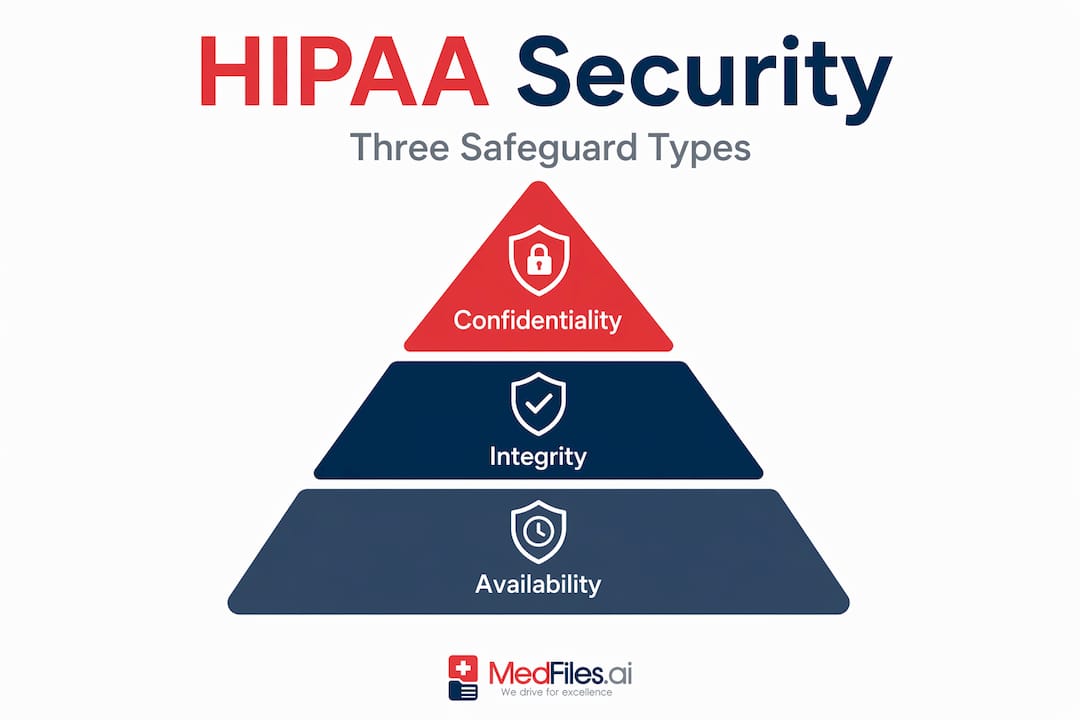
The core obligation is to protect the confidentiality, integrity, and availability of all ePHI you create, receive, maintain, or transmit. Those three properties are not interchangeable. Confidentiality means only authorized people see the data. Integrity means the data has not been altered without authorization. Availability means authorized users can access records when they need them.
Administrative safeguards: policies, training, and risk management
Administrative safeguards are the policies and procedures that govern how an organization manages health data protection. They are often overlooked because they are not as visible as a locked server room or encrypted database. But they are arguably the most important layer.
Here are the core administrative safeguard requirements under HIPAA, in the order organizations typically implement them:
- Conduct a security risk analysis. Evaluating risks to ePHI is a legal requirement under 45 CFR §164.308. This is not a checklist you complete once. It is an ongoing process of identifying threats, assessing their likelihood and impact, and documenting your findings. Effective risk analysis involves data lifecycle mapping to understand exactly how ePHI flows through your systems.
- Implement a risk management plan. After identifying vulnerabilities, you must take action to reduce them to a reasonable and appropriate level. Document every decision, including risks you choose to accept and why.
- Establish workforce training programs. Every employee who touches ePHI needs training on medical privacy guidelines and security expectations. This includes front desk staff, nurses, billing personnel, and contracted workers.
- Control workforce access. Authorize each person’s access based on their role. A billing coordinator should not have access to clinical notes. Role-based access limits exposure when credentials are compromised.
- Develop an incident response plan. When a breach happens, you need a documented plan. Healthcare providers must notify patients promptly about breaches that may have compromised their protected health information. A response plan shortens the window between discovery and notification.
- Review and evaluate regularly. HIPAA requires ongoing evaluation of security measures and system activity monitoring. Your policies should be reviewed any time there is a significant operational or environmental change.
Pro Tip: Most organizations fail their risk analysis not because they skip it, but because they treat it as a one-time audit. A true risk analysis is a living document. Update it after every major system change, vendor addition, or reported incident.
Physical safeguards: protecting records you can see and touch
Physical safeguards address the tangible, real-world controls that protect ePHI from unauthorized access, theft, or destruction. They are easy to underestimate in an era of cloud computing, but physical vulnerabilities remain a significant source of breaches.

Physical safeguards include limiting facility access, securing workstations, controlling device and media movement, and ensuring secure disposal of sensitive information-containing media. The following table breaks down common physical safeguards alongside the specific risks they address.
| Physical safeguard | Risk addressed |
|---|---|
| Badge-controlled facility entry | Prevents unauthorized individuals from accessing areas where ePHI is stored or displayed |
| Visitor sign-in and escort policies | Reduces the risk of visitors observing screens or removing physical records |
| Screen privacy filters on workstations | Blocks shoulder-surfing in waiting rooms, shared offices, or open clinical areas |
| Locked storage for physical records and devices | Protects against theft of hardware containing ePHI |
| Secure shredding for paper records | Prevents recovery of sensitive data from discarded documents |
| Certified media destruction for drives | Removes residual ePHI from retired computers, USB drives, and imaging equipment |
| Device tracking and inventory systems | Enables rapid identification of lost or stolen devices before data is accessed |
One real-world example: a laptop containing unencrypted patient records left in a car gets stolen. That single physical lapse can trigger a federal breach notification, patient harm, and significant regulatory penalties. The data was encrypted at rest in one case but the device screen was unlocked when taken. Physical controls and technical controls must work together.
Pro Tip: When retiring old hardware, do not assume a factory reset deletes sensitive data. Use certified data destruction services or physical destruction for any device that ever stored ePHI. Hard drive recovery tools can retrieve data from “wiped” drives with startling reliability.
Technical safeguards: controlling and monitoring digital access
Technical safeguards are the technology-based measures that protect ePHI against unauthorized access, modification, and transmission. They are what most people picture when they think about electronic health record security. But there is more to them than encryption.
Under the HIPAA Security Rule, technical safeguards must address four core areas:
- Access controls. Every user who accesses ePHI must have a unique identifier. Shared logins are not compliant and make audit trails meaningless. Emergency access procedures must also exist so that authorized staff can reach critical records when normal authentication fails.
- Audit controls. Systems must record and examine activity. Audit logs and documentation prove not only that technical capabilities exist but that they are actively used to detect and respond to incidents. Logs sitting unread on a server do not satisfy this requirement.
- Authentication protocols. Beyond a username and password, authentication means verifying that the person requesting access is actually who they claim to be. Multi-factor authentication, security questions, and biometric verification all qualify.
- Transmission security. Any ePHI sent across a network, whether by email, app, or API, must be protected in transit. This is where encryption becomes critical. While HIPAA does not mandate encryption by name, the risk analysis process almost always leads organizations to adopt it as the most reasonable safeguard.
Hacking and IT incidents dominate breach types in healthcare, emphasizing why technical safeguards must go beyond the basics. For healthcare professionals, this means working with your IT department to verify that every system in your workflow, including third-party apps, patient portals, and scheduling software, meets these requirements. For patients, it means asking your providers what happens to data shared through online portals or telehealth platforms. You have the right to know.
If you want to understand how to verify these safeguards in your own healthcare settings, the patient data security guide from the admissions side of healthcare offers a complementary perspective on access controls and HIPAA compliance in practice.
Emerging challenges: ransomware, AI, and vendor risk
Medical record security cannot stay static. The threat environment shifts constantly, and three areas demand particular attention right now.
Ransomware is a clinical problem, not just an IT problem. Ransomware attacks can disrupt access to electronic health records, causing diagnostic delays, medication errors, and workflow interruptions. Viewing cybersecurity purely as a compliance burden misses the point. Treating cybersecurity as patient safety infrastructure is crucial not only for compliance but for preventing real harm to real patients.
AI systems create new ePHI exposure. As healthcare organizations adopt AI platforms for diagnostics, scheduling, and documentation, those systems often receive and store ePHI. Contracts with vendors managing ePHI must include explicit business associate agreements defining permitted access and data use. Many organizations assume that enterprise-grade AI tools handle HIPAA compliance automatically. They do not.
Vendor management requires active governance. Assuming third-party providers manage HIPAA obligations automatically is a common and risky mistake. Every vendor touching your ePHI needs a signed business associate agreement, clear data flow documentation, and periodic security reviews.
Here is a practical checklist to keep your organization on track:
- Map every system that touches ePHI, including cloud tools and mobile apps.
- Verify that all vendors have signed and current business associate agreements.
- Review AI platform contracts specifically for data ownership, retention, and access clauses.
- Run tabletop ransomware response exercises at least once per year.
- Subscribe to HHS breach notification updates to track current threat trends.
- Integrate security reviews into vendor contract renewals, not just onboarding.
Pro Tip: Many security failures in AI-based health systems trace back to contractual gaps around data governance. Before signing any healthcare technology contract, ask the vendor directly: “Where does our ePHI go, who can access it, and what happens to it when we terminate the contract?” If they cannot answer clearly, that is your answer.
My take on why compliance alone is not enough
I’ve worked with enough healthcare organizations to recognize a pattern that never stops being frustrating. They invest in the right technologies. They complete the right documentation. Then they treat the security program as finished. That is where things go wrong.
The organizations with genuinely secure patient records are the ones that treat security as an ongoing culture, not a project with a completion date. I’ve seen small clinics with modest budgets maintain stronger confidentiality in healthcare than large systems with enterprise security tools. The difference is almost always human. Are staff actually following access policies? Are audit logs being reviewed, or just collected? Does anyone own incident response, or is it theoretically everyone’s job?
What I’ve learned is that administrative, physical, and technical safeguards are inseparable. You cannot patch a gap in one with excellence in another. An airtight access control system means nothing when a visitor can walk unescorted to a workstation with an unlocked screen. Understanding all types of medical records you’re responsible for protecting is the first step toward building a security program that actually holds.
For individuals and families, the same principle applies. Know what data you are sharing, with whom, and through what platform. Ask questions. Read privacy notices. If a provider cannot explain how your records are stored and shared, treat that as a red flag.
— Team
Take control of your medical records with Medfiles
Understanding the theory behind medical record security is one thing. Putting it into practice for your personal or family health records is another.

Medfiles is built on HIPAA-ready infrastructure with end-to-end encryption, giving you the security foundation that matches everything covered in this guide. You can store test results, prescriptions, imaging reports, and clinical documents in one place, organized automatically and accessible the moment you need them. Secure sharing lets you send records directly to providers without relying on fax machines or paper printouts. For healthcare professionals looking to help patients manage their own records securely, Medfiles for Doctors offers the tools that align with the best practices for record security covered here. Explore plans and pricing and see how simple securing your health data can be.
FAQ
What is the HIPAA Security Rule?
The HIPAA Security Rule is a federal regulation requiring covered entities and their business associates to implement administrative, physical, and technical safeguards to protect electronic protected health information. It applies specifically to ePHI, not paper or verbal records.
What are the three types of safeguards under HIPAA?
HIPAA requires administrative safeguards (policies, training, risk management), physical safeguards (facility access, workstation controls, media disposal), and technical safeguards (access controls, audit logs, encryption, transmission security). All three must work together to meet compliance.
How do I know if my healthcare provider is following medical privacy guidelines?
You can ask your provider for a copy of their Notice of Privacy Practices, which outlines how they use and protect your health information. Providers are required to offer this document and notify you of any breaches affecting your records.
Why is ransomware a concern for patient safety, not just data security?
Ransomware attacks can lock healthcare staff out of electronic health records, causing delays in diagnoses, incorrect medication decisions, and disrupted care workflows. This makes cybersecurity a direct patient safety issue, not just an IT or compliance problem.
Do vendors and AI platforms need to follow HIPAA if they handle my health data?
Yes. Any vendor or AI platform that receives, stores, or processes ePHI on behalf of a covered entity must sign a business associate agreement and comply with the HIPAA Security Rule. Assuming they manage this automatically is a common and serious mistake.