Top 3 Medidocs.cloud Medical Record Management Alternatives 2026
Discover 3 medidocs.cloud alternatives for managing personal health records. Compare features to find the best medical record management solution.
Top 3 Medidocs.cloud Medical Record Management Alternatives 2026
Managing medical records across devices and providers is often slowed by clunky portals, manual uploads, and missing privacy controls for dependents or caregivers. Many existing solutions either restrict multi-profile support to expensive tiers or require separate logins for each patient, while provider integrations and plain-language summaries are often absent. This comparison reviews pricing, profile management, AI features, and integration options across leading medical record management platforms so you can choose the right fit for your family or practice without sacrificing compliance.
Table of Contents
MedFiles
At a Glance
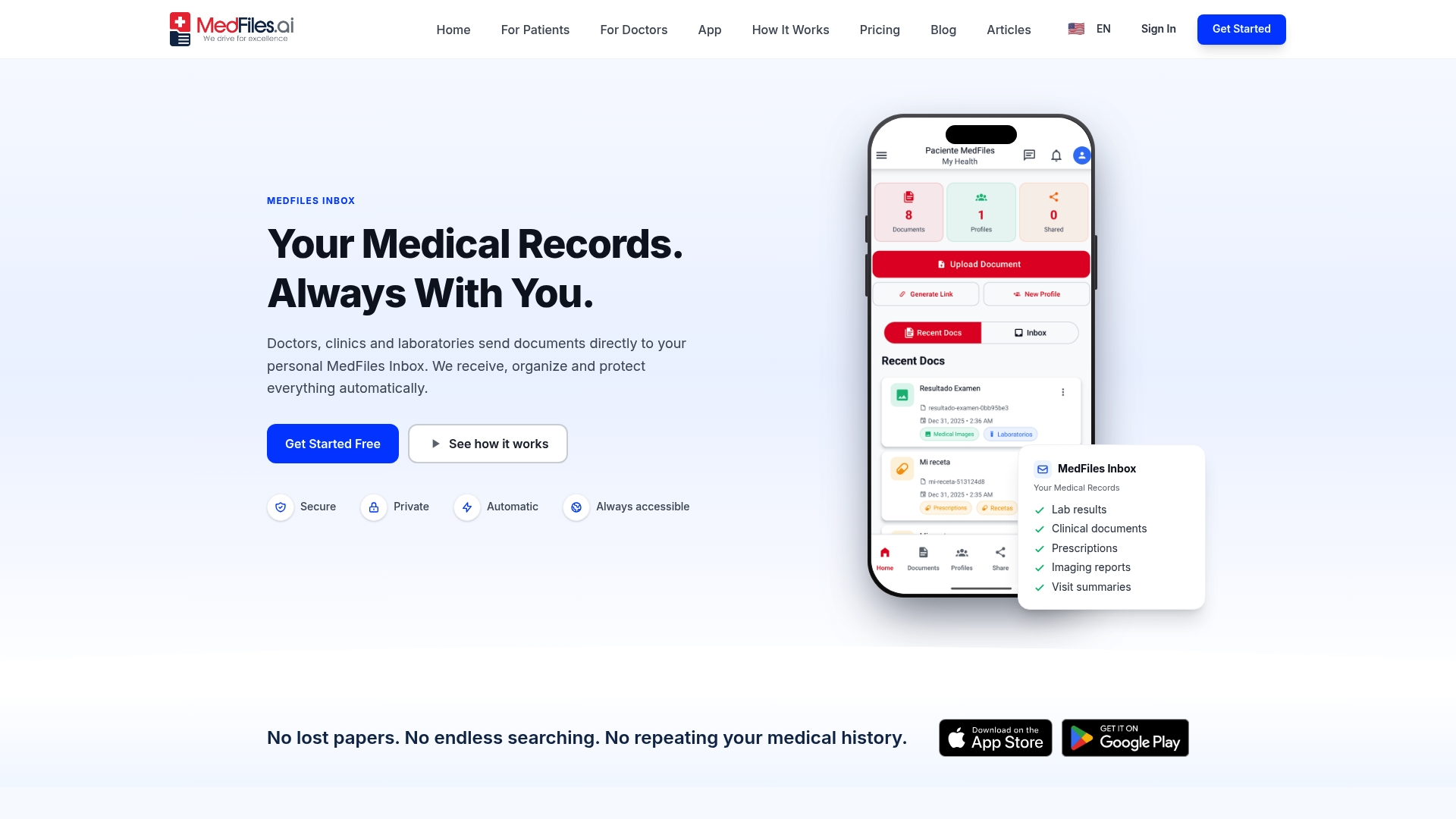
Paid plans start at $2.49/month for individuals with family tiers from $4.99/month, plus annual discounts for larger profiles. The vendor states it complies with HIPAA and GDPR standards, positioning privacy and regulated handling of health data as a selling point.
Core Features
MedFiles stores test results, prescriptions, reports, and images in secure cloud storage and automatically organizes uploaded documents into readable categories.
- Automatic organization reduces manual filing by tagging and grouping records as they arrive.
- Role-based access lets you grant clinicians or family members scoped permissions to specific profiles or documents.
- AI-powered analysis generates summaries and answers questions about your records via natural language queries.
- Family profile management supports multiple dependents and pet records under one account.
Key Differentiator
MedFiles pairs its automatic classification with AI-powered insights while enforcing role-based privacy rules. That trio means the app not only files documents for you but also highlights relevant findings and enforces who sees which summary or raw report.
Pros
-
Fast setup and low friction. The mobile and web apps let you upload records from a phone in under two minutes, which matters if you are collecting documents across providers.
-
Better appointment prep. The AI summaries turn stacks of lab reports into short, plain language briefs you can share with clinicians before visits.
-
Family and multi-profile support is practical. Managing an elderly parent and kids in one account keeps emergency info accessible without juggling logins.
-
Privacy controls match patient scenarios. Role-based permissions mean you can give a caregiver view-only access while keeping other records private.
-
Tiered pricing fits different needs. The free plan covers light use and the paid tiers add storage, extra profiles, and advanced AI queries.
Cons
- Limited visibility on integrations with hospital portals and EHR systems is a real limitation for users who want automatic pulls from provider records instead of manual uploads.
Who It’s For
Individuals and caregivers who want a private, readable record of medical history without complex IT. Parents managing pediatric care and adults supporting elderly relatives will find the family profiles and share controls especially useful.
Unique Value Proposition
The AI query feature lets you ask plain-language questions about uploads and get concise summaries. For people who need quick clarity from long reports, that turns a folder of PDFs into actionable information before an appointment.
Real World Use Case
A user scans a recent blood panel into MedFiles, asks the app what changed since the previous test, and receives a short summary highlighting three altered values. They forward that summary to their primary care doctor ahead of the visit, saving time in the clinic.
Pricing
Free plan with limited storage and basic sharing. Paid plans start at $2.49/month for individuals, $4.99/month for families, and $9.99/month for larger family plans. Annual billing offers discounts and add-on storage or extra profiles are available.
Website: https://medfiles.ai
MediDoc Pro
At a Glance
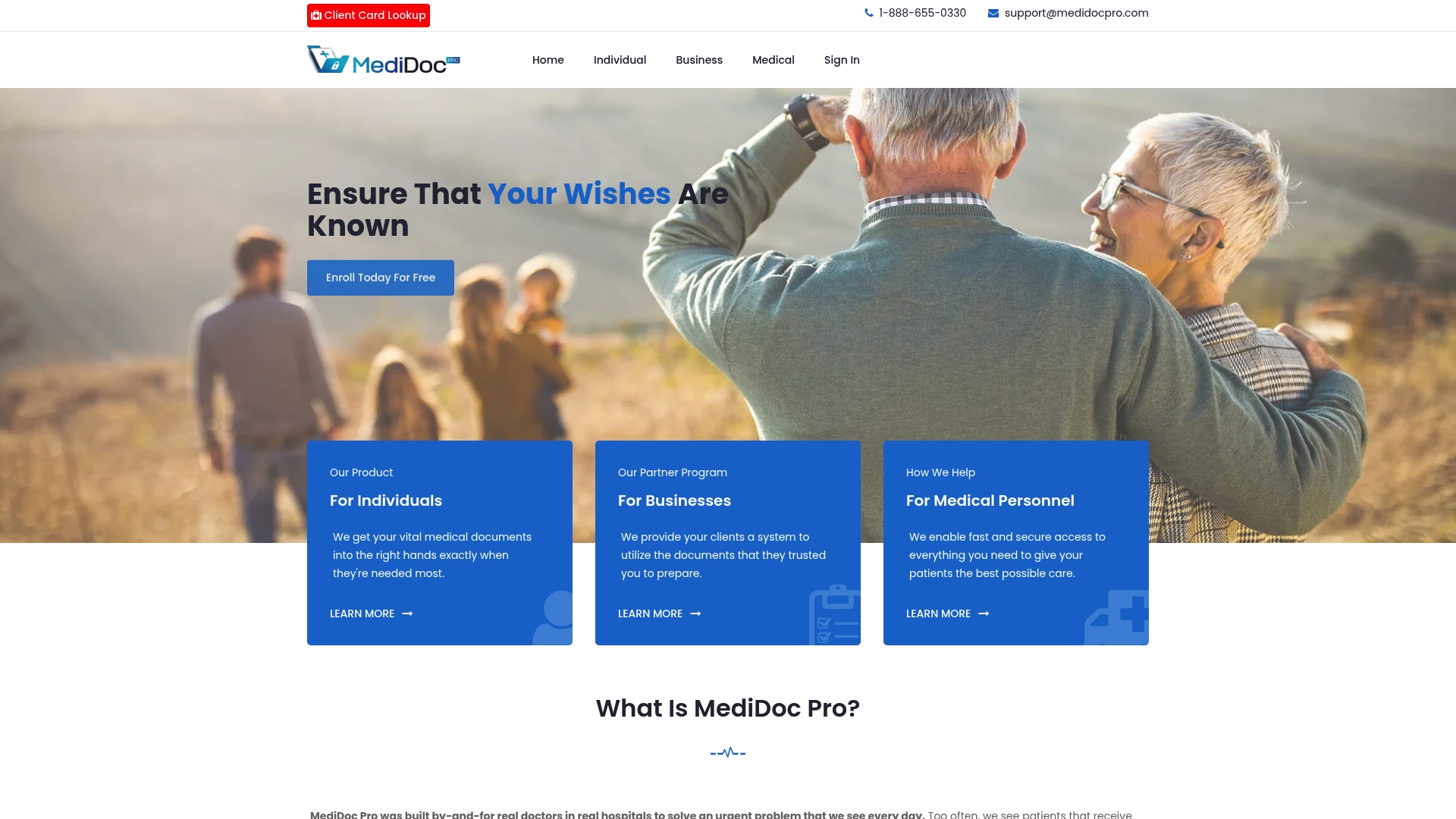
MediDoc Pro issues a wallet ID card and QR-based access designed so verified clinicians can pull a patient’s directives instantly at the bedside. The vendor advertises HIPAA compliance and advanced encryption as part of its security posture.
The product targets patients, clinicians, and organizations that need legal directives available during emergencies. It pairs cloud access with hospital-system integrations to place records where care is delivered.
Core Features
- Wallet ID card and scannable QR code for instant retrieval by providers.
- Secure cloud storage for medical directives, scans, and legal documents.
- HIPAA compliance and audit trails, as the vendor describes them, for record access transparency.
- Proprietary authentication system plus encryption to protect documents at rest and in transit.
- Integrations with hospital systems and EHRs to reduce manual lookups.
Key Differentiator
MediDoc Pro positions itself as a clinician-built solution and reports hospital partnerships that push patient directives directly into point-of-care workflows. That doctor-first design and integration focus aims to reduce the moments lost to searching for consent forms or code status in an emergency.
Pros
- Built from hospital experience. The team’s clinical background shows in features aimed at true time-sensitive needs rather than generic file lockers.
- Rapid, bedside retrieval. The wallet card and QR access cut the wait time for locating directives in critical moments.
- The compliance claim above gives organizations a clear audit trail for who accessed a document and when, which helps with medico-legal recordkeeping.
- EHR integrations reduce duplicate data entry and let providers see directives inside familiar workflows instead of switching apps.
- Cloud accessibility means patients and authorized proxies can update documents from anywhere and keep records current.
Cons
- Independent reviews cited by the vendor mention usability hiccups and technical glitches; specifics are not included in the scraped content.
- The scraped content lists conflicting details about pricing and public cost transparency, which complicates procurement conversations.
- Integration in complex hospital IT environments can require engineering support and project time, increasing implementation effort.
- The vendor provides limited public detail on customer support responsiveness and policy for non-hospital entities.
When It May Not Fit
If your organization needs an out-of-the-box solution with turnkey EHR adapters, be prepared for custom work. Smaller clinics without IT resources may find integrations and initial setup heavier than a simple cloud folder.
Also avoid it if you require on-premise-only solutions; the product is cloud oriented and the content flags potential integration complexity in some hospital systems.
Who It’s For
Patients who want secure, always-available access to advance directives and medical legal documents. Clinicians who need fast, verifiable access to treatment preferences at the point of care. Employers or practices seeking a clinician-oriented document solution for employees or clients.
Real World Use Case
A patient carries the MediDoc Pro wallet card. After a fall, an emergency clinician scans the card and opens the patient’s do-not-resuscitate order and medication list within seconds. Treatment aligns with documented wishes while the team avoids time lost hunting for paper forms.
Website: https://medidocpro.com
mdhub
At a Glance
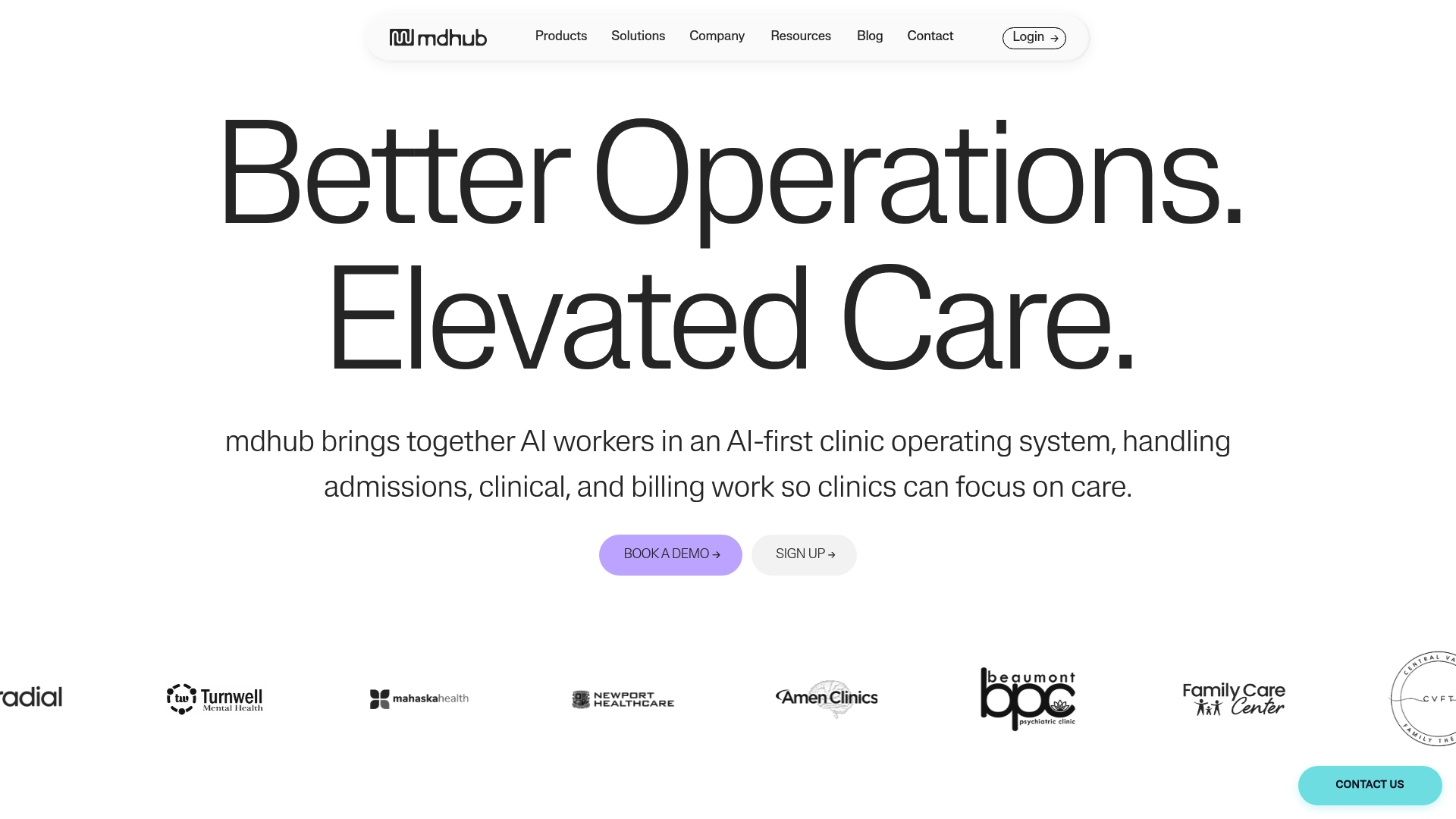
Specialized AI workers named Sarah, Emma, and Eric handle admissions, clinical notes, and billing workflows respectively, moving routine tasks off clinicians’ plates. The vendor states the platform runs on a HIPAA-compliant, SOC 2-certified infrastructure and supports multiple languages.
Core Features
- AI-powered operating system tailored to behavioral health clinics, with role-specific automation for admin and clinical work.
- End-to-end workflow orchestration covering scheduling, intake, documentation, and billing.
- Specialized AI workers for admissions, clinical documentation, and claims processing.
- Multi-language support including Spanish, French, and Mandarin to serve diverse patient populations.
- Customizable workflows and templates for clinic-specific policies and note formats.
Key Differentiator
mdhub centers on specialized AI workers that operate inside clinical workflows rather than a generic assistant sitting at the edge. The vendor claims high clinical accuracy with structured, compliant notes, which it pairs with billing automation to reduce manual handoffs and reconciliation. That combination targets behavioral health administrative overhead specifically.
Pros
- Staff time saved. The AI workers automate intake, note generation, and initial billing steps, freeing clinicians for patient care rather than paperwork.
- Better documentation consistency. Structured note templates reduce variation between clinicians and speed chart completion.
- Flexible templates and workflow customization let clinics adapt the system to their forms and regulatory needs without heavy engineering.
- According to the company, customers report measurable efficiency improvements and faster patient throughput after deployment.
- Security posture fits healthcare. The stated HIPAA and SOC 2 claims make the platform easier to justify to compliance teams.
Cons
- Public limitations are thin. The vendor did not list explicit buyer scenarios where the product is unsuitable, which makes fit harder to judge from marketing materials alone.
- Enterprise pricing requires a sales conversation. The tiered public pricing covers clinicians only; larger organizations should budget for negotiation and possible customization fees.
- Some deeper integrations or custom workflows may need professional services. Expect setup time and configuration for clinics with complex EHR connections or legacy processes.
Who It’s For
Behavioral health clinics and mental health practitioners looking to reduce administrative overhead while keeping documentation compliant. Small to mid-size group practices will see the clearest operational gains during intake and billing peaks.
Real World Use Case
A community clinic routes new patient intake through mdhub’s AI admissions worker. Intake fields populate the chart, the clinical worker drafts a structured note, and the billing worker prepares claims. The clinic reports faster check-ins and fewer billing edits after go-live.
Pricing
Public tiers start at Lite for $50/month per clinician and Pro at $119/month per clinician. Enterprise pricing requires contacting sales for custom quotes and volume discounts.
Website: https://mdhub.ai
**Competitor eligibility:** - Excluded products (discontinued / inaccessible / under construction): None - Usable competitors remaining: MediDoc Pro, mdhubIntro pre-write:
- Does medfiles.ai clearly outpace every usable competitor on a single dimension? No
- If NO: best tradeoff dimension for the primary reader — nuanced integration ease + limited automatic provider connections
- First sentence draft: With three platforms available, it is crucial to align their diverse offerings to specific medical record management needs.
Competitor win pre-write:
- Which competitor wins which dimension: mdhub wins administration automation because it offers specialized AI tools (Sarah, Emma, Eric) tailored for specific tasks.
- Does this dimension matter to the primary reader? Yes
Best Fit uniqueness check:
- List each bullet scenario in one clause: unique AI insights in document summaries with control access / hospital settings necessitating instant directive retrieval / reducing behavioral health administrative overhead.
- Can any two be swapped without changing meaning? No
Our Pick pre-write:
- The ONE capability unique to medfiles.ai in this set: AI capabilities paired with family-profile configurations.
- Evidence from the reviews: “AI-powered analysis generates summaries and answers questions about your records via natural language queries.” and “Family profile management supports multiple dependents and pet records.”
- Closing sentence draft: While medfiles.ai may not cover direct hospital EHR integrations, for users seeking advanced document insight capabilities, its features make it the standout choice.
- Substitution test: While mdhub may not cover direct hospital EHR integrations, for users seeking advanced document insight capabilities, its features make it the standout choice.
- Does the substituted version still work as a recommendation? No
Comparing Medical Record Management Platforms
Selecting a medical record management tool involves balancing distinct feature sets tailored for various user needs.
Integration and Accessibility
Medfiles.ai emphasizes individual and family record oversight, structured by user-friendly interfacing for broader accessibility. MediDoc Pro, on the other hand, aligns with emergency preparedness by integrating QR-code access to directives. While this feature is for clinical exigencies, it doesn’t extend towards general diagnostics-upload processes. mdhub pioneers in automating repetitive administrative tasks, excelling in streamlining clinic workflows, a distinct capability beneficial for behavioral health practices.
Feature Breadth and Specialization
MediDoc Pro integrates deeply with hospital management systems, catering specifically to legal directive workflows. This focus aligns it with its target audience of clinicians and administrative staff managing critical care settings. Medfiles.ai, however, supports broader document organization alongside patient-centric AI analysis, turning data into medical insights. Mdhub specializes further with its structured approach to automate recurring administrative tasks, a valuable perk for clinics handling high patient volumes.
Best Fit Suggestions
- Choose Medfiles.ai for its tailored document insights without the need for direct hospital connections, supporting families managing diverse medical records.
- Opt for MediDoc Pro when instantaneous legal directive access and provider interoperability best suit your requirements.
- Consider mdhub for its automation capabilities, essential for reducing paperwork in behavioral health clinic operations.
Our Pick
Medfiles.ai delivers a unique combination of AI-powered insights alongside family profile management, making medical record oversight both advanced and practical. However, for users seeking hospital-level directive integration, MediDoc Pro might fulfill those specific requirements better. Medfiles.ai shines in facilitating independent, document handling for individuals and multi-profile families.
Medical Record Management Solutions Comparison
Selecting the best medical record management platform depends on factors such as feature robustness, integration capabilities, and user convenience, with tools catering to a variety of use cases.
| Product | Core Feature | Key Differentiator | Pricing | Notable Limitation |
|---|---|---|---|---|
| MedFiles | Organized storage and AI-powered insights | AI analysis for document queries | Starting at $2.49/month | Limited hospital portal integrations |
| MediDoc Pro | Document storage with QR access | Focus on clinician and legal interactions | Not disclosed | Usability issues reported |
| mdhub | AI-powered clinic workflows | Specialized AI for specific clinic tasks | Starting at $50/month per clinician | Customization required for complex setups |
Discover a Smarter Way to Manage Your Medical Records with MedFiles
Managing medical records can feel overwhelming when you rely on manual uploads and complex sharing settings. If you seek powerful alternatives to medidocs.cloud that deliver automatic organization, AI-powered analysis, and protected sharing across family profiles, MedFiles offers a solution built to relieve that burden. With HIPAA-compliant security and multi-profile support, it helps families and individuals keep vital health documents accessible and understandable when it matters most.
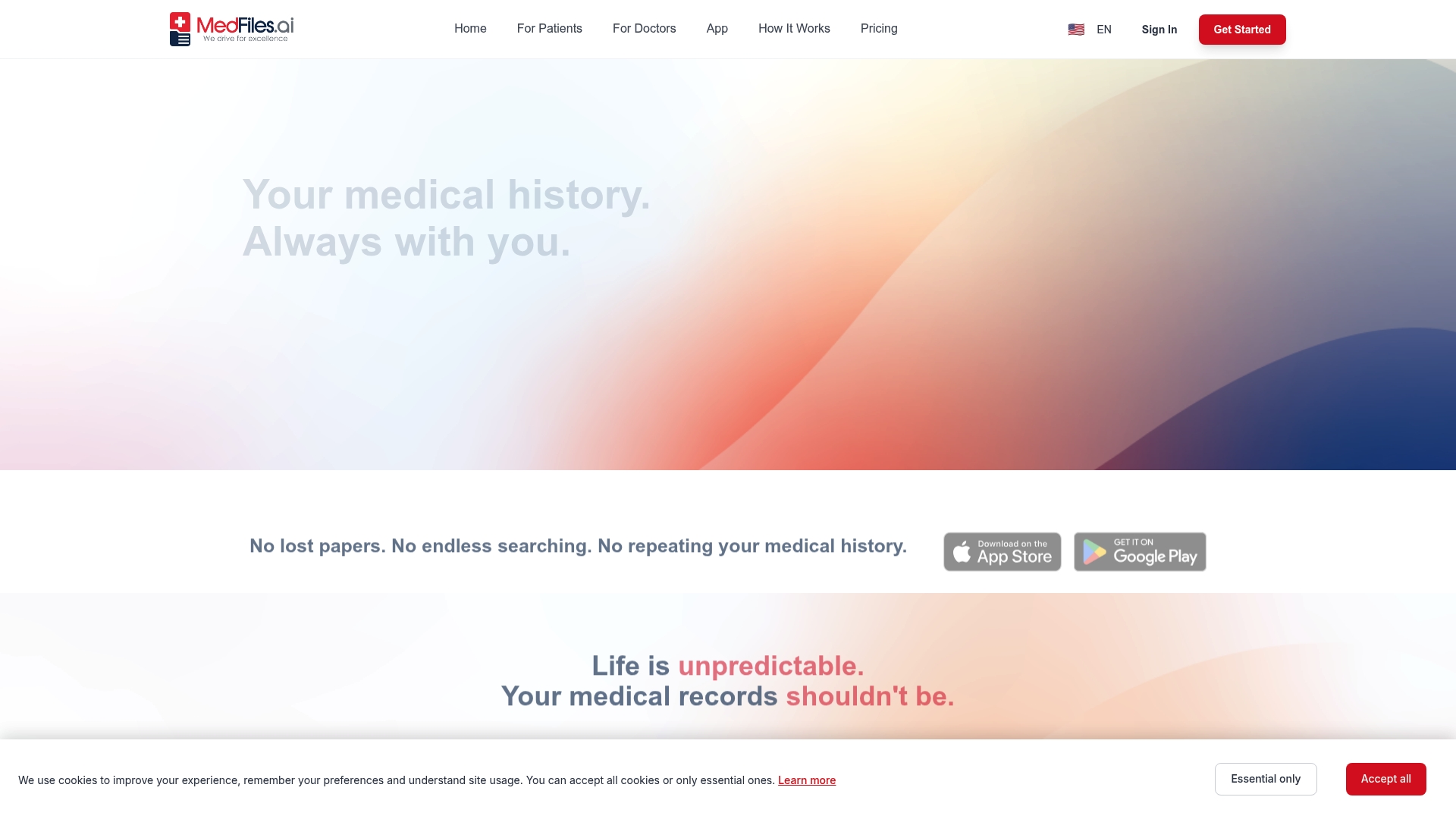
Experience how MedFiles turns piles of health reports into clear summaries you can share instantly with caregivers or doctors. Visit MedFiles.ai to start consolidating your medical history securely and see how quick it is to prepare for your next appointment with AI-generated insights. Take control of your health records and enjoy peace of mind today.
Frequently Asked Questions
How does Medfiles handle document organization for my medical records?
Medfiles automatically organizes documents into readable categories, minimizing the manual filing process. This feature of automatic organization tags and groups records as they arrive, which makes managing your health data quick and easy. Expect a streamlined experience that reduces the time spent sorting through files.
What is the difference between Medfiles and MediDoc Pro in terms of accessibility?
MediDoc Pro offers a wallet ID card and QR code, allowing verified clinicians to access patient directives instantly at the bedside. Medfiles, on the other hand, excels in its AI-powered summaries that turn complex medical documents into concise briefs for clinician visits. Users should consider their specific needs — quick bedside access or detailed pre-appointment summaries — to choose the right platform for their situation.
Which platform is better for family health management — Medfiles or mdhub?
Medfiles supports family profile management, allowing users to handle multiple dependents and pet records under one account. Meanwhile, mdhub focuses on automating workflow tasks primarily for behavioral health clinics. If family health management is a priority, Medfiles provides targeted features, making it the more suitable choice.
Can Medfiles keep my medical records private?
Medfiles enforces role-based access, giving users control over who can view specific documents. This ability ensures that clinicians or family members have permissions scoped to their needs, maintaining privacy effectively. For those concerned about secure handling of health data, Medfiles addresses privacy requirements thoughtfully.
How does the pricing of Medfiles compare to other alternatives?
Medfiles offers a free plan and paid plans starting at $2.49/month for individuals, while family tiers begin at $4.99/month. In contrast, pricing for alternatives like mdhub starts at $50/month per clinician, making Medfiles a cost-effective option for individuals and families looking to manage health records.
Does Medfiles support integration with hospital EHR systems?
Medfiles has limited visibility regarding integrations with hospital portals and EHR systems, as it requires manual uploads. Users seeking seamless data transfers from provider records may want to consider other platforms that offer stronger integration capabilities.