The Role of Patient Data in Healthcare Outcomes
Discover the vital role of patient data in healthcare outcomes, enhancing research and decision-making for better clinical results.

The Role of Patient Data in Healthcare Outcomes
Patient data has always been central to clinical care, but its role in healthcare extends far beyond what most assume. The role of patient data in healthcare now spans research, population health, quality improvement, and real-time clinical decision support. Yet a persistent misconception remains: that data simply flows where it should, used only by the treating clinician who collected it. The reality is more complex, and understanding that complexity is what separates clinicians and researchers who get results from those who do not. This article cuts through the noise and gives you a practical, evidence-grounded picture of how patient data actually works across modern healthcare systems.
Table of Contents
- Key takeaways
- The role of patient data in healthcare systems
- Data access, exchange, and care coordination
- Patient-generated data and advanced analytics
- Technical and operational challenges in data use
- Practical strategies for better patient data use
- My honest read on where patient data efforts fail
- How Medfiles supports better patient data management
- FAQ
Key takeaways
| Point | Details |
|---|---|
| Data types vary widely | Clinical, administrative, and patient-generated data each serve distinct roles and require different handling strategies. |
| Interoperability drives outcomes | By 2025, 76% of hospitals exchanged data across all four domains, yet integration gaps still compromise care coordination. |
| PGHD has real clinical value | Mobile health data can support triage and medication decisions but faces adoption barriers rooted in workflow and trust. |
| AI tools need workflow alignment | Embedding AI risk scores in EHRs without integration does not improve shared decision-making or patient outcomes. |
| Data quality is foundational | Fragmented records and poor identity resolution undermine both clinical use and research validity. |
The role of patient data in healthcare systems
Patient data in clinical contexts is formally known as health information or clinical data, depending on how and where it is collected. In practice, it is a broad category covering everything from a blood pressure reading to a genomic profile. Understanding the different types is the starting point for using data well.
The main categories clinicians and researchers work with include:
- Clinical data: Sourced from electronic health records (EHRs), physician notes, lab results, imaging, and clinical encounters. This is the most structured and widely used category.
- Patient-generated health data (PGHD): Collected from mobile health apps, wearables, home monitoring devices, and patient-reported outcomes. Less standardized, but increasingly available.
- Administrative data: Billing codes, insurance claims, scheduling records, and demographic information. Often underused in clinical contexts despite its value for population-level analysis.
- Demographic and social data: Age, race, socioeconomic status, and social determinants of health. Critical for understanding disparities and contextualizing clinical findings.
The fundamental challenge across all four types is standardization. Without it, data collected in one system cannot be understood or reused by another. Healthcare IT standards like HL7 FHIR (Fast Healthcare Interoperability Resources) have significantly improved the technical layer of data exchange, but implementation across institutions remains uneven.
| Data type | Primary source | Key challenge |
|---|---|---|
| Clinical data | EHRs, clinical encounters | Fragmentation across systems |
| PGHD | Apps, wearables, patient reports | Accuracy and clinician acceptance |
| Administrative data | Billing, insurance claims | Limited clinical context |
| Demographic data | Registration, social assessments | Incomplete capture and standardization |
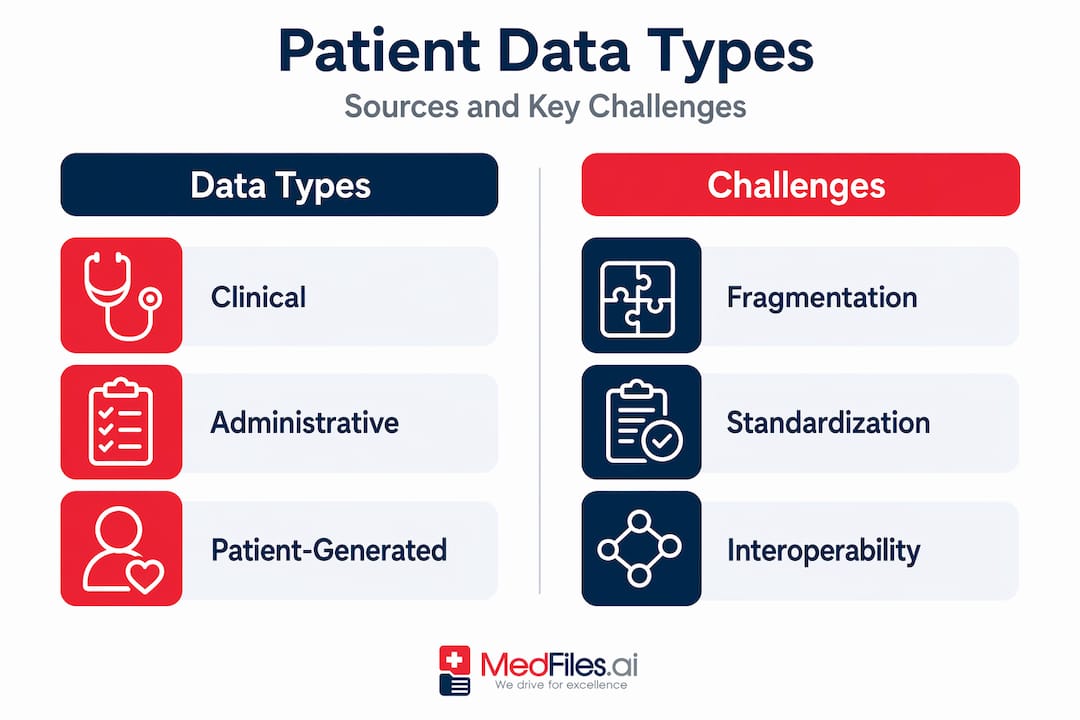
Effective data strategy starts with knowing which data type you are working with and what its limitations are before drawing conclusions or designing workflows around it.
Data access, exchange, and care coordination
Access is not the same as utility. A clinician who can technically access a patient’s records but cannot integrate them into a timely care decision is not materially better off than one working from paper.
The good news is that access has improved substantially. About 9 in 10 US hospitals now enable patient access to health information via an API, with 7 in 10 using standards-based APIs like HL7 FHIR. Patient portal adoption follows a similar trend: 65% of individuals accessed their online medical records or patient portals in 2024. These numbers reflect real infrastructure progress.
But access at the system level does not guarantee access at the point of care. Fragmented workflows, competing platforms, and non-standardized data formats mean clinicians often receive data that requires manual reconciliation before it can inform a decision. This is especially common when patients transition between providers or care settings, exactly the moments when complete information matters most.
The benefits of health data analysis are most visible in coordinated care scenarios. Consider a patient with heart failure managed by a primary care physician, a cardiologist, and a home health nurse. Without reliable data exchange across all three, each provider is working from a partial picture. Lab values ordered by one clinician may not reach another in time to prevent a medication error. Remote monitoring data from the patient’s home may sit unreviewed in a portal no one checks.

Pro Tip: When evaluating your organization’s interoperability posture, look beyond API availability. Audit how often data received from external systems is actually reviewed and acted on by clinical staff. The gap between technical capability and clinical utility is often larger than IT dashboards suggest.
Third-party integrations are expanding what is possible here. Telehealth platforms, remote monitoring tools, and connected health networks increasingly feed data into care pathways in near real time. The infrastructure exists. The gap is in making that data part of a clinician’s actual workflow rather than an additional screen to check.
Patient-generated data and advanced analytics
PGHD has moved beyond novelty. Wearable glucose monitors, cardiac rhythm trackers, and mental health apps now generate continuous data streams that, used correctly, can change clinical decisions. mHealth data supports proactive care and influences clinical workflows, with documented effects on triage decisions, medication adjustments, and remote monitoring protocols.
The practical applications are real:
- A patient with hypertension shares daily home blood pressure logs through a connected app. The clinician identifies a pattern that justifies a medication change two weeks before the next scheduled visit.
- A post-surgical patient’s wearable detects an abnormal heart rate trend. Automated alerts reach the care team before symptoms become an emergency.
- A patient managing depression tracks mood daily through a validated app. That data informs the psychiatrist’s dosing decisions with far more resolution than a monthly appointment allows.
Yet adoption remains inconsistent, and the reasons are worth examining honestly.
“PGHD has real potential to support patient-centered and proactive care, but challenges in integration and clinician skepticism can limit its impact, sometimes inadvertently reinforcing existing clinical hierarchies rather than enabling patient agency.” — PMC mHealth Review
Professional skepticism is not irrational. Many clinicians have legitimate concerns about data accuracy, liability, and the time cost of reviewing unstructured data streams with no clear workflow home. These are not technology problems. They are human and organizational problems.
The same applies to AI. A 2026 randomized trial found that embedding AI risk predictions in EHRs without strong workflow integration did not improve shared decision-making or communication outcomes in kidney transplant care. Low clinician utilization was the driver. The AI worked. The system around it did not.
Pro Tip: Before deploying any PGHD or AI tool in a clinical setting, map the exact workflow step where the data will be reviewed and acted on. If you cannot name a specific person, role, and time in the care process where that happens, the tool will not be used.
Applying general-purpose AI models to wearable and multimodal data compounds the problem. Specialized AI workflows involving iterative tool use, not simple prompt-based analytics, are what translate raw wearable data into clinically meaningful signals. Generic models applied to this data type regularly miss the mark.
Technical and operational challenges in data use
Even when clinicians want to use patient data well, the infrastructure beneath them creates obstacles that are difficult to see and harder to fix.
-
Record fragmentation: Most patients have records scattered across multiple systems, none of which communicate automatically. A patient who has seen five providers in three health systems likely has five disconnected records. Clinicians working from any one of them are working with incomplete information.
-
Semantic interoperability failures: Two systems can exchange data technically while still failing to understand each other. A medication coded one way in System A may be interpreted differently in System B. Fragmented records and lack of semantic standards are a major barrier to secondary use and analytics on EHR data. Standardized terminologies and ontologies are the solution, but adoption is slow and uneven.
-
Identity resolution errors: Duplicate patient records are more common than most organizations admit. A patient listed as “Robert Smith” in one system and “Bob Smith” in another may have two separate records that never merge. Master Data Management is the practical solution here, serving as a reconciliation layer that links records correctly across systems and prevents the kind of identity confusion that undermines both clinical care and research validity.
-
Data quality at the source: Garbage in, garbage out applies to EHRs as much as any system. Incomplete problem lists, outdated medication records, and unverified allergy entries degrade the quality of every downstream analysis or decision built on that data.
-
Specialized analytics requirements: Wearable and patient-generated data rarely yield useful insights through standard analytical approaches. They require domain-specific workflows and iterative reasoning, not one-size-fits-all models.
Practical strategies for better patient data use
Getting more value from patient data in both clinical practice and research comes down to a handful of decisions that can be made at the team or department level without waiting for system-wide change.
- Adopt standards-based APIs deliberately. If your organization offers API access, assess whether clinical teams are actually using it. Push for integration between your EHR and the platforms your patients use most.
- Build PGHD into existing workflows. Do not ask clinicians to check a new platform. Route patient-generated data to the same inbox or dashboard they already monitor. Acceptance follows convenience.
- Prioritize data quality upstream. Invest in training and protocols that improve documentation at the point of care. Downstream analytics are only as reliable as the records they draw from.
- Partner with IT on identity matching. Advocate for MDM implementation if your organization struggles with duplicate records or fails to reconcile data across systems. This is not purely a technical problem. Clinicians need to raise it as a patient safety issue.
- Treat AI scores as one input, not the answer. Risk prediction tools have value, but only when they fit into a care process where someone reviews them and takes action. A score that sits unreviewed in a sidebar is not improving care.
Pro Tip: When presenting a case for better data integration to hospital leadership, frame it as a patient safety and liability issue rather than an efficiency argument. Safety language activates faster organizational response than cost-savings framing.
Patient engagement matters here too. Involving patients in understanding and sharing their own data, including sharing records with providers proactively, reduces the information gaps that cause the most preventable harm.
My honest read on where patient data efforts fail
In my experience, the most common failure point in patient data initiatives is not the technology. It is the assumption that providing access automatically changes behavior.
I have seen institutions deploy sophisticated patient portals with low engagement. AI risk tools go live in EHRs and sit unused. PGHD platforms launch with enthusiasm and stall when no one specifies how the data gets reviewed. The pattern is consistent: technology gets resourced, workflow transformation does not.
What actually moves the needle is integrating data into the moments that already exist in clinical practice. A risk score that appears at the top of a pre-visit summary gets used. The same score buried in a separate tab does not. A patient-generated blood pressure log routed to a message pool that someone owns gets acted on. One that lands in a shared inbox no one monitors does not.
The importance of patient data is not in dispute. What is underappreciated is how patient agency fits into this picture. When data systems are designed primarily for clinical extraction rather than patient participation, they can actually reduce patients’ sense of control over their own health. The best implementations I have seen treat patients as data contributors with a stake in the outcome, not just subjects from whom data is collected.
Multidisciplinary collaboration, between clinicians, informaticists, patients, and administrators, is the structure that makes data utility real. Technology is the tool. People and process are the strategy.
— Team
How Medfiles supports better patient data management
Getting patient data right requires more than a good EHR. It requires patients and providers working from the same complete, current picture.

Medfiles gives healthcare professionals access to patient-organized digital medical histories that are secure, current, and shareable. Patients upload records including test results, imaging, prescriptions, and physician reports, all automatically organized and encrypted using HIPAA-ready infrastructure. When a patient shares their profile, you see a complete history, not just what happened to be faxed over.
For clinicians managing complex or multi-provider patients, Medfiles reduces the time spent chasing records and increases confidence in the data you are working with. Explore how Medfiles for doctors fits into your clinical workflow and supports the kind of coordinated, data-informed care your patients need.
FAQ
What is the role of patient data in healthcare?
Patient data informs clinical decisions, supports research, enables quality improvement, and drives public health programs. Its value depends on how well it is accessed, exchanged, and integrated into care workflows.
How does patient data improve health outcomes?
When patient data is complete and accessible in real time, clinicians make better-informed decisions, reduce duplication, and coordinate care more effectively across providers. 65% of patients now access their records online, which also supports engagement and self-management.
What are the biggest challenges with using patient data effectively?
Fragmented records, semantic interoperability failures, identity resolution errors, and low clinician adoption of new data tools are the primary barriers. Technical infrastructure alone does not solve them.
Does AI improve care when embedded in EHRs?
Not automatically. A 2026 randomized trial showed that AI risk predictions embedded in EHRs did not improve shared decision-making when clinician utilization was low. Workflow alignment is what determines impact.
What is patient-generated health data and why does it matter?
Patient-generated health data includes readings from wearables, mobile health apps, and patient-reported outcomes. It gives clinicians a more continuous view of a patient’s health status between visits, particularly valuable for managing chronic conditions remotely.