Why Access Health Records During Travel: 2026 Guide
Learn why access health records during travel is crucial. Discover how to keep your medical history safe and ensure proper care abroad.

Why Access Health Records During Travel: 2026 Guide
Accessing your health records during travel is defined as having your complete medical history available to foreign healthcare providers so they can deliver accurate, timely treatment without starting from scratch. When you cross a border, your medical context does not travel with you automatically. Allergies, chronic conditions, current medications, and recent test results stay locked in your home provider’s system unless you take deliberate steps to bring them along. This guide explains the real risks of traveling without that information, how to secure it, and which digital tools make the job straightforward.
Why access health records during travel matters most
Travel health record access is not a convenience feature. It is a clinical safety measure. When a foreign emergency department physician treats you without your history, the care you receive is based on incomplete information. That gap produces real consequences: repeated diagnostic tests, delayed treatment decisions, and higher costs.
Organized personal health records help patients and caregivers visualize health history, which directly improves outcomes in both chronic disease management and emergency care. For travelers, this means the difference between a physician who can act immediately and one who must guess.

The importance of health records becomes especially clear when you consider how quickly a routine trip can turn into a medical event. A food allergy reaction, a cardiac episode, or a medication interaction can happen anywhere. Your records are the fastest way to give a treating physician the context they need.
How limited access affects your care abroad
The risks are concrete and well-documented. Diagnostic errors increase and emergency department length of stay grows when providers lack your medical history. Repeated imaging, redundant blood panels, and duplicated tests all add time and cost to your care at the worst possible moment.
Language and cultural barriers compound the problem. Lack of formal interpreters and unfamiliar health systems delay both understanding and treatment. Even in countries with strong healthcare infrastructure, a physician who cannot read your home country’s records faces a real disadvantage.
Consider what a treating doctor needs to know in the first ten minutes of an emergency:
- Current medications (generic names and doses, not just brand names)
- Known allergies and documented reactions
- Chronic conditions such as diabetes, heart disease, or epilepsy
- Recent surgeries or procedures that affect treatment options
- Blood type and immunization history
Without this list, a physician must either delay care to gather information or proceed with incomplete data. Neither outcome serves you well. Carrying both physical and digital copies of your records is the most reliable way to close this gap.
“The single most protective step a traveler with a chronic condition can take is ensuring their medical history is readable, current, and immediately available to any treating physician worldwide.”
What security risks come with accessing records abroad?
Medical data is among the most valuable personal information on the internet. Complete medical records sell for between $10 and $1,000 each on dark web markets. That value reflects the depth of information they contain: identity data, insurance details, prescription history, and financial records all in one file.
When you access a patient portal from a hotel lobby, airport lounge, or café, you are often on an unsecured public Wi-Fi network. These networks are prime targets for data interception. Cybersecurity experts treat VPN use as standard defense when accessing sensitive health data on foreign networks, because a VPN encrypts your traffic and routes it through a secure server before it reaches the portal.
Legal jurisdiction adds another layer of risk. Privacy laws vary dramatically by country. Data intercepted on a foreign network may not carry the same legal protections as data accessed at home under HIPAA or GDPR.
Before you travel, address these security basics:
- Install a reputable VPN app (NordVPN, ExpressVPN, or Proton VPN are widely used options) and test it before departure
- Enable two-factor authentication on every health portal you use
- Avoid accessing records on shared or public devices
- Log out completely after every session, especially on hotel computers
Pro Tip: Switch from SMS-based two-factor authentication to an authenticator app like Google Authenticator or Authy before you leave home. SMS-based 2FA can lock you out when your phone number does not receive texts on a foreign network.
How to prepare and access your health records securely
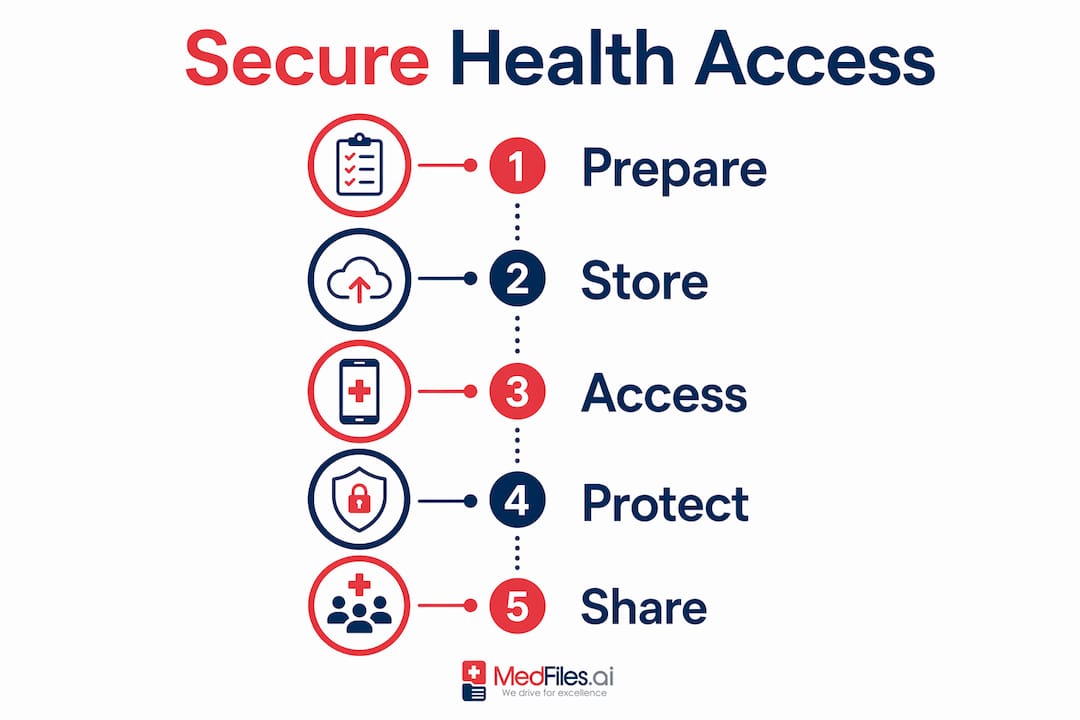
Preparation is the only reliable strategy. Waiting until you are in a foreign emergency room to figure out how to access your records is too late. The CDC recommends that travelers with chronic illnesses carry a physician letter that details their condition, medications by generic name and dose, known allergies, and provider contact information. That letter is your baseline.
Here is a practical preparation sequence to follow before any international trip:
- Request an updated summary from your primary care physician. Ask specifically for a letter that includes diagnoses, current medications with generic names and doses, allergies, and emergency contact numbers for your care team.
- Download your records from your patient portal. Most major health systems, including those using Epic or MyChart, allow you to export a PDF summary. Save it to your phone and a secure cloud location.
- Set up a secure digital storage platform. A dedicated medical record app gives you organized, encrypted access from any device. Understanding all types of medical records helps you know exactly what to include.
- Configure app-based two-factor authentication on every portal before departure, not after.
- Install and test a VPN on your phone and laptop. Confirm it connects reliably before you board.
- Share access with a trusted contact at home. If you are incapacitated, someone else needs to be able to retrieve and relay your records to a treating physician.
Pro Tip: Store a printed one-page medical summary in your passport wallet alongside your travel insurance card. Digital access is ideal, but paper works when your phone battery is dead or your data connection fails.
How digital tools and provider portals help travelers
Electronic health records (EHRs) and patient portals have transformed what travelers can carry. Healthcare providers increasingly offer portals with prescription history, lab results, and visit summaries available online, meaning your records are no longer locked in a filing cabinet.
The table below compares the main options travelers use to access their health data abroad:
| Access method | Best for | Key limitation |
|---|---|---|
| Provider patient portal (MyChart, Epic) | Accessing records from your home health system | May block access from foreign IP addresses without VPN |
| Dedicated medical record app (Medfiles) | Centralized, encrypted storage across all providers | Requires upfront organization before travel |
| Printed physician letter | Emergency situations with no internet access | Becomes outdated quickly; no real-time updates |
| USB drive with PDF records | Backup access without internet | Can be lost or stolen; no encryption by default |
Electronic health records improve care by giving providers instant access to your history, reducing duplicate testing, and supporting faster clinical decisions. For travelers, the practical benefit is that a physician in Tokyo or Lisbon can review the same information your home doctor uses.
Sharing access securely matters as much as having the records. HIPAA-compliant encryption protects data in transit and at rest, which is the standard you should require from any platform storing your medical information. Platforms that meet this standard protect your data whether you are accessing it from Chicago or from a café in Bangkok.
Key takeaways
Travelers who access their health records before and during a trip receive faster, more accurate care in emergencies and avoid the cost and delay of repeated diagnostic tests abroad.
| Point | Details |
|---|---|
| Records prevent diagnostic errors | Foreign providers without your history repeat tests and delay treatment, raising costs and risk. |
| Security requires active steps | Use a VPN and app-based 2FA before departure to protect portal access on foreign networks. |
| Physical and digital copies both matter | A printed physician letter covers emergencies when internet access or device power fails. |
| Preparation must happen before travel | Configuring access, downloading records, and testing your VPN cannot wait until you land. |
| Digital platforms centralize everything | A dedicated medical record app gives encrypted, organized access from any device, anywhere. |
The preparation gap most travelers ignore
Most travelers spend more time researching restaurants than organizing their medical records before an international trip. That is not a criticism. It reflects how easy it is to assume that healthcare will simply work the way it does at home. It does not.
I have seen this pattern repeatedly: a traveler with well-managed hypertension lands in a foreign city, has a cardiac event, and the treating team spends the first critical hour piecing together a medication list from memory and a family member’s phone calls. The records existed. They were just inaccessible.
The uncomfortable truth about accessing medical records while traveling is that the technology to solve this problem has existed for years. Patient portals, encrypted cloud storage, and digital health apps are all mature, accessible tools. The gap is not technical. It is behavioral. People do not prioritize record preparation because they do not expect to need it.
Organized records empower travelers with chronic conditions to manage health proactively rather than reactively. That shift from reactive to proactive is the real value. You are not just preparing for emergencies. You are giving every healthcare interaction abroad a better starting point.
The travelers who handle foreign medical situations best are not the ones with the best insurance. They are the ones who show up with a clear, current, accessible record of their health history. That preparation takes less than two hours and costs nothing beyond a little organization.
— Team
Store your records with Medfiles before your next trip
Medfiles gives you a single, secure place to store every medical document you need while traveling. Upload test results, prescriptions, physician letters, and imaging reports. Medfiles automatically organizes them and makes them available from any device, anywhere in the world, with end-to-end encryption protecting every file.
For families, Medfiles supports multi-profile management so you can carry records for every family member in one place. For travelers with chronic conditions, the MedFiles Inbox makes uploading and accessing documents fast and straightforward. Healthcare providers can also use Medfiles for doctors to share records securely with patients before they travel. Start organizing your health data at MedFiles.ai today.
FAQ
Why should I access health records when traveling?
Accessing your health records during travel gives foreign healthcare providers the medical history they need to treat you accurately and quickly. Without this information, providers repeat diagnostic tests, delay treatment, and face higher risk of errors.
How can I access my medical records while abroad?
Download a PDF summary from your provider’s patient portal before departure, store it in a secure medical record app like Medfiles, and carry a printed physician letter as a backup. Use a VPN when logging into any health portal on a foreign network.
Are my medical records safe to access on public Wi-Fi?
Public Wi-Fi in airports, hotels, and cafés is not secure. Always use a VPN to encrypt your connection before accessing any health portal abroad, and log out completely after each session.
What should a travel medical summary include?
The CDC recommends your summary include current diagnoses, all medications by generic name and dose, known allergies with documented reactions, your blood type, immunization records, and emergency contact information for your home care team.
What is the risk of not having records available in a foreign emergency?
Missing medical history causes diagnostic errors, repeated testing, longer emergency department stays, and higher treatment costs. Language barriers and unfamiliar health systems make these problems worse when records are unavailable.