Why Eliminate Paper Clutter in Medical Records
Discover why eliminating paper clutter in medical records is essential for better care, efficiency, and cost savings. Go digital today!
Why Eliminate Paper Clutter in Medical Records
You already know that pile of folders, lab printouts, and old prescriptions is a problem. But the real cost of keeping paper medical records goes far beyond a messy drawer. Understanding why eliminate paper clutter in medical records matters means looking at what that clutter actually costs you: delayed care, missed information, and stress that compounds every time you see a new doctor or face an emergency. This article cuts through the noise and gives you the clearest, most practical case for going digital.
Table of Contents
- Key Takeaways
- Why paper clutter in medical records costs more than you think
- Paper vs. digital records: an honest comparison
- How to actually eliminate paper clutter from your health records
- The broader impact of going paperless in healthcare
- My honest take on the paper problem in healthcare
- Start organizing your records with Medfiles
- FAQ
Key Takeaways
| Point | Details |
|---|---|
| Paper clutter raises care risks | Lost or fragmented records slow diagnoses and increase the chance of medical errors during treatment. |
| Digital records beat paper on access | Secure digital files are instantly retrievable anywhere, unlike paper that can be lost, damaged, or misfiled. |
| Eliminating paper saves real money | The CMS estimates electronic documentation changes will save roughly $781 million annually in administrative costs. |
| Going paperless requires a plan | Digitizing without a retention schedule creates digital clutter that mirrors the paper problems you started with. |
| Compliance protects you | HIPAA gives patients the right to electronic copies of their records, so understanding your rights simplifies access. |
Why paper clutter in medical records costs more than you think
Most people assume keeping paper records is the safe, simple option. It feels familiar. No software to learn. No login to forget. But the hidden costs are significant, and they show up in places you might not expect.
Paper records demand constant manual handling. Every time a document is filed, retrieved, or transferred, there is room for human error. A misfiled lab result means a doctor orders a duplicate test. A lost referral means a delayed specialist appointment. These are not rare edge cases. They are routine consequences of paper-based workflows.
The burden falls hardest on the people doing the documentation. For every 30 minutes of patient care, clinicians spend 36 minutes charting, a ratio that worsens when workflows are fragmented by paper. That means less face time with you, more after-hours clerical work, and a healthcare provider running on empty.
The burden is not equal across the population, either. Administrative complexity undermines care access for everyone, but it hits lower-income patients hardest. 45% of individuals earning under $25,000 report billing and insurance problems, compared to 28% of those earning over $75,000. Paper-heavy systems make an already complex process even harder to navigate.
Here is what paper clutter specifically does to your healthcare experience:
- Delays care delivery when records cannot be located quickly during appointments or emergencies
- Increases duplication of tests and procedures because prior results are unavailable or unreadable
- Raises error rates through illegible handwriting, misfiling, and version confusion
- Adds time pressure on providers who must reconcile fragmented paper trails before treating you
- Creates compliance exposure when documents are stored without proper security or retention controls
Pro Tip: If you visit more than one provider, ask each office whether your records are stored electronically. Under HIPAA, you have the right to electronic copies if your provider maintains records digitally, and they cannot charge you for retrieval labor.
Paper vs. digital records: an honest comparison
Paper records are not without genuine advantages. They are low cost to start, require no technical setup, and many patients and providers feel comfortable with them. In small, single-provider practices, a paper chart can be pulled and reviewed in seconds. There is no system downtime, no login, and no software update to wait for.
But those advantages have a ceiling. As your healthcare picture grows more complex, paper collapses under its own weight. Paper records carry real risks including errors from manual handling, lost documents, and slow information transfer between providers.
Digital records change the equation significantly. Here is how the two approaches stack up across the dimensions that matter most to you:
| Factor | Paper records | Digital records |
|---|---|---|
| Accessibility | Physical location only | Available anywhere, anytime |
| Security | Vulnerable to loss, fire, theft | Encrypted with access controls |
| Error risk | High due to manual handling | Lower with structured data entry |
| Sharing between providers | Slow: fax, mail, or courier | Instant secure transfer |
| Storage space | Grows indefinitely | Scalable cloud storage |
| Compliance | Difficult to audit | Easier to track and verify |
| Cost over time | Labor-intensive and space-heavy | Lower per-record cost at scale |
The advantages of digital medical files are real, but the transition requires thought. Digitizing is a continuous lifecycle. Without retention schedules and clear naming conventions, digital files become bloated and unsearchable. You can recreate the same chaos you started with, just on a screen instead of a shelf.
Pro Tip: When you move to digital storage, create folder categories that match how you search, not how records are generated. Think “Cardiology,” “Annual Checkups,” and “Prescriptions” rather than organizing by provider name or date alone. This is how to declutter health records in a way that stays organized.
How to actually eliminate paper clutter from your health records
Knowing why matters. But knowing how is where most people get stuck. The process does not have to be overwhelming. Taken in order, these steps make it manageable.
-
Sort before you scan. Pull everything together in one place. Separate records into three groups: keep, discard, and verify. Not every piece of paper needs to be digitized. Old insurance explanations of benefits from a decade ago, for example, are rarely worth the storage space.
-
Shred, do not just trash. Medical documents contain sensitive personal data. Use a cross-cut shredder for any paper you decide not to keep. Tossing documents in the recycling bin is a privacy risk.
-
Scan in logical batches. Start with the most critical records: current prescriptions, recent lab results, imaging reports, and surgical histories. Use a document scanner or a high-quality mobile scanning app. Save files as PDFs with clear, descriptive names like “BloodPanel_March2026.pdf.”
-
Organize by category, not by date. Date-based filing feels logical but leads to buried information. Category-based organization, where you can browse types of medical records by type, makes retrieval faster in a real emergency.
-
Choose a secure storage platform. A general cloud folder is not designed for medical data. Look for platforms that offer encryption, HIPAA-ready infrastructure, and access controls. This is where purpose-built tools pay off over general solutions.
-
Set a retention schedule. Decide how long you keep different document types. Most experts recommend keeping records of major diagnoses, surgeries, and chronic conditions permanently. Routine checkup notes can often be archived after five to seven years.
-
Review quarterly. Block time every three months to scan new documents, file them properly, and remove anything outdated. Fifteen minutes four times a year is enough to prevent recluttering.
Pro Tip: Family health management adds a layer of complexity. If you are managing records for children, aging parents, or even pets, a platform with multi-profile management keeps everyone’s information separated but accessible from one account.
The broader impact of going paperless in healthcare
The benefits of eliminating paper clutter are not limited to your home filing cabinet. When individuals and clinics reduce paper in healthcare, the effects ripple across the entire system.
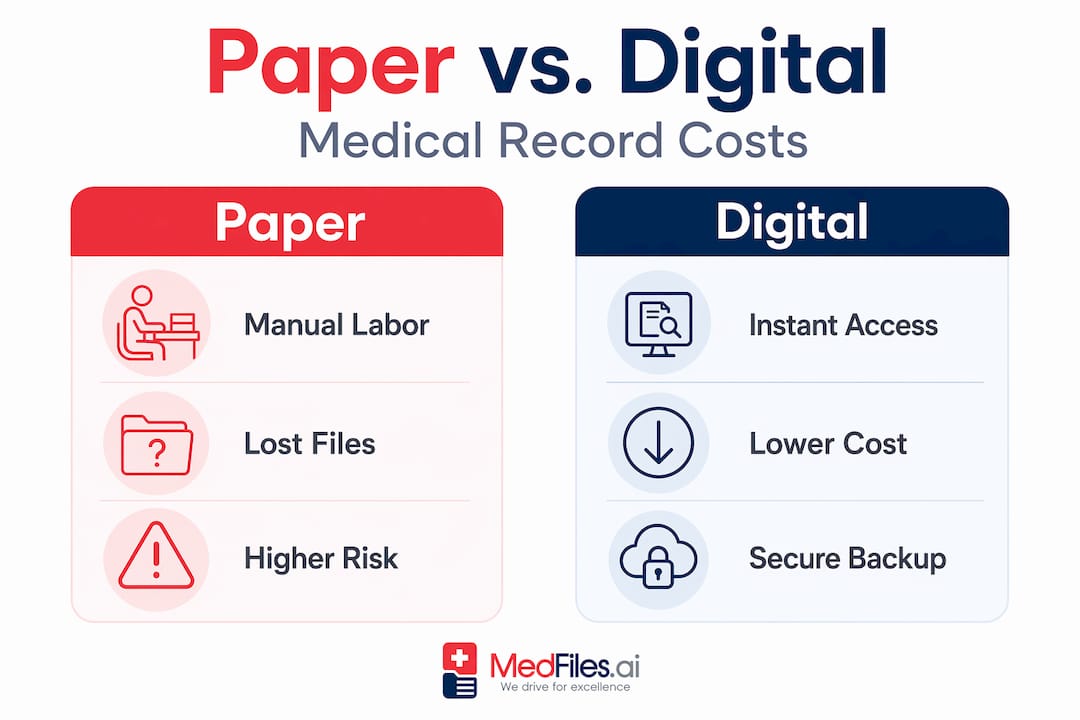
The financial evidence is striking. The CMS’s 2026 rule phasing out fax and mail for claims documentation is projected to save approximately $781 million annually. That savings comes from eliminating the labor, postage, and processing time that paper demands at every step of the claims cycle.
Faster claims also mean faster care. When documentation moves electronically, digital workflows reduce fragmented clerical work that typically spills into evenings and weekends for providers. That time gets returned to direct patient care.
Data security improves dramatically as well. Paper records can be copied, stolen, or destroyed in a fire. Digital records with proper encryption and access logging are significantly harder to breach and far easier to audit when compliance questions arise.
“After-hours documentation normalized by clinics is a symptom of broken paper-based systems. Digitization can reclaim provider time and return the focus to where it belongs: the patient.”
The patient experience changes too. When your records are complete, accessible, and shareable, you spend less time repeating your medical history to every new provider. You arrive at appointments with context already established. You leave with documentation you can actually read and store.
From a compliance standpoint, patients who request electronic copies have rights that providers are increasingly encouraged to honor without friction. Waiving copy fees for electronic records is now recognized as both a compliance best practice and a gesture of patient-centered care.
My honest take on the paper problem in healthcare
I have worked around healthcare management long enough to notice something consistent: most people do not eliminate paper clutter because they think it requires a big overhaul. They picture a weekend of scanning, a new system to learn, and a process they will probably abandon by Tuesday.
That belief keeps more people stuck with shoe boxes of lab results than any shortage of motivation.
Here is what I have learned. The switch is not about perfection. It is about momentum. Starting with your most recent records and building forward is more practical than trying to digitize everything at once. I have seen individuals go from a drawer full of mixed documents to a clean, searchable digital archive in under two hours by following this exact approach.
I have also seen the other side. Families who scramble for records during a medical emergency, only to find that key documents were lost in a move or destroyed in a flood. That scenario is entirely preventable. And the tools to prevent it are more accessible than most people realize.
The myth I encounter most often is that digital means complicated. The reality is that modern platforms designed for personal health records handle the complexity for you. You upload. The system organizes. You access when you need it.
The bigger risk is not starting. Every week of continued paper clutter is another week of exposure to loss, error, and delay.
— Team
Start organizing your records with Medfiles
If this article has made one thing clear, it is that knowing why to act is only the first step. The next step is having the right tool to make it real.

Medfiles is built precisely for this. Upload your documents, and the platform automatically organizes them by type and date. Share specific records securely with any provider in seconds. Access everything from your phone during travel or an emergency visit. The infrastructure is HIPAA-ready with end-to-end encryption, so your data stays private and protected.
Whether you are managing your own records or coordinating health information for your whole family, Medfiles scales with you. Explore plans and pricing to find the right fit, check out the inbox feature for centralized document management, or see what Medfiles offers for doctors if you are a provider looking to reduce paper burden on both sides of the exam room.
FAQ
What is the main reason to eliminate paper clutter in medical records?
Paper clutter causes delays, errors, and lost information that directly affect care quality. Eliminating it improves record accuracy, speeds up access during emergencies, and reduces stress for both patients and providers.
Are digital records actually more secure than paper?
Yes. Digital records stored with encryption and access controls are significantly harder to breach, copy without authorization, or destroy accidentally. Paper records have no equivalent protection against fire, theft, or physical damage.
Does HIPAA require providers to give patients digital copies?
Under HIPAA, if a provider maintains records electronically, patients have the right to receive electronic copies. Providers cannot charge for retrieval labor, though they may charge for copying and postage in some cases.
How do I start decluttering my health records without getting overwhelmed?
Start with your most recent and most critical documents: current prescriptions, recent lab results, and surgical histories. Scan and categorize those first, then work backward. A clear folder structure and a secure storage platform make the process manageable in small sessions.
What happens if I digitize records without a retention schedule?
Without a retention schedule, digital files accumulate without structure and become just as hard to search as a paper pile. Without retention policies, digital archives grow bloated and defeat the purpose of going paperless in the first place.