Why Protect Patient Confidentiality: What You Need to Know
Discover why protecting patient confidentiality is vital. Learn about its ethical, legal, and clinical importance for better health outcomes.

Why Protect Patient Confidentiality: What You Need to Know
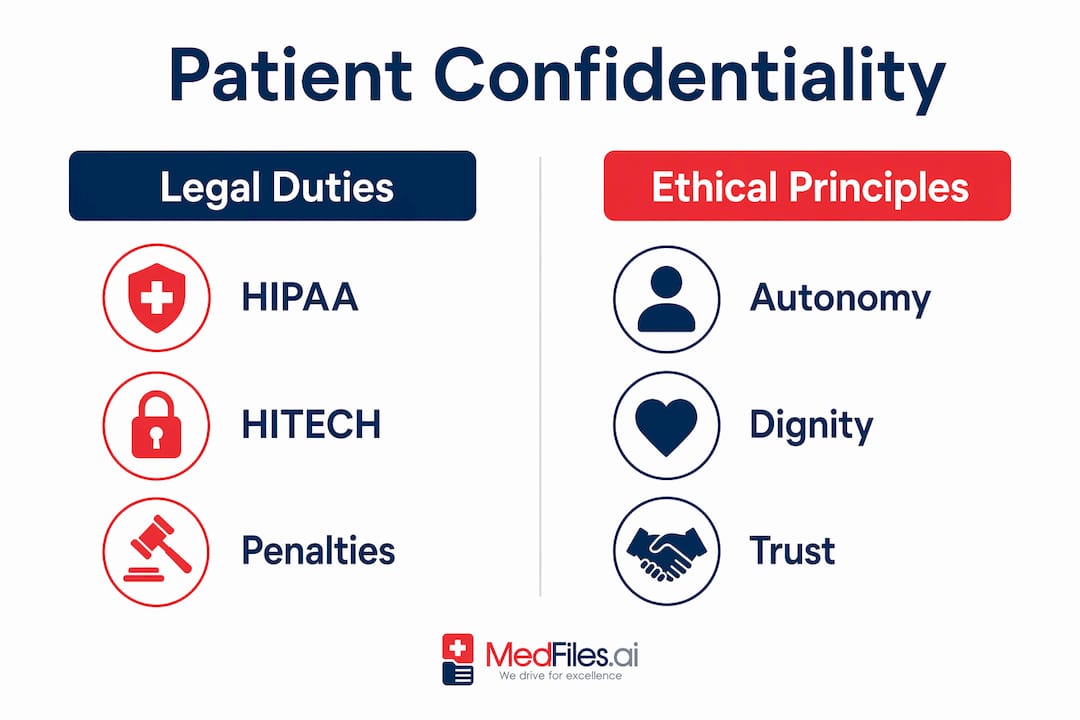
Protecting patient confidentiality is essential because it preserves your autonomy, enables honest clinical disclosure, and is a legal duty under U.S. law. Without it, patients withhold symptoms, providers face federal penalties, and the entire foundation of trust in healthcare erodes. This article covers the ethical, legal, clinical, and practical reasons confidentiality matters, plus the exceptions, safeguards, and steps you can take right now.
The core reasons to protect patient confidentiality:
- Ethical: Respects your dignity, autonomy, and right to control your own health information
- Clinical: Patients who trust that privacy will be maintained disclose more completely, enabling accurate diagnosis and better outcomes
- Legal: HIPAA and HITECH impose binding federal obligations on covered entities and their business associates, enforced by the HHS Office for Civil Rights (OCR)
- Practical: Breaches expose patients to discrimination, identity theft, financial fraud, and damaged relationships
The primary U.S. legal framework is HIPAA (Health Insurance Portability and Accountability Act of 1996), which defines protected health information (PHI), sets Privacy, Security, and Breach Notification Rules, and authorizes HHS OCR to investigate complaints and impose civil monetary penalties.
Table of Contents
- What patient confidentiality actually covers
- Why ethics demand confidentiality: autonomy, dignity, and trust
- U.S. legal obligations: HIPAA, HITECH, and HHS OCR enforcement
- How confidentiality directly affects your care quality
- Real harms that follow a confidentiality breach
- When confidentiality can lawfully be limited
- How confidentiality is protected in practice
- What to look for in a secure digital record platform
- Consequences for providers who violate confidentiality
- Key Takeaways
- Confidentiality is personal, not just procedural
- Authoritative sources and where to learn more
What patient confidentiality actually covers
Patient confidentiality means that health information you share with a provider stays within the care relationship and is not disclosed without your consent, except as law specifically permits. The HIPAA Privacy Rule defines this information as “protected health information” (PHI): any individually identifiable health data held or transmitted by a covered entity or its business associates, in any form.

That includes more than most people realize. Lab results and prescriptions are obvious. But your name paired with a diagnosis, your insurance payment records, even a verbal conversation between your doctor and a nurse, all qualify as PHI.
| PHI Category | Examples |
|---|---|
| Identifiers | Name, address, date of birth, Social Security number, phone number |
| Clinical information | Diagnoses, treatment plans, medications, test results, imaging |
| Financial data | Insurance details, billing records, payment history |
| Administrative records | Appointment dates, referral letters, provider notes |
| Electronic communications | Secure portal messages, telehealth session records |
The people who handle your PHI extend well beyond your doctor. Nurses, medical assistants, billing staff, and administrative coordinators all touch it routinely. So do business associates, the vendors and contractors (labs, billing companies, health IT platforms) that process data on a provider’s behalf. Each of these actors carries legal and ethical obligations to protect what they access. Understanding what counts as healthcare data helps you recognize when your information is at risk.
Why ethics demand confidentiality: autonomy, dignity, and trust
Confidentiality is not just a legal checkbox. It is a foundational ethical duty, and professional bodies in the U.S. treat it that way.
The AMA Code of Medical Ethics states that physicians have an ethical obligation to preserve confidentiality, with only rare exceptions, and that patient information generally remains confidential even after death. The reasoning is direct: you cannot make free, informed decisions about your health if you fear that what you tell your doctor will reach your employer, insurer, or family without your permission. Confidentiality protects your ability to seek care on your own terms.
The American Nurses Association frames it the same way, stating that protecting privacy and confidentiality is foundational to respecting dignity and autonomy, and specifically flags the growing risks from electronic records and everyday clinical interactions. A nurse who mentions a patient’s diagnosis in a hallway conversation, even casually, can breach that duty.
The clinical stakes are real. When patients fear disclosure, they under-report. Someone struggling with substance use may not mention it. A patient with a stigmatized condition may downplay symptoms. Those omissions lead directly to missed diagnoses, wrong treatments, and preventable harm.
Key ethical obligations for providers:
- Obtain informed consent before disclosing PHI for non-treatment purposes
- Avoid sharing information for commercial purposes without explicit patient authorization
- Document patient communication preferences and honor them consistently
- Treat confidentiality as a duty that survives the end of the care relationship
Pro Tip: If you are a clinician, open privacy conversations proactively. Ask patients at the start of care how they prefer to receive communications and who, if anyone, may be included in discussions. Document those preferences in the record. Patients who feel heard on privacy are more likely to disclose fully.
U.S. legal obligations: HIPAA, HITECH, and HHS OCR enforcement
Protecting confidentiality is a legal duty, not a suggestion. The CMS/HHS HIPAA basics document summarizes the three core rules that govern how covered entities must handle PHI.
| HIPAA Rule | What It Requires | Key Detail |
|---|---|---|
| Privacy Rule | Governs use and disclosure of PHI; grants patients access and correction rights | Minimum-necessary standard applies to all disclosures |
| Security Rule | Requires administrative, physical, and technical safeguards for electronic PHI (ePHI) | Risk analysis must be conducted and documented regularly |
| Breach Notification Rule | Requires prompt notification to affected patients, HHS, and sometimes media | Covered entities must notify HHS of breaches affecting a large number of individuals without unreasonable delay |
HITECH (Health Information Technology for Economic and Clinical Health Act) strengthened HIPAA by extending obligations directly to business associates and increasing civil monetary penalties. State laws can go further still: where a state privacy law is stricter than HIPAA, the state law governs.
Core legal obligations for covered entities:
- Provide patients with a Notice of Privacy Practices (NPP) explaining how their data is used and their rights to request restrictions
- Apply the minimum-necessary rule: disclose only the PHI actually needed for the stated purpose
- Grant patients access to their records within a reasonable timeframe after a written request
- Execute Business Associate Agreements (BAAs) with every vendor that handles PHI
- Conduct regular risk analyses and document findings
- Implement workforce training on HIPAA requirements
- Apply technical safeguards: encryption, access controls, audit logs
Penalties range from civil monetary fines (tiered by culpability) to criminal charges for knowing, intentional violations. Professional discipline from state medical boards adds another layer of accountability. The AMA HIPAA toolkit notes that the Notice of Privacy Practices is a practical transparency tool, not a bureaucratic formality. It is your right to receive it, read it, and act on it.
How confidentiality directly affects your care quality
Confidentiality is not just about protecting data. It shapes whether you get the right care at all.
The GMC’s ethical guidance puts it plainly: confidentiality fosters the trust necessary for patients to seek medical help and to be honest about symptoms. Without that trust, patients withhold information, and providers work from an incomplete picture. That gap has direct clinical consequences.
Consider mental health. A patient who fears that a depression diagnosis will reach their employer may minimize symptoms or avoid care entirely. In sexual health, fear of disclosure to a partner or insurer can prevent someone from getting tested for a communicable disease. With substance use disorders, the stigma of disclosure is so significant that federal law (42 CFR Part 2) adds a separate layer of confidentiality protections on top of HIPAA specifically for those records.
The connection is straightforward: when patients trust that their information stays private, they disclose more completely. More complete disclosure leads to more accurate diagnoses, appropriate referrals, and better follow-through on treatment plans.
StatPearls/NCBI confirms that ensuring the security, privacy, and protection of healthcare data is critical, and that HIPAA’s privacy and security safeguards exist precisely to maintain the conditions under which patients can engage honestly with their providers. The role of complete patient data in improving outcomes is well established across clinical settings.
Real harms that follow a confidentiality breach
A breach is not an abstract compliance failure. It causes concrete, sometimes lasting harm to real people.
What patients can lose when confidentiality is violated:
- Employment and insurance discrimination: A disclosed mental health diagnosis or chronic condition can affect hiring decisions or insurance coverage, even when such discrimination is legally prohibited. Enforcement is imperfect, and the damage can precede any remedy.
- Social and relationship harm: Disclosure of a stigmatized condition (HIV status, addiction history, psychiatric diagnosis) to family members, colleagues, or community contacts can damage relationships and reputations in ways that are difficult to reverse.
- Identity theft and financial fraud: PHI typically includes Social Security numbers, dates of birth, insurance IDs, and billing data. That combination is more valuable to identity thieves than credit card numbers alone, because it can be used to file fraudulent insurance claims or obtain prescription medications.
- Medical errors from fragmented records: When patients respond to a breach by switching providers or withholding information from new ones, the resulting gaps in the medical record increase the risk of duplicate testing, drug interactions, and missed diagnoses.
- Impaired future care-seeking: Patients who have experienced a breach, or who fear one, may delay or avoid care. That avoidance has downstream health consequences that are hard to measure but well documented in clinical literature.
The AMA Code of Medical Ethics specifically warns that disclosures for non-clinical, commercial purposes without consent undermine trust and violate confidentiality principles. A provider sharing patient data with a marketing partner, even without names attached, crosses that line.
When a breach does occur, covered entities must notify affected patients and, depending on the scale, HHS OCR and local media. That notification obligation is itself a cost: legal review, remediation, reputational damage, and the administrative burden of managing hundreds or thousands of individual notifications.
When confidentiality can lawfully be limited
Confidentiality is not absolute. U.S. law and professional ethics recognize specific circumstances where disclosure is permitted or required, even without patient consent.
Common exceptions and how they work:
- Mandatory reporting: Providers are required by state law to report suspected child abuse, elder abuse, and certain other forms of harm to designated authorities. These obligations vary by state but override patient confidentiality.
- Imminent threat to safety: When a patient poses a credible, imminent threat to themselves or an identifiable third party, providers may disclose limited information to prevent harm. This is the principle behind the Tarasoff duty-to-warn doctrine recognized in many states.
- Public health reporting: Infectious diseases (tuberculosis, certain sexually transmitted infections, COVID-19) must be reported to public health authorities. The scope of required reporting is set by state law and federal guidance.
- Court orders and subpoenas: A valid court order can compel disclosure of PHI. A subpoena alone, without a court order, does not automatically override HIPAA protections. Providers should seek legal counsel before responding.
- Care coordination: Providers may share PHI with other treating clinicians without explicit consent when it is necessary for treatment. The minimum-necessary standard still applies.
- Law enforcement: Specific, narrow circumstances allow disclosure to law enforcement, such as reporting gunshot wounds or responding to a valid warrant.
The AMA Code of Medical Ethics emphasizes that even when disclosure is permitted, physicians should disclose only the minimum information necessary and, where possible, inform the patient that a disclosure has occurred or will occur. As a patient, you have the right to ask your provider to document any disclosure made without your consent and to explain the legal basis for it.
How confidentiality is protected in practice
Confidentiality requires layered safeguards from both providers and patients. Neither side can do it alone.

| Provider Safeguards | Patient Actions |
|---|---|
| Written privacy policies and designated privacy officer | Request and read your Notice of Privacy Practices |
| Workforce training on HIPAA and PHI handling | Set communication preferences (phone, mail, portal) |
| Encryption of ePHI at rest and in transit | Use your provider’s secure patient portal instead of email |
| Role-based access controls and audit logs | Ask which third-party vendors have access to your records |
| Business Associate Agreements with all vendors | Request restrictions on specific disclosures |
| Regular risk analysis and documented findings | Verify your records for accuracy at least annually |
| Physical safeguards (locked records, screen privacy) | Know how to file a complaint with HHS OCR |
StatPearls/NCBI recommends regular risk analysis, encryption of data in transit and at rest, and limiting storage on personal portable devices as core technical controls. The ANA specifically calls out routine clinician interactions, hallway conversations, shared workstations, and verbal handoffs as underappreciated breach risks that training must address.
For patients, secure health information sharing within your family requires the same discipline: know who has access, use encrypted channels, and keep your own records organized so you can spot errors or unauthorized disclosures quickly.
Pro Tip: Ask your provider for a copy of their Notice of Privacy Practices on your first visit. Read the section on your right to request restrictions and to specify how you want to be contacted. Then put those preferences in writing and ask that they be noted in your record. It takes five minutes and gives you documented control over how your information flows.
If you suspect a breach, act quickly. Contact your provider’s privacy officer first. If you are not satisfied with the response, you can file a complaint directly with HHS OCR at hhs.gov/hipaa/filing-a-complaint.
What to look for in a secure digital record platform
Properly managed digital record platforms can strengthen confidentiality when they provide HIPAA-ready controls and transparent policies. But not all platforms are equal, and the burden is on you to ask the right questions before trusting one with your PHI.
Checklist: what to verify before using any health record platform:
- Business Associate Agreement (BAA): The platform must be willing to sign a BAA with your provider. No BAA means no HIPAA accountability for that vendor.
- Encryption at rest and in transit: Data should be encrypted using current standards both when stored and when transmitted. Ask specifically, not just whether they “use encryption.”
- Role-based access controls: Only authorized users should be able to view specific records. Ask how access is granted, modified, and revoked.
- Audited access logs: The platform should maintain logs of who accessed which records and when, and those logs should be available for review.
- Independent security audits: Look for SOC 2 Type II certification or equivalent third-party audit evidence. Marketing claims about security are not a substitute for documented audit results.
- Breach response plan: Ask whether the platform has a documented incident response plan and how they notify users in the event of a breach.
- Clear, readable privacy policy: The policy should state explicitly that your data will not be sold or used for commercial purposes without your consent.
The data privacy guide from Klyrmedia notes that modern privacy practices align vendor features with clinical ethical duties, and that patients increasingly need to evaluate platforms the same way providers evaluate business associates.
Medfiles operates on HIPAA-ready infrastructure with end-to-end encryption, giving patients a secure place to store, organize, and share their own records. When you control your own records, you also control who sees them and when.
Pro Tip: Before signing up for any health platform, ask for their most recent SOC 2 report or equivalent audit summary. A reputable vendor will provide it. One that deflects or offers only a marketing brochure is a signal to look elsewhere.
Consequences for providers who violate confidentiality
Violations carry real financial, legal, and professional consequences. HHS OCR enforces HIPAA through a tiered civil monetary penalty structure, with fines that scale based on whether the violation was unknowing, due to reasonable cause, or the result of willful neglect. Willful neglect that is not corrected carries the highest penalties.
Enforcement pathways:
- HHS OCR investigation: Any patient can file a complaint with HHS OCR. OCR investigates, may conduct audits, and can impose corrective action plans that require organizations to overhaul their privacy programs under federal oversight.
- Civil monetary penalties: Fines are tiered by culpability. Violations due to willful neglect that are not corrected carry the most severe penalties under the HIPAA framework.
- Criminal charges: Knowing, intentional violations of HIPAA, particularly those involving personal gain or malicious intent, can result in criminal prosecution and imprisonment.
- State medical board discipline: Physicians and nurses can face license suspension or revocation through their state licensing boards, independent of any federal action.
- Civil liability: Patients may pursue civil claims under state law for privacy violations, even when federal penalties do not apply directly.
Breach notification obligations add another layer of urgency. Covered entities must notify affected individuals and HHS without unreasonable delay, and for breaches affecting 500 or more individuals in a state, they must also notify prominent local media. That public exposure compounds the reputational damage.
For patients who believe their privacy has been violated, the process is straightforward: file a complaint at hhs.gov/hipaa/filing-a-complaint. OCR accepts complaints from patients, family members, and advocates.
Key Takeaways
Protecting patient confidentiality is a legal duty under HIPAA, an ethical obligation under AMA and ANA standards, and a clinical necessity that directly determines whether patients disclose the information providers need to deliver accurate, safe care.
| Point | Details |
|---|---|
| Legal duty under HIPAA | Covered entities must follow the Privacy, Security, and Breach Notification Rules, enforced by HHS OCR. |
| Ethical core | AMA and ANA treat confidentiality as foundational to patient dignity, autonomy, and the therapeutic relationship. |
| Clinical impact | Patients disclose more completely when they trust privacy is protected, leading to better diagnoses and outcomes. |
| Breach consequences | Violations can cause discrimination, identity theft, financial fraud, and lasting harm to care-seeking behavior. |
| Patient action | Request your Notice of Privacy Practices, set communication preferences, and use secure portals for all health data. |
Confidentiality is personal, not just procedural
Most discussions of patient confidentiality focus on compliance checklists and penalty tiers. Those matter. But the reason confidentiality exists in the first place is simpler and more human: people will not tell their doctors the truth if they are afraid of what happens next.
That fear is rational. A disclosed mental health history can affect employment. An addiction record can change how a patient is treated in future clinical encounters. A sexual health diagnosis shared without consent can damage a relationship. The legal framework exists because, without it, the incentive to disclose would erode, and healthcare would become less effective for everyone.
What gets underestimated is how much of this rests on everyday behavior, not just policy. The nurse who lowers her voice in the hallway. The front desk staff member who does not repeat a patient’s diagnosis to a family member who calls. The provider who actually reads a patient’s communication preferences before sending a letter. Confidentiality is built or broken in those moments, not in the compliance manual.
If you are a patient, talk to your provider about how your records are stored and shared. Ask who has access. Request your Notice of Privacy Practices and read it. If you believe your privacy has been violated, file a complaint with HHS OCR. You have that right, and using it matters.
Authoritative sources and where to learn more
These are the primary U.S. sources cited in this article. Each is publicly available and free to access.
- Summary of the HIPAA Privacy Rule | HHS.gov: The definitive federal summary of what PHI is, who is covered, and what the Privacy Rule requires.
- HIPAA Basics for Providers (CMS): Plain-language overview of the Privacy, Security, and Breach Notification Rules with enforcement details.
- Patient Confidentiality, StatPearls/NCBI: Clinical reference covering PHI definitions, safeguards, and practical compliance guidance.
- HIPAA Compliance, StatPearls/NCBI: Detailed clinical and legal overview of HIPAA obligations for healthcare teams.
- Patient Privacy and Confidentiality | AMA Code of Medical Ethics: The AMA’s authoritative ethical guidance for physicians on confidentiality duties and exceptions.
- AMA HIPAA Toolkit: Practical guidance on the Notice of Privacy Practices and patient rights under HIPAA.
- Privacy and Confidentiality | American Nurses Association: ANA’s position statement on confidentiality as a nursing ethics obligation.
- Ethical and Legal Duties of Confidentiality | GMC: UK-based clinical guidance on the trust and disclosure principles underlying confidentiality (cited for clinical reasoning, not U.S. law).
- Model Notice of Privacy Practices | HHS.gov: The HHS model NPP template, which explains your rights as a patient in plain language.
State-specific rules: HIPAA sets the federal floor. Many states have stricter privacy laws covering mental health records, HIV status, substance use disorders, and genetic information. Check your state health department or a licensed attorney for rules that apply in your state.
To file a HIPAA complaint: Visit hhs.gov/hipaa/filing-a-complaint to submit a complaint to HHS OCR online, by mail, or by fax. Complaints must generally be filed within 180 days of when you knew or should have known of the violation.
This article is general information, not legal or medical advice. For guidance specific to your situation, consult a qualified healthcare attorney or your state’s relevant regulatory authority.