Healthcare Information Management Explained for Patients
Discover how to explain healthcare information management and ensure your medical records are accurate, secure, and always accessible.

Healthcare Information Management Explained for Patients
Most patients assume their medical records are always complete, current, and waiting whenever they need them. That assumption can be dangerous. Records get scattered across providers, test results go unfiled, and emergency access fails at the worst possible moment. Research confirms that effective healthcare information management (HIM) is what actually keeps your data accurate, secure, and usable. This guide breaks down what HIM really means for you as a patient or caregiver, how your data moves between systems, and what you can do right now to stay in control.
Table of Contents
- What is healthcare information management?
- How healthcare information moves: EHRs, PHRs, and health exchanges
- Your privacy, security, and access rights
- Ensuring accuracy, quality, and data sharing in healthcare information
- Applying healthcare information management: Steps for patients and caregivers
- The real ROI of healthcare information management: What most guides overlook
- Get help managing your medical information securely and efficiently
- Frequently asked questions
Key Takeaways
| Point | Details |
|---|---|
| Health information management defined | It means collecting, organizing, securing, and sharing patient records for safe, coordinated care. |
| Access improves outcomes | EHRs, PHRs, and exchanges enable patients and caregivers to coordinate care and handle emergencies. |
| Privacy and proxy matters | HIPAA and patient portals give you control and allow you to set up secure caregiver access. |
| Check and correct records | Review your information for accuracy since errors or delays can affect your medical care. |
| Take proactive steps | Get your records, keep them up to date, and plan ahead for emergencies by using health IT tools. |
What is healthcare information management?
Healthcare information management is not just a hospital back-office function. It directly shapes the quality of care you receive and your ability to act quickly in a crisis.
HIM is defined as “the set of processes and systems used to collect, organize, protect, and use patient information across the care continuum so it is accurate, complete, and available for appropriate uses.” In simple terms, it means the right people have the right information at the right time.
For patients and caregivers, managing your health information is not optional. It is a critical part of getting safe, coordinated, and effective care.
The four core goals of HIM are:
- Accuracy: Your records reflect what actually happened during every visit, procedure, or prescription.
- Availability: The information is accessible when and where it is needed, including emergencies.
- Security: Only authorized individuals can view or use your protected information.
- Proper use: Data is shared only for care, billing, operations, or with your explicit consent.
A few terms worth knowing:
- EHR (Electronic Health Record): Your official medical record, maintained by your provider or hospital. They control it, though you have legal rights to access it.
- PHR (Personal Health Record): A record you manage yourself, often in an app or secure platform. You control it entirely.
- PHI (Protected Health Information): Any information that can identify you and relates to your health, such as diagnoses, test results, or treatment notes.
“When patients understand their own health data, they participate more actively in care decisions, catch errors before they become problems, and avoid dangerous gaps in their medical history.”
The stakes are real. A missing allergy list in an emergency room, a duplicate prescription nobody caught, or a missing surgical history before a procedure can all lead to serious harm. HIM prevents these scenarios from happening.
How healthcare information moves: EHRs, PHRs, and health exchanges
With the basics of HIM in mind, let’s look at how your medical information actually travels and gets used, especially as a patient or caregiver.
Your data does not sit in one place. It flows between systems, providers, and platforms. Understanding that flow helps you catch gaps before they hurt you.

EHR vs. PHR vs. HIE: what is the difference?
| Feature | EHR | PHR | HIE |
|---|---|---|---|
| Who controls it | Your provider | You | Network of providers |
| Who can add data | Clinicians and staff | You (and sometimes providers) | Connected healthcare organizations |
| Your access level | View and request copies | Full control | Read-only in most cases |
| Best use case | Official clinical record | Personal tracking and sharing | Emergency care, cross-provider coordination |
| Privacy governance | HIPAA-covered entity rules | Your own security practices | HIPAA and network agreements |
Health information exchange (HIE) allows “health care professionals and patients to access and securely share a patient’s medical information electronically, improving speed, quality, safety, coordination, and cost of care.” When you visit an out-of-network specialist or an emergency room in another city, HIE is what lets them pull your prior records instantly, assuming those systems are connected.
A personal health record (PHR) is “an electronic application where patients can maintain and manage their health information in a private, secure, and confidential environment.” Unlike an EHR, you own it completely.
What happens when you need your records?
Here is how data access plays out in a real scenario, step by step:
- You arrive at an urgent care clinic while traveling. Your primary care provider is three states away.
- The clinic requests your records through HIE if they are in the same network. If not, access may be delayed or unavailable.
- If you have a PHR, you can share your records directly with the urgent care provider right from your phone.
- The provider reviews your history, checks for drug interactions, and prescribes safely.
- After the visit, new records are added to your EHR and, if you update it, to your PHR as well.
Without a PHR or active HIE connection, step 4 becomes a guessing game. That is a risk you can eliminate with a little preparation. Reviewing a family medical records workflow is a great way to see how this process works in practice for households managing multiple people’s records.
For more specific examples of how data is used across care settings, practical healthcare data examples walk through real patient scenarios you will recognize.
Your privacy, security, and access rights
Understanding where your data goes raises another big question: who controls access, and how is your information protected?
HIPAA is the federal law that governs how healthcare providers, insurers, and their partners handle your health data. But knowing your rights under HIPAA is more useful than simply knowing it exists.
What HIPAA actually protects
PHI covers any individually identifiable health information: names, dates of service, diagnoses, test results, billing records, and more. ePHI is the same information stored or transmitted electronically. Both are protected under HIPAA’s Privacy and Security Rules.
A key aspect of HIM is privacy and security governance under HIPAA, which includes Privacy Rule and Security Rule protections for PHI and ePHI, along with breach notification requirements. That means if your data is exposed, your provider is legally required to tell you.
| HIPAA rule | What it covers | What it means for you |
|---|---|---|
| Privacy Rule | Who can see and use your PHI | You have the right to access, correct, and restrict certain uses of your records |
| Security Rule | How ePHI must be stored and transmitted | Providers must use encryption, access controls, and audit logs |
| Breach Notification Rule | What happens if your data is compromised | You must be notified within 60 days if your PHI is breached |
If a breach occurs, here is what you should do:
- Read the breach notification letter carefully, noting what data was exposed.
- Monitor your health insurance claims for services you did not receive.
- Contact your provider’s privacy officer if you have questions or concerns.
- Consider placing a fraud alert with credit bureaus if financial information was also involved.
Proxy and caregiver access
Caring for a parent, child, or partner often means you need access to their records too. Patients and caregivers can manage access using proxy mechanisms in EHR-linked patient portals, where a patient authorizes another person to view and act on the patient’s information, often with role-based limits.
This means a parent can grant a spouse read-only access, or an adult child can receive full proxy access to an elderly parent’s portal. Access levels matter. Full access allows scheduling, messaging providers, and viewing all records. Limited access may restrict sensitive categories like mental health notes.
Pro Tip: Review your proxy access settings at least once a year. Life changes such as divorce, a change in caregiver, or a child turning 18 all require access updates to protect privacy and keep the right people informed.
For practical guidance on setting this up safely, check out these secure family access tips to walk through the process step by step.
Ensuring accuracy, quality, and data sharing in healthcare information
Security is not the only priority. Data quality and sharing features make a direct difference in care outcomes and how usable your records actually are.
An accurate record is not just a bureaucratic nicety. It can determine whether a drug interaction is caught, whether a referral goes to the right specialist, or whether a new provider understands your full medical history on day one.
Why data quality matters so much
Consider a real scenario: you have had an MRI, a follow-up with a specialist, two medication changes, and a physical all within the same calendar year. If those records do not connect accurately across systems, the next provider you see is working with an incomplete picture.
Standards and interoperability are essential within HIM, with health information organizations using standards for content and terminology, along with interoperability frameworks such as HL7 messaging and FHIR APIs, to exchange data reliably. These standards are what allow a hospital in one state to read records generated by a clinic in another.
What to review in your own records:
- Medication list: Is every current prescription listed, and have discontinued drugs been removed?
- Allergy list: Are reactions documented accurately, including the specific reaction type?
- Diagnosis history: Are active and resolved conditions correctly labeled?
- Immunization record: Are all vaccines listed with correct dates?
- Contact information: Is your emergency contact current?
Important stat: According to a study published in PLOS ONE, real-time EHR data may change after an encounter, meaning records used for secondary purposes such as research or analytics may not reflect the most final, stabilized version of your data. For patients, this is a reminder to check your records a week or two after any significant visit.
Pro Tip: Request a complete copy of your records after every hospitalization or major procedure. Errors are easiest to catch and correct when the details are still fresh.
For a full breakdown of what record types exist and which ones matter most, understanding medical records types covers every format in plain language. And if you are thinking about long-term preservation, maintaining long-term records offers a solid framework for keeping data accessible for years.
Applying healthcare information management: Steps for patients and caregivers
With all the background in place, let us put it into practice with clear steps you can follow right now.
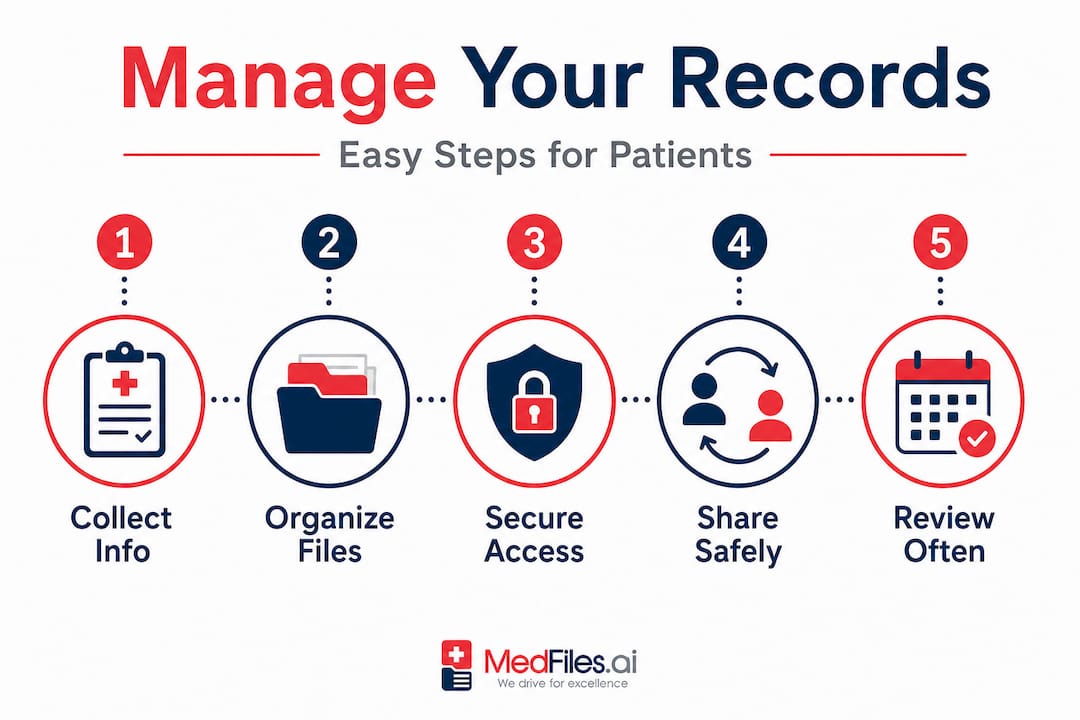
These steps work whether you are managing your own records, caring for a family member, or preparing for a potential emergency. They do not require technical knowledge. They just require consistency.
Step-by-step action plan
-
Request your records. Contact every provider you have seen in the last five years and ask for a complete copy of your records. Under HIPAA, providers must give you access, usually within 30 days and often at no cost.
-
Review for accuracy. Go through your medication list, diagnosis history, allergy list, and immunization records. Flag anything that looks incorrect, outdated, or missing.
-
Correct errors promptly. If you find a mistake, submit a written amendment request to your provider’s health information department. Keep a copy for yourself.
-
Set up a PHR. Store your records in a personal health record platform that you control. Upload key documents: test results, discharge summaries, specialist reports, and imaging.
-
Set up proxy or caregiver access. Log in to each provider’s patient portal and authorize trusted caregivers to access your account with appropriate permission levels.
-
Prepare an emergency summary. Create a one-page summary that includes your active diagnoses, current medications with dosages, allergies, emergency contacts, and your primary care provider’s name. Keep it in your PHR and as a printed backup.
-
Review and update annually. Treat your records the same way you treat a fire safety plan. Review it once a year, after every major health event, and any time your care team or caregiver situation changes.
“Secure electronic sharing of medical information, including access during unplanned settings such as emergency care, directly supports care coordination and emergency preparedness for patients and caregivers.”
This digital records workflow makes the whole process easier for families managing records for multiple people at once, including children, elderly parents, or family members with chronic conditions.
The real ROI of healthcare information management: What most guides overlook
Most guides on this topic focus on compliance checklists and access steps. Those matter. But they miss the more important point: the real value of HIM shows up in moments of crisis, not in routine paperwork.
Think about what happens when a family member has a stroke, an unexpected surgery, or an allergic reaction while traveling abroad. In that moment, having organized, accurate, and shareable medical records is not a convenience. It is the difference between receiving appropriate treatment quickly and waiting for records that may never arrive in time.
The patients and families who benefit most from HIM are not those who built elaborate systems. They are the ones who took a few simple steps consistently: keeping one updated list of medications, setting up one trusted caregiver with portal access, uploading one copy of their last discharge summary. That is not a technical task. It is a habit.
There is also a less-discussed benefit: reduced stress for caregivers. When you are managing care for someone with a complex condition, not having to chase down records from four different providers saves hours of time and reduces the risk of making decisions based on incomplete information. Reviewing real-life examples of health data use makes it clear how often this kind of preparation changes outcomes in everyday care scenarios.
The trap most people fall into is treating HIM as something that only matters inside the clinic. In reality, your records have a life outside the exam room. They travel with you. They speak for you when you cannot. Building a simple, consistent management habit now is one of the most practical things you can do for your long-term health and safety.
Get help managing your medical information securely and efficiently
For those ready to take charge, here is how you can make managing medical records stress-free, private, and effective.
MedFiles.ai is built specifically for patients, caregivers, and families who want one secure place to store, organize, and share their complete medical history. Upload test results, prescriptions, specialist reports, and imaging. Share instantly with any provider. Keep your whole family covered with multi-profile management and HIPAA-ready encryption.

Whether you are a patient managing a chronic condition, a caregiver supporting an aging parent, or a family that wants to be prepared for any emergency, MedFiles.ai has a plan that fits. Explore MedFiles.ai pricing to find the right tier for your needs. Healthcare professionals looking to streamline clinical communication can also explore tools for healthcare professionals. Your records. Your control. Always ready.
Frequently asked questions
What’s the difference between an EHR and a PHR?
An EHR is managed by your provider and contains your official medical record, while a PHR is managed by you as the patient to track and share your own health information privately and securely.
Can caregivers legally access my medical records through patient portals?
Yes, with your authorization. Proxy access mechanisms in EHR-linked portals allow you to grant caregivers the ability to view and act on your records, usually with role-based limits you define.
How can I prepare my medical information for emergencies?
Keep your PHR updated with current medications, allergies, and diagnoses, and ensure key caregivers have authorized access. Secure electronic sharing supports care coordination even in unplanned emergency settings.
What rights do I have if my medical data is breached?
Under HIPAA breach notification rules, healthcare providers must notify you within 60 days if your protected health information is compromised, unless there is a low probability of harm.
Are all my medical records always up-to-date between hospitals?
Not always. EHR data may change after a clinical encounter, so reviewing your records for completeness and accuracy shortly after major visits is an important habit to build.